

Furnish Your Future: Smart Financing for Restaurant Seating
Why Smart Financing Can Transform Your Restaurant's Future
Restaurant furniture financing offers a strategic path to creating the dining atmosphere your customers crave without draining your startup capital or depleting your operational cash reserves. In today's fiercely competitive hospitality landscape, where diners have endless choices, the right ambiance is not just a bonus—it's a fundamental component of your business strategy. It's the silent host that greets your guests, influences their mood, and ultimately determines whether they have a memorable experience worth repeating and recommending.
Quick Answer: Restaurant furniture financing options include:
- Equipment Financing Agreements (EFAs) & Furniture Loans: This is a straightforward loan where you borrow a specific amount to purchase the furniture. You own the assets from day one, and they serve as collateral. Payments are fixed over a set term, making budgeting predictable.
- Leasing Agreements: A popular choice for flexibility. You pay a monthly fee to use the furniture for a set period. At the end of the term, you can often choose to purchase it (sometimes for as little as $1), renew the lease with new furniture, or simply return it. This keeps your establishment looking fresh.
- Rent-to-Own Programs: This hybrid model allows you to rent furniture with a portion of your payments contributing toward eventual ownership. It offers a lower barrier to entry than a loan but provides a clear path to owning the assets.
- Online Lenders & Fintech Platforms: These lenders specialize in speed and accessibility, offering streamlined applications and rapid funding, often within 24-48 hours. They are an excellent resource for restaurant owners who need to move quickly.
- Specialized Restaurant Financing: Some lenders focus specifically on the hospitality industry, offering terms that can include up to 100% financing, with the furniture itself acting as the sole collateral, minimizing risk to your other business assets.
The core challenge for any restaurant, new or established, is balancing significant upfront investment needs with the often unpredictable nature of cash flow. High-quality seating, tables, lighting, and décor are not mere expenses; they are revenue-generating assets that directly impact customer comfort, length of stay, and willingness to return. Delaying necessary upgrades or opting for lower-quality, uncomfortable pieces to conserve cash can be a critical misstep. It can lead to shorter guest visits, lower check averages, negative online reviews, and a poor first impression that is difficult to overcome.
Smart financing masterfully solves this dilemma. It empowers you to acquire premium, durable, and stylish furniture by breaking down the cost into manageable monthly payments. Many financing options require no significant down payment and use the furniture as its own collateral, making it an accessible strategy even for new businesses without a long credit history. With a vast majority of U.S. companies leasing or financing assets to fuel their operations, it's clear that this is a cornerstone strategy for intelligent cash management and sustainable growth.
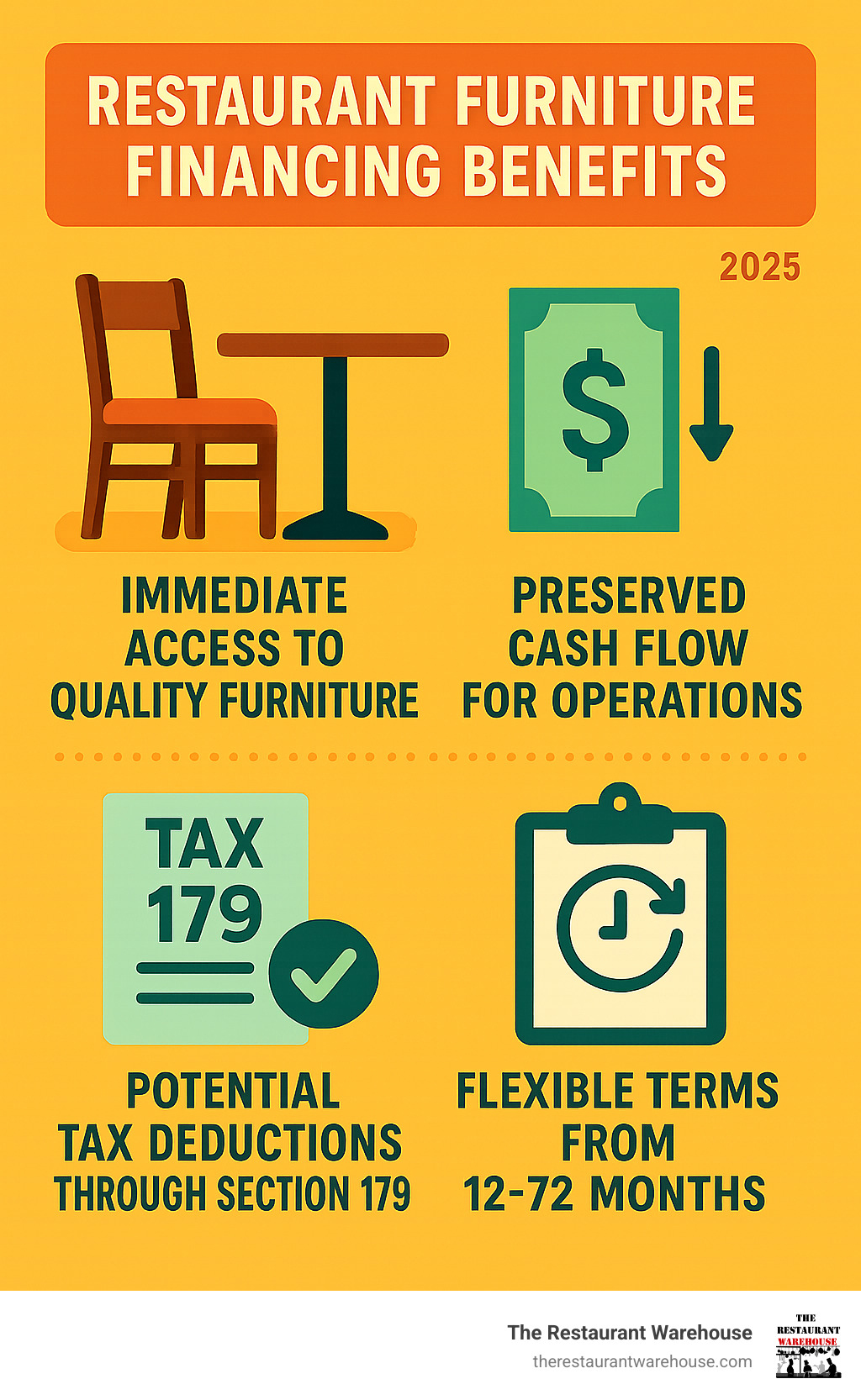
Restaurant furniture financing terms to remember:
- restaurant furniture financing basics
- furniture leasing for restaurants
- how to finance restaurant furniture
Improve and Manage Your Cash Flow
Cash flow is the lifeblood of any restaurant, the critical current that powers everything from payroll and inventory to marketing and maintenance. Financing your furniture is one of the most effective ways to protect and manage this vital resource. Instead of making a massive, depleting cash outlay for a necessary but expensive purchase, you convert that large expense into a series of predictable, manageable monthly payments that fit neatly into your operational budget. This strategic move makes financial planning and forecasting significantly easier and more accurate.
Consider the opportunity cost of paying with cash. A $40,000 cash purchase for new tables, chairs, and booths immediately removes that capital from your business. That's $40,000 you can no longer use for other critical, revenue-generating activities. By financing that same purchase, you might have a monthly payment of around $900, leaving over $39,000 in your bank account. This preserved working capital acts as a crucial safety net and a growth engine. It allows you to confidently cover payroll during a slow week, invest in a timely marketing campaign for a holiday, stock up on inventory to take advantage of a bulk discount, or handle an unexpected emergency—like a sudden plumbing issue or a price hike from a key supplier—without inducing panic or compromising service.
Furthermore, maintaining a healthy cash reserve allows you to be agile and opportunistic. You can invest in staff training to lift service, experiment with new menu items to attract different clientele, or upgrade your point-of-sale (POS) system to improve efficiency. Financing furniture isn't just about acquiring assets; it's about retaining the financial flexibility to run your business effectively and seize opportunities for growth as they arise.
Navigating Your Options: Financing vs. Leasing Explained
When it comes to acquiring the essential furniture for your restaurant, you have two primary pathways: financing (often structured as a loan or equipment financing agreement) and leasing. Both involve regular payments over a set term, but they diverge significantly in terms of ownership, overall cost, flexibility, and impact on your financial statements. Understanding these distinctions is absolutely critical to selecting the option that best aligns with your restaurant's long-term goals, financial situation, and operational strategy.
| Feature | Furniture Financing (Loan/EFA) | Furniture Leasing |
|---|---|---|
| Ownership | Borrower owns the furniture once the loan is paid off. | The leasing company (lessor) owns the furniture. |
| Upfront Costs | May require a down payment (e.g., 10-20%). | Often requires no down payment, only the first and last month's payment. |
| Monthly Payments | Typically higher, as they cover the full cost plus interest. | Often lower, as they only cover the furniture's depreciation over the term. |
| Long-Term Cost | Generally lower total cost if you plan to keep the furniture. | Can be more expensive if you decide to buy it at the end of the term. |
| Flexibility | Less flexible; you own an asset you must maintain or sell. | Highly flexible; easy to upgrade to new styles or return equipment. |
| Tax Implications | Potential for a large Section 179 deduction in year one. | Lease payments are typically 100% tax-deductible as an operating expense. |
| Balance Sheet | Appears as both an asset and a corresponding liability. | An operating lease may not appear on the balance sheet, improving financial ratios. |
| End of Term | You own the furniture outright with no further payments. | Options include buying it, renewing the lease, or returning it. |
Understanding Furniture Financing (Loans)
Furniture financing is essentially a loan used to purchase your restaurant furniture. With this option, you gain immediate ownership (or equity), and the furniture becomes an asset on your balance sheet from day one. This path is ideal if you view your furniture as a long-term investment and want to build equity in your business assets. The furniture itself typically serves as the collateral for the loan, which can simplify the application process and make it more accessible than a traditional unsecured business loan. While a down payment may be required, the major advantage is that once the loan is fully repaid, you own the furniture outright. This gives you the complete freedom to continue using it for years, sell it to recoup some of its residual value, or even refurbish it to match a future redesign, all without any further payments.
Understanding Furniture Leasing
Leasing, on the other hand, is more like a long-term rental agreement. The leasing company purchases the furniture you select and then rents it to you for a fixed monthly payment over a specific term. The key benefit here is lower upfront costs and smaller monthly payments, which can be a significant advantage for preserving cash flow. Leasing offers unparalleled flexibility. If your restaurant's concept evolves or you simply want to refresh your decor every few years to keep up with trends, leasing makes it easy. At the end of the lease term, you typically have several options. A $1 Buyout Lease (a type of capital lease) functions much like a loan, ending with you owning the furniture for a nominal fee. A Fair Market Value (FMV) Lease (an operating lease) gives you the choice to purchase the furniture at its current market value, renew the lease, or return the items and walk away, providing the ultimate flexibility to adapt to changing business needs.
Typical Terms, Rates, and Repayment Structures
Financing solutions for restaurant furniture are designed to be highly flexible, catering to the diverse needs of the hospitality industry, from a small, independent café to a large, multi-location restaurant group. Lenders can typically offer financing for amounts ranging from as little as $500 for a small top-up purchase to $250,000 or more for a complete renovation or new build-out. The repayment terms are equally adaptable, usually ranging from 12 to 72 months. This wide range allows you to strike the perfect balance between a lower monthly payment (longer term) and a lower total interest cost (shorter term), aligning the payment schedule directly with your projected cash flow.
Most financing plans feature fixed interest rates. A fixed rate is an interest rate on a loan that remains the same for the entire term of the loan. This is a significant advantage for business owners, as it means your monthly payments remain consistent and predictable from the first payment to the last. This stability simplifies budgeting and eliminates the risk of your payments increasing due to market fluctuations. The specific rate you receive will depend on several factors, including your personal and business credit scores, the length of time your business has been in operation, your annual revenue, and the total amount being financed.
Recognizing the unique cyclical nature of the restaurant business, many specialized lenders offer even more custom repayment structures. For example, a seasonal payment plan is an excellent option for businesses in tourist areas. This structure allows you to make higher payments during your peak busy season when cash flow is strong and significantly lower payments during the quieter off-season. Another popular option is a deferred payment plan, which might allow you to postpone your first one to three payments. This gives you valuable breathing room, allowing your new furniture to start generating revenue before your first bill is even due.
Securing Funding: Lenders, Applications, and Bad Credit Solutions
The modern lending landscape provides more opportunities than ever for restaurant owners to secure the funding they need. From the established pillars of traditional banking to the agile and world of online lenders, there is a financing partner available for nearly every business situation—even for entrepreneurs with less-than-perfect credit. The key to success lies in knowing where to look, understanding the different requirements, and preparing a strong application that effectively presents your business's potential.

Specialized Lenders vs. Traditional Banks
When seeking restaurant furniture financing, you'll primarily encounter two types of lenders, each with distinct advantages and disadvantages.
- Traditional Banks: Banks and credit unions are often the first place established businesses look. Their primary advantage can be lower interest rates for highly qualified applicants. However, they are known for their stringent underwriting requirements, demanding extensive documentation, high credit scores, and significant time in business. The approval process is often slow and bureaucratic, potentially taking weeks or even months. This path is generally best suited for well-established restaurants with a long, profitable history, excellent credit, and no immediate need for the funds.
- Specialized & Online Lenders: This category of lenders has revolutionized business financing by prioritizing speed, flexibility, and accessibility. Their application processes are typically digital and streamlined, with approvals often granted in a matter of hours and funding disbursed in just 1-2 business days. They have a deep understanding of the restaurant industry's unique cash flow patterns and are often more willing to look beyond a single credit score, placing greater emphasis on recent business performance like monthly revenue. While their interest rates may be slightly higher than a traditional bank's, the convenience, high approval rates, and rapid access to capital make them the preferred choice for the vast majority of restaurant owners.
A Step-by-Step Guide to the Application Process
- Gather Your Documents: Be prepared. Most online lenders require basic information to start. This typically includes your business name and address, tax ID number (EIN), time in business, and estimated annual revenue. For a full approval, you will likely need to provide the last 3-6 months of your business bank statements, a copy of your driver's license, and a voided business check.
- Complete the Application: Most applications can be completed online in just a few minutes. Be accurate and thorough with the information you provide.
- Receive and Review Offers: After submitting your application, you will typically receive a decision and one or more financing offers within hours. Review these offers carefully, paying close attention to the loan amount, interest rate, term length, and monthly payment.
- Finalize and Fund: Once you select the offer that best fits your needs, you will sign the financing agreements electronically. The lender will then work with you and your chosen furniture vendor to pay for the equipment, and the funds are often disbursed on the same day.
A Guide to Restaurant Furniture Financing with Less-Than-Perfect Credit
Don't let a challenging credit history deter you from pursuing the furniture your restaurant deserves. Equipment financing is one of the most accessible forms of business funding because the furniture itself serves as collateral, which significantly reduces the lender's risk. Online lenders are particularly helpful in these situations, as their underwriting models often prioritize the health and consistency of your business's recent cash flow over past financial difficulties. To improve your chances of approval, consider these strategies: offer a larger down payment (10-25%) to lower the amount being financed, provide a personal guarantee to show your commitment, or find a co-signer with a stronger credit profile. Most importantly, be prepared to demonstrate steady recent revenue and present a clear, confident plan for how the new furniture will contribute to your restaurant's growth.
Potential Drawbacks and What to Watch For
While financing is a powerful tool, approach it with diligence. Before signing any agreement, be sure to scrutinize the details:
- Interest Rates and APR: Don't just look at the interest rate; ask for the Annual Percentage Rate (APR), which includes the interest rate plus any lender fees, giving you a more accurate picture of the true cost.
- Loan Terms: A longer term reduces your monthly payment but increases the total interest you'll pay over the life of the loan. Use a loan calculator to find the sweet spot that works for your budget without costing too much in the long run.
- Prepayment Penalties: Ask specifically if there is a penalty for paying the loan off early. Some loans have clauses that require you to pay all or a portion of the originally planned interest, even if you pay it off ahead of schedule.
- Hidden Fees: Read the fine print carefully. Look for origination fees, documentation fees, administrative fees, or late payment fees that can add to your total cost.
- Total Repayment Cost: This is the single most important number. Calculate the full amount you will have paid at the end of the loan term (monthly payment x number of months) to understand the complete cost of financing.
- Lender Reputation: Partner with a reputable company. Read online reviews, check their Better Business Bureau rating, and ask for references to ensure you are working with a transparent and trustworthy lender.
Frequently Asked Questions about Restaurant Furniture Financing
Navigating restaurant furniture financing can bring up many questions. To help you make an informed decision, here are concise answers to some of the most common inquiries we hear from restaurant owners.
Can I finance used or refurbished restaurant furniture?
Yes, absolutely. Many lenders are more than willing to finance the purchase of used or refurbished furniture. From their perspective, as long as the asset has a reasonable resale value, it can serve as effective collateral. This is an excellent strategy for restaurant owners looking to acquire high-end, custom, or unique vintage pieces at a significantly lower cost than new items. When pursuing this option, be prepared to provide the lender with details about the seller, the age and condition of the furniture, and photos. The financing terms may be slightly different from those for new furniture, but it remains a very viable and popular option.
How quickly can I get approved and receive funding?
Speed is one of the primary advantages of working with modern specialized and online lenders. They have heavily invested in technology to streamline their application and underwriting processes. It is common to fill out a simple online application in under ten minutes and receive a credit decision within a few hours. Once you are approved and have signed the financing documents, funding is typically available within 24 to 48 business hours. This rapid turnaround allows you to act decisively on furniture sales, meet contractor timelines, and keep your opening or renovation project on schedule.
Will applying for financing negatively impact my credit score?
This is a valid and common concern, but the process is designed to be credit-friendly. The vast majority of online lenders initiate the process with a "soft credit pull" or "soft inquiry" to pre-qualify you for financing. A soft pull has zero impact on your credit score. This allows you to shop around, compare offers from multiple lenders, and find the best possible rates and terms without any penalty. A "hard credit pull," which can cause a minor and temporary dip in your credit score, is only performed after you have reviewed your options, selected a specific lender, and decided to proceed with finalizing the loan.
What specific types of furniture and related items can I finance?
Financing is not limited to just tables and chairs. You can typically bundle your entire furniture and décor package into a single financing agreement. This can include everything your restaurant needs to create the perfect ambiance: dining chairs, bar stools, booths, banquettes, dining tables, outdoor patio furniture, host stands, server stations, lighting fixtures, and even decorative items. This comprehensive approach simplifies the purchasing process and allows you to manage one single monthly payment for the entire project.
Can I include shipping, delivery, and installation costs in the financing?
Yes, in most cases, you can. Many lenders understand that the cost of furniture goes beyond the sticker price. They will often allow you to roll the associated costs of shipping, delivery, assembly, and professional installation into the total financed amount. This is incredibly helpful for cash flow management, as it turns all upfront project costs into one manageable monthly payment, preventing you from having to pay for these services out of pocket.
How does the Section 179 tax deduction work with furniture financing?
The Section 179 deduction is a powerful tax incentive for businesses. It allows you to deduct the full purchase price of qualifying equipment and software in the year it is placed into service. Even if you finance the furniture and are only making monthly payments, you may still be able to deduct the entire cost of the furniture (up to the current limit) on your tax return for that year. This can lead to significant tax savings that can help offset the cost of the financing itself. It's a major benefit of financing over leasing, but you should always consult with a tax professional to understand how it applies to your specific financial situation.
Conclusion: A Strategic Investment in Your Restaurant's Success
Exploring restaurant furniture financing reveals that it is far more than a simple payment method—it is a powerful strategic tool for sustainable growth and long-term success. By choosing to finance your furniture instead of paying with cash, you preserve your most vital asset: your working capital. This preserved cash flow keeps your business resilient and agile, ready to handle day-to-day operations, cover unexpected costs, and seize new opportunities for growth without hesitation. This financial stability is the foundation upon which a thriving restaurant is built.
Moreover, financing empowers you to invest in the high-quality, comfortable, and aesthetically pleasing furniture that is essential for crafting an exceptional customer experience. The right ambiance encourages guests to relax, stay longer, order more, and return for future visits. It transforms a simple meal into a memorable event, directly boosting your revenue and building a loyal customer base that will advocate for your brand. This is the tangible return on your investment.
Finally, making consistent, on-time payments on your financing agreement helps to build a strong business credit profile. This strengthens your restaurant's financial foundation, making it easier and more affordable to secure funding for future projects, whether it's opening a second location, expanding your current space, or investing in new technology. In today's competitive market, customer comfort and experience are non-negotiable elements of success. Thankfully, with the flexible and accessible financing and leasing options available, a limited budget no longer has to limit your vision.
Take the time to assess your needs, explore your options, and partner with a reputable lender. By making a smart financing decision today, you can build the inviting and successful restaurant you've always envisioned.
About The Author

Sean Kearney
Sean Kearney used to work at Amazon.com and started The Restaurant Warehouse. He has more than 10 years of experience in restaurant equipment and supplies. He graduated from the University of Washington in 1993. He earned a BA in business and marketing. He also played linebacker for the Huskies football team. He helps restaurants find equipment at a fair price and offers financing options. You can connect with Sean on LinkedIn or Facebook.
Leave a comment