

Your Guide to Food Truck Permit Requirements
Securing the right permits for your food truck is one of those hurdles that can feel like a bureaucratic maze. It’s a mix of local health codes, state business licenses, and even vehicle registrations. The process isn't a one-size-fits-all deal; it changes dramatically from one city to the next, but the core goal is always the same: protecting public health and ensuring everyone operates safely.
Your Guide to the Food Truck Permit Checklist
Launching a food truck is an incredible journey, but let's be honest—the web of permits can feel like a frustrating roadblock right at the start. Before you even get to the fun stuff like perfecting your menu or scouting your first location, you need a solid map of the legal paperwork required to get rolling.
Think of this checklist as your strategic guide. It’s here to help you get on the road legally and with the confidence that you’ve checked all the right boxes.
These rules aren't just there to make your life difficult. They exist for crucial reasons, mainly to protect your customers and your business. Everything from the required temperature of your refrigerators to the fire suppression system over your grill is designed to prevent foodborne illness and accidents. When you understand the "why" behind the paperwork, it feels less like a chore and more like what it is: responsible business ownership.
Why Location Is Everything in Your Permit Journey
One of the first things every new food truck owner discovers is that permit requirements are hyper-local. An entrepreneur firing up a grill in Austin, Texas, will face a completely different set of rules than someone starting out in Jersey City, New Jersey.
Let's stick with that Austin example. Our Texas-based owner will need to connect with:
- The Austin Public Health Department for a mobile food vendor permit.
- The Texas Department of Motor Vehicles (DMV) for commercial vehicle registration.
- The City of Austin for a general business license and maybe even specific zoning permits.
Each of these agencies is its own little world, complete with unique application forms, fees, and inspection schedules. This is exactly why your first real step should always be to get in touch with your local city hall and county health department. They are the ultimate source of truth for your specific area.
The sheer number of permits often catches new owners by surprise. A common mistake is thinking a single 'food truck license' covers everything. In reality, you're building a portfolio of permits—each one serving a distinct purpose for your business, your vehicle, and your daily operations.
The Core Permits Almost Everyone Needs
While the fine print varies, a handful of core permits form the backbone of nearly every food truck operation in the country. Food truck permit requirements are layered, involving health permits, vehicle licensing, and operational permits. Cities like Los Angeles and New York, for instance, require a health permit that involves strict compliance with food safety standards, sanitation inspections, and food handler certifications.
This highlights the layered nature of compliance—it's not just about one approval, but several. Before we dive deep into each specific permit, it’s helpful to see them all in one place. You can also learn more about the nuances of specific food truck regulations in our detailed guide.
To give you a head start, I've put together a quick-glance checklist of the most common permits you'll likely encounter. Think of this as your initial roadmap—it shows you the key players you'll need to talk to as you begin your journey.
Core Food Truck Permit and License Checklist
| Permit or License | What It's For | Who Issues It |
|---|---|---|
| Business License | Grants the legal authority to operate a business within a city or county. | City Hall or County Clerk's Office |
| Health Department Permit | Confirms your truck meets all food safety and sanitation standards. | Local or County Health Department |
| Mobile Food Vendor Permit | Allows you to legally sell food from a mobile unit. | City Business Licensing or Health Dept. |
| Vehicle Registration | Legally registers your truck as a commercial vehicle for road use. | State Department of Motor Vehicles (DMV) |
| Food Handler's Permit | Certifies that you and your staff are trained in safe food handling. | Health Department or Third-Party Provider |
This table provides a high-level overview, giving you a strategic plan so you can start your journey knowing exactly which agencies to contact first.
Passing Your Health and Safety Inspections
Let's talk about the absolute backbone of your food truck operation: the health department permit. Getting this piece of paper isn't just about filling out a form. It's about proving your mobile kitchen is a safe, clean, and professional place to prepare food. This all comes to a head during a detailed inspection where an official will scrutinize every single inch of your truck.
Think of it this way: your truck is a restaurant on wheels, and it has to meet the same fundamental safety standards as any brick-and-mortar spot. The health inspector’s job is to protect the public, and trust me, they take that responsibility seriously.
Preparing for Your On-Site Health Inspection
The inspection is where the rubber really meets the road. An inspector will climb into your truck with a detailed checklist, making sure your setup complies with every local health code. Failing this inspection can trigger some seriously costly delays and force you to redo work, so you absolutely have to be prepared.
I once knew a new owner, Alex, who bought a used delivery van to convert. He was so excited he installed a grill and a fridge right away but completely overlooked the specific plumbing requirements. During his first inspection, the health official immediately flagged the truck for lacking a three-compartment sink for washing, rinsing, and sanitizing. He also didn't have a separate handwashing station. That one mistake forced Alex to rip out his brand-new counters and replumb the entire truck, setting him back weeks and thousands of dollars.
To avoid a nightmare like Alex's, you need to nail these non-negotiable elements:
- Proper Sink Setup: You must have a three-compartment sink with hot and cold running water for dishwashing. Critically, you also need a completely separate sink designated only for handwashing.
- Correct Refrigeration: Your coolers and refrigerators have to hold a steady temperature at or below 40°F. The inspector will have their own thermometer to check, so make sure yours is accurate.
- Adequate Ventilation: A commercial-grade ventilation hood is required over all your cooking equipment. This is non-negotiable for managing grease, smoke, and heat.
- Food-Safe Surfaces: Every surface you use for food prep must be smooth, non-porous, and easy to sanitize. Think stainless steel.
The graphic below gives you a good sense of the typical steps you'll be following.
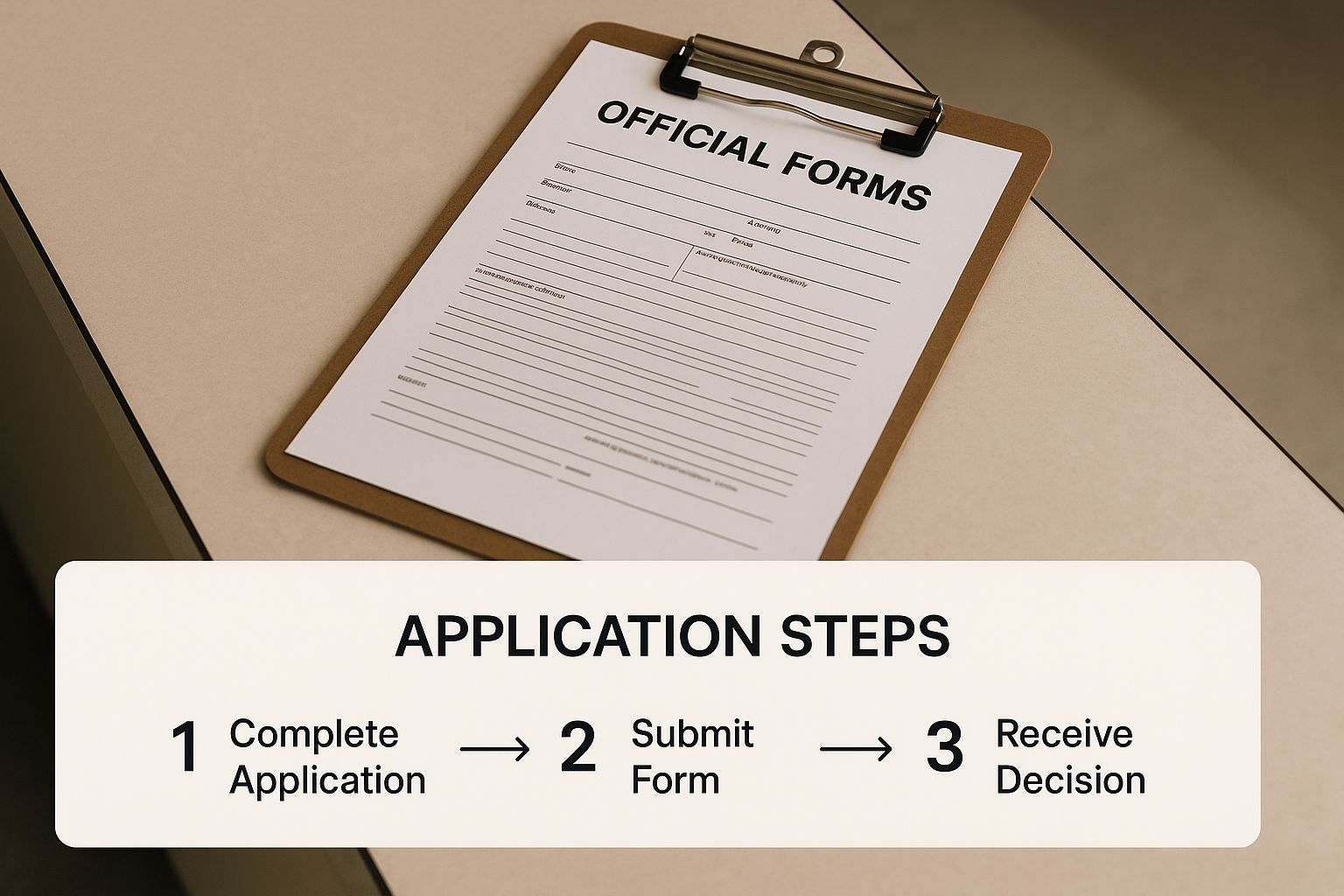
As you can see, getting your permits is a multi-stage journey, not a one-and-done task.
The Role of the Commissary Kitchen
Here’s something that trips up a lot of new owners: many cities and counties don't allow food trucks to be completely self-sufficient. Instead, they require you to partner with a commissary kitchen. This is a licensed, commercial-grade facility where you can safely prep ingredients, store bulk supplies, and properly dispose of waste.
In many places, having a signed commissary agreement is a prerequisite for your health permit. The health department needs official proof that you have a legitimate home base for handling the not-so-glamorous—but critically important—parts of the business:
- Sourcing fresh, potable water for your truck's tanks.
- Disposing of greywater (from sinks) and used cooking grease in an environmentally safe way.
- Doing major food prep that might be too cumbersome or messy for the tight space on your truck.
- Securely storing dry goods and extra refrigerated items overnight.
Your health permit application will almost certainly ask for a signed contract from your commissary. This is your proof that you have a solid plan.
Certifications for You and Your Team
The health department isn't just looking at your equipment; they also need to know that the people handling the food are properly trained. This is where food handler certifications come into play.
Most jurisdictions require at least one person on every shift to hold a Certified Food Protection Manager (CFPM) credential. On top of that, every single employee who touches food—from your main cook to the cashier who might occasionally wrap a sandwich—will likely need a basic Food Handler's Card.
These courses cover the essentials you need to know:
- Preventing cross-contamination
- Understanding proper cooking and holding temperatures
- Practicing good personal hygiene
- Recognizing major food allergens
Don't just check a box with these certifications. The knowledge you gain is your first and best line of defense against a foodborne illness outbreak, which could permanently destroy your reputation and shut your business down for good.
Finally, never forget about fire safety. With propane tanks and high-heat cooking equipment on board, the risks are real. Before the fire marshal shows up for their inspection, review a thorough fire safety inspection checklist to make sure your vehicle is up to code. This is often a separate inspection from the health department's visit, but it's just as crucial for getting your food truck permit requirements fully signed off.
Getting Your Business and Vehicle Road-Legal
Your food truck isn't just a mobile kitchen—it's a registered business and a commercial vehicle. This split personality means you've got two separate streams of legal paperwork to sort out: one for the company itself and another for the truck. Getting these foundational pieces right from the start is non-negotiable if you want to avoid some seriously painful fines and delays later on.
First up, let's give your business a proper legal identity. This isn’t just a formality. The structure you choose dictates your personal liability, how you’ll file taxes, and your ability to bring on a team. Most food truckers go one of two ways.
- Sole Proprietorship: The simplest path. Legally, you and the business are one and the same. It's a breeze to set up, but there's a huge catch: zero personal liability protection. If your business gets sued, your personal assets are on the line.
- Limited Liability Company (LLC): This creates a legal wall between you and your business. For most food truck owners, this is the smartest move. It shields your personal assets—like your home or car—from any business debts or lawsuits.
Once you’ve picked your structure, your next stop will probably be city hall or the county clerk's office. This is where you'll apply for a general business license, the official green light to operate in that specific town or county.
Nailing Down Your Tax IDs
With your business structure sorted, you'll need a Federal Employer Identification Number (EIN) from the IRS. Think of it as a Social Security Number for your business. It's completely free to get on the IRS website and an absolute must if you plan on hiring anyone.
Even if you're flying solo, grabbing an EIN is a solid move. It lets you open a business bank account and helps establish your operation as a legitimate, separate entity. You'll also need a State Tax ID (often called a sales tax permit) from your state’s department of revenue, which gives you the authority to collect and pay sales tax on all that delicious food you sell.
Making Sure Your Truck is Street-Legal
Alright, let's switch gears to the truck itself. Your food truck is a commercial vehicle, not your personal minivan, and the government sees it that way, too. A standard vehicle registration won't cut it. You need to secure commercial vehicle registration through your state's DMV.
This process is more involved than just filling out a form. Depending on where you are and the sheer size of your truck, you'll likely have to pass specific inspections that go way beyond what a regular car needs.
- Safety Inspections: A mechanic will check all the critical stuff—brakes, tires, lights, steering—to make sure your rig is safe to be on public roads.
- Emissions Inspections: Many states have strict environmental standards for commercial vehicles to keep pollution in check.
A classic rookie mistake is messing up the truck's weight classification. If you fail to register your vehicle under the correct Gross Vehicle Weight Rating (GVWR), you're looking at hefty fines. In some cases, you might even need a Commercial Driver's License (CDL).
Let me tell you a quick story about an owner I know, Marco. He bought a beautiful, fully-loaded truck but tried to save a few bucks by registering it in a lower weight class. During a routine traffic stop, an officer took one look at all the heavy-duty kitchen gear and sent him straight to a weigh station. The truck was almost 5,000 pounds over its registered limit.
The outcome? Marco got slammed with huge fines, his truck was temporarily pulled from service, and he had to start the entire DMV registration process from scratch. That "small" shortcut cost him a crucial three weeks of his launch season.
Finally, you absolutely must get commercial auto insurance. Your personal policy won't cover you for a single thing that happens while you're operating the business. A solid commercial policy needs to include liability coverage (in case your truck causes an accident) and property coverage for both the vehicle and all that expensive equipment you've got packed inside. Getting this right isn't just a permit requirement—it's your financial safety net.
Where You Can Legally Park and Sell
Alright, you've conquered the health inspection, and your truck is officially road-legal. Now comes the million-dollar question every new food truck owner asks: where can I actually park this thing and start selling?
This is where you wade into the world of operational, parking, and zoning permits. Honestly, it's often the most tangled and confusing part of the whole journey.
Don't make the rookie mistake of thinking your business license and health permit are an all-access pass. They're not. Cities have very specific rules designed to manage traffic, keep noise down, and protect their brick-and-mortar restaurants. Mess this up, and you're looking at hefty fines and a bad reputation before you even get started.
Navigating Local Zoning and Parking Rules
Your first mission is to dive headfirst into your local municipal code. I know, it sounds about as fun as reading the dictionary, but this is where the gold is. The code spells out exactly where mobile food vendors can—and can't—operate.
These rules can be shockingly detailed and vary wildly from one town to the next.
For example, a city like Chicago might have a lottery for prime downtown spots and a strict rule against parking within 200 feet of an existing restaurant. A quiet suburb, on the other hand, might just require you to stay clear of school zones during dismissal.
Don't ever assume you can just pull up to a busy corner and start serving. Most cities have designated food truck zones or require specific permits for on-street vending. Ignoring these rules is the fastest way to get a ticket or, even worse, see your truck getting towed.
These zoning laws didn't just appear overnight. As food trucks blew up in popularity in the early 2000s, cities had to scramble to create formal systems to deal with public health and traffic. This led to the rules we see today, like mandatory commissary use and designated vending zones. You can discover more insights about the food truck market's growth to see how this history shapes current regulations.
Securing Your Vending Location Permits
Once you've scouted some promising areas, it's time to get the right permits. This isn't a one-size-fits-all application; the permit you need is tied directly to where you plan to sell.
Here are the most common types you’ll run into:
- On-Street Parking Permit: This lets you operate from a public street spot. These are often the most competitive and might be restricted to certain times of day.
- Private Property Vending Permit: Eyeing that busy office park for the lunch rush? You'll need written permission from the property owner and likely a separate city permit to operate there.
- Designated Food Truck Zone Permit: Many cities now have dedicated food truck parks or zones. To get in, you'll probably apply with the zone's manager or the city department in charge.
Applying often means submitting a proposed route or a list of locations you're interested in. Come prepared. Having a clear plan that shows why your truck is a great fit for those spots can make all the difference. While you're planning your locations, don't forget about your kitchen's efficiency—it's crucial for serving crowds quickly. For instance, high-efficiency fryers can be the secret sauce for food truck success, especially in high-demand spots.
The Power of Special Event Permits
Beyond your daily grind, special event permits are the golden tickets. These temporary permits let you sell at places where vending is normally off-limits, and they can be incredibly lucrative.
Just think about the possibilities:
- Music Festivals & Concerts: A captive audience of thousands of hungry people.
- Farmers' Markets: A built-in crowd that's actively looking for quality, local food.
- Community Fairs & Carnivals: High foot traffic in a fun, family-friendly setting.
- Sporting Events: Serving pumped-up fans before or after the big game.
Event organizers almost always have a formal application process for food vendors. You'll need to provide copies of your licenses, proof of insurance, and your menu. The fees can be higher, but the potential return is massive. This is where you can truly build your brand and create a loyal following.
How to Manage Renewals and Stay Compliant
Getting that first stack of permits feels like a massive victory, and it is! But it’s not the finish line. Think of it as the starting line for the real marathon: long-term compliance.
A lapsed permit isn't just a piece of paper that's out of date. It's a legal roadblock that can get your truck shut down on the spot, costing you thousands in lost sales and a whole lot of stress. Staying compliant is an active, ongoing job. You have to build a system to track every single expiration date, from your annual health permit to that six-month vehicle inspection. One missed deadline can kick off a domino effect of problems, so getting proactive isn't just a good idea—it's essential for survival.
Create a Permit Renewal Calendar
Your most powerful tool for staying on the right side of the law is surprisingly simple: a dedicated renewal calendar. Don't try to rely on memory or a few sticky notes on your dashboard. Set up a digital calendar and create an event for every single permit, license, and certification you have.
For each one, you'll want to include a few key details:
- Permit Name: Get specific. Not just "vending permit," but "City of Denver Mobile Vending Permit."
- Expiration Date: The day it officially becomes invalid.
- Renewal Window: Some agencies only accept renewal applications during a specific timeframe. Note when that window opens.
- Required Documents: Make a checklist of everything you’ll need. Is it a new commissary agreement? Updated proof of insurance?
Set your first reminder for 90 days before the expiration date. This gives you plenty of breathing room to get your paperwork together and sort out any unexpected issues. I'd add another reminder at 60 days, and a final, "get this done now" alert at 30 days out. This simple system is your best defense against last-minute panic.
Navigating Health and Safety Inspections
That first health inspection you passed to get licensed? It won't be your last. You can count on routine annual inspections and, in many places, completely unannounced spot-checks. The only way to handle this is to be "inspection-ready" every single day you're open for business. An inspector can absolutely show up right in the middle of a chaotic lunch rush, and you have to be prepared.
A smart food truck owner I know, Maria, keeps what she calls a "compliance binder" right in her truck. It’s got copies of every current permit, the food handler cards for all staff on duty, and her latest inspection report. When an inspector arrives, she just hands over the binder. It immediately shows she’s organized, transparent, and takes this stuff seriously.
"Treat every service day like it's inspection day. That means temperatures are always monitored, gloves are always changed, and cleaning logs are always up-to-date. When you make compliance a daily habit, a surprise inspection becomes a routine check-in, not a moment of panic."
And don't forget, it's not just about food safety. Your truck is a workplace, which means you also need to follow general workplace safety rules, like those covered in an OSHA compliance checklist.
Staying Ahead of Regulatory Changes
The rules of the road are always changing. A new city ordinance might change where you can park, or the county health department could update its food safety code. This is a huge challenge for operators. In fact, keeping up with permit requirements is a major hurdle for about 35% of food truck owners.
Permit renewal timelines can be anything from six months to a year, though thankfully more cities are moving to digital platforms to make it a little less painful. You can read the full research about these operational challenges to get a better sense of the landscape.
So, how do you stay on top of it all? Join your local food truck association or a small business alliance. These groups are usually the first to hear about proposed changes and can give you the inside scoop on how to adapt. Following your city's official social media pages and signing up for their business newsletters are also great ways to catch updates before they turn into problems.
Common Questions About Food Truck Permits
Even after you've sorted through the big categories of licenses, a few nagging questions always seem to pop up when you're navigating the world of food truck permit requirements. It's totally normal. Certain situations can feel a bit murky, and the details matter—a lot.
This section is all about tackling those common uncertainties head-on. Think of it as the final check-in before you hit the road, giving you clear, direct answers so you can finalize your launch plan with confidence.
Do I Need a Permit to Operate on Private Property?
Yes, you absolutely do. This is hands-down one of the biggest misconceptions I see. New owners get permission from a business to park in their lot and assume they're good to go. That's only half the battle.
While you definitely need the property owner's written consent, most cities also require you to get a Private Property Vending Permit. This permit is your proof to the city that you're not just some random operator, but a legitimate business that’s been approved to be in that specific, non-public spot. It also confirms you're still meeting all the necessary health and safety codes, even if you aren't on a public street.
How Long Does It Take to Get All My Permits?
The timeline for getting all your permits in order can vary wildly, but it's almost never a quick turnaround. I tell everyone to budget for three to six months—and in stricter areas, it can easily take longer. This is one part of the process you just can't rush.
A few things can really affect your timeline:
- Local Government Speed: Let's be honest, some city offices are just more efficient than others.
- Inspector Availability: You're on the health and fire departments' schedule, not the other way around.
- Application Errors: One tiny mistake or a single missing document on your application can send you right back to the start, adding weeks to your wait.
The best advice? Start the process as early as humanly possible. For a more detailed look at the entire journey, our guide on how to start a food truck breaks down all the initial steps.
Can I Use My Food Truck Permit in Another City or State?
Almost certainly not. Food truck permits are intensely local and are not transferable between different jurisdictions. A health permit from Austin won't fly in Dallas, and a vending license from Jersey City is useless in Newark.
Every single city, county, and state has its own unique rulebook, fee structure, and inspection process. If you plan to operate in multiple towns, you have to go through the full application and inspection gauntlet for each and every one.
The "one truck, many cities" dream is absolutely achievable, but it means getting a completely separate set of permits for every single municipality you want to serve in. There are no shortcuts here; from a legal standpoint, each new location is a brand-new business launch.
This is exactly why so many successful trucks master one territory before even thinking about expanding. It’s far more manageable to build a loyal following and perfect your operations in a single city before taking on the headache of multi-city compliance.
What Happens If My Permit Expires?
Letting a permit lapse—even by one day—can lead to some serious trouble. In a best-case scenario, you’re looking at a late fee and having to shut down until it’s renewed. In a worst-case scenario, you could be slammed with huge fines, get your truck impounded, or even have your permit revoked for good.
Most cities don't offer a grace period. The second a permit expires, you are operating illegally. This is why a detailed renewal calendar isn't just a helpful tool; it's absolutely critical for your business's survival.
Ready to build the mobile kitchen of your dreams? The Restaurant Warehouse has all the durable, professional-grade cooking and refrigeration equipment you need to pass your inspections and serve your customers safely. From compact fryers to stainless steel prep tables, we provide top-tier supplies with financing options to get you on the road faster.
Equip your vision at https://therestaurantwarehouse.com.
About The Author

Sean Kearney
Sean Kearney used to work at Amazon.com and started The Restaurant Warehouse. He has more than 10 years of experience in restaurant equipment and supplies. He graduated from the University of Washington in 1993. He earned a BA in business and marketing. He also played linebacker for the Huskies football team. He helps restaurants find equipment at a fair price and offers financing options. You can connect with Sean on LinkedIn or Facebook.
Leave a comment