

Your Guide to Food Truck Insurance Requirements
When you're launching a food truck, figuring out insurance can feel like trying to decipher a secret menu. But a few core policies are absolutely mandatory to operate legally. You'll need General Liability, Commercial Auto, and Product Liability insurance at a minimum. Think of these as the foundational safety net protecting your business from the most common bumps in the road—like customer accidents, vehicle collisions, or claims of foodborne illness.
The Three Pillars of Food Truck Protection
Getting your food truck insurance sorted is a lot like perfecting a new recipe; each component is essential for the final product to work. Without the right coverage, a single mishap—a customer tripping over a power cord or a minor fender bender in a parking lot—could put your entire dream on hold.
The key is to understand the three foundational policies that work together to shield your mobile kitchen from all sides.
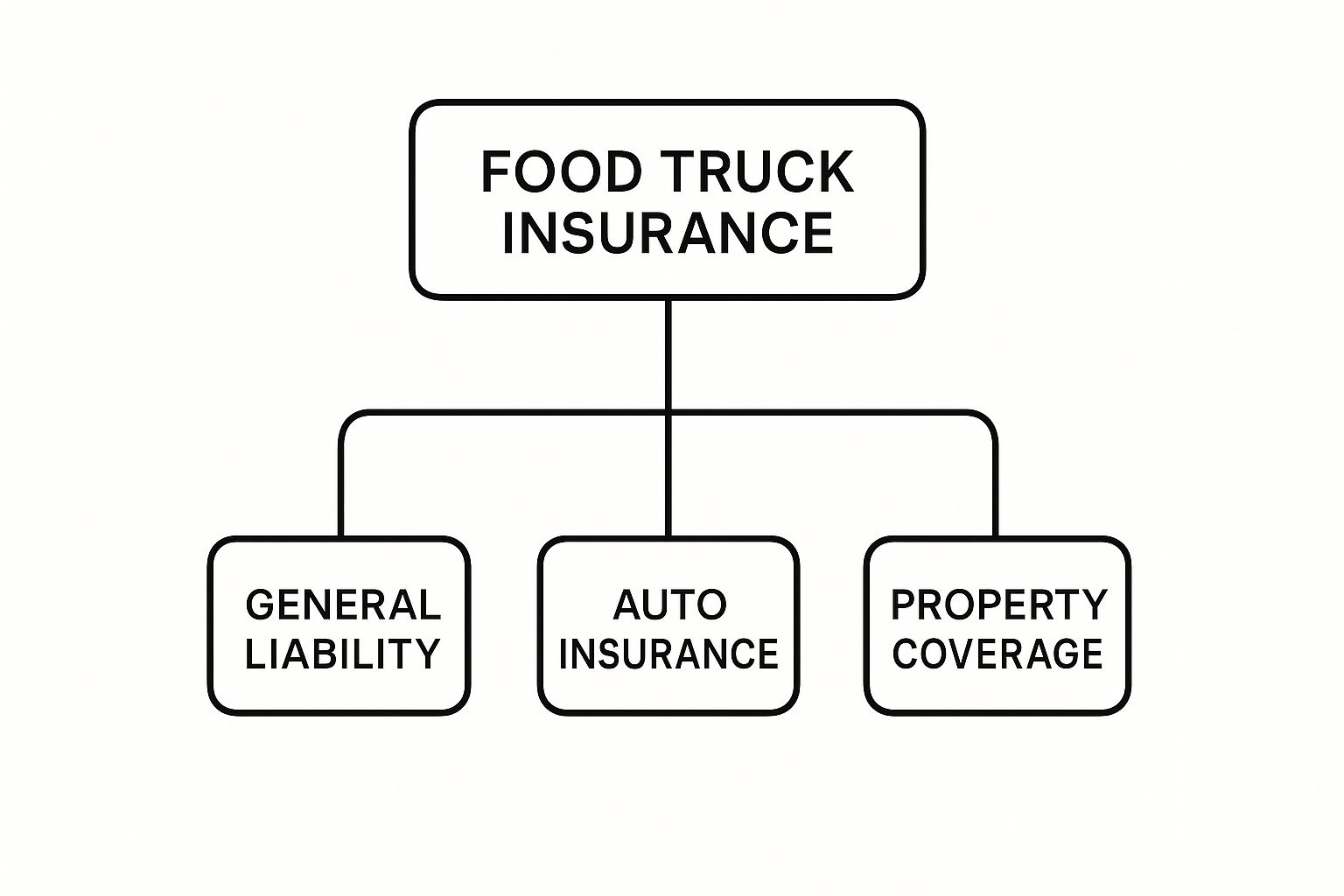
This simple breakdown shows how your protection strategy is built on three distinct but interconnected pillars. Each one handles a different part of your operation, from your interactions with the public to your safety on the road.
To make this crystal clear, here’s a quick summary of the essential coverages you’ll need to have in place.
Core Food Truck Insurance Coverages at a Glance
| Insurance Type | What It Covers | Why It's Essential |
|---|---|---|
| General Liability | Bodily injury or property damage to third parties (non-auto, non-food related). | Protects against slip-and-fall accidents, or if your setup damages someone's property. |
| Commercial Auto | Accidents involving your food truck while it's being driven for business. | Covers injuries to others and damage to other vehicles or property you cause on the road. |
| Product Liability | Sickness or injury caused by the food or beverages you serve. | Defends against claims of food poisoning, contamination, or allergic reactions. |
This table gives you the high-level view, but let's break down exactly what each of these policies does for you.
1. General Liability Insurance
Think of General Liability as your customer-facing shield. This policy is designed to protect your business from claims of bodily injury or property damage that happen because of your operations—but aren't related to your vehicle or the food itself.
For example, if a customer trips over your generator's power cord and breaks their wrist, this is the policy that steps in. It also covers you if your service window awning accidentally damages a nearby building during setup. It's there to handle the legal fees and medical costs that can come from those everyday operational risks.
2. Commercial Auto Insurance
Let's be clear: your personal auto policy will not cover your food truck. Commercial Auto Insurance is a non-negotiable requirement because it covers accidents that happen while you're driving your truck for business. This includes liability for any injuries or damages you cause to other people or their property.
This policy can also cover physical damage to your own truck from collisions, theft, or vandalism, safeguarding what is likely your most expensive asset.
A critical mistake new owners make is assuming their personal car insurance covers their food truck. Regulators, health departments, and event organizers will always require proof of a commercial policy, as it's tailored to the higher risks that come with a business vehicle.
3. Product Liability Insurance
This coverage is your defense against the most specific risk in the food industry: claims of foodborne illness or contamination. If a customer alleges they got sick after eating your tacos, Product Liability Insurance is what covers the associated legal costs, potential settlements, and medical expenses.
This protection is absolutely essential for maintaining your reputation and financial stability in an industry where one bad review can go viral.
These three policies form the bedrock of your insurance plan. They are every bit as crucial as the gear on your food truck equipment checklist for running a successful and secure business from day one.
Understanding Liability: A Food Truck Owner's Shield
Picture this: you're set up at a huge downtown festival, the line is long, and the energy is buzzing. Then, a sudden gust of wind sends your menu sign flying, and it clips a customer. Or, even worse, a patron calls the next day claiming your signature tacos gave them a serious case of food poisoning. These aren't just nightmare scenarios; they're the real-world risks where liability insurance becomes the most important tool in your toolbox.
Without it, a single accident could spark a lawsuit that shuts down your dream for good. This is where your liability coverage steps in, acting as a financial shield to protect your business and your personal assets from claims that could otherwise be completely devastating.
Getting a food truck on the road can cost anywhere from $50,000 to $200,000. While that’s often a more manageable startup cost than a traditional restaurant, these mandatory insurance policies are a non-negotiable layer of financial protection. In just about every market, general liability and product liability insurance are required to handle everything from third-party injury claims to foodborne illness. You can dive deeper into the numbers with a full food truck market analysis to get a better handle on these startup costs.
General Liability: The Foundation of Your Protection
Think of General Liability insurance as your "slip-and-fall" coverage. This policy is your first line of defense against claims of bodily injury or property damage that happen around your truck but aren't directly related to your vehicle being in motion or the food itself. It’s all about covering the everyday operational hazards that come with serving the public.
Here are a few real-world examples of what it covers:
- Customer Injuries: A customer trips over the power cord running from your truck to a generator and breaks their arm. Your General Liability policy is designed to handle their medical bills.
- Property Damage: Your large service window awning scrapes against the side of a historic building you’re parked next to, causing damage.
- Advertising Injury: You accidentally use a copyrighted image on your menu or social media post, and the owner sues you for it.
Without this coverage, you’d be on the hook personally for medical bills, legal defense fees, and any settlement costs. Those numbers can skyrocket into the tens of thousands of dollars in the blink of an eye.
Your General Liability policy is the first thing venues and event organizers will ask to see. They almost always require you to list them as an "additional insured," which just means your policy also protects them if a claim comes from your operations at their event.
Product Liability: Your Food-Specific Shield
While General Liability handles accidents around your truck, Product Liability insurance is all about the actual product you sell—your food and drinks. This is arguably one of the most critical food truck insurance requirements because it protects you if someone claims your food or beverage caused them harm.
This coverage is your safety net for situations like:
- A customer has a severe allergic reaction because of an ingredient you forgot to list.
- Several people report getting sick after eating at your truck, leading to a food poisoning claim.
- A foreign object, like a small piece of plastic, is found in a dish and causes an injury.
Even with the most rigorous food safety standards, mistakes can and do happen. Product Liability ensures that one claim of foodborne illness doesn't poison the future of your business by covering legal fees and potential payouts. Together, these two liability policies form a powerful shield, giving you the peace of mind to focus on what you do best: serving amazing food.
Insuring Your Most Valuable Asset: The Truck Itself
Your truck isn't just a vehicle—it's your entire business on wheels. It’s your kitchen, your storefront, and your moving billboard all rolled into one. That's why trying to protect it with a standard personal auto policy is like using a dinner napkin to put out a kitchen fire. It’s simply not designed for the job and will fail when you need it most.
A personal policy is built for commuting to an office or running weekend errands, not for a commercial vehicle loaded with thousands of dollars in professional cooking equipment. If you get into an accident while driving to a food festival, your personal insurer will almost certainly deny the claim because you were using the vehicle for business. That leaves you on the hook for all the damages—a risk no entrepreneur can afford to take.
This is precisely why Commercial Auto Insurance is a non-negotiable legal and financial requirement for every single food truck out there.
What Commercial Auto Insurance Actually Covers
Think of Commercial Auto Insurance as a hybrid policy that gets the dual nature of your food truck: it’s both a vehicle and a place of business. This specialized coverage protects you from the unique risks you face every single time you turn the key.
A solid policy is typically built on these core components:
- Liability Coverage: This is the big one. If you cause an accident, this covers the medical bills for anyone who gets hurt and the repair costs for damaged property, like another car or even a storefront. States mandate minimum liability limits, but most seasoned operators carry at least $1,000,000 in coverage.
- Collision Coverage: This pays to repair or replace your own truck if it gets damaged in a wreck with another vehicle or object, no matter who was at fault.
- Comprehensive Coverage: This is your protection against all the other chaos life can throw at you. It covers damage from non-collision events like theft, vandalism, fire, hail, or even a tree falling on your truck while it's parked.
Remember, Commercial Auto insurance focuses on the vehicle itself. That expensive equipment bolted inside—your griddles, fryers, and refrigerators—often needs separate coverage to be fully protected.
Don't Forget Your Permanently Installed Equipment
One of the biggest mistakes new food truck owners make is assuming their commercial auto policy covers the custom kitchen built into the back. In most cases, it doesn’t. A standard auto policy is designed to cover the chassis and the cab, not the $30,000 worth of specialized cooking gear you've installed.
To properly insure these items, you'll need to add a specific endorsement for permanently installed equipment or purchase a separate Business Personal Property policy. This ensures that if your truck is stolen or damaged in a fire, you have the funds to replace not just the vehicle, but the entire kitchen that makes your business run.
For those still in the process of acquiring their truck, exploring various business auto loan options is another crucial step in getting set up for success right from the start.
Protecting Your Gear Beyond The Vehicle
Your Commercial Auto policy has your truck covered, but what about the gear inside it? We're talking about the expensive, specialized equipment that actually makes you a food business—your commercial-grade grill, deep fryers, refrigerators, and that high-tech POS system.
Let's be clear: a standard auto policy won't touch these items if they're damaged in a crash, swiped in a break-in, or lost in a fire. Your business is so much more than just the vehicle, and protecting this equipment is a critical part of a complete insurance strategy. Without it, a single bad day could force you to shell out tens of thousands of dollars just to get cooking again.
Business Personal Property (BPP) Coverage
Think of Business Personal Property (BPP) insurance as the policy that protects everything inside your mobile kitchen. It’s designed specifically for the contents—the items that aren't permanently bolted down to the truck itself. This is the coverage that steps in to help you replace your gear if it gets damaged, stolen, or destroyed.
So what does that cover, exactly? Things like:
- Cooking appliances (griddles, ovens, fryers)
- Refrigeration units and freezers
- Your point-of-sale (POS) system and tablets
- Generators, cookware, and utensils
Without BPP, you're on the hook for replacing every last one of these out-of-pocket. It’s a foundational layer of protection for the tools you rely on every single day.
Inland Marine Insurance for Mobile Operations
But what about the gear that doesn't stay on the truck? If you use portable catering equipment, pop-up tents, or extra tables and chairs for festivals, your BPP coverage won't protect them once they leave the vehicle. This is where Inland Marine insurance comes into play.
Don't let the name fool you; this policy has nothing to do with water. It's built to cover your business property while it's in transit or at a temporary, off-site location. It's the perfect solution for protecting your equipment while you’re setting up at a farmer's market, catering a wedding, or participating in a food truck rally.
Inland Marine insurance is your "on-the-go" property coverage. It bridges a critical gap by protecting your valuable assets no matter where your business takes you, ensuring your gear is safe both on and off the truck.
Equipment Breakdown Coverage
Okay, one last scenario. What happens when your gear just... breaks? Not from an accident, but from a sudden mechanical or electrical failure. A blown compressor in your main refrigerator or a short-circuited generator can shut down your entire operation in an instant, right in the middle of a lunch rush.
Equipment Breakdown coverage is designed for these exact situations. It helps cover the cost of repairing or replacing essential equipment after a covered breakdown, like a power surge or simple mechanical failure. This policy is the key to minimizing your downtime and getting your kitchen back up and running fast after an unexpected malfunction.
Navigating Local and State Insurance Rules
Food truck insurance isn't a single, neat package you can just buy off the shelf. Think of it more like a patchwork quilt stitched together by city, state, and even specific event rules. The policy that makes you perfectly legal in one county might fall completely flat just a few miles down the road.
This variability is honestly one of the trickiest parts of the business, but getting a handle on it is absolutely key to operating without any surprise shutdowns. Your journey starts by understanding that different authorities care about different things. The state DMV is focused on your Commercial Auto liability, while the city's health department is way more concerned with General and Product Liability to protect the public. A one-size-fits-all approach just doesn't work here.
This is especially true across North America, where the booming food truck scene has led to much stricter safety and public health standards. The major growth in the food truck insurance market is directly tied to city councils and regulators demanding solid financial protection to cover potential risks. You can dig into these insurance market trends to see just how this is impacting owners like you.
Finding Your Local Mandates
So, how do you untangle this web of rules? The best way is to start local and work your way up. Never assume anything; you have to verify the requirements for every single place you plan to operate.
Your main points of contact should be:
- Your Local Health Department: They are usually the main gatekeepers for food service permits and will have a clear list of the minimum liability coverage you need.
- The City Clerk or Chamber of Commerce: These offices are your go-to for information on business licensing and any other city-specific insurance rules.
- Event Organizers and Commissaries: Any festival, market, or commissary kitchen you work with will have its own insurance requirements, which are often even stricter than the city's.
And remember, insurance is just one piece of the puzzle. You'll need to understand all the local regulations to operate legally. Our guide on food truck permit requirements can help you build a complete compliance checklist so nothing slips through the cracks.
Who requires you to have insurance and what do they typically ask for? It’s a mix of different players, each with their own focus. To make it clearer, we've broken down the most common entities and what they usually demand.
| Common Insurance Requirements by Entity | ||
|---|---|---|
| Requiring Entity | Commonly Required Insurance | Typical Coverage Limit |
| State DMV | Commercial Auto Liability | Varies by state; often $50,000 - $1M |
| City/County Health Dept. | General & Product Liability | $1M per occurrence / $2M aggregate |
| Event Organizers (Festivals, Markets) | General Liability, Additional Insured | $1M - $2M per occurrence |
| Commissary Kitchens | General Liability, Additional Insured | $1M per occurrence / $2M aggregate |
| Property Landlords (e.g., Office Parks) | General Liability, Additional Insured | $1M per occurrence / $2M aggregate |
As you can see, a $1 million General Liability policy is pretty much the standard baseline for doing business. This table is a great starting point, but always be sure to confirm the exact requirements directly with each entity you plan to work with.
The Role of an Additional Insured
One term you are going to hear over and over is "additional insured." When an event organizer or a property owner asks for this, they're asking to be added to your general liability policy.
This doesn't cost you anything extra, but it is a non-negotiable step for almost any partnership. It simply extends your liability protection to cover them for any claims that arise from your operations. For example, if a customer trips over your generator cord and decides to sue both you and the festival, your policy will step in to defend them, too.
Failing to provide a certificate of insurance with the correct additional insured endorsement will get you turned away from profitable events every single time. It’s a standard, crucial part of doing business on the go, so get familiar with the process.
Common Questions About Food Truck Insurance
Stepping into the world of food truck insurance can feel like learning a whole new language. As a new owner, you’re juggling a million things, and all this talk of premiums, liability, and insureds can feel overwhelming. You just want straight answers.
This section is here to do just that—cut through the jargon and tackle the most common questions we hear from food truckers. Getting these details right is just as important as perfecting your signature sauce. A misstep here can be a lot more expensive than burning a batch of fries, so let's clear up the confusion.
How Much Does Food Truck Insurance Cost?
This is the big question, and the honest answer is: it depends. There’s no single price tag. Most food truck owners can expect to pay somewhere between $2,000 and $5,000 a year, but that number can swing wildly based on a few key things.
Your location, the value of your truck and all the gear inside it, your personal driving record, and the amount of coverage you choose all play a huge role. Think about it—a simple salad-and-sandwich truck operating in a quiet suburb is a much lower risk than a truck loaded with deep fryers navigating a chaotic downtown core. More risk almost always means a higher premium. The best move is to get quotes from a few different insurers who really know the food truck scene. They'll help you find a rate that’s competitive but still gives you the protection you actually need.
What Is an Additional Insured and Why Is It Required?
You're going to hear the term "additional insured" a lot. Festival organizers, property managers, and commissary kitchens will all ask for it, and it’s non-negotiable. So, what is it? An additional insured is simply another person or organization you add to your liability policy. This literally extends your insurance protection to cover them if a lawsuit pops up because of something related to your business.
Here’s a real-world example: A customer trips over your power cord at a music festival and decides to sue both you and the festival organizer. Because you named the festival as an additional insured, your policy steps in to defend them, too. It’s a standard safety net for venues and a critical part of your food truck insurance requirements.
Do I Need Workers Compensation Insurance?
If you have employees—even just one part-timer—the answer is almost always a resounding yes. Workers' Compensation insurance is required by law in pretty much every state for any business with staff on the payroll. This is the policy that covers medical bills and lost wages if one of your team members gets hurt or sick on the job.
The specific rules can vary from state to state, so it’s crucial to check your local regulations. Don't skip this. Failing to carry workers' comp when you're supposed to can lead to massive fines, legal trouble, and leave you personally on the hook for any workplace accidents. Protecting your team isn't just a legal requirement; it’s a core part of building a solid, sustainable business. Speaking of which, mapping out these compliance steps is a key part of creating a strong food truck business plan. A solid plan will help you account for all these critical details from day one.
At The Restaurant Warehouse, we provide the high-quality, durable equipment you need to build your mobile kitchen with confidence. From commercial-grade refrigeration to powerful cooking appliances, we offer top brands at discounted prices with fast delivery to get you on the road sooner. Explore our extensive catalog and flexible financing options today.
About The Author

Sean Kearney
Sean Kearney is the Founder of The Restaurant Warehouse, with 15 years of experience in the restaurant equipment industry and more than 30 years in ecommerce, beginning with Amazon.com. As an equipment distributor and supplier, Sean helps restaurant owners make confident purchasing decisions through clear pricing, practical guidance, and a more transparent online buying experience.
Connect with Sean on LinkedIn, Instagram, YouTube, or Facebook.