

Cooking Equipment for Food Truck: A Practical Guide
Outfitting your food truck with the right cooking gear is one of the most important decisions you'll make. It’s not like a traditional restaurant where you have acres of space. In a truck, every single inch counts. The equipment you choose is the engine of your entire operation, directly impacting how fast you can serve, how consistent your food is, and ultimately, how much money you make.
Building Your Essential Food Truck Kitchen
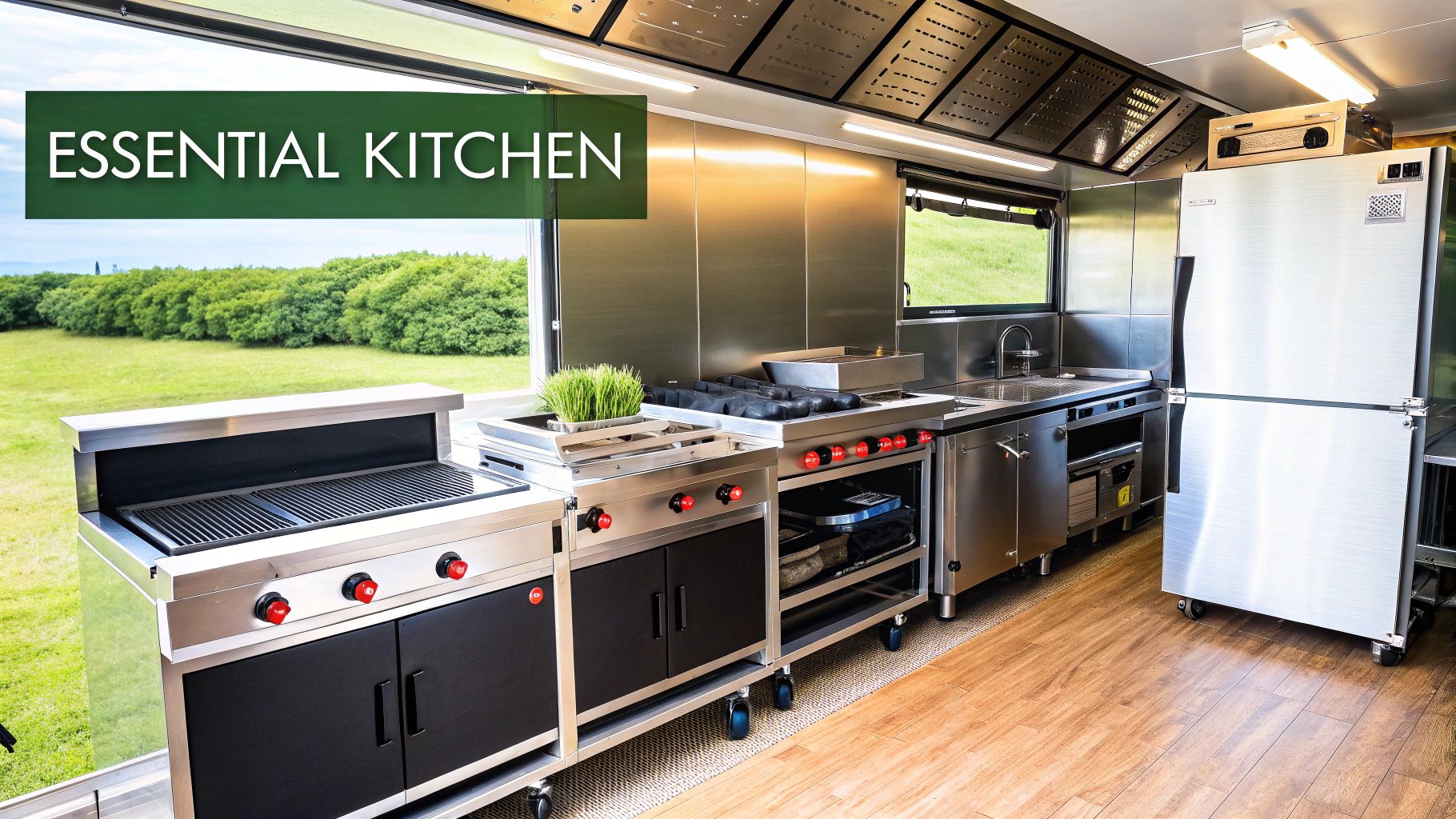
Think of it this way: your kitchen gear has to earn its spot on the truck. Each piece needs to be a heavy-duty, commercial-grade workhorse that can handle the chaos of a lunch rush while fitting into a tight, mobile environment. From the sizzle of burgers on the griddle to the hum of the refrigerator keeping your ingredients safe, every component plays a crucial role.
For most food trucks, the foundation rests on three pillars: a commercial griddle, a deep fryer, and solid refrigeration. This setup is the backbone for countless popular street food concepts, from tacos and sliders to loaded fries. While your specific menu will guide your final choices, starting with these essentials is a proven recipe for success.
Core Appliances and Budgeting
Let's be real—kitting out a food truck is a major investment. A brand-new, fully equipped truck can run anywhere from $50,000 to $175,000, while a good used or renovated one often lands between $30,000 and $100,000. The core cooking and refrigeration appliances alone can easily cost $10,000 or more, so planning is key.
Your equipment list is more than a shopping list—it's the blueprint for your menu's success. Choosing versatile, high-output gear ensures you can serve customers quickly and consistently, which is the key to building a loyal following.
To give you a clearer picture of where that money goes, I’ve put together a quick breakdown of the foundational pieces. This table should help you start planning your budget and layout.
Core Cooking Equipment for Your Food Truck
This table breaks down the essential cooking and refrigeration appliances, their function, and estimated costs to help you budget effectively.
| Equipment Category | Primary Function | Key Considerations | Estimated Cost (New) |
|---|---|---|---|
| Griddle/Flat-Top | Searing, grilling, toasting | Size (24" to 48"), heat distribution, gas vs. electric | $1,500 - $4,000 |
| Deep Fryer | Frying foods quickly | Capacity (lbs of oil), recovery time, number of baskets | $800 - $2,500 |
| Refrigerator | Chilling ingredients | Undercounter vs. reach-in, energy efficiency, NSF-certified | $1,500 - $3,500 |
| Freezer | Long-term frozen storage | Compact chest vs. undercounter, temperature consistency | $1,200 - $3,000 |
| Exhaust Hood & Fan | Ventilation and safety | Must meet local fire codes, proper size for appliances | $2,000 - $5,000+ |
This is just a starting point, of course. For a more exhaustive breakdown, this comprehensive https://therestaurantwarehouse.com/blogs/restaurant-equipment/food-truck-equipment-list is a fantastic resource to make sure you haven't missed anything.
And don't forget, once the kitchen is sorted, you need to get customers to your window. Investing in a few essential outdoor business signs is a smart move to make sure your truck stands out in a crowd.
Matching Your Cooking Gear to Your Menu
When it comes to outfitting your food truck, there’s one golden rule: the menu comes first, always. Picking your cooking equipment isn't about snagging the biggest, shiniest gear you can find. It’s a strategic decision, and your menu is the playbook. Think of your kitchen like a master mechanic’s toolbox—every tool has a specific job. You wouldn't use a sledgehammer to fix a watch, and you definitely shouldn't install a massive six-burner range if your entire menu revolves around smoothies and açai bowls.
Every single piece of equipment has to earn its spot. Inside a food truck, space is pure gold. An appliance that isn't pulling its weight every single day isn’t just a bad investment; it’s a physical roadblock that gums up your workflow, slows down service, and bleeds you dry. The goal is to build a lean, mean, money-making machine where every appliance is directly tied to an item on your menu.
Aligning Appliances with Your Concept
The connection between what you cook and what you cook it on is direct and non-negotiable. Let’s break it down with a few real-world examples so you can see exactly what I mean.
-
The Gourmet Burger Truck: Your whole operation is built on cranking out juicy, perfectly seared burgers and crispy fries, fast. You absolutely need a large flat-top griddle to handle multiple patties at once, a high-capacity deep fryer that can keep up with the endless demand for fries, and maybe a charbroiler to get that signature smoky flavor that sets you apart.
-
The Mobile Pizzeria: Here, the oven is the star of the show, no question. A compact, high-heat pizza deck oven is essential for that perfect crispy-chewy crust. To support it, you’ll need a refrigerated prep table with inserts for all your toppings and a heavy-duty dough mixer if you're making fresh dough on the truck.
-
The Coffee & Pastry Truck: The focus flips entirely. The heart of this kitchen is a top-notch commercial espresso machine, a couple of powerful coffee grinders, and a good convection oven for baking fresh pastries and muffins. A griddle or fryer in this setup would be a complete waste of precious counter real estate.
These scenarios make it crystal clear: the menu dictates the hardware, ensuring every piece of equipment has a profitable purpose.
Future-Proofing Your Equipment Choices
While you’re mapping out your kitchen, it’s smart to keep an eye on the future. The food truck world is always moving, and what’s popular today might be old news tomorrow. This is especially true as the industry continues to boom.
The U.S. food truck market was valued at around $1.09 billion in 2025 and is expected to hit $1.51 billion by 2030. A lot of that growth comes from food trucks tapping into new trends—unique, healthy, or niche foods that often demand specific cooking gear to get right. You can dive deeper into these food truck market trends on MordorIntelligence.com.
Choosing versatile equipment can be a brilliant long-term play. For instance, a combi-oven can steam, bake, and roast all in one footprint. That single piece of gear gives you the flexibility to add all sorts of new items to your menu without having to rip your kitchen apart.
Thinking about menu flexibility now can save you a world of hurt—and a ton of money—down the road.
The Cost of a Mismatch
Picking the wrong equipment isn't a small mistake; it's a critical failure with immediate and painful consequences. Picture a taco truck owner who cheaped out and bought a small two-burner range instead of the 36-inch flat-top griddle they really needed. The moment the lunch rush hits, they’re dead in the water. They can only warm a few tortillas or cook a tiny bit of meat at a time.
This one bad decision creates a massive bottleneck, leading to a domino effect of disaster:
- Longer Wait Times: Hangry customers will walk away, and they probably won't be back.
- Lower Sales Volume: You simply can’t push food out the window fast enough to hit your revenue goals.
- Inconsistent Quality: When you're rushing orders on the wrong gear, food gets undercooked or burnt.
That single mismatch cripples the entire business. By carefully matching your cooking equipment to your menu, you're not just buying appliances; you're designing a kitchen built for speed, quality, and profit from day one.
Powering Your Mobile Kitchen Reliably
Even the slickest, most expensive cooking equipment is just shiny stainless steel without a reliable power source. Your food truck runs on two lifebloods: electricity and gas. Figuring out how to manage them safely and efficiently isn't just a technical chore—it's the difference between a killer service and a complete shutdown during your busiest lunch rush.
Think of your power system as the heart and lungs of your operation. Electricity keeps your lights on, your refrigeration humming, and your smaller appliances running. Gas, on the other hand, typically fuels the heavy-hitting, high-heat cooking gear. If either one fails, your whole business can grind to a halt. That’s why building a tough, redundant power plan is a non-negotiable part of setting your truck up for success.
Generators and Propane: The Dynamic Duo
Most food trucks you see out there run on a classic combination: a generator for electricity and propane tanks for cooking. Each has its own job to do, and knowing their strengths and weaknesses is the key to a setup that actually works in the real world.
- Generators: These are your mobile power plants. They turn fuel (like gasoline, diesel, or even propane) into the electricity you need for refrigerators, freezers, lights, your POS system, and any electric cooking appliances.
- Propane: This is the go-to fuel for high-BTU cooking equipment like your griddle, fryers, and ranges. It pumps out intense, consistent heat and is often the more cost-effective choice for those heavy-duty cooking tasks.
Using both lets you balance the load. You can run all your heat-hungry appliances on efficient propane, leaving your generator's electrical output free for everything else. This dual-fuel strategy is the industry standard for a good reason—it’s practical, resilient, and gets the job done.
Calculating Your Power Needs
Before you even think about buying a generator, you need to do a little math. Underestimating your power needs is a classic rookie mistake, and it leads to tripped breakers and failing equipment right when you have a line of hungry customers. You have to calculate your total wattage requirement to pick a generator that can actually handle the load.
To do this, make a list of every single piece of electrical equipment in your truck, from the biggest cooler down to the phone charger. For each one, you need to find the "starting wattage" (that initial surge of power needed to turn it on) and the "running wattage."
Key Takeaway: Always add the starting wattage of your most demanding appliance (usually a refrigerator or freezer) to the total running wattage of everything else. This simple sum gives you the minimum generator size you need to operate without constant issues.
For example, a refrigerator might need a 1,200-watt jolt to start but only 400 watts to run. If all your other gear adds up to 2,000 running watts, you'll need a generator that can handle at least 3,200 watts (1,200 + 2,000) to avoid a power trip every time the compressor kicks on. A detailed guide on the essential electrical gear for food trailers can really help you nail these critical calculations.
Quiet Power and Safe Practices
Let's be real: a loud, rumbling generator is more than just annoying; it’s bad for business. Many cities and event organizers have strict noise rules, and a generator that sounds like a jet engine can get you sent packing. Investing in a quiet-run inverter generator is a must-have for both compliance and customer experience. These models are built to run at much lower decibel levels, creating a more pleasant vibe for everyone.
Safety is just as critical. You’re dealing with highly flammable propane and complex electrical systems inside a vehicle that’s constantly vibrating down the road. This requires serious attention to detail.
- Propane Safety: Make sure your tanks are securely mounted in a well-ventilated compartment, far away from any potential ignition sources. Get in the habit of regularly inspecting your lines and connections for leaks using a bit of soapy water.
- Electrical Safety: All wiring should be professionally installed to handle the bumps and shakes of the road. Use commercial-grade, heavy-duty cords and outlets—no shortcuts here.
- Redundancy: Always, always have a backup plan. This could be as simple as carrying a small spare generator or just having an extra full propane tank on hand. Losing power for even an hour can cost you hundreds in sales.
Designing a Smart and Safe Kitchen Layout
In a brick-and-mortar restaurant, space is a luxury. In a food truck, you have a shoebox on wheels. Every single square inch is prime real estate, and how you arrange your cooking equipment for food truck operations isn't just a design choice—it's the core of your entire business strategy. A smart layout is the secret sauce for speed and profit, while a poor one creates frustrating bottlenecks that will absolutely kill your service times.
Think of your food truck's interior as a finely tuned assembly line. The goal is to get from raw ingredients to a finished dish in a customer's hand as smoothly and quickly as possible. This demands a logical, linear workflow that cuts out unnecessary steps and keeps your staff from tripping over each other during a chaotic lunch rush.
Adapting the Kitchen Triangle for a Truck
Anyone who's been through culinary school knows the "kitchen work triangle"—that classic layout connecting the refrigerator, stove, and sink. It’s designed to minimize steps in a square kitchen, but it just doesn’t translate to the long, narrow corridor of a food truck. Instead, we have to adapt that concept into a linear workflow.
This means setting up your equipment in stations that follow the journey of your food, from start to finish:
- Cold Storage: Your fridges and freezers should live at one end. This is where the process begins, giving you easy access to all your raw ingredients.
- Prep Station: Right next to storage is your prep area, complete with cutting boards and sinks. This is where ingredients get washed, chopped, and portioned out.
- Cooking Line: This is the hot zone. Your griddle, fryers, and ovens are lined up here, ideally in the order you'll use them to cook a dish.
- Service Window: Finally, a finishing and plating area sits right beside the service window, ready for the final handoff to a happy customer.
This assembly-line approach creates a seamless flow that can shave precious seconds off every single order. For some great visual ideas, it’s worth exploring a dedicated guide on a typical food truck layout to see how others have perfected their flow.
Prioritizing Safety in Your Layout
A well-designed kitchen is more than just efficient; it has to be safe. Let's be honest, food trucks are packed with potential hazards—propane tanks, vats of hot oil, and high-wattage electrical systems all crammed into a tight, vibrating metal box. Your layout is your number one defense against disaster.
The most critical piece of this puzzle is your ventilation and fire suppression system. A commercial-grade exhaust hood isn't just a good idea; it’s a legal requirement that must be installed directly above all your heat- and grease-producing appliances. A proper system not only pulls greasy, hot air out of the truck but will also deploy flame-retardant chemicals if a fire ever breaks out.
Every food truck owner's nightmare is a fire. Proper placement of cooking equipment under a certified hood and an integrated fire suppression system is the single most important safety investment you will make. It protects your staff, your customers, and your entire business.
Beyond the hood, sink placement is another non-negotiable, code-driven element. Health codes almost universally demand a three-compartment sink for washing, rinsing, and sanitizing, plus a completely separate handwashing sink. These have to be installed correctly with proper plumbing for both fresh and wastewater to even think about passing inspection.
As this infographic shows, your primary power sources—propane for the cooking line and a generator for electricity—are the lifeblood of your kitchen's operation.
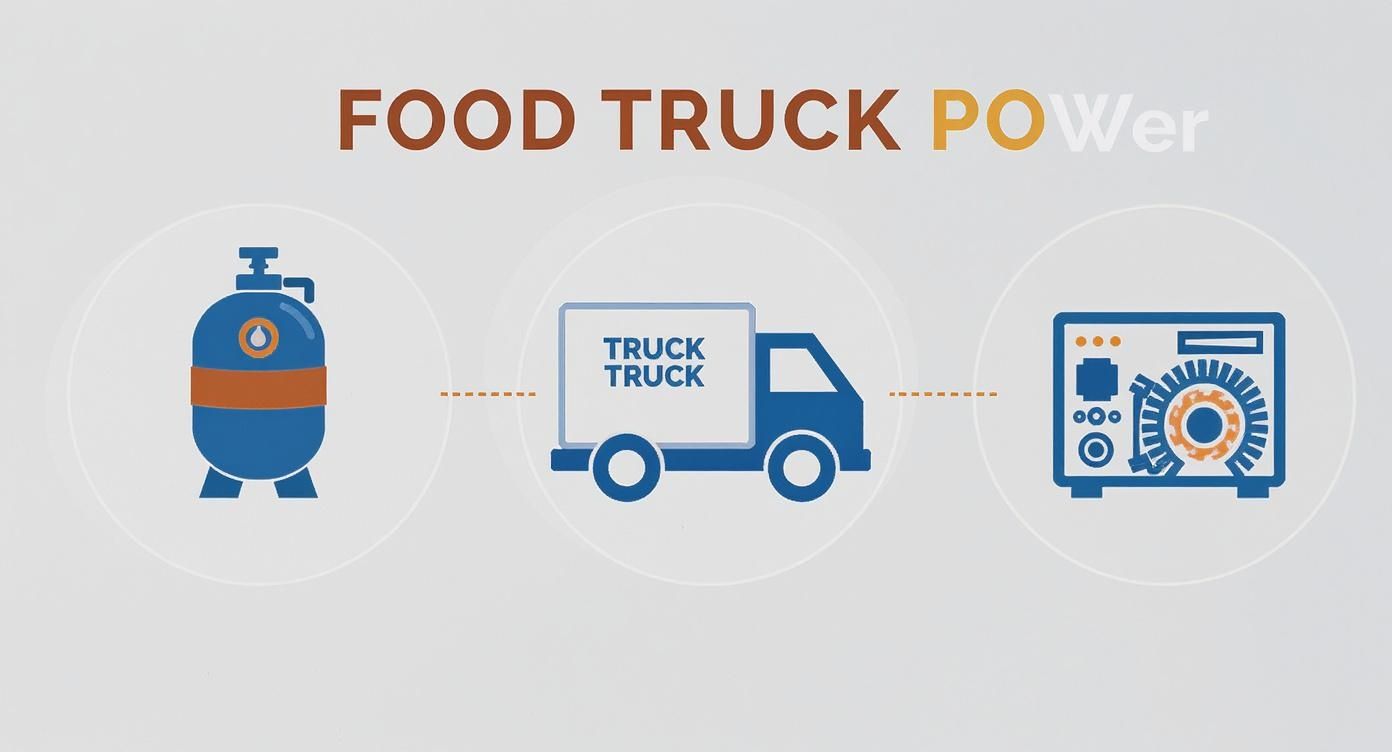
This visual breaks down the distinct roles each power source plays, making it clear why you have to design your layout with safe, accessible, and well-ventilated compartments for both.
Sample Food Truck Layout Concepts
To give you a better idea of how these principles come together in the real world, let’s look at a few common layout strategies. The best approach for your truck will depend heavily on your menu and the size of your vehicle.
| Layout Concept | Best For (Menu Type) | Pros | Cons |
|---|---|---|---|
| Assembly Line | Burgers, Tacos, Sandwiches | Extremely fast and efficient for high-volume, simple menus. Clear, linear workflow minimizes staff movement. | Can be rigid; less flexible for complex menus with varied prep steps. |
| Zone Layout | Pizza, Complex Dishes | Creates dedicated stations (e.g., prep, baking, finishing) that can work in parallel. Good for specialized tasks. | Requires more space and can lead to bottlenecks if one zone falls behind. |
| Galley Kitchen | Coffee, Smoothies, Limited Menu | Maximizes counter space with two parallel counters. Very space-efficient for small trucks. | Can feel cramped with more than two staff members; limited room for large equipment. |
Choosing the right layout is a foundational decision that impacts everything from service speed to staff morale. Think through every step of making your most popular dish and design a space that makes that process as smooth as possible.
Ultimately, designing your food truck kitchen is a balancing act between blazing-fast efficiency and uncompromising safety. By mapping out a logical workflow and building your layout around those mandatory safety systems, you create an environment where your team can cook their best and your business can grow without costly mistakes or dangerous accidents.
Choosing Your Smallwares and Support Gear
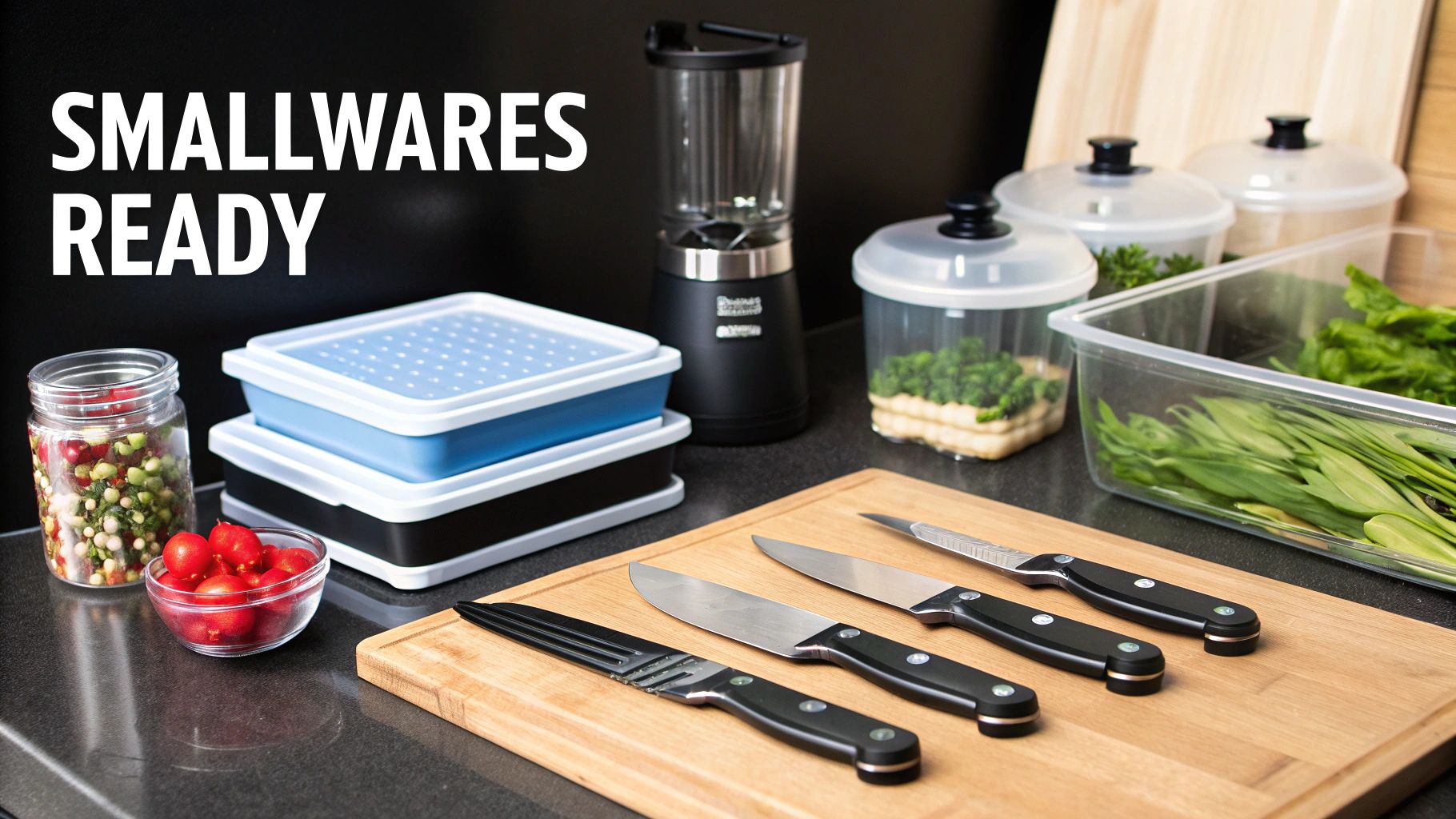
It’s easy to focus on the big-ticket items like griddles and fryers, but they're only half the story. The real speed and flow of your kitchen come down to the smaller, unsung heroes: your smallwares. Think of your large appliances as the engine. Your smallwares? That's the high-performance transmission and steering. Without them, you’re just making a lot of noise and not going anywhere fast.
These are the tools your team will have in their hands for every single order. This is not the place to cut corners. Consumer-grade knives will go dull in a week, flimsy cutting boards will warp under pressure, and cheap plastic containers will crack during a busy service. Durable, NSF-certified smallwares are built to survive the relentless pace of a professional kitchen.
The Tools That Power Your Prep
A fast service is built on the back of efficient prep. Before your window even slides open, your crew needs the right gear to chop, mix, and portion everything quickly and safely. The wrong prep tools create immediate bottlenecks that send ripples through your entire workflow.
Here’s what you can’t live without:
- High-Quality Chef's Knives: A sharp, durable knife set is a chef’s best friend. You'll need a primary chef's knife, a serrated knife for things like bread, and a paring knife, at a bare minimum.
- Color-Coded Cutting Boards: This is non-negotiable. Using different colored boards for raw meats, poultry, fish, and produce is a fundamental food safety practice that prevents dangerous cross-contamination.
- Commercial Food Processor: If your menu involves a ton of shredded cheese, sliced veggies, or puréed sauces, a tough food processor will save you an incredible amount of time.
- Immersion Blender: This handheld gadget is a space-saving genius. It’s perfect for blending soups and sauces right in the pot, which means less cleanup than a traditional blender.
Organization and Storage Essentials
In the tight quarters of a food truck, smart organization is absolutely everything. A good storage system doesn't just keep your truck tidy; it's critical for food safety and a streamlined cooking process. This means using the right containers to keep ingredients fresh, easy to find, and compliant with health codes.
Key Insight: Your storage system is a direct reflection of your kitchen's efficiency. A well-organized truck with clearly labeled containers allows your team to find what they need instantly, shaving critical seconds off every order.
Must-haves include durable, food-grade containers in various sizes, squeeze bottles for all your sauces, and Cambro containers for bulk ingredients.
The Unseen Support Systems
Beyond prep and storage, a few key support systems are vital for just making it through the day. The most crucial of these is your Point-of-Sale (POS) system. A modern, tablet-based POS designed specifically for food trucks is essential for taking orders quickly, processing payments, and tracking sales on the go.
The entire commercial kitchen equipment market is pushing forward, with a projected growth of nearly $4.8 billion globally between 2025 and 2029. This boom is heavily influenced by the adoption of digital tools like mobile POS systems and multi-functional, space-saving appliances that are perfect for food trucks. You can find more details on this growth trend over at TheBusinessResearchCompany.com.
By equipping your truck with these essential smallwares and support systems, you’re giving your team every tool they need to prep, cook, and serve at their absolute best.
Keeping Your Equipment Running Smoothly
Let’s be honest, the cooking gear in your food truck is more than just a bunch of metal—it's the engine that powers your entire business. Protecting that investment with consistent maintenance isn't just a good idea; it's non-negotiable. Think of it like a high-performance race car. You wouldn't dream of skipping an oil change and still expect to win, right? The same goes for your kitchen.
Regular care keeps your equipment running at its best, helps you dodge those gut-wrenching, costly breakdowns, and ensures you're always on the right side of the health inspector. Neglecting it is one of the quickest ways to see your dream grind to a halt. A dead fryer during the lunch rush is a recipe for lost sales and unhappy customers. Worse, a faulty gas line or a clogged grease trap can lead to a fire, turning your dream into a nightmare. A simple, disciplined routine is your best defense.
Building Your Maintenance Checklists
The secret to making maintenance stick is consistency. When you break down the overwhelming job of "upkeep" into simple daily, weekly, and monthly checklists, it becomes totally manageable. This isn’t just about scrubbing surfaces; it's about the kind of preventative care that adds years to the life of your appliances.
Daily Routine (End of Shift):
- Surface Cleaning: A full wipe-down of all stainless steel is a must. This includes your griddles, ranges, and prep tables.
- Fryer Filtering: Filter that fryer oil! It makes the oil last longer and keeps your food tasting fantastic.
- Floor Care: Sweep and mop to get rid of any grease buildup. A greasy floor is a major slip-and-fall waiting to happen.
- Trash and Grease Disposal: Empty all the trash cans and get rid of that used cooking oil the right way.
Weekly Tasks:
- Deep Cleaning: Give your fryers a full "boil out" to get them sparkling clean and degrease your exhaust hood filters.
- Griddle Seasoning: Scrape down your flat-top and give it a fresh seasoning. This is key for maintaining that perfect non-stick surface.
- Refrigerator Maintenance: Clean out the inside of your fridges and freezers. While you're at it, check the door seals for any wear and tear.
It's also smart to know how to handle specific emergencies. Understanding what to do during a reefer breakdown can be the difference between a minor hiccup and losing thousands of dollars in spoiled inventory.
Preventative Checks and Troubleshooting
Beyond the daily scrubbing, you need to be proactive. This means regularly looking for the small issues before they snowball into big, expensive headaches. It’s all about getting to know your equipment and learning to spot the early warning signs of trouble.
A food truck kitchen is a high-vibration environment. The constant movement on the road can loosen connections and wear out parts faster than in a stationary restaurant. Regular inspections are not just best practice—they are essential for safety and reliability.
Set up a monthly inspection routine. Check all your gas lines and connections for leaks using the soapy water trick. Clean your refrigerator coils so the compressor doesn't have to work overtime, and take a moment to calibrate your thermostats to make sure they're accurate.
Learning a few basic troubleshooting skills—like how to relight a pilot light or reset a circuit breaker that’s tripped—can save you from an expensive service call and keep you from shutting down mid-shift. This proactive mindset is what keeps your mobile kitchen safe, profitable, and ready for the rush.
Frequently Asked Questions
Jumping into the world of food truck equipment can bring up a ton of questions. That’s completely normal. Getting your mobile kitchen set up right is a big deal, so let's tackle some of the most common questions I hear from new and aspiring owners.
My goal here is to give you clear, straightforward answers to help you make decisions you can feel good about.
What Is the Most Essential Piece of Equipment?
While it really depends on your menu, if I had to pick just one workhorse for most food truck concepts, it would be the commercial flat-top griddle. Think about it: its huge, even surface can handle almost anything you throw at it.
You can sear a dozen burger patties, toast buns, cook up breakfast, and sauté vegetables—often at the same time. In a tight space where every inch counts, a griddle’s versatility is a total game-changer for high-volume service.
How Do I Choose Between New and Used Equipment?
This is the classic budget-versus-risk dilemma every owner faces. There's no single right answer, but here’s how to think about it:
- New Equipment: You're paying for peace of mind. It comes with a manufacturer's warranty, the latest energy-saving tech, and you know it's reliable right out of the box. The upfront cost is higher, but you’re far less likely to get hit with a surprise repair bill right after you launch.
- Used Equipment: This route can save you a serious chunk of change—sometimes thousands of dollars—that you can put toward other parts of your business. The trade-off is the risk. It usually comes with no warranty and a higher chance of a breakdown, which could lead to expensive downtime.
If you decide to go the used route, here's a non-negotiable rule: Always have a certified technician inspect any used cooking equipment before you buy it. A pro can spot hidden problems with gas lines, thermostats, or electrical parts that you’d easily miss. This one step can save you from a truly disastrous purchase.
Can I Use Residential Appliances in My Food Truck?
Absolutely not. Please, don't even consider it. Using residential-grade equipment is one of the most critical mistakes you can make, for two huge reasons.
First, your local health department will require you to use NSF-certified commercial equipment. These are the only appliances designed and approved for the tough, continuous use of a food business.
Second, your home toaster or stove simply wasn't built to handle the constant vibrations and demands of being on the road. It will break down quickly, poses a serious fire hazard, and is pretty much guaranteed to make you fail your first health and fire safety inspections.
Ready to build the kitchen that will drive your success? The Restaurant Warehouse provides a massive selection of new and used NSF-certified commercial cooking equipment perfect for any food truck concept. Explore our inventory and find flexible financing options to get your business rolling.
Find your ideal equipment at The Restaurant Warehouse.
About The Author

Sean Kearney
Sean Kearney is the Founder of The Restaurant Warehouse, with 15 years of experience in the restaurant equipment industry and more than 30 years in ecommerce, beginning with Amazon.com. As an equipment distributor and supplier, Sean helps restaurant owners make confident purchasing decisions through clear pricing, practical guidance, and a more transparent online buying experience.
Connect with Sean on LinkedIn, Instagram, YouTube, or Facebook.