


How Much Does a Commercial Kitchen Hood Installation Cost?
Let's be honest, figuring out the true commercial kitchen hood installation cost can feel like hitting a moving target. The price swings wildly, from a basic setup around $950 to $1,200 per linear foot to a full system that can top $4,000 to $5,000 per linear foot. So, what causes that huge gap? It’s the details that don't show up on an initial quote—things like your building's unique layout or tricky city permits. This guide will break down what really drives the final price, helping you budget smarter and avoid any nasty surprises.
So, what does that mean in real dollars? A simple 10-foot hood project might land around $12,000, but a more complex, all-in installation could easily blow past $40,000. It's a huge range, and understanding what drives those numbers is key to budgeting without any nasty surprises.
How Much Does a Commercial Kitchen Hood Installation Cost?
Putting in a commercial kitchen hood is so much more than just buying a piece of equipment. It's a foundational investment in your restaurant's safety, your legal compliance, and how smoothly your kitchen actually runs day-to-day.
This system is basically the lungs of your kitchen. It's working nonstop to pull grease, smoke, and heat out of the air, creating a much safer space for your staff and protecting your building from fire hazards.
Getting a handle on the commercial kitchen hood installation cost is your first step toward building a kitchen that's both functional and up to code. The final price tag isn't just for that big steel hood you see. It’s a whole package deal of critical parts that all have to work together perfectly.
If you're looking for a deeper dive into the different components, our commercial kitchen hood guide is a great place to start understanding the equipment itself.
What Really Influences Your Installation Cost?
Several core things will shape your final bill. The size of your hood system, the quality of the materials, and how complicated the ventilation path is are the main drivers.
Most installers quote prices "per linear foot," but that number can change dramatically depending on whether you're getting just the basics or a complete, all-inclusive system. A bare-bones installation might only include the hood and a fan, but a "turnkey" solution is the whole shebang:
- The hood unit itself
- Exhaust fan and all the ductwork
- A makeup air unit to keep the air pressure balanced
- An integrated fire suppression system
- All the electrical and gas line connections
- Permits and final inspections from the city
A turnkey system gives you a complete, code-compliant ventilation solution from a single company. This saves you the massive headache of trying to coordinate a bunch of different contractors. While the upfront cost is higher, it guarantees all the parts are designed to work together and meet local laws.
Project Timeline and Budget Impact
One of the biggest things to wrap your head around is the timeline. Installing a commercial kitchen hood isn't a quick job; the entire process, from initial design to the final sign-off, can easily stretch out for more than a year. You have to account for architectural plans, working through local fire codes, and waiting for permits, all before a single tool is picked up. This extended schedule can directly affect your budget. A longer project means more time paying for project management, and it leaves you vulnerable to price increases on materials or labor. Any unexpected delay can create a domino effect, pushing back your opening date and adding costs you didn't plan for.
The high price tag isn't just for the shiny steel hood. The total cost covers a whole ecosystem of essential services and components, including the design, ductwork, electrical wiring, plumbing, and the critical fire suppression system. Because this is such a foundational investment in your kitchen's safety and legal compliance, every piece has to be perfect. With so many moving parts affecting the final price, exploring restaurant equipment financing can give you some much-needed breathing room in your budget, helping you manage the cash flow for this large-scale, long-term project without compromising on quality or safety.
Commercial Hood Installation Costs at a Glance
To give you a clearer picture, here’s a table that breaks down the major cost components and their typical price ranges. Think of it as a cheat sheet to see where your money is going during the installation process.
| Cost Component | Typical Price Range (Low End) | Typical Price Range (High End) |
|---|---|---|
| Hood Unit (10-foot) | $3,000 | $7,000 |
| Exhaust Fan & Ductwork | $4,000 | $15,000 |
| Makeup Air Unit | $3,500 | $10,000 |
| Fire Suppression System | $3,000 | $6,000 |
| Labor & Installation | $3,000 | $8,000 |
| Permits & Inspections | $500 | $2,000 |
Keep in mind, these numbers are solid estimates, but your final costs will depend on your specific kitchen, location, and the contractor you choose.
Decoding Your Kitchen Hood Installation Quote
Getting a quote for your commercial kitchen hood installation can feel a bit like reading a foreign language. It's often a long document packed with technical terms and line items that don't immediately make sense. But don't let it intimidate you. The best way to think about that quote is as a detailed blueprint for your kitchen's entire respiratory system. Every single part has a critical job to do to keep your kitchen safe, compliant, and full of clean air.
Understanding this blueprint is your key to a successful project. When you can dissect each part, you see exactly where your money is going and why every element is necessary. This knowledge empowers you to have a smart, productive conversation with your contractor and spot any potential red flags before you even think about signing on the dotted line.
This visual breaks down the difference between just buying the basic parts and investing in a full, turnkey installation.
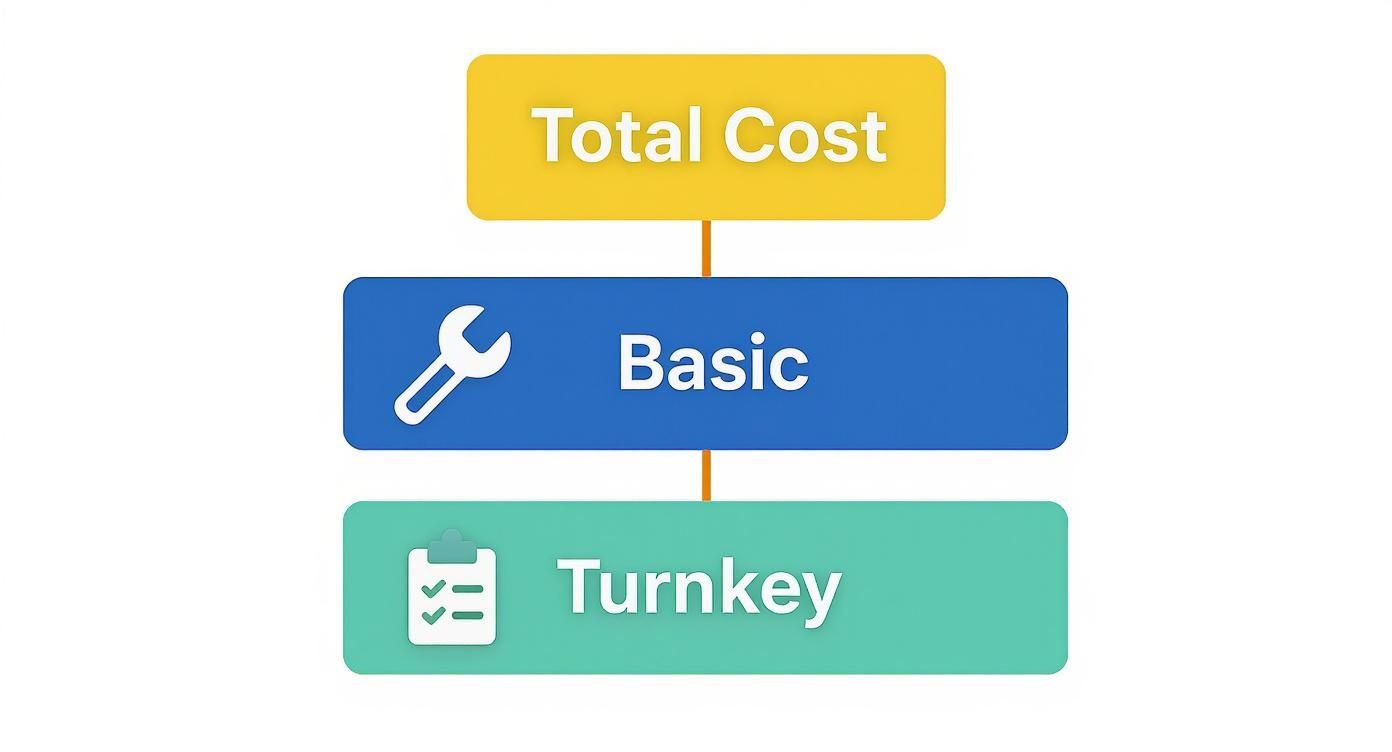
As you can see, a turnkey solution is the whole package—from the equipment itself to the final sign-off from the inspector. It’s a complete service, not just a pile of parts.
To give you a clearer picture, let's walk through what each line item on your quote really means. Here's a table that breaks down the estimated costs for a standard 10-foot system.
Example Breakdown: A 10-Foot Hood System
| Line Item | Estimated Cost | Description of What It Covers |
|---|---|---|
| Hood Unit (Type I) | $3,000 - $6,000 | The stainless steel hood itself, including baffle filters for grease capture. This is the main component over your cooking line. |
| Exhaust Fan | $2,500 - $5,000 | The powerful, roof-mounted fan that pulls smoke, heat, and grease-laden vapor out of the kitchen. |
| Makeup Air Unit (MUA) | $4,000 - $8,000 | The system that brings fresh, conditioned air back into the kitchen to replace what's exhausted, ensuring proper air balance. |
| Ductwork | $2,000 - $7,000+ | All the welded steel ducting that connects the hood to the rooftop fan. Cost varies greatly with the complexity of the run. |
| Fire Suppression System | $3,500 - $6,000 | The integrated, UL 300-compliant system with nozzles, chemical tanks, and pull station to extinguish grease fires. |
| Labor & Installation | $4,000 - $10,000+ | The skilled labor from licensed technicians to install all components, including electrical, gas lines, and welding. |
| Permits & Inspections | $500 - $2,000 | Fees paid to the city for mechanical permits and the cost of having the final installation inspected and approved by officials. |
Now that you've seen the numbers, let's explore what each of these components does and why it's so important for your kitchen.
The Hood Unit: The Core Component
The hood itself is the most visible part of the system and your first line of defense against grease and smoke. You'll generally see two main types on a quote:
- Type I Hoods (Grease Hoods): These are the heavy-duty workhorses. They’re designed for cooking equipment that produces grease and smoke, like your fryers, griddles, and charbroilers. They use baffle filters to trap grease particles before they can enter the ductwork.
- Type II Hoods (Condensate Hoods): These are for appliances that only create heat, steam, and moisture—think dishwashers or pasta cookers. They don't need to handle grease, so they're a simpler (and cheaper) design.
The cost of the hood depends on its size (measured in linear feet), the gauge of the stainless steel, and whether it's a standard model or a custom fabrication. A quote for a Type I hood will always be higher because of its more complex build and filtration system.
Costs for Different Hood Placements
The placement and complexity of your hood system dramatically affect the price. A basic setup can start around $950 to $1,200 per foot, but a complete, ready-to-use system—what contractors call "turnkey"—will be closer to $4,000 to $5,000 per foot. For a standard 10-foot hood, that's the difference between a $12,000 project and a $50,000 investment. The higher price tag isn't just for the hood itself; it covers the entire process, including design, permits, electrical work, plumbing, and the essential fire suppression system. Since this is a major capital expense, many restaurant owners explore equipment financing to manage the cost without tying up all their cash.
Specialized Hood Types for Unique Kitchens
The type of hood you need comes down to what you're cooking. If your kitchen line is full of equipment that produces grease and smoke—think charbroilers, griddles, or deep fryers—you'll need a Type I hood. These are the heavy-duty systems designed to handle intense heat and capture grease particles. On the other hand, for appliances that only create steam and heat, like a commercial dishwasher or pasta cooker, a simpler and more affordable Type II (condensate) hood is the right choice. Matching the hood to the equipment isn't just about passing inspection; it's about ensuring safety and avoiding the cost of a system that's more powerful than you really need.
The Exhaust Fan: The System's Engine
If the hood is the shield, the exhaust fan is the engine. Usually mounted on your roof, this powerful fan is responsible for physically pulling all that smoke, greasy vapor, and heat out of your kitchen and safely expelling it outside.
A fan's power is measured in Cubic Feet per Minute (CFM), and the CFM your kitchen needs is tied directly to the size of your hood and the type of cooking you do. A high-volume steakhouse with a massive charbroiler needs a much beefier fan than a small café that just uses a couple of burners. The fan's cost reflects its size, motor power, and overall durability.
A correctly sized exhaust fan is completely non-negotiable. An undersized fan won't clear the air, leaving you with a smoky kitchen, failed inspections, and a serious fire hazard. This is one area where you absolutely cannot cut corners.
Belt-Driven vs. Direct-Driven Fans
When you look at your quote, you'll likely see one of two types of fans listed: belt-driven or direct-driven. Belt-driven fans use a pulley system to connect the motor to the fan blades. This design is a big deal because it keeps the motor out of the direct path of all that hot, greasy air your kitchen produces, making them the go-to choice for heavy-duty cooking. They are powerful enough to handle the high static pressure that comes with long or complicated duct runs. The only real trade-off is maintenance; those belts will eventually wear out and need to be replaced as part of your regular upkeep.
Direct-driven fans are simpler. The fan blades are mounted right onto the motor's shaft. With fewer moving parts, this design generally means less maintenance and better energy efficiency, and they often run quieter. The catch is that the motor sits directly in the airstream. Because of this, they are better suited for kitchens with lower heat and grease output, like those focused on steaming or baking. For most busy restaurants using equipment like deep fryers or charbroilers, a belt-driven fan is almost always the recommended choice to protect the motor and ensure the system lasts.
Makeup Air Unit: The Kitchen's Lungs
As your powerful exhaust fan yanks air out of the kitchen, something has to replace it. That’s the job of the makeup air (MUA) unit. It acts as the kitchen's lungs, pulling fresh, conditioned air from outside to replace every cubic foot of air that gets exhausted.
Without an MUA unit, your kitchen would develop negative air pressure. This can cause all sorts of bizarre problems, from exterior doors that are nearly impossible to open to dangerous back-drafting from your gas appliances, which can pull carbon monoxide back into the room. The cost of an MUA unit depends on its size and whether it just brings in fresh air or also needs to heat and cool it.
The Added Cost of Tempered Make-Up Air
Depending on your climate, you might see the term "tempered" or "conditioned" on your MUA quote. This just means the unit will heat or cool the outside air before it enters your kitchen. You can't just pump freezing winter air or scorching summer humidity directly onto your cook line—it would make the environment miserable and throw your building's HVAC system into chaos. A tempered MUA unit ensures the fresh air coming in is at a reasonable temperature, keeping your kitchen stable and your staff comfortable.
This feature is a primary driver behind the wide price range for MUA units, which can run from $3,500 to $10,000. A basic, untempered unit sits at the low end, but adding heating and cooling components significantly increases the price. In most climates, this isn't an optional luxury; it's a requirement to meet building codes and maintain a functional workspace. Since this represents a major expense, exploring restaurant equipment financing can help you manage the upfront cost for this essential system.
Ductwork: The System's Pathway
Ductwork is simply the network of channels connecting your hood to the exhaust fan on the roof. Think of it as the system's circulatory system. The cost of your ductwork is driven by a few key things:
- Length and Complexity: A straight, simple run from the kitchen to the roof is far cheaper than a complicated path that has to wind through multiple floors or tight spaces.
- Material: To comply with fire codes, commercial kitchen ducts must be made from continuously welded, grease-tight steel. No shortcuts allowed here.
- Insulation: Certain sections of the ductwork may require special fire-rated wrapping, which adds to both material and labor costs.
Fire Suppression & Permits: Non-Negotiable Safety Costs
A modern commercial kitchen hood isn't complete without an integrated fire suppression system, usually a wet chemical system that meets UL 300 standards. This system has nozzles aimed right at your cooking appliances and is designed to automatically discharge fire-retardant chemicals if a fire is ever detected. Your quote will cover the cost of the tanks, piping, nozzles, and the crucial professional certification.
Finally, your quote will include line items for permits and inspections. A licensed contractor has to pull a mechanical permit from your city, and the finished work will be inspected by officials to ensure it meets all fire, building, and health codes. For example, in a city like Houston, the ventilation permit alone can cost 2% of the total job cost plus extra administrative fees.
This focus on safety is part of a growing trend. Globally, the demand for high-quality kitchen hood systems is projected to grow from USD 13.6 billion in 2025 to USD 19.9 billion by 2035, all driven by an increasing focus on kitchen safety and air quality.
To get a better feel for how these quotes are structured, it can be helpful to look at how other major installations are priced. For example, guides on understanding major appliance installation pricing can offer useful parallels on how labor, parts, and compliance all add up to the final cost.
Budgeting for Professional Plans
Before any installation work begins, you'll need a set of professional plans. Think of these as the architectural blueprints for your ventilation system. These aren't just simple sketches; they are detailed engineering drawings that map out every component, from the hood's exact placement to the specific path of the ductwork. Your local building department requires these plans to issue a permit, as they prove your system is designed to meet all safety and building codes. While this adds an upfront cost, it's a critical investment that prevents expensive mistakes and ensures your installation goes smoothly from start to finish.
Understanding the Wide Range of Fire Suppression Costs
The fire suppression system is the single most important safety feature in your kitchen, and its cost reflects that. This is a non-negotiable component of any Type I hood system, typically ranging from $3,000 to over $6,000. The price varies based on the size of your hood and the number of cooking appliances that need to be protected with nozzles. This system is your automated firefighter, designed to meet strict UL 300 standards for extinguishing grease fires. Because this is a significant but vital investment in protecting your staff and business, it's wise to factor it into your budget early. Exploring options like restaurant equipment financing can help make this essential safety system more manageable financially.
Beyond the Quote: Hidden Factors That Affect Your Price
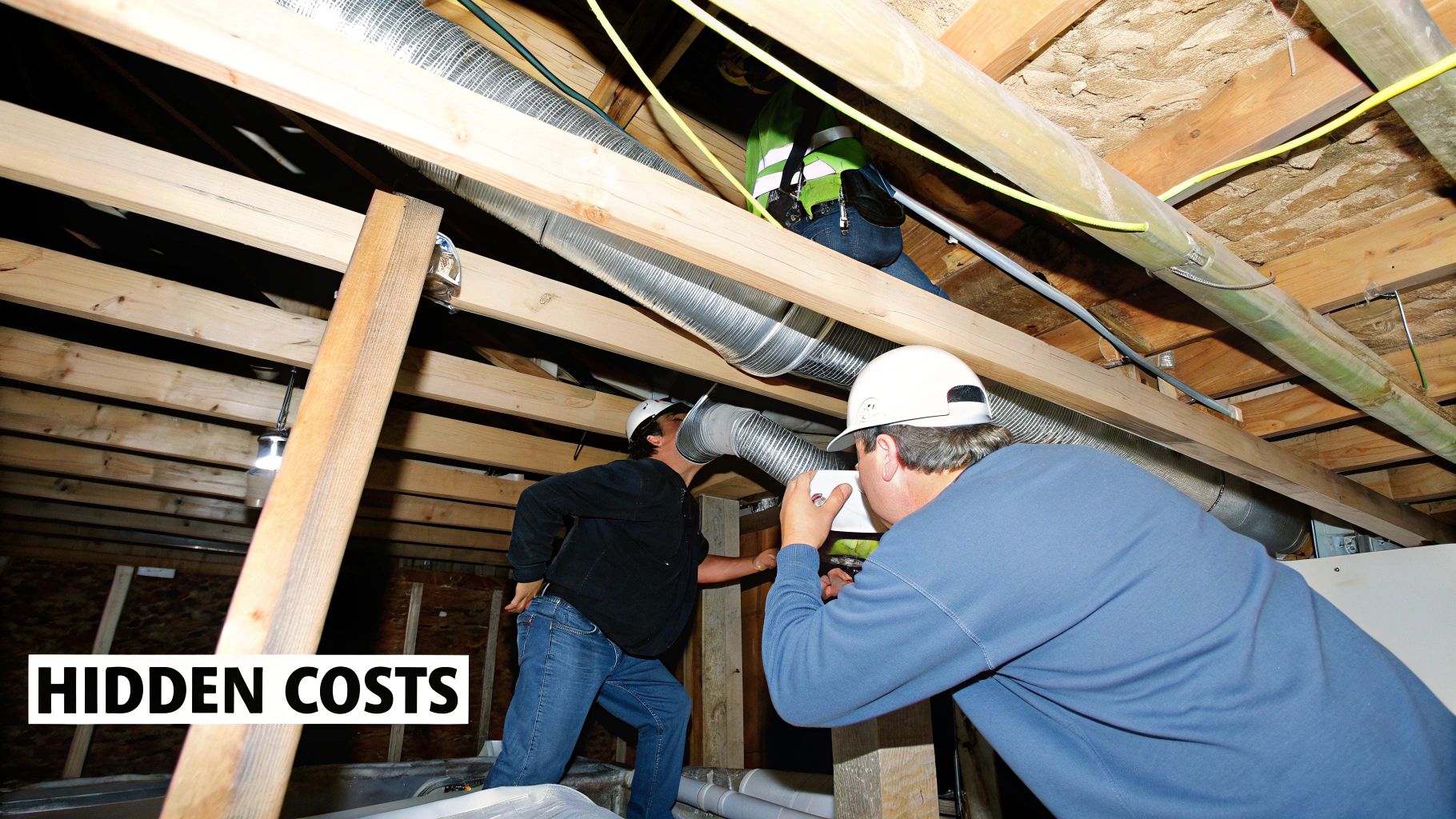
That initial quote for your kitchen hood installation? It’s a great starting point, but it's almost never the final number you'll write on the check. Plenty of "hidden" factors can pop up during the project, turning a nice, predictable budget into a major source of stress.
Getting a handle on these variables before you start is the key to figuring out the real total cost and avoiding those painful financial surprises down the road. Think of your initial quote as the main highway on a road trip map. The hidden costs are all the unexpected detours, surprise road construction, and local traffic jams that weren't obvious at first glance.
How Local Labor Rates Impact Your Budget
One of the biggest variables in your commercial kitchen hood installation cost is something you have absolutely no control over: your location. The cost for skilled, licensed mechanical contractors, electricians, and welders can swing wildly from one city to the next.
For example, installation labor in a major city like New York or San Francisco is going to be substantially higher than in a smaller, more rural town. We're not talking about a few dollars here—this difference can easily add thousands to your final bill for the exact same job. Always ask potential contractors for a detailed breakdown of their labor rates to see what you’re really up against.
Is Your Building's Layout Adding to the Cost?
Not all buildings are created equal, and your restaurant's specific structure can be a huge source of unexpected costs. A simple, single-story building with a flat roof makes for a pretty straightforward duct run, keeping labor and material costs down. Anything more complicated, though, can present some expensive challenges.
- Historic Buildings: These often come with strict preservation rules, forcing creative—and costly—solutions for running ducts without messing with the building's historic character.
- Multi-Story Properties: Pushing ductwork through multiple floors is a serious engineering puzzle. It requires more materials, a ton of labor for cutting through concrete, and specialized fire-rated enclosures.
- Limited Access: If your kitchen is tucked away in a basement or a tight urban spot, just getting materials inside and running ducts to the roof can become a logistical nightmare, driving up labor hours.
These structural hurdles can quickly turn a seemingly simple installation into a much more involved—and expensive—project.
Don't underestimate the building itself. A complicated duct run is like solving a 3D puzzle—every turn, every obstacle, and every extra foot adds directly to your material and labor costs.
The Cost of Expanding an Existing System
If you're thinking about adding a new piece of cooking equipment, like a high-capacity deep fryer or another griddle, you can't just drop it into your cook line and call it a day. Your ventilation system has to be able to handle that extra heat and grease. Expanding an existing hood system often feels like a brand-new installation because it can require a complete re-evaluation of your kitchen's airflow. You might need a more powerful exhaust fan, a larger makeup air unit, or even new ductwork to meet code. The costs can mirror those of a new setup, running anywhere from $950 per foot for basic additions to over $4,000 per foot if the entire system needs a significant upgrade to support the new load.
Factoring in Monthly Energy Costs
The expenses don't stop once the installation is complete. Your commercial kitchen hood system is a power-hungry beast that runs for hours every single day. This constant operation can add a significant amount to your monthly utility bill, typically ranging from $200 to $800 in electricity costs alone. This ongoing expense is a critical part of the total cost of ownership that you need to factor into your budget from day one. An inefficient system, especially one with a long and complex duct run, will have to work harder, consuming more energy and driving that monthly cost even higher. It's a recurring operational expense that sits right alongside the cost of your ingredients and labor.
The Price of Meeting Health and Safety Codes
Permits and inspections often get treated like minor afterthoughts in early budget talks, but they are non-negotiable expenses that can really add up. Every town has its own fee structure and set of hoops to jump through, which your contractor will have to navigate.
Beyond the initial permit, you'll also be paying for a series of inspections to make sure the system is installed correctly and safely. A failed inspection doesn't just delay your grand opening; it also means you'll be paying re-inspection fees. These compliance costs are an essential part of the process, making sure your kitchen is both safe and legal. Forgetting to budget for them is a common and costly mistake. To get a better handle on these rules, you can learn more about commercial kitchen ventilation requirements in our detailed guide.
The Consequences of Non-Compliance
Trying to save a few thousand dollars by skipping a code-compliant hood might seem tempting, but the financial fallout can be devastating. The cost of non-compliance isn't just a slap on the wrist; it's a direct threat to your business. Local authorities can issue fines that easily climb over $10,000 and have the power to shut your restaurant down on the spot until the issue is fixed. A failed inspection doesn't just mean a delay in your grand opening; it also comes with re-inspection fees that add up quickly. These aren't just bureaucratic hurdles; they are essential safety measures designed to protect your staff, your customers, and your investment.
Beyond the immediate fines, cutting corners on ventilation opens you up to even bigger risks. A poorly ventilated kitchen is a major fire hazard, especially with grease-producing equipment like deep fryers. If a fire does break out and your system isn't up to code, your insurance company could refuse to cover the damages, leaving you with a total loss. It also creates an unsafe work environment. Poor air quality can lead to health problems for your staff, resulting in sick days, high turnover, and even the potential for lawsuits. Simply put, a proper ventilation system isn't an expense—it's one of the most critical investments you'll make in your restaurant's safety and long-term survival.
Installation Cost Examples for Three Common Kitchens
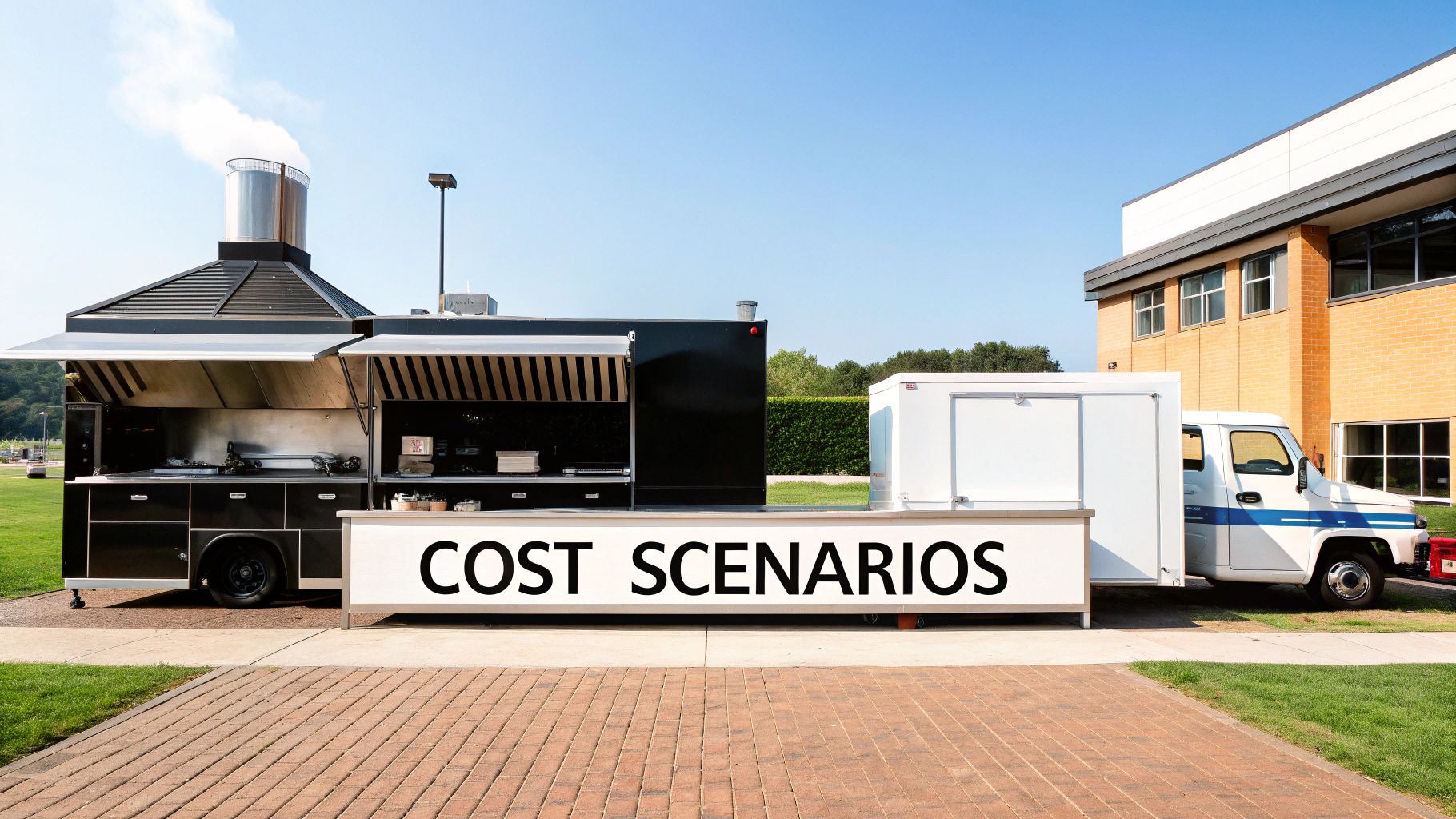
All the numbers and components we've been talking about can feel a bit abstract. So, to make the commercial kitchen hood installation cost more concrete, let's walk through three common, real-world scenarios. Each example shows how different business needs, cooking equipment, and physical spaces can dramatically change the final price tag.
By looking at these situations side-by-side, you can get a much better feel for which one lines up with your own project. It’s a practical way to move from a ballpark guess to a realistic budget.
Scenario 1: The Small Coffee Shop or Ghost Kitchen
Picture a small café or a compact ghost kitchen. The cooking lineup is simple: a panini press, a countertop convection oven, and maybe a small electric fryer. Cooking volume is pretty low, and the kitchen is tight on space—maybe only 200 square feet. The goal here is simple: meet code and stay efficient without breaking the bank on an oversized system.
For this kind of setup, the needs are straightforward. A simple, shorter hood system is more than enough to handle the limited grease and heat coming off the countertop gear.
System Breakdown and Cost Estimate:
- Hood Type: A 6-foot Type I low-profile hood is a perfect fit. Its smaller size saves on material costs and doesn't overwhelm a tight space.
- Ventilation: A standard, direct-drive rooftop exhaust fan can easily handle the lower CFM requirements. In a single-story building, the duct run is short and direct, keeping labor and material costs down.
- Makeup Air: A basic, non-tempered makeup air unit is likely all that’s needed to keep the air balanced, steering clear of the high cost of a heated or cooled system.
- Fire Suppression: A pre-piped fire suppression system designed for a 6-foot hood is a cost-effective choice.
For smaller operations, the key is to match the system's power directly to the cooking equipment. Over-engineering the ventilation for a few light-duty appliances is one of the fastest ways to inflate your budget.
With a simple installation in a single-story building and less complex equipment, the owner is looking at a much more manageable investment. This approach keeps the project focused on the essentials without any unnecessary frills.
Estimated Total Cost Range: $9,000 - $14,000
Scenario 2: The Full-Service Restaurant
Now, let's imagine a bustling, full-service restaurant with a big, diverse menu. The kitchen is large and features a full 14-foot cooking line packed with a 6-burner range, a charbroiler, two deep fryers, and a large flat-top griddle. This is a high-volume operation, and it pumps out some serious grease, smoke, and heat. It demands a powerful, robust ventilation system.
This scenario requires a heavy-duty solution built for intense, all-day use. Every single component has to be upsized to handle the tough environment and keep the kitchen safe and comfortable for the staff.
System Breakdown and Cost Estimate:
- Hood Type: A 14-foot Type I hood is a must to cover the entire cooking line. That extra length significantly increases the base equipment cost.
- Ventilation: A high-CFM, belt-drive upblast exhaust fan is essential to clear the heavy, grease-filled vapor from the charbroiler and fryers.
- Ductwork: The duct run is likely more complex, maybe having to navigate around other HVAC units on the roof or snake through a second story. That adds significant labor and material costs.
- Makeup Air: A large, tempered (heated and cooled) makeup air unit is non-negotiable here. It's needed to maintain comfort and air balance in a big kitchen, and it adds a substantial cost.
- Fire Suppression: A comprehensive, multi-nozzle fire suppression system is required to protect every appliance along that 14-foot line.
The sheer scale and complexity of this system are what drive the price way up. The powerful equipment, extensive ductwork, and advanced MUA unit all contribute to a much larger final bill.
Estimated Total Cost Range: $35,000 - $55,000+
Scenario 3: The Mobile Food Truck
Finally, we have the unique challenge of a food truck. Here, space is the ultimate luxury, and the entire system has to be compact, lightweight, and tough enough to handle constant vibration and movement. A typical food truck might have a small flat-top griddle and a two-basket fryer.
The primary constraints are size and weight. Every single component must be specifically designed for mobile use, and that specialized construction often comes at a premium.
System Breakdown and Cost Estimate:
- Hood Type: A custom-fabricated, lightweight 5-foot Type I hood is needed to fit into the truck's tight confines.
- Ventilation: This requires a special, low-profile exhaust fan built for concession vehicles. These fans are designed to be durable and weather-resistant.
- Installation: Labor costs can be higher because this is specialized work. Technicians have to weld the system securely to the truck's frame and expertly route wiring and ductwork within the vehicle's walls and ceiling.
- Fire Suppression: A compact fire suppression system specifically designed for mobile kitchens is mandatory.
Even though the system is small, the custom nature of the components and the specialized labor involved often make the per-foot cost higher than a standard brick-and-mortar installation.
Estimated Total Cost Range: $10,000 - $18,000
How to Save on Your Kitchen Hood Installation
Getting a handle on your kitchen hood installation cost doesn't mean you have to skimp on quality or safety. With a bit of smart planning, you can bring that final number down quite a bit without cutting corners where it really counts. The trick is to go into it with a clear budget and a sharp eye for long-term value.
It's tempting to jump at the lowest upfront price, but a high-quality, efficient system will literally save you money for years. Try to see it less as a one-time hit and more as an investment in your kitchen's future. The right choices now will pay you back with lower utility bills and fewer maintenance headaches down the road.
Get and Compare Detailed Quotes
One of the best tools you have for keeping costs in check is getting several detailed quotes. Never, ever settle for the first offer that comes your way. Instead, reach out to at least three reputable, licensed contractors and ask them for a full, line-by-line bid.
This isn't just about making them compete on price. It gives you a crystal-clear picture of how different companies build their costs and what they consider a "standard" package.
Once you have the quotes, lay them out and compare them carefully:
- Equipment Brands: Are they all quoting the same quality of hood, fan, and makeup air unit? Or is one a premium brand and another a budget option?
- Labor Rates: How much does the cost of skilled labor vary between them?
- Hidden Fees: Keep an eye out for vague charges like "miscellaneous materials" or "project management fees."
- Included Services: Does the price include pulling permits, handling inspections, and final system testing?
This deep dive helps you spot any outliers and makes sure you’re getting a fair market price for the job.
A vague, one-page quote is a major red flag. A true professional will always provide a detailed breakdown of every single component and service, giving you a transparent look at exactly where your money is going.
Explore Tax Deductions and Rebates
After you’ve reviewed the quotes, the final number can still feel pretty intimidating. But the good news is that the upfront cost isn't the end of the story. Smart financial strategies can help you recover a significant chunk of your investment. By looking into federal tax deductions and local utility rebates, you can make this essential purchase much easier on your budget. Think of it as finding hidden money that makes the project more affordable. Of course, it's always a good idea to chat with a tax professional who can give you advice tailored to your specific business and location.
Leveraging Section 179 for Equipment Purchases
One of the most powerful tools for restaurant owners is Section 179 of the IRS tax code. In simple terms, this provision lets you write off the full purchase price of qualifying equipment during the tax year you put it into service. Instead of depreciating the cost over several years, you get the entire deduction at once. This tax break isn't just for your ventilation system; it can apply to other major purchases, from new freezers to the deep fryers on your line. This can substantially lower your taxable income for the year, providing a welcome financial cushion.
Finding Local Utility Rebates for Energy-Efficient Systems
Beyond tax deductions, don't forget to look for local rebates. Many utility companies and state programs offer cash back for installing energy-efficient systems. They want to encourage businesses to use less power, and they’re willing to pay you to do it. Before you buy, check the websites of your local electric and gas providers for programs related to commercial kitchen equipment. High-efficiency exhaust fans and makeup air units are often eligible. A system that qualifies for a rebate might have a slightly higher price tag, but the money you get back, combined with lower monthly energy bills, can make it the smarter financial choice in the long run.
Plan Your Kitchen Layout for Efficiency
Your kitchen's design can have a massive impact on the final installation bill. The single biggest factor here is the length and complexity of your ductwork. A smart layout that places your cook line directly under the best spot on the roof for the exhaust fan can save you thousands of dollars in materials and labor.
And while you're at it, think about the long-term operational savings of energy-efficient equipment. An exhaust fan with a variable speed motor, for example, might cost more today but could slash your electricity bills by only running as hard as it needs to. Investing in energy-saving models can lead to thousands in savings over the equipment's lifespan.
Should You Buy Pre-Owned Equipment?
Buying a used commercial kitchen hood can feel like a brilliant way to slash your budget. And while you can find some amazing deals, this path is loaded with potential traps that can wipe out any savings in a heartbeat.
If you're thinking about buying used, you have to be incredibly careful. The most critical thing is making sure the entire system—the hood, fan, and especially the fire suppression system—meets all current fire and safety codes, including UL 300 standards. An older, non-compliant system will get rejected by inspectors, forcing you to rip it out and pay for a whole new installation anyway. Always, always have a licensed professional inspect any used equipment before you hand over any money to verify its condition and compliance.
A Note on Sourcing Your Own Parts
Going a step further than just buying a used hood, some ambitious owners consider sourcing all the individual parts themselves to piece together a system. While you might hear that this DIY approach can cost as little as $1,500 to $2,000 per foot, this path is loaded with the same risks as buying a complete used system, only magnified. You become the general contractor, responsible for ensuring every single component is compatible and compliant. A turnkey system from a single company saves you the massive headache of trying to coordinate a bunch of different contractors and guarantees all the parts work together. If you do decide to source your own parts for your commercial kitchen equipment, the most important rule still applies: have a licensed professional inspect every single piece before you spend a dime.
How to Finance Your Kitchen Hood System
Let's be honest, the price tag on a full commercial kitchen hood installation can make you catch your breath. It's a major capital investment, and for a new or growing restaurant, it can put a serious strain on your cash flow. The good news is, you don't have to drain your bank account to get the compliant, high-performance system your kitchen needs to operate safely and legally.
This is where financing and lease-to-own programs come in. They are designed specifically to make this essential purchase manageable. These options let you break down that big, intimidating expense into predictable monthly payments, which frees up your working capital for all those other critical day-one needs like inventory, marketing, and hiring your team.
Why Financing Can Protect Your Cash Flow
Think of financing as a strategic tool in your business arsenal. Instead of tying up $30,000 or more in a single equipment purchase, you can spread that cost out over several years. This move keeps your cash reserves healthy and gives you the breathing room to handle unexpected expenses or jump on a growth opportunity without a second thought.
It's smart to explore the different ways you can finance a major installation project, because the principles are similar whether you're installing a new roof or a new kitchen hood. You're getting essential infrastructure in place without breaking the bank.
The whole point of equipment financing is simple: get the tools you need to make money now without crippling your ability to run the business day-to-day. It turns a huge barrier to entry into a manageable operational expense.
Getting approved for these programs is often more straightforward than getting a traditional bank loan. Lenders will look at factors like how long you've been in business and your credit history, but because the equipment itself acts as collateral, the approval process can be much simpler. For a complete walkthrough of how it all works, check out our comprehensive restaurant equipment financing guide. It breaks down the application process and what you’ll need to qualify, giving you a clear financial path forward.
Using Equipment Financing to Your Advantage
The biggest hurdle with a new hood system isn't just the price—it's the massive, one-time hit to your cash flow. This is where smart restaurant equipment financing comes in. Think of it less as taking on debt and more as a strategic way to manage your money. By breaking down that huge capital expense into a predictable monthly payment, you keep your cash reserves free for the things that actually generate revenue day-to-day. That could mean buying quality ingredients, running a marketing campaign, or getting that extra deep fryer you need for a new menu item. It turns a huge barrier to entry into a manageable operational cost, letting you get the essential equipment you need to open or expand without draining your working capital.
Got Questions? Let's Talk Hood Installation Costs
Even when you have a solid plan, a few specific questions about the installation cost and the whole process are bound to come up. Getting these last details ironed out helps make sure there are no surprises down the road, so you can move forward with confidence. Here are the most common questions we hear from restaurant owners just like you.
How Long Does a Typical Installation Take?
The timeline for getting a commercial kitchen hood installed can swing pretty wildly depending on how complex the job is. For a straightforward setup in a simple, single-story building, the actual on-site work might only take two to four days. But that’s just the hands-on part.
The real timeline starts way before the tools come out. From the first chat and system design to getting the city's stamp of approval on your permits, the whole process can take anywhere from three to eight weeks. A few things can stretch that out:
- Custom Fabrication: If your hood needs to be custom-built to fit your space, you'll have to add that manufacturing time to the schedule.
- Permit Delays: Let's be honest, local permitting offices can be unpredictable. How long they take to review and approve your plans is a major wild card.
- Complex Ductwork: If your ductwork has to snake through multiple floors or navigate tight, tricky spaces, that adds a lot of hours to the on-site labor.
The Lifespan of a Commercial Hood System
A commercial hood system is a serious workhorse, and with proper care, you can expect it to last anywhere from 10 to 20 years. But that lifespan isn't guaranteed—it's earned through consistent maintenance. The biggest threat to your system is grease buildup, which not only creates a dangerous fire hazard but also forces your exhaust fan to work harder, leading to premature failure. Regular professional cleaning is non-negotiable. It's a small operational cost that protects a massive investment and ensures the system functions effectively for years to come.
Neglecting your system can have staggering financial consequences. A fire suppression system damaged by excessive grease can cost anywhere from $7,000 to $20,000 to replace, completely wiping out any savings from skipped cleanings. The system's lifespan also begins with the quality of its components and installation. Opting for a professional, turnkey installation with higher-grade materials ensures everything works together seamlessly from the start, preventing the kind of wear and tear that can shorten the life of cheaper, poorly installed systems. Investing in quality from day one is the best way to guarantee a long and effective service life.
Can I Install a Kitchen Hood Myself?
I'm going to be blunt here: trying to DIY a commercial hood installation is a huge mistake with serious consequences. There's a reason this is a highly regulated trade—you're dealing with complex electrical wiring, gas lines, and critical fire safety systems. Without the right licenses and expertise, you're looking at a massive fire hazard, guaranteed code violations, and putting your staff in real danger.
Beyond the immediate safety risks, no city inspector will ever approve a system installed by someone without a license. That means you legally can't open for business. What started as an attempt to save a few bucks could end up killing your entire project.
Why Licensed Professionals Are Required for Approval
Hiring a licensed professional isn't just a strong recommendation—it's the only way your installation will ever get a green light from a city inspector. These systems are a complex mix of high-voltage electrical wiring, gas lines, and sophisticated fire suppression mechanics. An inspector's primary job is to verify that everything is installed according to strict local and national fire safety standards, and the first thing they'll check is the installer's license. An unlicensed installation is an automatic failure, which means you legally cannot open your restaurant. Beyond that, a failed inspection isn't just a delay; it comes with re-inspection fees that add to your costs. This rule is in place to protect your business, your staff, and your building from a very real fire hazard.
What Are the Ongoing Maintenance Costs?
Your financial commitment doesn't stop once the hood is up and running. Regular maintenance isn't just a good idea; it's a non-negotiable, legally required part of owning a commercial kitchen hood system to prevent fires.
You’ll need to budget for a professional hood cleaning service to get all the grease buildup out of the hood, filters, and ducts. How often you need this depends on what you’re cooking and how much, but a typical restaurant can expect to pay $400 to $600 per cleaning. This is usually done quarterly or semi-annually. On top of that, your fire suppression system has to be professionally inspected and serviced every six months to stay compliant, adding another recurring cost to your operational budget.
Figuring out the complexities and costs of a new kitchen hood system can feel like a lot to handle. At The Restaurant Warehouse, we don't just provide top-tier equipment; we also offer flexible financing options to make your project affordable. Explore our solutions and get your kitchen running safely and efficiently.
Professional Hood Cleaning
Grease is the unavoidable byproduct of a busy kitchen, and it's also highly flammable. That's why professional hood cleaning is a critical, recurring expense you absolutely must budget for. This isn't a quick wipe-down; it's an intensive service where specialists remove grease buildup from the entire system—the hood, filters, and all the way through the ducts. For a typical restaurant with equipment like deep fryers and griddles, you can expect to pay between $400 and $600 per cleaning. Depending on your cooking volume and menu, this service is usually required quarterly or semi-annually to keep your kitchen safe and compliant with fire codes.
Filter Replacements
The baffle filters in your hood are your first line of defense, trapping grease particles before they can build up in your ductwork. To keep your system working efficiently, these filters need to be replaced regularly. Clogged filters restrict airflow, which means smoke and heat don't get pulled out of the kitchen effectively, and it also creates a concentrated fire hazard right above your cooking line. Plan on changing them every few months, with each filter costing between $50 and $150. This is a relatively small investment that plays a huge role in the overall health and safety of your entire ventilation system.
Annual Inspections
Your fire suppression system is your kitchen's most important safety feature, but it only works if it's properly maintained. To remain compliant with local fire codes and ensure it will function in an emergency, the system must be professionally inspected and serviced every six months. This is not optional—it's a legal requirement. An inspector will check the nozzles, chemical levels, and activation mechanisms to certify that everything is in perfect working order. This recurring service is another essential operational cost you'll need to factor into your annual budget to keep your restaurant, your staff, and your customers safe.
Key Takeaways
- Budget for the Entire System, Not Just the Hood: The final price goes far beyond the visible hood, covering essential components like the exhaust fan, makeup air unit, and fire suppression system. A complete quote should include everything from permits to final inspection to give you a true picture of the total investment.
- Your Building's Layout Is a Major Cost Factor: The initial quote can change dramatically based on your specific location. Hidden costs often come from a complex duct run, the need to navigate multiple floors, or high local labor rates, all of which add to the final bill.
- Control Your Costs with Smart Financial Strategy: You can make this large expense more manageable by comparing several line-by-line quotes, exploring equipment financing to preserve your cash flow, and investigating tax deductions like Section 179 to lower your overall financial commitment.
Related Articles
About The Author

Sean Kearney
Sean Kearney is the Founder of The Restaurant Warehouse, with 15 years of experience in the restaurant equipment industry and more than 30 years in ecommerce, beginning with Amazon.com. As an equipment distributor and supplier, Sean helps restaurant owners make confident purchasing decisions through clear pricing, practical guidance, and a more transparent online buying experience.
Connect with Sean on LinkedIn, Instagram, YouTube, or Facebook.