

Rent-to-Own Restaurant Equipment: A Complete Guide
What if you could equip your entire professional kitchen with top-of-the-line gear without draining your bank account? That’s the core benefit of a rent-to-own restaurant equipment plan. This financing model is designed to protect your most valuable asset: your cash flow. By making fixed, predictable payments, you can get the commercial refrigerators, ovens, and fryers you need to start generating revenue immediately. It gives you the flexibility to upgrade as your business grows and the power to build a competitive kitchen on a budget. Let's look at how this strategy can help you operate efficiently from day one.
Equip Your Dream Kitchen Without Breaking the Bank
Exploring rent to own restaurant equipment can be a game-changer for your business, offering a flexible path to a fully equipped kitchen.
What is Rent-to-Own Restaurant Equipment?
- Definition: A financing option where you make regular payments to use equipment with the option to purchase it at the end of the term.
- Key Benefit: Acquire essential commercial kitchen equipment without a massive upfront investment.
- Best For: Startups, businesses preserving working capital, or those with limited access to traditional loans.
- Outcome: Gain immediate access to necessary tools with the potential for future ownership.
Outfitting a restaurant is a major expense. A new setup can cost between $100,000 and $300,000, with kitchen equipment alone accounting for $30,000 to $120,000. This significant upfront cost leads many owners to seek alternatives to outright purchasing.
This guide explores how rent-to-own options allow you to get top-notch gear while preserving capital. Let's examine how this financing strategy can give your business a competitive edge.
Find more about rent to own restaurant equipment:
How Does Rent-to-Own Restaurant Equipment Work?
Rent to own restaurant equipment, also known as lease-to-own, is a flexible financing strategy that allows you to use essential commercial kitchen equipment by making regular payments. At the end of the agreement, you have the option to purchase the equipment. This "try before you buy" approach is ideal for new businesses or those looking to expand without a large upfront cash expenditure. You can get a new walk-in freezer or commercial range immediately and pay for it with manageable weekly or monthly installments, preserving your capital for other needs.
Your Step-by-Step Rent-to-Own Guide
The process for acquiring rent to own restaurant equipment is straightforward:
Application: You apply with a financing provider, sharing basic business and financial information. Unlike traditional loans, many rent-to-own programs focus more on your business's revenue and health rather than just your personal credit score. Some even offer "no credit check" options.
Equipment Selection: Once approved, you select the restaurant equipment you need. The financing provider purchases the equipment from a supplier, and you become the lessee.
Agreement Terms: You'll receive a clear agreement outlining the terms. These are often flexible, with terms typically ranging from 12 to 60 months. You agree to make fixed, regular payments, which simplifies budgeting and cash flow management.
Equipment Delivery & Use: The new equipment is delivered directly to your restaurant, ready for immediate use. This eliminates downtime and allows you to start generating revenue without delay.
-
End-of-Term Options: As the agreement concludes, you have several choices:
- Purchase Buyout: Buy the equipment outright for a pre-set amount or its fair market value. Some programs, like "Rent-Try-Buy," may apply a portion of your rental payments toward the purchase price.
- Return the Equipment: If your needs have changed, you can simply return the equipment to the provider.
- Upgrade Your Equipment: Many providers allow you to exchange your current items for newer, more advanced models.
- Re-lease: You may have the option to continue leasing the equipment under a new agreement.
The flexibility in payment plans and end-of-term options makes rent to own restaurant equipment a powerful tool for managing your restaurant's assets.

Find more about how these flexible options can benefit your business by exploring our guide on Lease To Own Restaurant Equipment.
Gathering Your Documents for Application
Getting started with a rent-to-own application is typically less demanding than applying for a traditional bank loan. You’ll apply with a financing provider, sharing basic business and financial information. Unlike conventional loans, many rent-to-own programs focus more on your business's revenue and overall health rather than just your personal credit score. This approach opens doors for many new or growing restaurants. Be prepared to provide details like your business name and address, tax ID number, and recent bank statements or proof of revenue. Having this information ready will make the process smooth and efficient, getting you one step closer to the equipment you need.
Understanding Approval and Funding Timelines
One of the biggest advantages of rent-to-own financing is speed. While traditional loans can take weeks or even months, the timeline for rent-to-own is significantly shorter. Approval can be as quick as 24 hours, with some providers even offering a decision in under 60 seconds. Once you’re approved and you’ve signed the agreement, funding can happen in about two business days. This rapid turnaround means you can get essential items like new freezers or prep tables delivered and installed in your kitchen without missing a beat, allowing you to maintain operations and serve your customers without lengthy delays.
Is Rent-to-Own the Right Choice for Your Restaurant?
Making an informed financial decision is crucial. When considering rent to own restaurant equipment, it's important to weigh the immediate benefits against the long-term implications to find the best fit for your business.

Why Choose a Rent-to-Own Agreement?
The appeal of rent to own restaurant equipment lies in its numerous advantages for businesses in the food service industry.
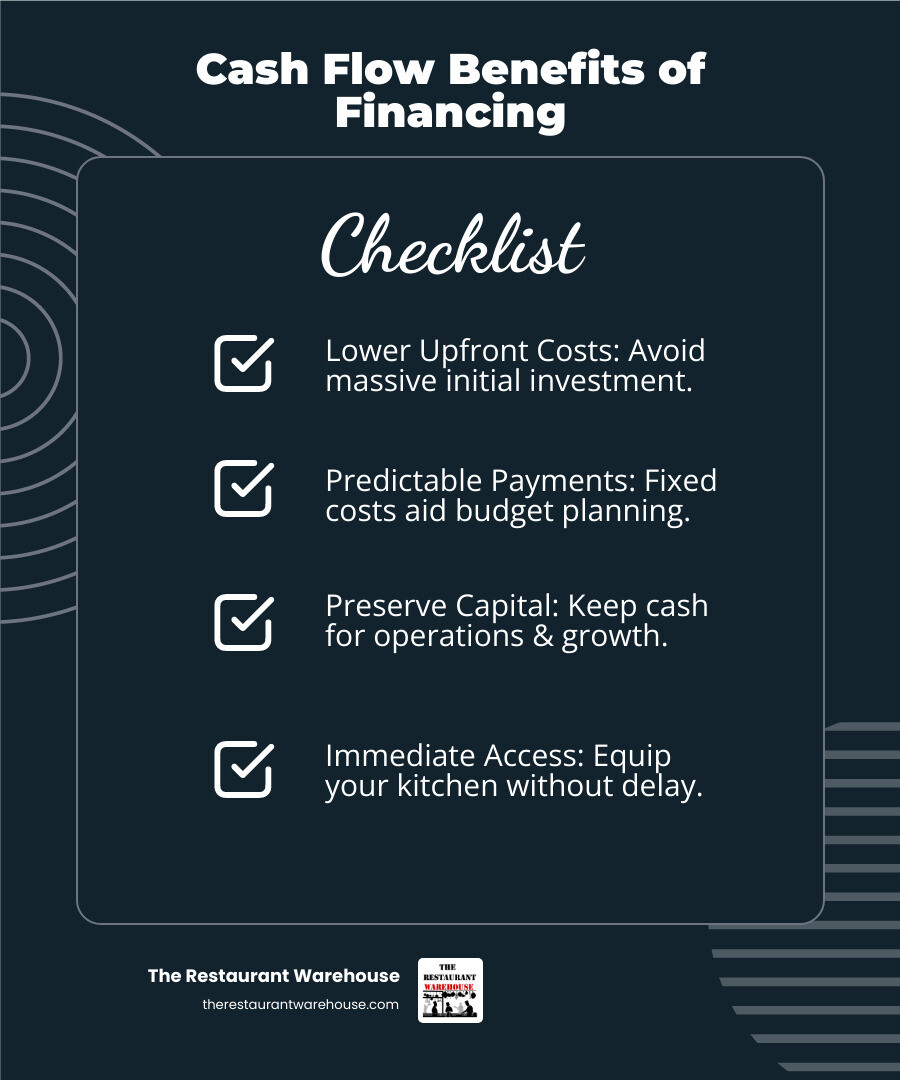
- Preserve Working Capital: This is the biggest benefit. Instead of a large upfront purchase, you acquire equipment with little to no money down, freeing up cash for payroll, inventory, or marketing.
- Low Upfront Costs: Get your kitchen running or upgraded without a significant initial outlay, as most programs require minimal or no down payment.
- Fixed, Predictable Payments: Payments are typically fixed, making budgeting and cash flow management much easier.
- Access to High-Quality Equipment: Get the latest and most efficient commercial kitchen equipment without the burden of a high purchase price, helping you stay competitive.
- Flexibility to Upgrade: Agreements often allow you to upgrade equipment, so you're not stuck with outdated machinery as technology and your needs evolve.
- Try-Before-You-Buy Benefit: Some models let you use the equipment for a period before committing to ownership, ensuring it's the right fit for your operations.
- Building Business Credit: Making consistent, on-time payments can help improve your business credit score, opening doors to better financing in the future.
For a deeper dive into these advantages, check out our comprehensive guide on the Benefits Of Restaurant Equipment Financing.
Protection Against Price Increases
The cost of commercial kitchen equipment isn't static; it can change due to inflation, supply chain issues, and rising material costs. If you're saving up to buy a new freezer or prep table, you might find the price has jumped by the time you're ready to purchase. A rent-to-own agreement protects you from this uncertainty. Once your agreement is signed, your payments are locked in for the entire term. This means your monthly payments stay the same, even if the equipment's market price goes up later. This stability makes financial planning much simpler and ensures you won't face unexpected cost increases down the road, giving you a clear and predictable path to ownership.
Coverage for Additional Costs Like Shipping and Installation
The sticker price on a piece of equipment is rarely the final amount you'll pay. You also have to account for "soft costs" like taxes, shipping fees, and professional installation, which can add a significant amount to your initial expense. One of the most practical benefits of a rent-to-own plan is that it can help you pay for these extra costs. Instead of facing multiple large bills, you can often roll these expenses into your financing agreement. This consolidates everything into a single, manageable monthly payment, simplifying your budget and preventing surprise costs from draining your working capital when you're getting your new restaurant equipment up and running.
What Are the Potential Downsides?
While the advantages are compelling, be aware of the potential downsides of rent to own restaurant equipment:
- Higher Total Cost Over Time: The total cost of payments, fees, and interest is often higher than the outright purchase price. It's a trade-off for lower upfront costs and flexibility.
- Long-Term Contractual Commitment: You are typically locked into a contract for the full term and obligated to make payments, even if business slows down. Early termination can lead to penalties.
- No Equity Until Final Buyout: You don't own or build equity in the equipment until you complete all payments and exercise the buyout option.
- Maintenance and Repair Responsibilities: You may be responsible for all maintenance, repairs, and insurance. Clarify this in your contract to avoid unexpected costs.
- Potential Restrictions and Penalties: Agreements may have clauses limiting equipment modification or movement, as well as late fees or repossession for missed payments.
Understanding these potential pitfalls is key. We encourage you to dig deeper with our guide: How To Lease Restaurant Equipment Without Losing Your Lunch Money.
Restrictions on Equipment Customization
Before you sign a rent-to-own agreement, it's essential to understand any limitations on how you can use the equipment. Many agreements include clauses that restrict equipment modification or even where you can move it within your kitchen. While you might want to add a custom feature to a prep table or adjust a freezer to fit a specific space, the contract may prohibit it. This is because the financing company technically owns the equipment until you complete the buyout. They need to protect their asset's condition and resale value. Always review the fine print to know exactly what you can and can't do, ensuring the terms align with your operational needs.
Risks of Missing Payments
The restaurant industry has its ups and downs, but a rent-to-own contract requires consistent payments regardless of your cash flow. You are typically locked into the agreement for the full term and must make payments even if business slows down. Missing a payment can trigger a cascade of negative consequences. First, you'll likely face hefty late fees that can quickly add up. Continued non-payment can damage your business credit score, making future financing more difficult to secure. The most severe risk is repossession; the financing company can reclaim the equipment, potentially shutting down a critical part of your kitchen's operations and leaving you with nothing to show for the payments you've already made.
Rent-to-Own vs. Buying vs. Leasing: Which is Best?
Choosing how to acquire equipment is a fundamental financial strategy that impacts cash flow and risk. Let's compare rent to own restaurant equipment with buying outright and traditional leasing to help you select the best path for your business.
Renting to Own vs. Buying Outright
This comparison comes down to a "pay as you go, own later" versus a "pay now, own now" approach. Buying equipment requires a significant upfront investment, which can drain capital. Rent-to-own preserves cash flow by spreading the cost over manageable payments. However, the total cost of ownership is typically lower when buying outright, as you avoid financing fees and interest. When you buy, the equipment is immediately an asset on your balance sheet, whereas with rent-to-own, you build no equity until the final buyout. Rent-to-own offers greater flexibility to upgrade to new technology, while buying may leave you with obsolete equipment.
Here’s a quick overview of how these two stack up:
| Feature | Rent-to-Own Restaurant Equipment | Outright Purchase |
|---|---|---|
| Upfront Cost | Low (minimal or no down payment) | High (full purchase price) |
| Total Cost | Higher (due to interest and fees over time) | Lower (no financing costs) |
| Ownership | Acquired at end of term (after buyout) | Immediate |
| Equity Building | No equity until buyout | Immediate equity and asset on balance sheet |
| Cash Flow Impact | Preserves working capital | Significant initial drain on capital |
| Flexibility | High (easy to upgrade, return, or adapt to new tech) | Low (stuck with equipment; selling can be difficult) |
| Maintenance | Varies by agreement (may be included or lessee's responsibility) | Owner's responsibility after warranty |
| Tax Benefits | Payments may be deductible; potential for Section 179 at buyout | Depreciation deductions; Section 179 at purchase |
How Each Option Affects Your Financial Statements
The choice between leasing and buying equipment goes beyond your bank account; it directly impacts your financial statements. When you lease, the regular payments are treated as operating expenses, which can lower your taxable income. If you buy, the equipment becomes an asset on your balance sheet, increasing your business's value on paper. Instead of writing off the whole cost at once, you'll deduct its depreciation over time. This distinction is crucial for financial reporting and securing future loans. Understanding these financial mechanics is a key part of any smart equipment strategy, and exploring restaurant equipment financing can help clarify which path aligns best with your long-term financial goals.
Considering Used Equipment as an Alternative
Don't overlook the value of used equipment. It can be a fantastic middle ground, offering the benefits of ownership without the steep price tag of brand-new items. You can find significant savings on essential, high-cost pieces like commercial refrigerators and walk-in freezers, freeing up capital for other areas of your business. While you'll want to inspect any used item carefully and ask about its service history, the cost savings are often worth the extra diligence. This approach is especially practical for back-of-house equipment where pristine aesthetics aren't a priority, allowing you to build a powerful kitchen on a budget.
How Rent-to-Own Differs from a Traditional Lease
The terms "rent-to-own" and "leasing" are often used interchangeably, but key distinctions exist, primarily around the intention to own. Traditional leasing includes two main types:
Capital Lease: This is very similar to a rent to own restaurant equipment agreement. It's structured like a loan with the clear intention for the lessee to own the equipment at the end. From an accounting perspective, it's treated as a purchase, appearing as an asset and liability on your balance sheet. These leases often qualify for tax benefits like the Section 179 deduction.
Operating Lease: This is more like a long-term rental, where the goal is not ownership. Payments are typically lower, and the lessor often handles maintenance. At the end of the term, you usually return the equipment, renew the lease, or purchase it at its current market value. These lease payments are treated as a regular operating expense and are generally tax-deductible.
The key difference is your end goal. Rent-to-own (or a capital lease) puts you on a path to ownership, while an operating lease offers maximum flexibility without the commitment of ownership.
For more detailed information, explore our resource on Restaurant Equipment Leasing.
Impact on Your Business Credit Report
A rent-to-own agreement can be a powerful tool for building your business's financial reputation. When you consistently make your payments on time, you're demonstrating reliability to lenders and credit bureaus. This responsible payment history helps improve your business credit score over time. A stronger credit score is a valuable asset, as it can unlock better financing opportunities with more favorable terms and lower interest rates down the road. It’s a strategic move that pays dividends long after you’ve acquired your new equipment, positioning your restaurant for sustainable growth and success.
What’s great about many rent-to-own programs is their focus on your business's overall health, not just a single credit score. Lenders often look at your revenue, operational stability, and business plan, which means you can still qualify even if your credit history has a few bumps. This approach makes it possible to get the essential equipment you need to run your restaurant efficiently, like a new refrigerator or prep table, without being held back by past financial hurdles. It’s a practical solution that prioritizes your current business performance and future potential, removing a major barrier for many aspiring restaurant owners.
Another key benefit is how leasing affects your overall credit profile. Because a rent-to-own agreement is often treated as an operating expense rather than a loan, it doesn't typically show up as debt on your balance sheet. This is a smart way to manage your credit utilization ratio—a key factor that influences your credit score. It keeps your other credit lines, like business credit cards, open and available for inventory, payroll, or emergencies. By choosing a rent-to-own plan, you're not just getting the restaurant equipment you need without a huge upfront cost; you're also making a savvy financial move that supports your business's long-term health.
Finding the Right Financing for Your Business
Every restaurant has a unique financial profile, whether you're a startup, an established eatery with imperfect credit, or an expanding chain. Fortunately, accessible financing solutions exist for nearly every situation, helping you get the rent to own restaurant equipment you need to thrive.
Exploring Different Leasing and Financing Programs
Several specific programs are designed to fit different business needs:
- Lease-to-Own Programs: A straightforward way to get equipment now with a plan to own it later, preserving cash today for an asset you'll need long-term.
- Revenue-Based Financing: An option for restaurants with strong sales but perhaps imperfect credit. Payments are tied to a percentage of your sales, offering flexibility that aligns with your cash flow.
- Accounts Receivable Financing: Use your future customer payments as collateral to get cash now, which is helpful for bridging temporary cash flow gaps.
- Asset-Based Lending: Use existing assets, like equipment or property, as collateral to secure financing for new items.
- Microloans for Equipment Financing: Smaller loans, often from community-focused lenders, designed to help small businesses acquire specific items or build credit.
Learn more about these diverse solutions on our page for Restaurant Equipment Financing Options. When you're ready, you can Apply now for financing.
Common Credit Score and Business History Requirements
If you're worried that a less-than-perfect credit score might stand in your way, you can breathe a little easier. While traditional bank loans often have strict requirements, such as a credit score of at least 600 and a business history of one year or more, rent-to-own financing is typically more flexible. Many financing partners focus more on your restaurant's overall financial health and consistent revenue rather than just your personal credit history. This approach opens doors for startups and businesses that are still building their credit profile. Some programs even offer "no credit check" options, making it possible to secure the equipment you need based on the strength of your business plan and cash flow. This flexibility is a core part of making quality equipment accessible to everyone, which is why we've built our restaurant equipment financing program to accommodate a wide range of business situations.
Typical Financing Amounts and Loan Types
Financing programs are designed to be as versatile as the restaurants they serve. Whether you need to finance a single deep fryer for a few thousand dollars or outfit an entire kitchen with costs reaching $40,000 or more, there's likely a plan that fits. Some financing partners can approve amounts from $1,000 up to $250,000, ensuring you can get exactly what you need without compromise. The application process is also built for the speed of the foodservice industry, with many providers offering approvals in just a few minutes. This means you can quickly select your equipment, get approved, and have your new gear on the way without lengthy delays. This efficiency allows you to focus on what matters most: running your business and serving your customers.
How to Choose the Right Financing Partner
Choosing the right financing partner is as important as selecting the right equipment. Look for these key qualities:
- Transparency in Terms: A reputable partner will be open about interest rates, buyout options, maintenance responsibilities, and any potential penalties. Always read the contract thoroughly.
- Flexible Payment Structures: Look for a partner who offers payment plans (weekly, bi-weekly, or monthly) that match your restaurant's cash flow rhythm.
- Hospitality Industry Experience: A provider who understands the restaurant industry's unique challenges and opportunities can offer more suitable and effective financing.
- Excellent Customer Support: You want a partner who is responsive and supportive throughout your agreement, not just during the application.
- Reputable Lenders: Seek providers with a strong track record and positive reviews. Platforms that provide multiple quotes can help you find competitive terms.
Look for Experience and a Strong Reputation
A lender who understands the seasonal rushes and slow periods of a restaurant can offer much more suitable financing terms. They get that a new freezer isn't just a box; it's a critical tool for your operation. Look for partners with a proven track record in the hospitality sector and check for positive reviews from other restaurant owners. A strong reputation is your best indicator that a company provides transparent, reliable restaurant equipment financing and will be a supportive partner, not just a creditor. Choosing someone with this background ensures they appreciate the unique pressures and opportunities you face every day.
What Restaurant Equipment Can You Rent to Own?
A major advantage of rent to own restaurant equipment is the vast range of items available. Whether you're opening a small cafe or a large restaurant, you can outfit nearly your entire kitchen with flexible financing, covering everything from major cooking units to small prep tools.

Popular Equipment Available for Rent-to-Own
Essential kitchen equipment categories commonly available for financing include:
- Cooking Equipment: The heart of the kitchen, including commercial ranges, griddles, deep fryers, and charbroilers.
- Commercial Refrigeration: Essential for food safety, this includes refrigerators, freezers (reach-in, walk-in, or chest), and prep tables.
- Dishwashing Equipment: From compact undercounter units to large conveyor systems to maintain hygiene and efficiency.
- Commercial Ice Machines: A constant supply of ice is a must, and various sizes and types are available.
- Food Preparation Equipment: Improve workflow with heavy-duty mixers, slicers, food processors, and prep tables.
- Beverage Dispensers & Bar Equipment: Equip your front-of-house with coffee machines, soda fountains, and bar refrigeration.
- Display & Merchandising Equipment: Showcase your food with hot holding cabinets, display cases, and bain maries.
- Stainless Steel Equipment & Work Tables: The foundational elements of a sanitary kitchen, including benches, shelving, and sinks.
- Specialty Equipment: Items specific to your niche, like commercial smokers or soft-serve ice cream machines, can often be financed. Most providers will finance items with an invoice value over a certain threshold, often starting around $1,000.
Explore a wide range of options in our Lease Commercial Kitchen Equipment Guide.
What to Know Before You Sign a Rent-to-Own Agreement
Before committing to rent to own restaurant equipment, it's crucial to perform due diligence. This involves carefully evaluating the agreement details and understanding potential tax advantages to ensure you're making a sound business decision.
How to Review Your Rent-to-Own Agreement
When reviewing an agreement, look beyond the monthly payment to understand the full commitment:
- Total Cost Calculation: Multiply the monthly payment by the number of months in the term and add any buyout fees. Compare this total to the outright purchase price to understand the true cost of financing.
- Factor Rate vs. APR: Some agreements use a factor rate instead of a traditional interest rate (APR). Be sure to convert the factor rate to an equivalent APR to accurately compare financing offers.
- End-of-Lease Buyout Options: Clarify if the buyout is a fixed amount (like a $1 buyout) or based on Fair Market Value (FMV), which is determined at the end of the lease. Your choice should align with your goal of ownership.
- Maintenance Clauses: Determine who is responsible for repairs and upkeep. Some agreements include service, while others place the responsibility on you.
- Read the Fine Print: Scrutinize every clause for details on early termination fees, late payment penalties, insurance requirements, and equipment use restrictions. Do not sign until you understand the entire agreement.
For a deeper dive, consult our detailed Restaurant Equipment Lease Guide.
The Importance of Negotiation
Don't just sign on the dotted line; your rent-to-own agreement is a conversation, not a command. Many terms are more flexible than you might think, so it's always worth asking for better deals on payment plans, service agreements, or warranties. A small adjustment in the monthly payment or a more favorable buyout option can significantly lower your total cost over the agreement's life. The goal is to secure a plan that supports your cash flow, not strains it. By discussing your needs, you can often tailor the terms to better fit your business's unique financial rhythm. This turns a standard contract into a strategic partnership for your kitchen's success, so be prepared to discuss your options when exploring restaurant equipment financing.
Understanding the Section 179 Tax Deduction
Financing your rent to own restaurant equipment can offer significant tax benefits, most notably through the IRS Section 179 Deduction.
The IRS Section 179 Deduction allows businesses to deduct the full purchase price of qualifying equipment in the year it is placed into service, rather than depreciating it over several years. This can result in substantial tax savings.
Agreements structured as capital leases (where you intend to own the equipment) often qualify for the Section 179 deduction, allowing you to get a large, upfront tax write-off while still making manageable monthly payments. For operating leases, the monthly payments are typically treated as a deductible business expense.
Many small to medium-sized restaurants financing less than $1,000,000 in equipment during a tax year may be eligible. For example, financing $10,000 of qualifying equipment could result in a $3,500 tax reduction for a business in a 35% tax bracket, effectively lowering the equipment's cost to $6,500.
Tax laws are complex and can change, so we always recommend consulting a tax professional. An accountant can provide personalized advice to help you maximize deductions and ensure compliance.
For more information on this deduction, you can Learn more about the Section 179 Deduction.
Estimating Your Return on Investment (ROI)
Calculating the return on investment for rent-to-own equipment isn't just about the final price. The real value is in what the equipment helps you achieve immediately. Instead of a major cash expense, you get a tool that generates income right away. Think about how a new, efficient refrigerator reduces food spoilage or a high-capacity deep fryer lets you add popular new appetizers to your menu. To estimate your ROI, calculate the projected monthly profit from these improvements and compare it to your fixed payment. If the equipment earns you more than it costs each month, you're building a positive cash flow. This approach lets the equipment pay for itself while you preserve capital for other critical needs like payroll and marketing.
Is Rent-to-Own Your Path to a Fully Equipped Kitchen?
Outfitting your kitchen doesn't have to be a financial burden. Rent to own restaurant equipment is a clever, flexible, and accessible solution for businesses of all sizes. It's a strategic move that preserves your working capital for other critical areas like staffing, marketing, and inventory.
This approach allows you to acquire top-notch, modern equipment with manageable, predictable payments, avoiding prohibitive upfront costs. It provides the flexibility to adapt to market changes, upgrade technology, and even benefit from potential tax advantages like the Section 179 Deduction.
At The Restaurant Warehouse, our mission is to supply commercial restaurant equipment and food service supplies at affordable, wholesale prices. By cutting out high commissions and retail overhead, we pass the savings directly to you, helping you get the equipment you need at a price you'll love.
Making a smart financial choice for your equipment is critical for your restaurant's long-term success. By considering a rent-to-own strategy, you're not just acquiring machinery; you're investing in flexibility, financial stability, and future growth.
Ready to explore your financing possibilities? Dive deeper with The Ultimate Guide To Restaurant Equipment Financing.
Frequently Asked Questions
What’s the real difference between rent-to-own and a standard lease? Think of it in terms of your end goal. A rent-to-own agreement is designed from the start with ownership in mind; it's a clear path to making the equipment yours. A standard operating lease is more like a long-term rental. You use the equipment for a set period, and when the term is up, you typically return it. If your plan is to eventually own your kitchen assets, rent-to-own is the more direct route.
Can I still get approved for a rent-to-own plan if my credit isn't perfect? Yes, you absolutely can. While traditional bank loans often fixate on your personal credit score, many rent-to-own financing partners focus more on your restaurant's overall health. They look at factors like your monthly revenue and how long you've been in business. This approach makes it possible for new businesses or owners with a few credit bumps to get the essential equipment they need to operate and grow.
Will I end up paying more in the long run compared to just buying the equipment? In terms of total dollars spent, yes, a rent-to-own plan will likely cost more than buying the equipment outright with cash. You're paying for the convenience of low upfront costs and the flexibility of manageable payments. It's a strategic trade-off. You get to keep your cash for other critical expenses like payroll and inventory while putting your new equipment to work generating revenue immediately.
What happens if a piece of equipment breaks? Am I responsible for repairs? This is a critical detail that depends entirely on your specific agreement. In many cases, you will be responsible for the maintenance and repairs of the equipment you're using. Before you sign anything, make sure you read the contract carefully to understand who covers repair costs. Some agreements may include service plans, but it's important to clarify this to avoid any surprise expenses down the road.
How does the buyout work at the end of the term? When your agreement ends, you'll have a few options, but the buyout is how you take ownership. The terms of the buyout are set at the beginning of your contract. It could be a fixed, pre-determined amount, sometimes as low as one dollar, which is common in agreements structured like a capital lease. Other times, the buyout price is the equipment's Fair Market Value (FMV) at the end of the term. Your agreement will clearly state which option applies to you.
Key Takeaways
- Protect Your Cash Flow: Rent-to-own turns a massive equipment bill into a manageable monthly payment. This keeps your cash available for day-to-day needs like payroll and inventory, which is critical when you're starting out or expanding.
- Get Flexibility with an Option to Own: You get the equipment you need now without the long-term commitment of buying. At the end of your term, you have the power to choose: purchase the equipment, upgrade to a newer model, or simply return it.
- Read the Fine Print Before Signing: A rent-to-own plan is a great tool, but understand the total cost over time will be higher than buying. Always clarify the buyout terms, maintenance duties, and any potential fees so you know exactly what you're agreeing to.
Related Articles
About The Author

Sean Kearney
Sean Kearney used to work at Amazon.com and started The Restaurant Warehouse. He has more than 10 years of experience in restaurant equipment and supplies. He graduated from the University of Washington in 1993. He earned a BA in business and marketing. He also played linebacker for the Huskies football team. He helps restaurants find equipment at a fair price and offers financing options. You can connect with Sean on LinkedIn or Facebook.
Leave a comment