

How to Choose the Best Espresso Machine for You
The morning rush is a great problem to have—if your equipment can handle the pressure. When the line is out the door, your espresso machine is the heart of your operation. The wrong one creates chaos; the right one keeps service smooth. Finding the best espresso machine for a high-volume café means focusing on workflow and power. That's why for most busy shops, a dual-boiler, semi-automatic machine is the answer. Models like the XYZ Pro and CaféMaster Duo deliver the consistency, temperature stability, and steam performance you need without breaking a sweat.
How to Choose the Best Espresso Machine
Picking the right commercial espresso machine is a major decision for any café or restaurant. It’s the heart of your coffee program, and the right one will empower your baristas to pull consistently delicious shots, while the wrong one can become a daily frustration. It’s not just about the brand name; it’s about matching the machine’s capabilities to your specific needs, from your daily customer volume to your team’s skill level. Thinking through these key factors will help you find a machine that works as hard as you do and delivers a fantastic return on your investment. Since this is a significant purchase, exploring restaurant equipment financing can make a top-tier machine more accessible for your budget.
Consider Your Barista's Skill Level
The first thing to assess is who will be using the machine. If you have a team of experienced baristas who love the craft of making coffee, a semi-automatic machine is an excellent choice. These machines give the user control over variables like grind, tamp, and extraction time, allowing them to dial in the perfect shot. This control is fantastic for quality but requires training and skill. On the other hand, if your staff has a high turnover rate or you need to prioritize speed and consistency above all else, a super-automatic machine might be a better fit. These machines grind, tamp, and brew at the push of a button, minimizing human error during a busy service.
Match Capacity to Your Daily Volume
How many coffees do you expect to serve during your busiest hour? Your answer will determine the type of heating system you need. For businesses with lower coffee volume, a machine with a thermoblock might suffice, as it heats water on demand. However, most commercial settings require a machine with a robust boiler system. A dual-boiler machine is even better, as it has separate boilers for brewing espresso and steaming milk. This allows you to do both simultaneously without losing temperature or pressure, which is essential for keeping up with a long line of customers. A machine that can’t keep up will slow down your entire operation, impacting sales and customer satisfaction.
Prioritize Temperature Stability
One of the most critical factors for great espresso is consistent water temperature. Even a few degrees of fluctuation can turn a perfectly good shot sour or bitter. This is why you should look for a machine equipped with a PID (Proportional-Integral-Derivative) controller. A PID is essentially a highly accurate digital thermostat that maintains a stable water temperature, shot after shot. While it might sound like a technical detail, it makes a huge difference in the final taste of your coffee. It’s a feature that separates good machines from great ones and ensures your customers get the same high-quality drink every time they visit.
Think About Cleaning and Maintenance
An espresso machine is a complex piece of equipment that needs daily care to function properly. Neglecting maintenance can lead to costly repairs and inconsistent coffee quality. To make this essential task easier on your staff, look for machines with features that simplify upkeep. Many modern espresso machines come with automatic cleaning cycles that backflush the group heads and clean the internal lines. This doesn’t replace the need for manual cleaning, but it automates some of the most tedious parts of the process. A machine that’s easier to clean is more likely to be cleaned correctly, extending its lifespan and protecting your investment in all your restaurant equipment.
How to Choose the Best Espresso Machine for Your Cafe
Finding the right machine means matching its capacity to your service style. You’ll want enough boiler output and group heads to keep lines moving without wasting counter space.
Key factors to weigh:
- Daily Volume: Aim for a boiler capable of at least 3 L output if you serve 300–500 drinks per day.
- Group Heads: Two heads handle back-to-back orders. Add a third if you regularly top 450–500 cups.
- Steam Recovery: Look for recovery times under 30 seconds so milk orders don’t bottleneck.
- Footprint: A compact chassis can fit tight bar layouts—underbar boilers save precious real estate.
- Energy Efficiency: Insulated boilers and programmable standby modes cut utility bills.
Finding the Right Fit: Capacity vs. Space
In a snug café, you might have to choose between a larger boiler or more group heads. Underbar boilers can be a clever compromise, tucking performance out of sight yet close at hand.
How Many Coffees Will You Serve Daily?
Track peak-hour orders and note how many complex milk drinks you pull. A solid rule of thumb: one group head per 150 drinks each day to avoid slowdowns.
Machine Needs for Different Cafe Sizes
Match machine to staffing for smooth service:
- 350 daily drinks with two baristas → XYZ Pro keeps shots and steam flowing in tandem.
- 550 daily drinks with three baristas → CaféMaster Duo’s extra group head slashes wait times.
Your Espresso Machine Checklist
Get these core dimensions right, and your café runs without hiccups.
Dual-boiler designs lock in brewing pressure and steam availability—no more waiting when your line is packed.
Below is a quick snapshot of our top picks against core criteria.
Quick Recommendation and Key Criteria
Use this table to see which machine aligns with your volume and workflow.
| Recommendation | Key Criteria | Ideal Use Case |
|---|---|---|
| XYZ Pro | Dual 3 L boilers, 2 group heads, 25 s steam recovery | Busy café serving 400 drinks/day |
| CaféMaster Duo | Dual 2.5 L boilers, 3 group heads, 30 s steam recovery | High-traffic drive-thru exceeding 500 cups/day |
This chart shows the XYZ Pro shining at 350–450 drinks daily, while the CaféMaster Duo steps up nicely beyond 500 cups.
Use these insights to narrow your shortlist, balancing your café’s traffic patterns, workspace constraints, and long-term maintenance and service support.
A Breakdown of Commercial Espresso Machine Types
Commercial espresso machines generally divide into five categories, distinguished by their level of automation and boiler setup. Your choice here directly shapes both workflow and drink quality.
- Semi-Automatic: Manual dosing and shot timing for barista precision.
- Fully Automatic: Automated dose and shot length for repeatable results.
- Dual-Boiler: Separate boilers keep brew and steam temps rock-steady.
- Heat-Exchanger: Single boiler with crossflow design for faster steam recovery.
- Prosumer (Compact): Modular boilers fit tight counters and low-volume cafés.
Every machine’s brewing tech affects speed and consistency. Dual-boilers hold temperature under pressure, while heat-exchangers bounce back quickly during rushes. That means you can sustain spikes from 100 to 300 drinks per hour without noticeable dips in shot quality.
| Machine Type | Automation Level | Boiler Design | Ideal Throughput |
|---|---|---|---|
| Semi-Automatic | Manual | Single | Up to 80 cups/hr |
| Fully Automatic | Automated | Single | Up to 120 cups/hr |
| Dual-Boiler | Hybrid | Dual | 200+ cups/hr |
| Heat-Exchanger | Manual | Single + HX | 150–250 cups/hr |
| Prosumer | Manual | Modular Options | Up to 200 cups/hr |
How Much Control Do You Want?
If uniformity is your north star, fully automatic machines often dominate high-traffic cafés. They handle every pump, shot and pause with minimal intervention.
60% of global café operators choose fully automatic machines, reflecting their reliability under pressure. According to Intel Market Research, the global espresso machines market was valued at USD 3,338 million and is projected to reach USD 5,133 million by 2032 at a 6.5% CAGR. Learn more about these market findings on Intel Market Research.
On the other hand, heat-exchanger models shine when you need uninterrupted flow. And for pop-ups or office stations, prosumer units pack the essentials into a compact footprint.
How Boiler Type Affects Your Workflow
Picking the right boiler layout means matching daily volume with temperature stability. Dual-boiler machines excel when you’re pulling over 300 milk-based drinks a day.
Consider these real-world use cases:
- Dual-Boiler: Specialty cafés serving 150+ lattes and cappuccinos.
- Heat-Exchanger: Drive-thrus demanding nonstop espresso shots.
- Prosumer: Satellite bars or boutique pop-ups under 200 daily cups.
Compact prosumer setups often pair a single boiler for brewing with an on-demand steam wand. They save energy but may slow down if you steam and pull shots at the same time.
Which Machines Are More Energy-Efficient?
Footprint and power draw shift dramatically from one design to the next. Dual-boiler machines typically pull 4–6 kW at peak, while heat-exchangers average around 3–5 kW but can spike higher during heavy milk work.
| Machine Type | Peak Power Draw | Typical Standby Draw |
|---|---|---|
| Dual-Boiler | 4–6 kW | 1.5–2 kW |
| Heat-Exchanger | 3–5 kW | 1–1.5 kW |
| Prosumer | 2–4 kW | 0.5–1 kW |

In practice, programmable sleep modes on fully automatic machines slash standby consumption. Prosumer units usually rely on manual switches, making staff training critical for energy savings.
Factoring in Long-Term Running Costs
Long-term costs hinge on energy, water use, and heat recovery strategies. Tracking these metrics helps you choose a model that aligns with your budget and green goals.
- Insulated Boilers: Cut standby losses and lower monthly kWh usage.
- Heat-Exchanger Systems: Recycle boiler heat but demand careful flushing to avoid cross-contamination.
- Fully Automatic Units: Offer auto-sleep functions to minimize idle power draw.
By integrating energy-use data into your procurement criteria, you ensure a purchase that supports both your café’s bottom line and sustainability targets.
A Head-to-Head Look at Leading Espresso Machines
Choosing the right espresso machine can feel overwhelming. But when you line candidates up side by side, clear front-runners emerge—some thrive in the morning rush, others excel at milk-based drinks. Below, we break down the core specs and performance factors that matter in a busy café.
Key evaluation areas include:
- Boiler Capacity for peak throughput
- Group Head Count to match your staffing levels
- Pump Pressure Stability for shot-to-shot consistency
- Steam Recovery Speed to keep milk orders flowing
- Footprint where every inch of counter space counts
What's Under the Hood? Boilers and Groupheads
Boiler size doesn’t just sit behind the scenes—it defines your throughput. If you routinely top 300 cups a day, dual boilers keep brew and steam systems separate so you don’t choke the line.
A heat-exchanger unit, by contrast, delivers fast shots but calls for precise venting and careful setup.
Group heads translate raw capacity into staffed workflow. Two groups handle steady streams, while a three-group machine cuts wait times once you near 500 drinks daily. That balance often makes or breaks service rhythm.
That said, commercial reliability is the No. 1 priority for high-traffic cafés. Semi-automatic, rugged workhorses still dominate.
With a global market set to swell from USD 18.90 billion in 2025 to USD 25.26 billion by 2030 at a 5.97% CAGR, many operators are finally upgrading their line-ups. For more context, check out this global coffee machine market report.
Boiler Types And Daily Capacity
- Dual Boiler: 200–350 cups/hr, rock-steady temps
- Heat Exchanger: 150–250 cups/hr, rapid steam recovery
- Single Boiler: 80–120 cups/hr, space-saving design
How They Handle the Morning Rush
Even a ±0.2 bar swing in pump pressure shows up in cup consistency. Compact vibration pumps suit tight bars, but rotary pumps lock in pressure when the espresso queue never quits.
Steam recovery is equally critical. Anything under 30 seconds between milk drinks keeps cappuccino lines moving. Higher-pressure wands shave precious seconds off every pitcher.
Side-by-Side: The Best Commercial Espresso Machines
Here’s a quick look at how top models measure up on boiler design, daily throughput, steam recovery and price.
| Model | Boiler Type | Daily Capacity | Steam Recovery Time | Price Range |
|---|---|---|---|---|
| XYZ Pro | Dual Boiler | 350–450 cups/day | 25 s | $8,000–$10,000 |
| CaféMaster Duo | Dual Boiler | 500–600 cups/day | 30 s | $10,500–$12,500 |
| RapidBrew 3000 | HX Boiler | 300–400 cups/day | 20 s | $7,000–$9,000 |
In practice, the XYZ Pro’s rapid recovery shaved 15% off the rush-hour queue, according to one Chicago café manager.
Keeping Your Machine in Top Shape
Downtime kills revenue. A few simple routines keep machines humming and flavors on-point.
- Group Head Cleaning: Quick rinse after each shift, weekly detergent backflush
- Descaling: Monthly or quarterly, based on local water hardness
- Gasket Checks: Inspect every three months to spot leaks early
- Steam Wand Care: Wipe and purge daily; deep-clean weekly
“Regular backflushing cut our service calls by 20%,” notes a technician in New York.
Setup Requirements and Built-to-Last Features
Counter space is precious. Underbar boilers free up worktops but demand dedicated plumbing. Look for:
- Heavy-Duty Frames and stainless components to resist wear
- Modular Parts for fast on-site repairs
- Service Agreements and vendor training to minimize downtime
Essentials include:
- Electrical: 208–240 V, 20–30 A dedicated circuit
- Plumbing: 3/8" water line plus filtration
- Venting: Overflow drains and steam catalyzers for air quality
A Breakdown of Energy Consumption
Espresso machines draw 3–6 kW under load, equating to $300–$600 in annual electricity costs for busy cafés. Standby draws vary based on insulation and sleep modes. Fully automatic units can halve idle power; prosumer models often rely on staff to power down.
- Peak Load Draw: 3–6 kW
- Standby Draw: 0.5–2 kW
- Sleep Mode Savings: Up to 50%
- Insulation Grade: Affects heat loss and recovery time
At $0.12 per kWh, a 4 kW machine running four hours daily costs roughly $230 per month. Use these figures to compare lifetime operating expenses.
Beyond the Sticker Price: Total Ownership Costs
Expect $7,000–$12,500 up front for a top-tier model. Total cost of ownership includes:
- Energy consumption
- Maintenance kits and spare gaskets
- Annual service contracts
Financing through The Restaurant Warehouse spreads payments over 12–36 months. Lease-to-own and deferred-payment plans protect cash flow. Delivery arrives in 1–3 days, complete with installation and staff training.
Partnering with a vendor who offers structured financing and rapid delivery transforms procurement from a headache into a strategic win.
The screenshot below visualizes core specs and performance metrics side by side.
From this screenshot, the CaféMaster Duo stands out for highest capacity while the RapidBrew 3000 leads in recovery time.
Fitting the Right Machine into Your Cafe's Workflow
Every café’s rhythm hinges on its service style—pop-ups, table orders or drive-thrus call for different machine setups. When you line up daily volume with group heads, you avoid those peak-hour bottlenecks that frustrate both baristas and customers.
For instance, 2-group heads can breeze through 400 drinks a day with two baristas sharing pulls seamlessly. In tighter bars, an integrated grinder clears up counter space and removes extra steps. Meanwhile, programmable dosing slashes mispours by 30%, and an auto-backflush cycle tacks on about 10 minutes back to your shift for cleanup.
These feature-to-role pairings lock in consistency, keeping every shot and steam wand sweep on point.
Below is a quick reference that pairs daily volume and service style with the ideal espresso machine configuration.
Workflow Scenarios and Recommended Machines
| Daily Drinks | Service Style | Recommended Machine Type | Key Feature |
|---|---|---|---|
| ≤300 | Pop-Up Bars | 1-Group Semi-Automatic | Compact Footprint |
| 300–500 | Table Service | 2-Group Dual-Boiler | Integrated Grinder |
| >500 | Drive-Thru | 3-Group Dual-Boiler | Fast Steam Recovery |
This chart helps you align your busy periods with the espresso machine features you need.
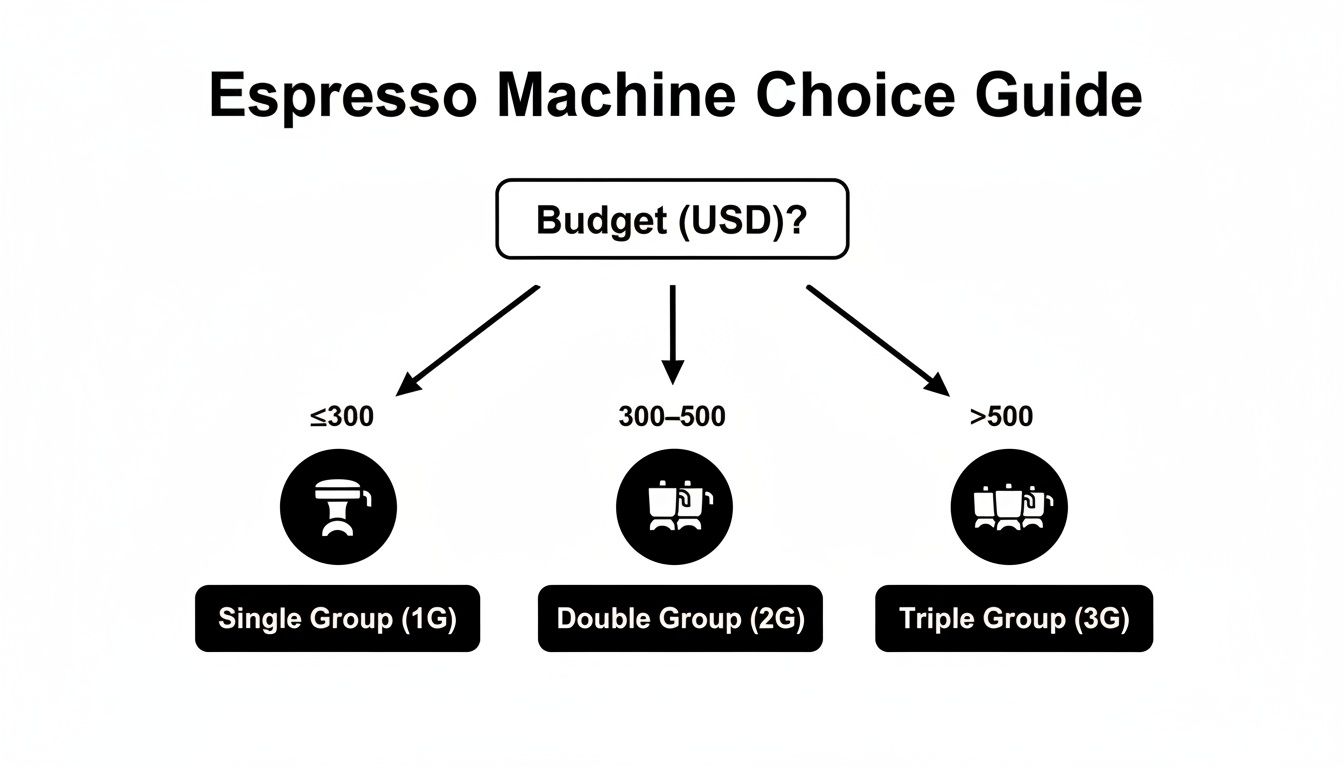
This screenshot shows how staff assign baristas by peak shift and machine capability—clear roles become essential when you’re juggling multiple group heads.
“During our busy morning shift, we sliced 20% off wait times with a three-group dual-boiler,” says a Seattle café owner.
Must-Have Features for Surviving the Rush
When the morning crowd hits, dual-spout groups and high-flow steam wands are your best friends. For 500+ drinks per day, a three-group dual-boiler unit with 25 s steam recovery keeps the line moving. Coupled with integrated grinders and programmable dosing, you lock in shot consistency even when orders spike.
- Role-based dosing assignments let baristas focus on extraction or steaming, not manual resets.
- Scheduled auto-backflush cycles free up baristas for customer service, reducing after-hours cleanup by 20%.
These bundles accelerate throughput and ease staff fatigue when every minute counts.
Building Daily Routines Around Your Machine
Translate those machine specs into crystal-clear tasks during training.
Pre-Shift Calibration
Confirm shot pressure and grind settings match your busiest menu items.Mid-Shift Checks
Run auto-backflush and verify steam wand temperature every 2 hrs.Shift Handoff
Log boiler pressure and water levels for seamless handovers.
Formalizing these steps locks in reliable performance under stress. For deeper workflow strategies, check out our guide on best coffee shop equipment.
Pairing your routines with The Restaurant Warehouse’s financing, delivery and support options ensures every detail—from purchase to upkeep—runs as smoothly as the espresso shots you serve.
Fine-Tuning Your Machine for Perfect Shots
A few adjustments today save headaches tomorrow.
Weekly Descale
Run a controlled descaling cycle to clear limescale without harming boiler components.Daily Steam-Wand Purge
Wipe and purge the wand after each milk service to prevent buildup and bacteria.
Install under-bar boilers if counter space is tight, and match water filtration to manufacturer specs for longer equipment life. Scheduled service agreements with pre-arranged parts and labor cut downtime. And training a backup operator on basic maintenance means no shift interruption if your lead barista is off.
Matching your workflow with the right espresso machine maximizes speed and staff satisfaction under any café demand. Use these feature and volume pairings to choose gear that performs when you need it most.
A Practical Guide to Service and Maintenance
Keeping your espresso setup in top form hinges on more than daily pulls—it’s about nailing the infrastructure and sticking to a proven upkeep plan. A dependable service network cuts surprises and keeps every shot consistent.
Your Pre-Installation Checklist
Before you even power up, make sure your utilities meet these specs:
- Water Pressure: 1.5–3 bars on a ¾" feed line
- Electrical: Dedicated 208–240 V circuit at 20–30 A
- Water Filtration: Inline filters to curb scale buildup
- Venting: Overflow drains and steam-condensate traps
This baseline setup locks in stable brew temperatures and reliable steam pressure. Following manufacturer guidelines here also reduces downtime and keeps you compliant with safety codes.
Daily, Weekly, and Monthly Cleaning Tasks
Adopt a simple, repeatable schedule to stave off major repairs. Break tasks into daily, weekly, and quarterly checkpoints:
-
Daily
- Wipe and purge steam wands after each use
- Backflush group heads with a water-only rinse
-
Weekly
- Run a detergent backflush on group heads
- Inspect gaskets and shower screens for wear
-
Quarterly
- Descale boilers using manufacturer-approved solutions
- Verify pump-pressure stability and swap out filters
These steps slot neatly into any shift and keep uptime high.
20% fewer breakdowns happen when you schedule gasket replacements and group-head cleanings.
You can expect 30% longer boiler life between rebuilds if you stick to regular descale cycles.
| Feature | Benefit | ROI Impact |
|---|---|---|
| Local Service Agreement | Priority scheduling and parts stock | 25% less downtime |
| Remote Diagnostics | Rapid error identification | 15% faster fixes |
| Auto-Clean Cycle | Automated backflush and rinse modes | Reduces labor by 20% |
Is a Service Agreement Worth It?
Partnering with a local service provider means faster on-site repairs and access to genuine parts. Check our comprehensive guide to restaurant equipment repair for detailed steps.
Bundled plans often include priority shipping and discounted labor rates. And having spare gaskets, valves, and shower screens on hand can turn an emergency call into a quick swap.
Simple Steps to Maximize Uptime
Downtime chips away at profits and frustrates both staff and customers. These tactics help you stay ahead:
- Use remote diagnostics to review error logs before the technician arrives
- Schedule auto-clean timers and lockout windows during rush hours
- Rotate maintenance tasks to build team-wide familiarity
- Keep a shared digital log of all upkeep activities and part replacements
Preordering critical parts—like gaskets and seals—means you’ll never wait for shipping. Combining automated cycles with hands-on checks delivers the best balance for continuous operation.
Auto-clean cycles plus manual inspections strike the ideal maintenance balance.
What to Budget for Maintenance
Investing in planned upkeep dramatically lowers your lifetime costs by cutting emergency repairs. You’ll see:
- Fewer part replacements over the machine’s life
- More consistent shot quality that drives customer loyalty
For café operators hunting the best espresso machine, turning maintenance into a strategy pays off. Regularly review logs and service reports to lock in peak performance. Consult The Restaurant Warehouse support team for tailored maintenance planning and on-demand training.
Finding the Best Espresso Machine for Your Home
Bringing the café experience into your kitchen is an exciting step, but the world of home espresso machines can be a lot to take in. Unlike the high-volume workhorses we see in commercial settings, home machines are designed for a different set of priorities: footprint, ease of use, and aesthetics. The goal is to find a machine that matches not just your counter space, but also your daily routine and your desire to be a hands-on barista. Whether you want to master the craft of pulling the perfect shot or just want a great latte with the push of a button, there’s a machine out there for you. Let's walk through how to find it.
Criteria for Selecting a Home Espresso Machine
Before you get swayed by shiny chrome and fancy features, it’s helpful to establish some core criteria. Thinking about the total investment, long-term support, and your personal skill level will guide you to a machine you’ll love for years to come. A great home espresso machine is an investment in your daily ritual, so it pays to look beyond the initial price tag. Consider how it will fit into your life, how you'll care for it, and what happens if something goes wrong. A little planning now ensures you won't face buyer's remorse later. We'll cover the key things to consider, from upfront costs to the availability of spare parts.
Home Use vs. Commercial Needs
The first thing to understand is the difference between home and commercial machines. While a café needs a machine that can produce hundreds of drinks an hour without losing steam pressure, a home machine is built for a slower pace. Your choice often comes down to your skill and interest. If you have some barista experience or are eager to learn, a semi-automatic machine from a brand like Breville or Rancilio gives you creative control over your espresso. However, if you're looking for convenience and consistency without a steep learning curve, a fully automatic machine is a much better fit, handling the grinding, tamping, and brewing for you.
Total Cost of Ownership: Beyond the Initial Price
It’s easy to focus on the sticker price, but the total cost of ownership tells a much bigger story. While a top-tier commercial machine can cost upwards of $12,000, a quality home setup still requires budgeting for more than just the machine itself. You'll need a capable grinder, which is non-negotiable for good espresso. You should also factor in ongoing costs like maintenance kits, cleaning supplies, and replacement gaskets. And of course, you'll need a steady supply of fresh, high-quality coffee beans. Thinking about these additional expenses from the start helps you create a realistic budget for your entire home coffee bar.
Customer Service and Parts Availability
An espresso machine has many moving parts, and eventually, something will need to be replaced. Before you buy, investigate the manufacturer's reputation for customer service and how easy it is to find spare parts. A machine from a well-established brand is more likely to have a reliable supply of gaskets, filters, and other essential components. There's nothing more frustrating than having an expensive machine out of commission because you can't find a simple, inexpensive part. Always ask the seller about their repair service and parts availability to ensure your investment is protected for the long haul.
Considering the Resale Value
While you might plan to keep your espresso machine forever, it's smart to consider its potential resale value. Machines from reputable companies with a history of quality and reliability tend to hold their value far better than those from lesser-known brands. Think of it as an investment. If you decide to upgrade in a few years, a machine with good resale value can help fund your next purchase. This is another reason why choosing a trusted brand with strong customer support and readily available parts is often the most sensible financial decision in the long run.
Specific Machine Recommendations for Home Use
With the criteria in mind, let's look at some specific machines that stand out in the home espresso market. There are fantastic options available at various price points and for different skill levels. Whether you're a complete beginner or a seasoned coffee enthusiast looking for an upgrade, certain models consistently receive high marks for performance, reliability, and value. We'll highlight a few popular choices that cater to different needs, from an all-around winner to picks for aspiring baristas and those with a bigger budget.
Best Overall Value: Breville Bambino Plus
For those who want excellent espresso without a huge learning curve or a massive footprint, the Breville Bambino Plus is often cited as the best overall value. Its major advantage is its ThermoJet heating system, which gets it ready to brew in just three seconds—perfect for busy mornings. It’s compact enough to fit in almost any kitchen, yet it delivers fantastic espresso. Perhaps its most user-friendly feature is the automatic steam wand, which textures milk to the perfect temperature and consistency for lattes and cappuccinos, making it incredibly easy for beginners to create café-quality drinks at home.
Recommendations for Different Skill Levels
Your ideal machine largely depends on how hands-on you want to be. For beginners, an automatic machine that handles the variables for you is a great starting point. But if you enjoy the process and want to refine your skills, a semi-automatic machine is the way to go. Brands like Breville, Rancilio, and even La Marzocco offer "prosumer" models that bring commercial-grade features into the home. These machines, when paired with a quality espresso grinder, give you the control needed to experiment with grind size, dose, and extraction time to pull the perfect shot.
High-End and Budget-Friendly Picks
If you're ready to invest in a machine that will last a lifetime, the Lelit Bianca V3 is a popular choice among espresso aficionados. At around $3,000, it's a high-end machine known for its advanced features, like pressure profiling, and exceptional build quality. On the other end of the spectrum, you don't have to spend a fortune to get started. Many reputable brands offer entry-level models that are more than capable of producing great espresso. The key is to stick with a known brand to ensure you're getting a well-made machine, even at a lower price point.
Key Factors for Quality Espresso at Home
Owning a great espresso machine is only half the battle. To truly replicate café-quality coffee, a few other elements are just as important. The freshness of your beans, the precision of your grinder, the quality of your water, and the stability of your machine’s temperature all play a critical role in the final taste of your shot. Understanding these factors will help you troubleshoot any issues and consistently produce delicious espresso. Getting these fundamentals right is what separates a good home coffee setup from a great one.
The Critical Role of a Coffee Grinder
Here’s a simple truth of making espresso: your grinder is just as important as your espresso machine, if not more so. Pre-ground coffee goes stale quickly and won't work for true espresso. You need a quality burr grinder capable of making fine, consistent adjustments. Without one, even the most expensive espresso machine will produce disappointing results. Plan to spend at least $300 on a dedicated espresso grinder. It might seem like a lot, but it's the single most important accessory for unlocking the potential of your machine and your coffee beans.
The Importance of Water Quality
The water you use has a massive impact on both the taste of your espresso and the health of your machine. Tap water, especially in areas with hard water, contains minerals that can build up inside your machine over time. This buildup, known as scale, can clog components and cause serious damage, significantly shortening the life of your equipment. The solution is simple: always use good, filtered water. An inexpensive water filter pitcher or an inline filter connected to your machine's water line will protect your investment and improve the flavor of your coffee.
Understanding Temperature Stability (PID)
You might see the acronym "PID" mentioned when researching espresso machines. It stands for Proportional-Integral-Derivative, but you don't need to remember that. Just know that it's essentially a highly accurate digital thermostat. A machine with a PID controller maintains a very stable water temperature, which is crucial for brewing consistently delicious espresso. Temperature fluctuations, even small ones, can make your shots taste sour or bitter. A PID takes the guesswork out of temperature management, helping you achieve repeatable results every time you brew.
Heating Systems for Home Use: Thermoblock vs. Boiler
Espresso machines use either a thermoblock or a boiler to heat water. Thermoblocks, like the one in the Breville Bambino Plus, flash-heat water on demand, allowing for very fast startup times. Boilers hold a larger reservoir of hot water, which can provide more powerful and consistent steam for milk frothing. High-end machines often have dual boilers—one for brewing and one for steaming. Regardless of the system, remember that espresso machines use a lot of electricity. Always check the power requirements and ensure your kitchen's electrical circuit can handle the load.
Warnings and Essential Accessories
As you finalize your decision, there are a few final warnings and recommendations to keep in mind. Avoiding certain pitfalls can save you from future headaches, while a few key accessories can significantly improve your daily coffee-making experience. These final tips will help you round out your home barista setup and ensure you're fully prepared to start pulling amazing shots of espresso from day one. Think of this as the last checklist before you make your purchase.
Cautions on High-End Machine Ownership
While it can be tempting to buy a machine with all the latest technology, be cautious of overly complex models, especially from very small or new companies. Advanced features can be amazing when they work, but they also introduce more potential points of failure. If the machine is highly proprietary and the company is small, you run the risk of being left with an expensive, unfixable appliance if the business ever closes down. Sometimes, a simpler, more mechanical machine from a long-standing company is the safer and more reliable choice for long-term ownership.
Risks of Machines from Smaller Companies
To expand on the previous point, consider the case of highly innovative but complex machines from boutique manufacturers. While these machines often push the boundaries of what's possible in home espresso, their reliance on custom software and unique parts creates a risk. As noted by experts at CoffeeGeek, if a small company were to go out of business, owners could be left with a "brick" that no one can service. For most home users, choosing a machine from a brand with a proven track record and a robust service network is the more prudent path.
Recommended Accessories for the Home Barista
Once you have your machine and grinder, a few extra tools can make a big difference. A quality tamper that fits your portafilter snugly is essential for even tamping. A digital scale that measures to a tenth of a gram will help you dose your coffee accurately. Many enthusiasts also recommend upgrading the stock filter basket to a precision one, like an IMS basket, for more even and consistent extractions. These relatively inexpensive accessories are the finishing touches that will help you get the most out of your new home espresso setup.
Your Buying Guide from The Restaurant Warehouse
Picking the right espresso machine isn’t just about specs. You also need financing, delivery, and support that work within your budget and schedule.
The Restaurant Warehouse lays out three tailored purchase paths to match different cash-flow rhythms:
- Lease-to-Own: Spread payments over 12–36 Months and gain ownership at the end of the term.
- Deferred Payment Plans: Start payments after 90 Days with zero interest—perfect for short-term promotions.
- Bulk-Buy Discounts: Save up to 15% on each unit when you order multiple machines.
Each option aligns with a specific budget cycle and long-term goal.
For example, lease-to-own typically begins with a down payment of 20%, and the remainder is divided into equal monthly installments.
"Our lease-to-own plan cut upfront costs by 50%," says a café owner in Texas.
Begin by submitting a detailed equipment request to The Restaurant Warehouse sales team. They’ll return tailored pricing that covers equipment cost, financing fees, and recommended service packages. Typical approval time runs 24–48 Hours, depending on credit checks and paperwork.
Exploring Your Financing Options
- Receive a formal quote with model options, cost breakdown, and lead times.
- Approve your financing plan and sign electronically.
- Schedule delivery and installation—plumbing and electrical hookups included.
- Opt in for barista training sessions and maintenance routines.
Lead times average 1–3 Business Days from order confirmation to doorstep arrival. Installation support covers on-site plumbing, electrical hookups, and barista training add-ons.
This chart highlights the 5 key phases designed to keep your downtime under 48 Hours:
- On-site plumbing and electrical setup to guarantee correct hookups.
- Barista training add-ons that focus on operation and routine maintenance.
- Pre-loaded spare-part inventory for immediate replacements.
Technicians will verify water filtration and ventilation during the install. You can also choose delivery windows around your café’s busiest hours to prevent service disruptions. Remember to request timeline confirmation and training slots when you sign your agreement.
From Order to Unboxing: What to Expect
Before we ship your espresso machine, use this table to confirm every logistic detail:
| Item | Details | Notes |
|---|---|---|
| Equipment Model | Dual-boiler or HX unit | Confirm specs |
| Financing Plan | Lease-to-own or deferred payment | Review terms |
| Delivery Address | Verified site with forklift access | Check clearance |
| Installation Services | Plumbing, electrical, training | Select add-on options |
| Training Package | Barista basics or advanced module | Schedule date |
You might be interested in our guide on the coffee shop equipment checklist to prep your site efficiently.
Partnering with The Restaurant Warehouse combines financing flexibility, rapid delivery, and expert support so your café can pour its first shot with confidence. Finalize your budget by comparing total cost of ownership across financing options, and don’t forget to include essential accessories:
- Barista training modules tailored to your menu with hands-on practice.
- Spare parts packages featuring gaskets, valves, and shower screens.
Ready to Make a Decision?
Ask your sales rep for a sample site layout to ensure the machine’s footprint and your bar flow fit together seamlessly.
"Having spare gaskets and filters on-site cut repair time by 30%," reports a veteran service technician.
Lock in your purchase schedule to minimize downtime. With every detail aligned—from financing through installation—your café will be ready to serve consistent, high-quality espresso shots without interruption. Contact TRW support today for custom financing and delivery scheduling. Secure your coffee program investment today.
FAQ
Q1 What Daily Volume Justifies A Dual-Boiler Machine?
Once your café is pulling more than 300 drinks per day, a dual-boiler setup really shines. It lets you brew espresso shots and steam milk side by side—no temperature swings, no lines backing up.
Why Dual Boilers Are a Game-Changer
- 300+ Drinks Daily Consistent throughput without bottlenecks.
- Simultaneous Brew And Steam Keeps milk-based orders moving.
- Stable Temperature Protects shot quality during rush hours.
Imagine a busy drive-thru cranking out 500+ orders a day. A dual-boiler keeps things flowing smoothly.
Q2 How Often Should Group Head Gaskets Be Replaced?
Check your gaskets every three months and swap them out every six if you’re running high volume. A healthy seal means stable pressure and fewer surprise breakdowns.
Regular gasket checks prevent pressure loss and leaks.
That simple habit can cut unexpected downtime by up to 20% in a busy café.
Why Your Cafe Will Outgrow a Prosumer Machine
Q3 Can Compact Prosumer Machines Handle Growth?
Prosumer units are great starter machines—modular boilers even let you add a bit more capacity. But once you approach 200 drinks daily, the single or dual group heads start to slow you down.
- Modular Boilers Add capacity but struggle under heavy loads.
- Limited Group Counts Often only one or two groups.
- Best For Low Volume Ideal under 200 daily drinks.
Prosumer machines are a stepping stone but require upgrade paths for sustained growth.
Getting Your Team Ready for the New Machine
Q4 What Training Do Staff Need?
A top-tier espresso machine delivers its best in skilled hands. Your baristas should master shot timing, milk texturing and basic upkeep.
- Manual Extraction Practice consistent shot lengths.
- Milk Steaming Nail ideal temperature and microfoam.
- Routine Cleaning Daily back-flushes and weekly deep-cleans.
Investing in barista training boosts efficiency and consistency.
Consistency in extraction and steam power directly impacts drink quality and customer satisfaction.
Follow these FAQs to keep your espresso station running at peak performance. For customized service intervals or parts support, consult your vendor.
Ready to optimize your café setup with the best espresso machine for cafe operations? Explore financing, rapid delivery, expert support at The Restaurant Warehouse
Key Takeaways
- Match your machine to your daily drink volume: For cafés serving over 300 drinks a day, a dual-boiler machine is non-negotiable. It ensures you can pull shots and steam milk simultaneously, keeping your line moving during the busiest hours.
- Choose automation based on your team's skill level: A semi-automatic machine offers creative control for experienced baristas, while a super-automatic model provides push-button consistency that's perfect for fast-paced environments or teams with less training.
- Look beyond the sticker price to total ownership costs: A great espresso machine requires a quality grinder, a consistent maintenance schedule, and a plan for service. Factoring these into your budget from the start protects your investment and prevents future headaches.
Related Articles
About The Author

Sean Kearney
Sean Kearney is the Founder of The Restaurant Warehouse, with 15 years of experience in the restaurant equipment industry and more than 30 years in ecommerce, beginning with Amazon.com. As an equipment distributor and supplier, Sean helps restaurant owners make confident purchasing decisions through clear pricing, practical guidance, and a more transparent online buying experience.
Connect with Sean on LinkedIn, Instagram, YouTube, or Facebook.