


The Essential Commercial Coffee Grinder Buyer's Guide
Let's talk about the real heart of your cafe. It's not the shiny espresso machine—it's your commercial coffee grinder. This is the single most important investment you'll make, the one piece of equipment that dictates your coffee quality, service speed, and ultimately, your profitability. Why? Because a great grinder delivers relentless consistency. It’s your promise to every customer that the coffee they loved on Monday will be just as perfect on Friday. This guide will help you choose the right machine to keep that promise, build your reputation, and serve amazing coffee, every single time.
Finding the right model isn’t about buying the most expensive or feature-packed unit. It’s about finding the one that’s a perfect match for your cafe’s specific volume, menu, and workflow.
Why Your Grinder Is Your Cafe's Most Important Investment
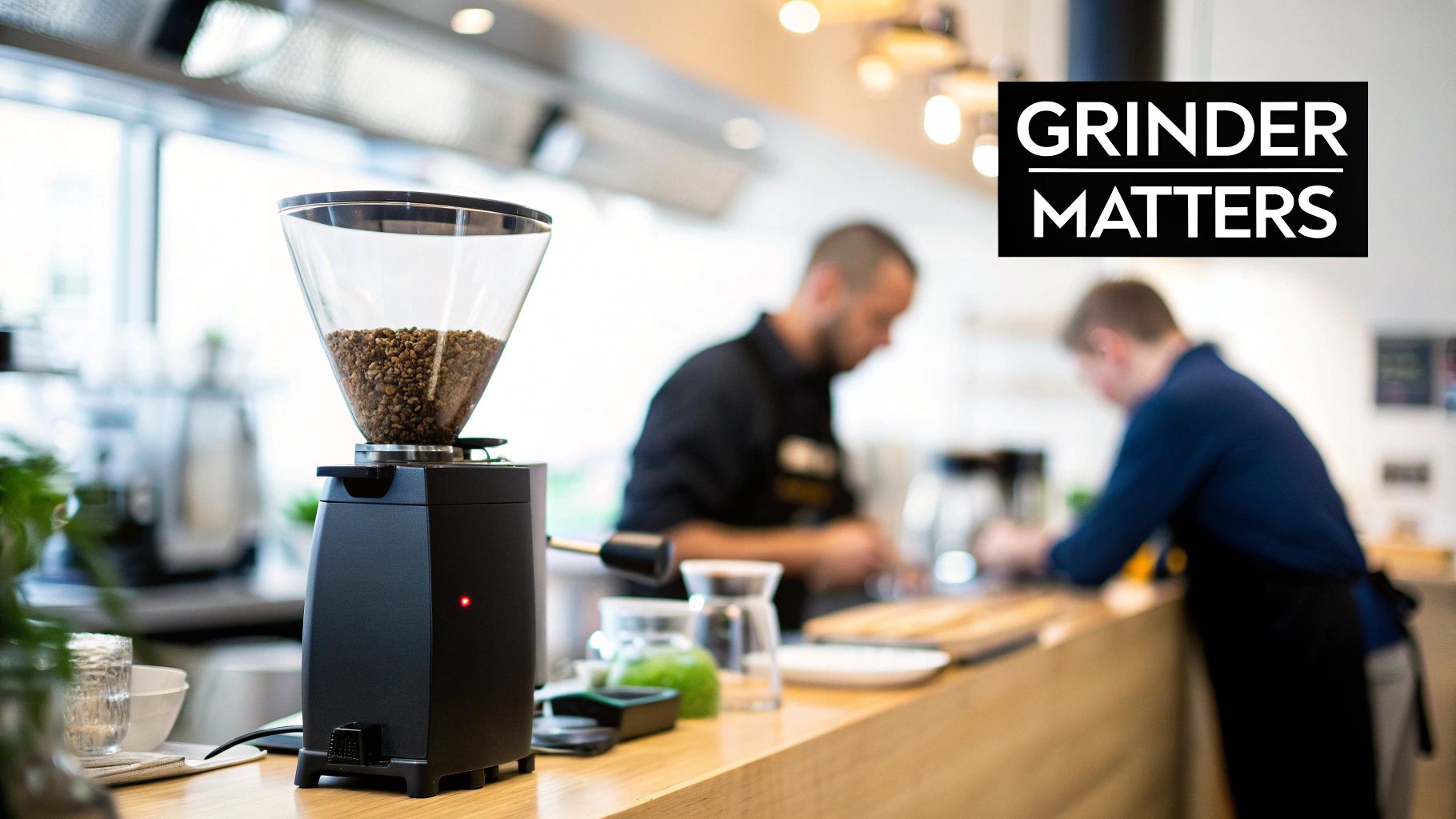
So many new cafe owners pour their budget into a flashy, high-end espresso machine, thinking it's the key to amazing coffee. Honestly, that's a common mistake. The grinder is the silent workhorse that actually unlocks the potential hidden inside your coffee beans. It’s the real difference between a memorable, perfectly extracted espresso and a bitter, forgettable one.
Here’s a good way to think about it: your espresso machine is the oven, but your grinder prepares the ingredients. It doesn't matter how incredible that oven is—it can't fix poorly prepped ingredients. A great grinder ensures every tiny particle of coffee is the exact right size, which leads to consistent extraction, predictable shot times, and a far superior final cup. That consistency is the bedrock of a great reputation and what keeps customers coming back.
How Does a Grinder Affect Your Bottom Line?
Beyond flavor, the right grinder has a direct, measurable impact on your operational efficiency and your profits. A machine that’s slow, inaccurate, or a pain to adjust will create serious bottlenecks during your morning rush, leading to longer wait times and lost sales. In contrast, an efficient, reliable grinder empowers your baristas to work faster and more consistently, serving more customers with less stress.
This focus on foundational equipment is crucial for success. The growing demand is reflected in the global commercial coffee bean grinders market, valued at USD 1.96 billion in 2024 and projected to reach USD 2.86 billion by 2035.
Your grinder isn't an expense—it's an asset that generates revenue. It reduces coffee waste, increases customer throughput, and builds the quality reputation that allows for premium pricing.
Beyond the equipment itself, smart business owners know that repeat business is everything. They focus on strategies like creating effective coffee shop loyalty programs to ensure those happy customers keep returning. By understanding the critical role of your grinder, you shift from simply buying equipment to making a strategic investment in your cafe’s future.
What's Inside? A Guide to Grinder Technology
The heart of any commercial coffee grinder isn't the flashy exterior; it's the technology humming away inside. Understanding the key components—the burrs, the motor, and something called grind retention—is like learning to read a blueprint for performance. These specs aren't just technical jargon; they directly translate into the quality of your coffee, the speed of your service, and the consistency of every single cup you sell.
A spec sheet can look a little intimidating at first glance, but once you learn the language, you can see how each feature solves a real-world problem behind the bar. Let’s pull back the curtain on the technology that separates a good grinder from a truly great one.
Flat vs. Conical Burrs: Which One Do You Need?
At the core of every high-quality grinder are the burrs, the two abrasive surfaces that crush whole coffee beans into uniform particles. Think of them like a chef's knives—the style of the knife dictates the type of cut, and the same is true for burrs and coffee grounds.
You'll mainly run into two types when you're hunting for the best commercial coffee grinder: flat and conical.
Flat Burrs: Imagine a Santoku knife, famous for its incredibly precise, clean, and uniform cuts. Flat burrs work in a similar way, using two parallel, ring-shaped discs to grind coffee into exceptionally consistent particles. This uniformity is absolutely critical for espresso, as it helps water pass through the coffee bed evenly, preventing "channeling" and ensuring a balanced, delicious extraction.
Conical Burrs: Now, think of a versatile chef's knife that can handle a whole range of kitchen tasks. Conical burrs have a cone-shaped inner burr and a ring-shaped outer burr. They create what’s known as a bimodal distribution of particle sizes (a mix of very fine and slightly coarser particles), which can add a wonderful complexity and body to brew methods like pour-over and drip coffee.
The choice between flat and conical burrs is a fundamental one. It's a strategic decision driven by everything from market demand to technological innovation, with the burr grinder segment projected to see some serious growth. The big players in the industry are constantly adapting their product lines to meet the diverse needs of both commercial and home users. You can learn more about these commercial coffee grinder market trends and see how things are evolving.
But for most modern cafes laser-focused on espresso? Flat burrs are the undisputed industry standard.
To make the choice clearer, let's break down the key differences.
Flat vs. Conical: A Quick Comparison
| Feature | Flat Burrs | Conical Burrs |
|---|---|---|
| Ideal Use Case | Espresso, single-origin espresso | Drip, pour-over, French press, versatile use |
| Grind Particles | Highly uniform, unimodal particle size | Bimodal particle size (fines and coarse) |
| Flavor Profile | Clarity, sweetness, highlights acidity | Body, complexity, rich texture |
| Heat Generation | Can generate more heat at high RPMs | Generally runs cooler, lower RPMs |
| Retention | Can have slightly higher retention | Often has lower retention |
| Alignment | Precise alignment is critical | More forgiving on alignment |
Ultimately, your menu dictates your choice. If espresso is your star, flat burrs will give you the precision you need. If you're running a diverse coffee program, a conical burr grinder could be a fantastic all-rounder.
Why Burr Size and Material Matter
Beyond just the shape, two other factors dramatically influence a grinder's performance: the size (measured in diameter) and the material of the burrs.
Bigger is often better here. Larger burrs give you more grinding surface area, which means they can grind coffee faster and at lower RPMs. This is a huge advantage because slower rotation generates less heat. Heat is the ultimate enemy of fresh coffee; it can literally bake the grounds before they even hit the portafilter, leaving you with flat, bitter flavors. A grinder with large burrs can power through a busy morning rush without overheating.
Burr material, usually steel or ceramic, affects both durability and how the burrs handle heat. Hardened steel burrs are the most common choice in commercial settings, prized for their sharpness and incredible longevity. They provide that clean, precise cut that's so essential for high-quality espresso.
Specific Burr Size Ranges
So, what numbers should you actually look for on a spec sheet? For any serious commercial application, you’ll want to see burrs that are at least 60mm in diameter. Anything smaller is generally intended for home use and simply won’t withstand the demands of a busy café. Most high-performance commercial grinders feature burrs ranging from 65mm to 180mm. A larger diameter provides more surface area to grind beans faster and at lower RPMs, which is the key to minimizing heat buildup that can destroy delicate flavor compounds. This efficiency is what allows a grinder to power through a morning rush without sacrificing the quality of a single shot. When you're ready to shop restaurant equipment, keep these figures in mind—a larger burr size is a direct investment in speed, consistency, and better-tasting coffee.
What Is Grind Retention and Why Does It Matter?
Here’s one of the most overlooked—but absolutely critical—specs: grind retention. This is simply the amount of stale, old coffee grounds left inside the grinder's chamber after each dose.
Imagine you grind a perfect 18-gram dose for an espresso. If your grinder has high retention, maybe 2-3 grams of those fresh grounds get left behind, swapped out for old grounds from the shot you pulled ten minutes ago. That stale coffee will immediately taint the flavor of your customer's drink.
Low retention isn't a luxury; it's a requirement for quality. It ensures that the coffee you grind is the coffee you serve, protecting flavor integrity and reducing waste from having to purge old grounds before every shot.
Look for grinders designed with minimal empty space between the burrs and the exit chute. That specific design choice directly minimizes how much coffee can get trapped, ensuring a fresher, more delicious dose every single time.
Don't Forget the Motor: What You Need to Know
Finally, let's talk about the motor. It's the engine that drives the whole operation. A weak motor will struggle under the load of a busy morning rush, running slow, generating excess heat, and maybe even stalling out completely.
A powerful motor, on the other hand, delivers the consistent torque needed to crush beans effortlessly, shot after shot. The best commercial coffee grinder will have a motor built for continuous, heavy use, often with features like cooling fans to maintain an optimal operating temperature. This ensures the grinder can perform reliably for hours on end, delivering consistent results from the first shot of the day to the very last. Reading the motor specs gives you a clear picture of the machine's endurance and its ability to handle your peak volume without breaking a sweat.
The Power of AC Motors
When you look at motor specifications, you'll often see "AC motor" listed for high-end commercial models. This isn't just a technical detail; it's a sign of durability and power. Unlike the DC motors found in most home grinders, commercial grinders use stronger AC motors that are specifically designed to run for extended periods without faltering. This is the kind of relentless performance you need to handle a line of customers that stretches out the door. An AC motor provides consistent, unwavering power, ensuring your grind speed and quality don't drop off halfway through the morning rush. It’s the difference between a machine built for a marathon and one built for a sprint.
Advanced Grinding Technology
The best commercial coffee grinders today are more than just powerful motors and sharp burrs; they're sophisticated pieces of technology designed to perfect the art of consistency. Modern grinders are packed with smart features that give baristas an incredible level of control over every single dose. These advancements aren't gimmicks—they are engineered to solve real-world problems like workflow bottlenecks, inconsistent shot times, and coffee waste. Top brands like Mahlkönig design their grinders for "mastering consistency" and getting "repeatable coffee quality," which is exactly what you need to build a reputation for excellence. Understanding these features will help you choose a machine that actively works to make your coffee better and your baristas more efficient.
Grind-by-Weight, Time, and Sync
Three of the most impactful innovations you'll see are Grind-by-Weight, Grind-by-Time, and Grind-by-Sync. Grind-by-Weight technology uses a built-in scale to dose coffee with incredible precision, eliminating the need for a separate scale and ensuring every shot is perfect down to a tenth of a gram. Grind-by-Time is a more common feature that doses based on a pre-set timer, offering a huge speed and consistency advantage over manual dosing. Finally, Grind-by-Sync allows the grinder to communicate with your espresso machine, automatically starting the grinding process for the next shot. These smart features streamline your workflow, reduce human error, and deliver the kind of precision that was once only possible with painstaking manual effort.
The Importance of Temperature Control
One of the biggest threats to your coffee's flavor is something you can't even see: heat. As one expert puts it, "Heat is the ultimate enemy of fresh coffee; it can literally bake the grounds before they even hit the portafilter, leaving you with flat, bitter flavors." This is especially true in a high-volume setting where the grinder is running almost constantly. The friction from the burrs and the heat from the motor can quickly build up, altering the delicate flavor compounds in your beans. That's why top-tier grinders incorporate cooling systems, like ventilation or dedicated fans, to maintain a stable temperature. This ensures that the last coffee you serve is just as fresh and vibrant as the first.
The Benefit of Upgradable Parts
Investing in a commercial grinder doesn't always mean buying the most expensive model right out of the gate. One of the smartest strategies for a new or growing cafe is to choose a grinder with a clear upgrade path. Many excellent mid-range grinders are built on the same solid chassis as their top-of-the-line counterparts, with the primary difference being the burrs or other internal components. This modular design is a huge advantage, as it allows you to improve your grinder's performance as your business grows and your budget allows. It’s a forward-thinking approach that protects your initial investment while giving you room to evolve.
For example, you can often upgrade parts like burrs on more affordable grinders to get the same high quality as more expensive models. This means you can start with a reliable workhorse and later swap in a set of premium burrs to achieve greater clarity and precision in your espresso. This strategy allows you to manage your initial equipment costs without sacrificing future quality. Making smart, incremental investments in your core machinery is key to long-term success. When you're planning your budget, considering options like restaurant equipment financing can also make it easier to acquire foundational pieces that offer this kind of flexibility and long-term value from the start.
How to Match a Grinder to Your Daily Volume
Choosing the wrong grinder for your cafe's volume is like trying to do a semi-truck's job with a small sedan—it might work for a moment, but you’re heading straight for a breakdown. Undersizing your grinder is a recipe for overheating, wildly inconsistent grinds, and a workflow bottleneck right when you need speed the most. On the flip side, oversizing means you've tied up serious capital in a machine whose power you'll never actually use.
The key is to ditch the guesswork and match your grinder's capabilities directly to your real-world demand. It all starts with one simple but critical piece of data: your peak-hour drink volume. Forget your total daily sales; zoom in on the busiest 60-90 minutes of your day. That number will tell you everything you need to know about the motor power, burr size, and overall throughput your operation truly demands.
Low, Medium, or High Volume? Finding Your Fit
To find the best commercial coffee grinder for your shop, we can break things down into three clear tiers based on daily output. Each tier has its own distinct needs when it comes to power and performance.
Low Volume (Under 50 drinks/day): This is the world of boutique shops, small bakeries, or restaurants where coffee is an important, but not primary, menu item. Your grinder doesn't need to be the fastest horse in the race, but it absolutely must be consistent. Look for grinders with smaller motors built for intermittent use and smaller burrs (around 50-60mm) that deliver quality without the hefty price tag. Hopper size is less of a concern here, as you won't be flying through beans.
Medium Volume (50-200 drinks/day): Welcome to the classic neighborhood cafe. You’ve got a distinct morning rush and a steady stream of customers all day. At this level, durability and speed become way more important. Your grinder needs a beefy motor, ideally with cooling features to prevent overheating during those long rushes. This is where larger burrs (a 64mm set is a popular sweet spot) become essential for grinding faster while keeping that particle uniformity locked in.
High Volume (200+ drinks/day): Now we're talking busy downtown cafes, drive-thrus, and any spot with a relentless queue. For this tier, maximum throughput is completely non-negotiable. You need a powerhouse with a heavy-duty motor, active cooling systems, and large flat burrs (75mm or larger) to chew through massive amounts of coffee quickly without generating excess heat. Efficiency features like grind-by-weight technology become invaluable for keeping up speed and accuracy under intense pressure.
A common mistake is buying a grinder for the business you hope to have, not the one you have right now. Be brutally honest about your current volume. You can always upgrade as you grow, but starting with the wrong machine will only hold you back.
Do You Need Dedicated Grinders for Espresso and Drip?
Once you've nailed down your volume tier, the next step is to look at your menu's complexity. Trying to use a single grinder for everything—your main espresso blend, decaf, and that special single-origin pour-over—is a recipe for operational chaos and flavor contamination.
Think about it: every time you switch beans, you have to empty the hopper, purge the old grounds, and then dial in the grind setting for the new coffee. That whole process wastes time, beans, and money, especially during a rush. More importantly, residual grounds from a dark, oily espresso blend will completely ruin the delicate, floral notes of an expensive single-origin filter coffee.
This infographic simplifies the initial choice based on your primary brewing method, a key step in building your grinder lineup.
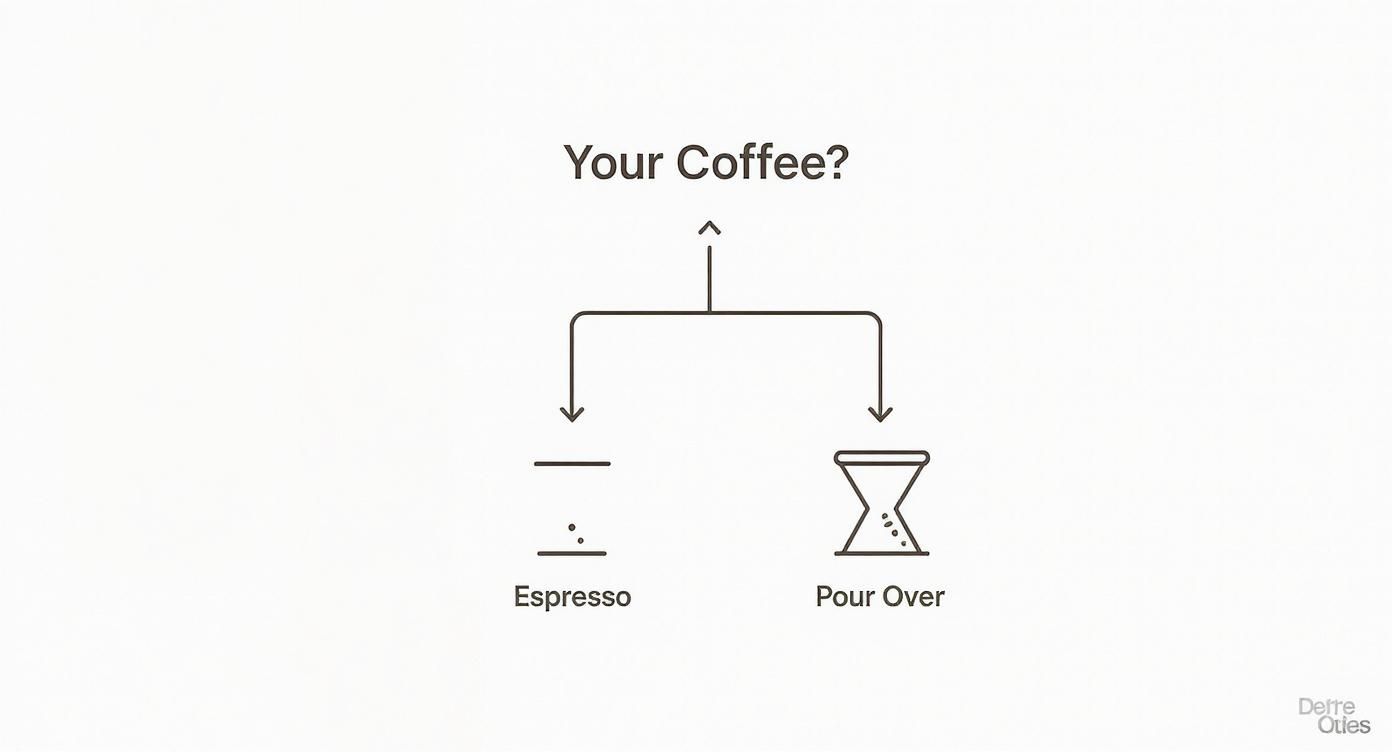
The visual clearly shows how the precision demands of espresso push you toward flat burrs, while pour-over methods are often better served by conical burrs that enhance body.
For any serious coffee program, dedicated grinders aren't a luxury; they are a necessity for quality and efficiency. A typical professional setup includes:
- Main Espresso Grinder: The workhorse for your house blend.
- Decaf Espresso Grinder: Prevents cross-contamination and keeps the workflow moving.
- Filter/Pour-Over Grinder: Often a conical burr model to handle a range of batch brew and single-cup offerings.
This approach protects the unique flavor profile of each coffee you serve and empowers your baristas to work cleanly and quickly, without constant, frustrating recalibration. It's a fundamental investment in a seamless workflow and a superior customer experience.
Considering Industrial Grinders for Roasting Operations
When you move from running a cafe to roasting your own coffee, the scale of your equipment changes completely. You’re no longer grinding a few doses per minute—you’re processing hundreds of kilograms of beans every hour. This is the world of industrial grinders. These machines are true powerhouses, engineered with heavy-duty motors and massive burrs for non-stop, high-volume work. To put it in perspective, some professional coffee grinders can handle up to 300 kilograms per hour. That kind of throughput is non-negotiable for a roasting business. It allows you to grind entire batches quickly and consistently, all without the excess heat that can ruin the delicate flavors you perfected in the roaster. This isn't just a step up; it's a different class of equipment designed for massive efficiency and endurance.
Fitting Your Grinder into Your Cafe's Workflow
A great grinder isn't just a machine; it’s a crucial member of your bar team. It needs to fit right into the daily rhythm of your cafe, making your baristas' jobs easier, not harder. This is where we go beyond the spec sheet and get into the real-world logistics of owning and operating a commercial coffee grinder. It's about thinking through the physical footprint, the noise it makes, and the simple habits that will keep it running like a dream.
Getting this integration right is what turns a solid equipment purchase into a smart business decision. It's about crafting a workspace that’s efficient, feels good for both staff and customers, and is built from the ground up for consistent quality.
Beyond the Grind: Counter Space and Cafe Ambiance
Before you even plug it in, you have to decide where your new grinder is going to live. Counter space is some of the most valuable real estate in your cafe, and every inch is precious. Make sure you measure the spot carefully, leaving enough room not just for the grinder itself but for your barista to move around it comfortably. A cramped workspace is a recipe for spills, slow service, and frustrated staff.
Beyond the physical fit, think about how the grinder will impact your cafe's vibe. Some high-output grinders can be seriously loud. If your bar is open to the seating area, that constant roar can completely shatter the calm, cozy atmosphere people come for. In that case, look for models designed with noise-dampening features. It's a small detail that makes a massive difference to the customer experience.
Choosing Your Workflow: Doser vs. On-Demand Grinders
One of the most important decisions you'll make for your workflow is choosing between a doser and an on-demand grinder. They operate in completely different ways.
- Doser Grinders: These are the old-school style. They grind a batch of coffee into a holding chamber, and the barista pulls a lever to dose out portions. While they can feel faster in a relentless rush, they’re a major source of waste and stale coffee.
- On-Demand (Doserless) Grinders: This is the modern standard, and for good reason. These grinders grind a precise, fresh dose of coffee directly into the portafilter the moment an order is placed. This method slashes waste, guarantees maximum freshness, and delivers shot-to-shot consistency that doser models simply can't touch.
For virtually any specialty coffee shop today, an on-demand grinder is the only way to go. The leap in quality and the reduction in waste easily trump any perceived speed advantage of an old-school doser.
Creating Your Grinder Maintenance Schedule
Your grinder is a serious investment. Like any valuable tool, it needs regular care to perform its best and last for years. A simple, consistent cleaning routine isn't just a good idea—it's non-negotiable for preserving the flavor of your coffee. Stale coffee oils and trapped grounds will quickly make even the best beans taste bitter and rancid.
Here’s a simple routine to get you started:
- Daily (5-10 Minutes): At closing time, brush out the burr chamber and dosing chute to clear out loose grounds. Wipe down the exterior and the bean hopper to get rid of dust and oils.
- Weekly (15-20 Minutes): Time for a deeper clean. Run a specialized grinder cleaning product (like Grindz) through the burrs to break down those stubborn coffee oils. Follow it up by grinding a small amount of coffee to purge any cleaner residue.
- Monthly/Quarterly: Depending on your volume, you may need to do a full teardown to deep clean the burrs and the entire grinding chamber. This is the only way to ensure no old coffee particles can taint the flavor.
A clean grinder is a consistent grinder. Five minutes of cleaning at the end of the day is the single best thing you can do to guarantee that the first coffee of the morning tastes just as good as the last.
This dedication to consistency is what the entire industry is built on. The coffee grinder market, which includes both commercial and home units, was valued at USD 430.14 million in 2025 and is projected to hit USD 731.28 million by 2032. That growth shows just how much demand there is for reliable, high-quality gear.
Of course, a grinder works hand-in-hand with its espresso machine. To learn more about that critical partnership, you might find the ultimate barista's guide to the Astoria Espresso Machine helpful. And for a broader look at outfitting your entire space, check out our guide on the best equipment for a new coffee shop.
A Step-by-Step Cleaning Guide
Ready to get your hands dirty? Just kidding—it’s not that messy. Here’s a straightforward routine you can follow to keep your grinder in perfect working order. Think of it as a small daily ritual that protects your investment and guarantees every cup of coffee is as fresh as possible. A clean machine is the foundation for great flavor, and understanding how buildup affects taste is the best motivation for ensuring no old, rancid oils spoil your carefully sourced beans.
Follow these simple steps to keep your grinder performing at its peak:
- Unplug It: Before you do anything else, always unplug the grinder from the wall. This is the most important step for safety. No exceptions.
- Empty the Hopper: Get all the leftover coffee beans out of the hopper. This prevents stale, old beans from mixing with your fresh supply and tainting the flavor.
- Disassemble the Removable Parts: Carefully take apart the hopper, the upper burr carrier, and any other removable pieces. Every grinder is a little different, so keep your manufacturer's guide handy if you're unsure.
- Brush Everything Out: Use a stiff, food-safe brush to sweep out all the loose coffee grounds from the grind chamber, the chute where the coffee comes out, and the burrs themselves.
- Clear Out the Fine Dust: For the stubborn, fine coffee dust that clings to everything, a small vacuum with a hose attachment or a can of compressed air works wonders. Get into all the nooks and crannies.
- Wash and Dry: Clean the hopper and any other washable parts with warm, soapy water. The most critical part of this step is to make sure every single piece is completely dry before you put it back. Any moisture can cause rust on the burrs or make fresh grounds clump together.
- Reassemble and Test: Once everything is clean and dry, put your grinder back together. Before you start serving customers, grind a small, sacrificial dose of coffee to make sure everything is running smoothly and to purge any grounds that may have been dislodged during cleaning.
By making this quick clean a part of your daily closing routine, you’re not just maintaining a piece of equipment; you’re ensuring consistency. You're making sure that the first coffee you serve in the morning is just as delicious and clean-tasting as the last one you served the day before. It’s that attention to detail that sets a great cafe apart.
What's the True Cost and ROI of a Grinder?
It’s time to talk about the numbers that really matter. A commercial coffee grinder isn't just another line item on an expense sheet; it's a powerful tool for generating revenue and should deliver a clear return on your investment. Thinking about a grinder only in terms of its upfront cost is a huge mistake that can hamstring your café’s potential before you even serve your first customer.
The right machine pays for itself over time by boosting quality, slashing waste, and speeding up service. Let's break down the market into practical price tiers and dig into how a high-performance grinder actually makes you money.
What Do You Get for Your Money? A Feature Breakdown
The market for commercial grinders can be split into three main price brackets. Each tier lines up with a different level of build quality, features, and the kind of business it’s truly built for.
To make things clearer, here's a simple breakdown of what you can expect at different price points.
Commercial Grinder Cost and Feature Breakdown
| Price Bracket | Typical Features | Best For |
|---|---|---|
| Entry-Level ($500-$1,500) | Smaller flat burrs (50-60mm), durable plastic components, basic timed dosing. | Low-volume cafes, restaurants, bakeries, or as a dedicated decaf grinder. |
| Mid-Range ($1,500-$3,000) | Larger steel burrs (64-75mm), robust metal construction, active cooling fans, precise on-demand dosing. | The majority of medium-to-high volume cafes that need a reliable daily workhorse. |
| High-End ($3,000+) | Extra-large burrs (80mm+), grind-by-weight tech, minimal retention design, advanced cooling. | Specialty shops focused on quality, high-volume cafes demanding ultimate consistency. |
Understanding these tiers helps you match your budget to your real-world needs. A small bakery doesn't need a $4,000 machine, but a busy cafe trying to skate by with an entry-level model is going to hit a performance wall—fast.
How to Calculate Your Grinder's ROI
A great grinder pays you back in three key ways: it cuts down on waste, speeds up service, and lets you justify premium prices. Think of it like plugging leaks in your revenue bucket while also opening up the faucet. A quality machine can pay for itself a lot faster than you’d think.
Here’s how the math breaks down:
Reduced Coffee Waste: High-retention grinders can waste 1-2 grams of coffee per shot from purging old grounds. If you pull 150 shots a day, that’s up to 300 grams of wasted coffee daily. At $15/lb for beans, you could be throwing away over $2,400 a year in coffee alone. A low-retention grinder turns that waste directly back into profit.
Increased Service Speed: A grinder that doses an 18-gram shot in 3 seconds versus 7 seconds saves you 4 seconds per drink. During a morning rush where you serve 100 customers, that’s over 6 minutes saved. This extra time allows you to serve more customers, increasing your peak-hour revenue potential.
Enhanced Cup Quality: Most importantly, a better grinder produces a noticeably better-tasting cup of coffee. That superior quality is what builds a loyal customer base and gives you the confidence to price your drinks at a premium, directly boosting your profit margins on every single sale.
Your grinder's true cost isn't the price on the tag. It's the purchase price minus the money it saves you on waste and the extra revenue it helps you generate through speed and quality.
Exploring the Used Grinder Market
If you're working with a tight budget, the used market can be a fantastic way to get a high-performance grinder without the brand-new price tag. Many cafes upgrade their equipment long before it's actually worn out, which means you can often find a durable, commercial-grade machine with plenty of life left in it. It’s a smart, resourceful move that lets you allocate more of your startup capital to other essential areas of your business. This approach isn't about cutting corners; it's about making strategic investments to get the best possible gear for your money, setting your new cafe up for success from day one.
Finding Quality Used Models
When you start your search, focus on brands known for building machines that last. Look for names like Mahlkönig, Mazzer, Bunn, and Ditting—these are the tanks of the coffee world, and their grinders are often built to be serviced, not replaced. You can frequently find these workhorses for a fraction of their original cost, sometimes in the $100 to $500 range, making a top-tier grinder incredibly accessible. While saving money upfront on a used model is a great strategy, remember that for larger new equipment purchases, exploring restaurant equipment financing can make getting warrantied gear much more manageable and predictable for your budget.
Common Repairs and Considerations
Buying used means you need to be a bit of a detective. The most common part that needs replacing is the burrs, but thankfully, this is usually a simple and affordable fix you can do yourself without needing special tools. When you inspect a used grinder, pay close attention to the motor—does it run smoothly and quietly, or does it sound strained? Check the burrs for any obvious dullness or damage. It's also a good idea to ask about its history. A grinder from a low-volume restaurant will have a lot less wear and tear than one that powered a busy drive-thru for five years. Being thorough here ensures your great deal doesn't turn into a headache down the road.
Financing vs. Leasing: What's Right for You?
The upfront cost of a top-tier grinder can feel pretty intimidating, especially if you’re just starting out. But you don’t have to drain your capital to get the best equipment. Smart financing and leasing programs are designed to make high-end gear accessible without a massive initial hit.
Leasing a grinder, for example, gets you a high-performance machine for a predictable, manageable monthly payment. This keeps your cash flow healthy and frees up capital for other essentials like marketing, staffing, or inventory. You can even explore tools to help you plan these expenses; using a restaurant equipment finance calculator can give you a clear picture of what your monthly payments might look like.
This approach lets you benefit from the ROI of a superior grinder from day one, using the extra revenue and savings it generates to help cover its own cost. It’s a strategic way to equip your cafe for success without putting your financial stability at risk.
Top Commercial Coffee Grinder Models to Consider
Now that you know what to look for, let's get into some specific models that consistently earn top marks from baristas and cafe owners. This isn't an exhaustive list, but it represents the best of the best across different price points and use cases. Whether you're running a high-volume drive-thru or a specialty pour-over bar, there's a grinder here that’s built to handle your specific needs. These are the workhorses that deliver on the promise of speed, consistency, and exceptional coffee quality, day in and day out.
For High-Volume Shops: Mahlkonig E80S GBW
When your cafe is absolutely slammed and every second counts, the Mahlkonig E80S GBW is the machine you want on your counter. This is a top-tier grinder built for pure speed and precision. It features massive 80mm flat burrs that can grind a full 18-gram dose in a mind-blowing 3 seconds. But its real superpower is the "Grind-by-Weight" (GBW) technology. Instead of relying on a timer, it doses the exact weight of coffee you need every single time, eliminating inconsistencies and waste. For a high-volume shop, this means faster service, perfectly repeatable shots, and a significant reduction in coffee costs over time.
Affordable High-Speed Option: Anfim Alba
If you love the lightning-fast performance of the E80S but need a more budget-friendly option, the Anfim Alba is an incredible contender. It delivers the same impressive speed, grinding a double shot of espresso in just 3 seconds. The main trade-off for the lower price point is a plastic body instead of the Mahlkonig's all-metal construction. However, the Alba has a clever trick up its sleeve: you can upgrade its burrs to the same high-quality set found in the E80S. This gives you a clear path to improve performance down the line, making it a smart, flexible investment for a growing cafe.
For Consistent Temperature: Mythos MYG75
The Mythos MYG75 is a grinder designed for the ultimate thermal stability. During a long rush, grinder burrs can heat up, causing the grind size to drift and affecting the taste of your espresso. The Mythos tackles this problem head-on with a specialized system that actively controls the burr temperature, ensuring your grind is incredibly consistent from the first shot of the day to the last. It features sleek 75mm flat burrs and also offers an optional "Gravimetric" system, which is their version of Grind-by-Weight. It's a fantastic choice for specialty shops that prioritize absolute consistency and flavor clarity.
For Bulk Grinding: Mahlkonig EK43
You'll see the iconic Mahlkonig EK43 in almost every serious specialty coffee shop, but it serves a very different purpose. This grinder isn't for dosing individual espresso shots; it's a bulk grinding powerhouse designed to tear through entire bags of beans in seconds. Its massive burrs and powerful motor make it the perfect tool for grinding coffee for batch brew, pour-overs, cold brew, or for bagging retail coffee for your customers. Its versatility is legendary, and it delivers a famously uniform grind that helps extract incredible sweetness and clarity from any coffee you put through it.
Best Value for Espresso: Mahlkonig E65S GBW
Think of the Mahlkonig E65S GBW as the slightly smaller, more accessible version of the E80S. It packs much of the same incredible technology into a more compact and affordable package. With 65mm burrs, it offers the same fantastic workflow and produces delicious, consistent espresso. It maintains a strong metal body and also features the game-changing Grind-by-Weight system for perfect, waste-free dosing. For many medium-to-high volume cafes, the E65S hits the absolute sweet spot of price, performance, and premium build quality, making it one of the best commercial coffee grinders you can buy for the money.
For Medium-Sized Cafes: Anfim Luna
Following the same logic as its bigger sibling, the Anfim Luna is the value-driven alternative to the Mahlkonig E65S. It provides a similar level of performance but at a more approachable price, primarily by using a durable plastic outer shell instead of a full metal body. This makes it a fantastic entry point into high-quality, on-demand grinding for medium-sized cafes. Just like the Alba, you have the option to upgrade the burrs to match the E65S, giving you a performance ceiling that can grow with your business. It’s a practical, reliable choice that doesn't force you to compromise on the quality of your coffee.
Ready to Buy? Your Final Checklist
You've made it through the technical deep dive and now you know what separates a workhorse grinder from a countertop paperweight. It’s time to put all that knowledge to work. Think of this as your final pre-flight check before you commit to one of the most important pieces of gear in your entire coffee setup.
Getting this right prevents a world of frustration and costly mistakes down the line. Before you click "add to cart," take a moment to run through these questions. Answering them honestly will connect the dots between the specs on a page and the reality of your daily grind.
Final Questions to Ask Before You Buy
This isn't just a list; it's a blueprint for your perfect grinder. Each question is designed to make you think about your specific cafe, your team, and your customers.
- What’s my real peak-hour volume? Be brutally honest. Is it 50 drinks, or is it closer to 200? This single number is the key to choosing the right motor and burr set.
- What does my menu actually demand? If you’re slinging espresso all day, that’s one thing. But if you’re also offering pour-overs, batch brew, and decaf, you need to think about dedicated grinders to keep those flavors clean and distinct.
- Have I actually measured my counter space? A grinder needs some elbow room. Get out the tape measure and confirm you have the space, making sure it fits neatly into your barista’s workflow—ideally right next to your espresso machine.
- Is my electrical setup good to go? Don't get tripped up on day one. Double-check the voltage and plug requirements to avoid a surprise call to an electrician.
- What's my total budget—really? Look beyond the sticker price. Factor in the long game, including routine maintenance and the eventual cost of a new set of burrs.
This checklist is how you turn theory into a concrete plan. It ensures the grinder you choose is based on your cafe's reality, not just a slick spec sheet.
By working through these points, you create a clear picture of the machine you need. This process ties all your gear decisions together, and for a complete look at what else you'll need, our comprehensive coffee shop equipment checklist can fill in any gaps.
You’re now ready to move from research to reality. Go make a confident choice that will power your business and delight your customers for years to come.
Got Questions About Commercial Grinders? We’ve Got Answers.
Even after you've done all the research, a few questions always seem to pop up right at the end. That's totally normal. Getting straight answers to these last few points can give you the confidence to pull the trigger on a grinder that’s going to be a real asset to your business. Let’s tackle some of the most common ones we hear.
How Often Do I Need to Replace the Burrs?
This is easily one of the most critical maintenance questions, and the honest answer is: it depends. The lifespan of your burrs comes down to your daily volume and the type of coffee you’re running through them. For a medium-volume cafe, a quality set of steel burrs should last for about 800 to 1,200 pounds of coffee.
But how do you know when it's time? Your coffee will tell you. Look out for these signs:
- Grind Inconsistency: You start seeing a mix of dust-like "fines" and chunky "boulders" in your grounds. A good grind should look uniform.
- Slower Grinding: The grinder takes noticeably longer to spit out the same dose it used to.
- Flavor Drop-Off: Your espresso shots start tasting flat, muddy, or just... dull. The vibrant notes are gone.
Think of your burrs like the tires on a car. As they wear down, performance suffers. Worn-out burrs just can't create the uniform particles you need for a balanced, delicious extraction, which directly impacts the quality of every single drink you serve.
Time-Based Replacement Schedules
Instead of waiting for your coffee quality to drop off a cliff, a much smarter approach is to set a time-based replacement schedule. Most steel burrs are rated for 800 to 1,200 pounds of coffee. Do a little quick math: if your cafe goes through, say, 30 pounds of espresso a week, you’ll hit that 800-pound mark in about six months. Mark that date on your calendar and order a new set of burrs *before* you need them. This proactive maintenance is the best way to guarantee consistency and protect the quality of every drink you serve. Treating all your shop restaurant equipment with this kind of planned care prevents unexpected downtime and keeps your business running smoothly.
Is a More Expensive Grinder Automatically Better?
Not at all. The "best" grinder isn't the one with the biggest price tag; it's the one that’s the perfect fit for your actual, day-to-day needs. A $4,000 grinder with fancy grind-by-weight tech is complete overkill for a small bakery selling maybe 30 coffees a day. On the flip side, a $700 entry-level model will become a massive bottleneck in a high-volume coffee shop, slowing down your whole operation.
The goal is to match the grinder's capabilities to your menu, your volume, and your workflow. A mid-range grinder that hits 100% of your needs is a much smarter investment than a top-of-the-line machine that's barely breaking a sweat.
Zero in on the features that will solve a real problem for you—whether that’s speed during the morning rush, dead-on consistency, or low coffee waste—instead of just chasing the most expensive model out there.
Can I Use Just One Grinder for Both Espresso and Drip Coffee?
Technically, some grinders can do both. But in a real café setting? It's a terrible idea that will create a workflow nightmare and make both your espresso and your drip coffee taste worse.
Here’s why it’s a non-starter in practice. Jumping from a coarse drip setting to a super-fine espresso setting isn't a quick flick of a switch. It requires a whole recalibration process called "dialing in," which wastes a ton of time and coffee—two things you can't afford to lose during a busy service. Plus, you’ll get cross-contamination. Leftover coarse grounds from your drip setting will absolutely ruin an espresso shot, and any lingering fine espresso particles will make your batch brew taste muddy and over-extracted. For quality and efficiency, dedicated grinders are non-negotiable.
Ready to find the perfect grinder that fits your volume, menu, and budget? Explore a wide range of top-tier options at The Restaurant Warehouse. Our equipment experts and flexible financing solutions make it easy to equip your cafe for success. Find your ideal grinder at https://therestaurantwarehouse.com today.
What Really Makes a Grinder "Commercial"?
The word "commercial" isn't just a marketing buzzword; it's a promise of durability, power, and consistency that a home grinder simply can't deliver. While a home unit is designed to grind coffee a few times a day, a commercial model is built to be a relentless workhorse. It features a much more powerful motor that can run for hours without overheating, paired with larger, tougher burrs designed to produce a perfectly uniform grind, shot after shot. This isn't just about making coffee; it's about reliably handling the intense pressure of a morning rush and ensuring the 200th customer gets the exact same quality as the first. This level of performance is the standard for all commercial-grade equipment, where failure during peak hours simply isn't an option.
Key Takeaways
- Your Grinder Is Your Most Important Investment: The quality and consistency of your grinder have a greater impact on flavor and profitability than your espresso machine. It's the true foundation of great coffee.
- Match the Grinder to Your Actual Volume: Select a grinder based on your peak-hour demand and menu complexity. Using dedicated grinders for different coffee types is essential for maintaining quality and an efficient workflow.
- Calculate the Return on Your Investment: A high-quality grinder isn't just an expense; it's a tool that generates revenue by reducing coffee waste, speeding up service, and enabling premium pricing for a superior product.
Related Articles
About The Author

Sean Kearney
Sean Kearney is the Founder of The Restaurant Warehouse, with 15 years of experience in the restaurant equipment industry and more than 30 years in ecommerce, beginning with Amazon.com. As an equipment distributor and supplier, Sean helps restaurant owners make confident purchasing decisions through clear pricing, practical guidance, and a more transparent online buying experience.
Connect with Sean on LinkedIn, Instagram, YouTube, or Facebook.