

The Great Debate: Unpacking the Pros and Cons of Restaurant vs. Food Truck
The Modern Culinary Crossroads
For aspiring food entrepreneurs, the restaurant food truck debate represents a fundamental crossroads in the journey to culinary success. This is more than a simple choice between a kitchen on wheels and a fixed address; it's a decision that defines your business model, your relationship with customers, and your day-to-day life as a business owner. Both paths offer unique avenues to profitability and brand recognition, but they diverge dramatically in terms of startup costs, operational flexibility, market reach, and long-term growth potential. The modern food landscape, shaped by a dynamic foodie culture and a demand for authentic, accessible culinary experiences, has liftd both models. The food truck, once a novelty, is now a respected incubator for culinary innovation, while the traditional restaurant continues to be the bedrock of community dining and gastronomic artistry.
Quick Comparison: Restaurant vs. Food Truck
| Factor | Food Truck | Traditional Restaurant |
|---|---|---|
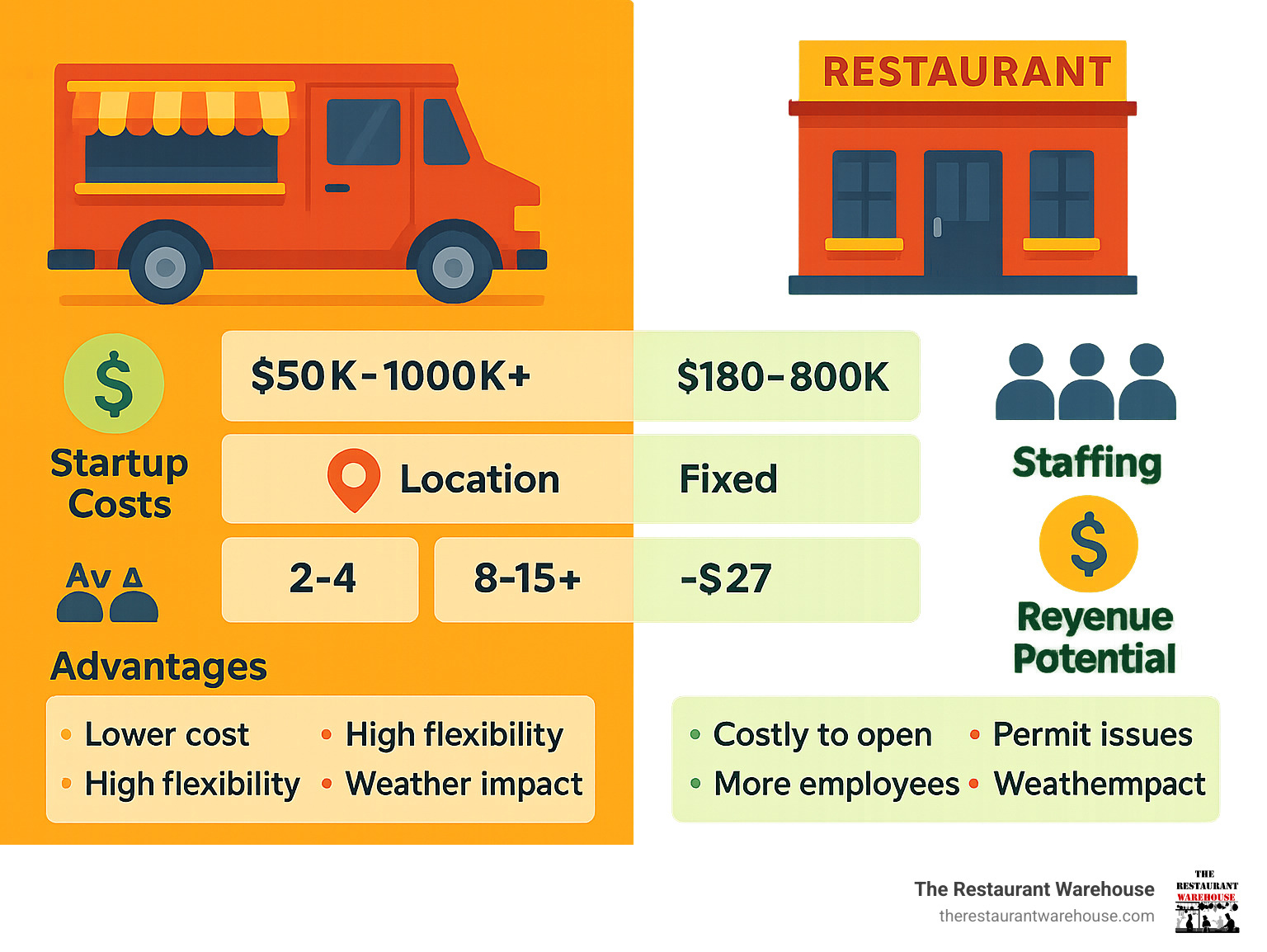
| Startup Cost | $50,000 - $100,000+ | $180,000 - $800,000+ |
| Location | Mobile, follows customers | Fixed, builds community |
| Staff Needed | 2-4 people | 8-15+ people |
| Revenue per Customer | ~$2 after expenses | ~$27 average transaction |
| Time to Profit | 6-12 months | 12-24 months |
The food truck industry has experienced explosive growth, reaching an estimated $2.7 billion by 2017 and continuing its upward trajectory. This surge reflects a significant shift in entrepreneurial thinking within the food sector. Many chefs and business owners now view food trucks not just as a stepping stone, but as a destination in themselves—a lean, agile, and viable alternative to the high-stakes world of brick-and-mortar establishments. This model allows for direct interaction with customers, rapid concept testing, and the ability to tap into diverse revenue streams like festivals, private catering, and corporate events.
However, it is crucial to understand that neither option is inherently superior. The ideal choice is deeply personal and strategic, contingent on your available capital, risk tolerance, lifestyle preferences, target demographic, and ultimate vision for your brand. A food truck promises the allure of mobility and significantly lower initial investment, but this freedom comes with its own set of formidable challenges: a complex web of municipal permits, the constant search for profitable parking, and a business model that is often at the mercy of the weather. Conversely, a traditional restaurant provides the invaluable assets of stability, a controlled environment, and much higher revenue potential per customer. This permanence, however, demands a monumental capital outlay, a long-term lease commitment, and the immense responsibility of managing a larger staff and facility.
The decision ultimately boils down to a series of critical trade-offs: choosing between flexibility and stability, lower initial costs and higher long-term revenue potential, and the freedom of mobility versus the power of permanence. Before starting on either path, a deep, honest assessment of these factors is not just recommended—it's essential for survival and success.
Must-know restaurant food truck terms:
- Commissary Kitchen
- Mobile Vending Permit
- Route Planning
- POS System
- Build-Out Costs
The Financial Fork in the Road: Startup Costs and Operational Expenses
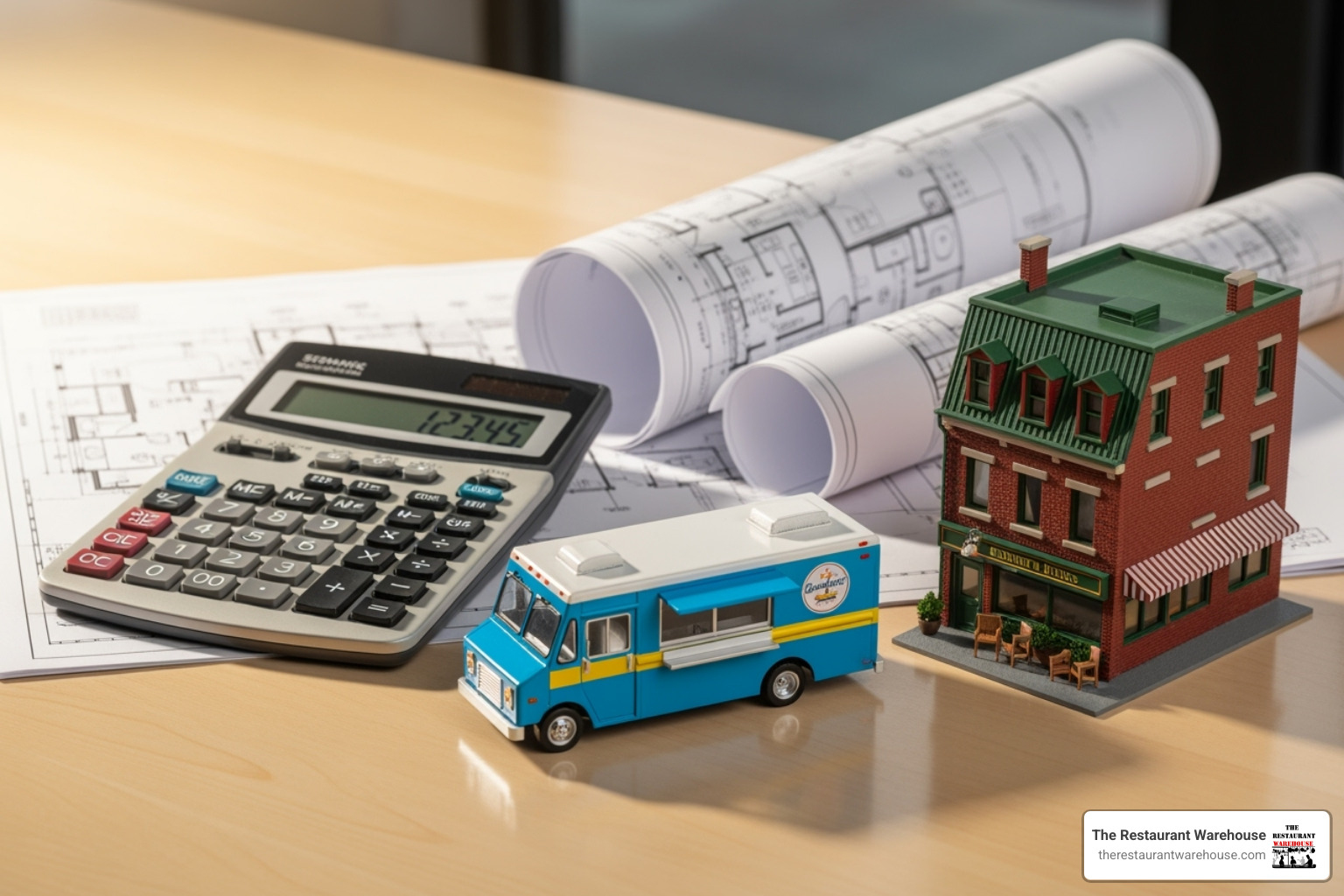
The initial investment is, for many, the most significant barrier to entry in the food industry. The financial realities of launching a restaurant food truck are starkly different from those of a traditional eatery, and this divergence impacts every subsequent decision, from securing your first loan to managing daily cash flow. A carefully crafted financial plan, complete with detailed projections and a robust contingency fund, is the non-negotiable backbone of any successful culinary venture, regardless of its form.
Breaking Down Food Truck Startup Capital
Food trucks present a more financially accessible entry point, with typical startup costs ranging from $50,000 to over $100,000. This figure generally covers the vehicle, essential kitchen outfitting, and initial operating capital. While still a substantial sum, it represents a mere fraction of the investment required for a brick-and-mortar restaurant, making it an attractive option for first-time entrepreneurs or those testing a new concept.
The vehicle itself is the single largest line item. A reliable used food truck can range from $30,000 to $75,000, depending on its age, mileage, and existing condition. For those seeking a turnkey solution, a new, custom-built vehicle can easily exceed $150,000. Leasing has also emerged as a popular strategy, allowing operators to enter the market with a lower upfront cash outlay, test their concept's viability, and potentially upgrade later.
Outfitting the mobile kitchen with the necessary tools for your specific menu can add another $5,000 to $30,000. This includes everything from refrigeration and cooking surfaces to prep stations and storage. Every square inch of a food truck is prime real estate, so efficient layout and multi-functional items are paramount to a smooth operation. A comprehensive list of kitchen essentials is a vital planning tool to ensure you are fully prepared for service.
Beyond the physical assets, a successful launch requires budgeting for a host of other expenses. Permits and licenses can cost $1,000 to $5,000 annually, varying wildly by municipality. Initial inventory and supplies, comprehensive business and vehicle insurance ($1,000 to $4,000 annually), and a professionally designed vehicle wrap to serve as your mobile billboard ($2,000 to $5,000+) are all critical pre-launch investments. With ongoing monthly expenses for a profitable truck often hovering around 85% of monthly sales, maintaining rigorous control over costs is not just good practice—it's essential for survival.
Understanding Brick-and-Mortar Restaurant Investments
Starting on the journey of opening a traditional restaurant is a significant financial undertaking, with startup costs ranging from $180,000 on the low end for a small cafe to well over $800,000 for a larger, full-service establishment in a prime location. The primary drivers of these liftd costs are the size, location, and permanence of the business.
Real estate is unequivocally the largest expense. Whether leasing or buying, securing a physical location involves substantial upfront costs, including security deposits, first and last month's rent, and potentially legal fees for lease review, which can collectively range from $30,000 to $100,000 or more. Following this, extensive and costly renovations are often required to transform a raw space into a functional and compliant restaurant. This build-out includes major investments in plumbing, electrical systems, HVAC, and interior design to create the desired atmosphere. You'll also need to outfit a much larger kitchen, with a wider array of specialized stations than a food truck requires.
Beyond the physical space, significant capital is allocated to furniture, fixtures, and equipment (FF&E), including tables, chairs, lighting, a sophisticated point-of-sale (POS) system, and a full complement of dining ware. Unlike a food truck's lean 2-4 person crew, a restaurant necessitates a full brigade of staff, including cooks, servers, hosts, bartenders, and managers. The costs associated with recruiting, hiring, and training this team before the doors even open represent a substantial pre-opening expense. This, combined with ongoing payroll, becomes one of the largest operational costs. While the average transaction is significantly higher at around $27 per customer, the business must generate consistent and high-volume traffic to cover these immense fixed costs and achieve profitability.
Location, Location, Location: Flexibility vs. Stability
One of the most defining differences between a restaurant food truck and a traditional restaurant lies in the concept of location. This single choice dictates how you find and connect with your customers, how you adapt to market trends and seasonal changes, and how you manage your daily operations. It is a strategic decision that fundamentally shapes the identity and trajectory of your entire business journey, pitting the agile freedom of mobility against the anchoring power of a permanent home.
The Freedom of the Open Road: A Food Truck's Reach
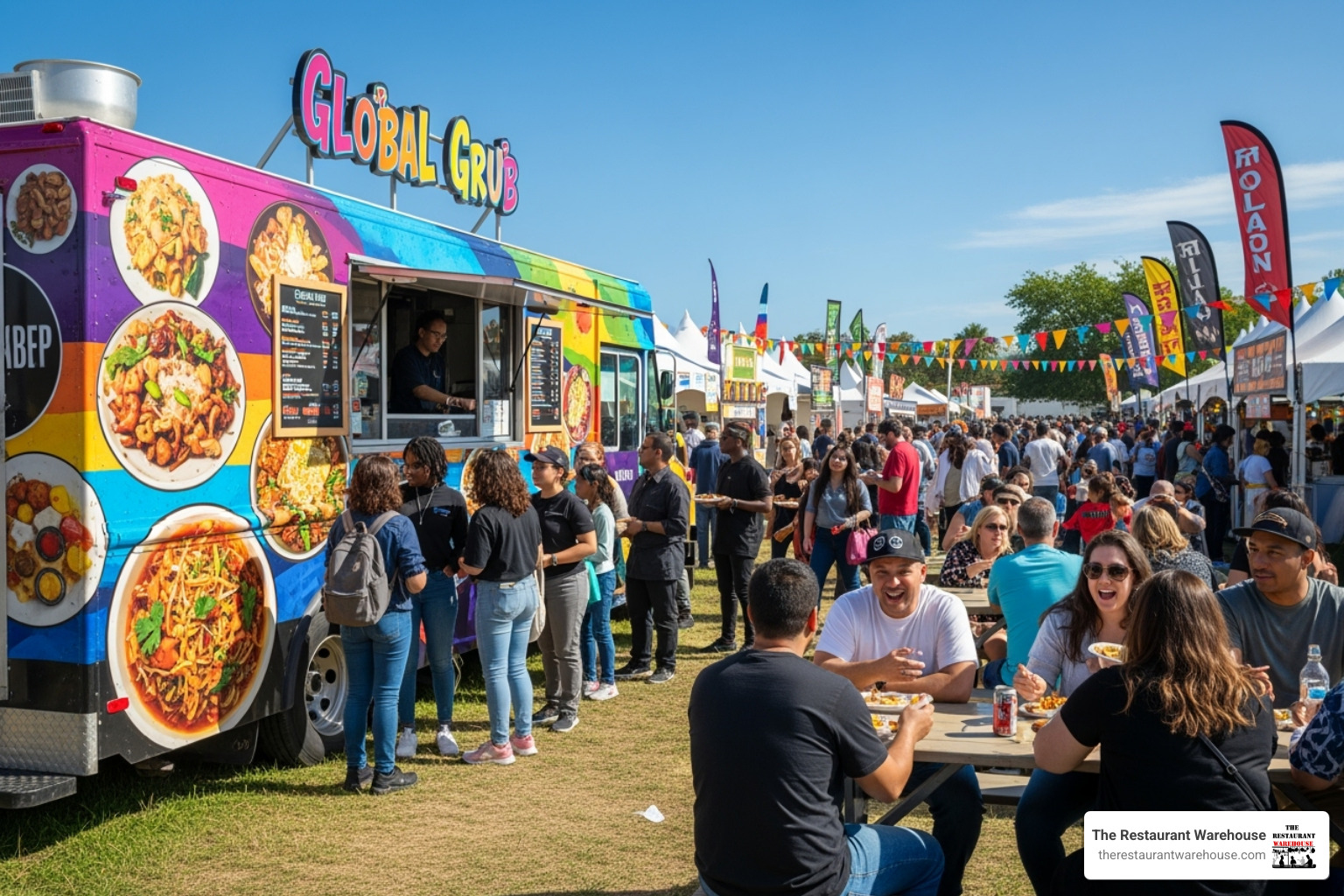
The core magic and primary strategic advantage of a food truck is its inherent mobility. You are not bound to a single address; instead, you possess the freedom to go wherever your target customers congregate. This gives you an unparalleled advantage in testing different markets and demographics without the commitment of a long-term lease. One day you might be serving the lunch rush at a busy corporate park, the next you could be at the heart of a vibrant music festival, a local farmers market, or a craft brewery. This adaptability also open ups highly lucrative private catering opportunities, from weddings to corporate functions, which can provide a stable and predictable revenue stream to complement daily sales.
This "restaurant on wheels" model empowers you to be nimble and responsive to demand. If a particular location proves to be less profitable than anticipated, you can simply start the engine and move to a new one. Many successful food truck owners develop a strategic weekly route, building a loyal following among regulars in different neighborhoods, while still retaining the flexibility to pivot to high-traffic special events on weekends. This ability to chase the crowds and position your business directly in the path of hungry customers is a powerful tool for building brand awareness and maximizing sales. It allows you to put your brand on the map by actively seeking out your audience rather than waiting for them to find you.
The Power of Place: A Restaurant's Community Anchor
A brick-and-mortar restaurant operates on the opposite principle. It is, by its very nature, fixed, stable, and designed to become a fixture within its environment. While you sacrifice the freedom of mobility, you gain a profound sense of permanence and place. Your restaurant has the potential to evolve beyond a mere place to eat, becoming a beloved neighborhood hub—a reliable and trusted destination for celebrations, casual weeknight dinners, and community gatherings. This stability fosters a deep, lasting loyalty that is difficult to replicate with a mobile model.
A fixed location allows you to carefully cultivate a specific atmosphere and a consistent, immersive brand experience. From the interior design and lighting to the music and decor, every element is within your control, working in concert to tell your brand's story. Customers know exactly where to find you, and your physical storefront serves as a constant, 24/7 marketing tool. This fosters a strong connection to the local community, as you become part of the fabric of the neighborhood. Furthermore, you are insulated from the daily whims of weather; a rainy day that might devastate a food truck's sales can be a cozy, inviting opportunity for a restaurant. The primary challenge, and it is a significant one, lies in the initial, high-stakes decision of choosing the perfect location—one with the right demographic fit, sufficient foot traffic, and a favorable competitive landscape to ensure your tables remain full.
Crafting the Experience: Menu, Operations, and Atmosphere
The soul of any food business resides in the intricate dance of preparing and serving its offerings. For a restaurant food truck versus a traditional restaurant, these operational realities are worlds apart, shaping everything from the composition of the menu and the structure of the team to the very essence of the customer experience.
Menu Design for a Restaurant vs. Food Truck
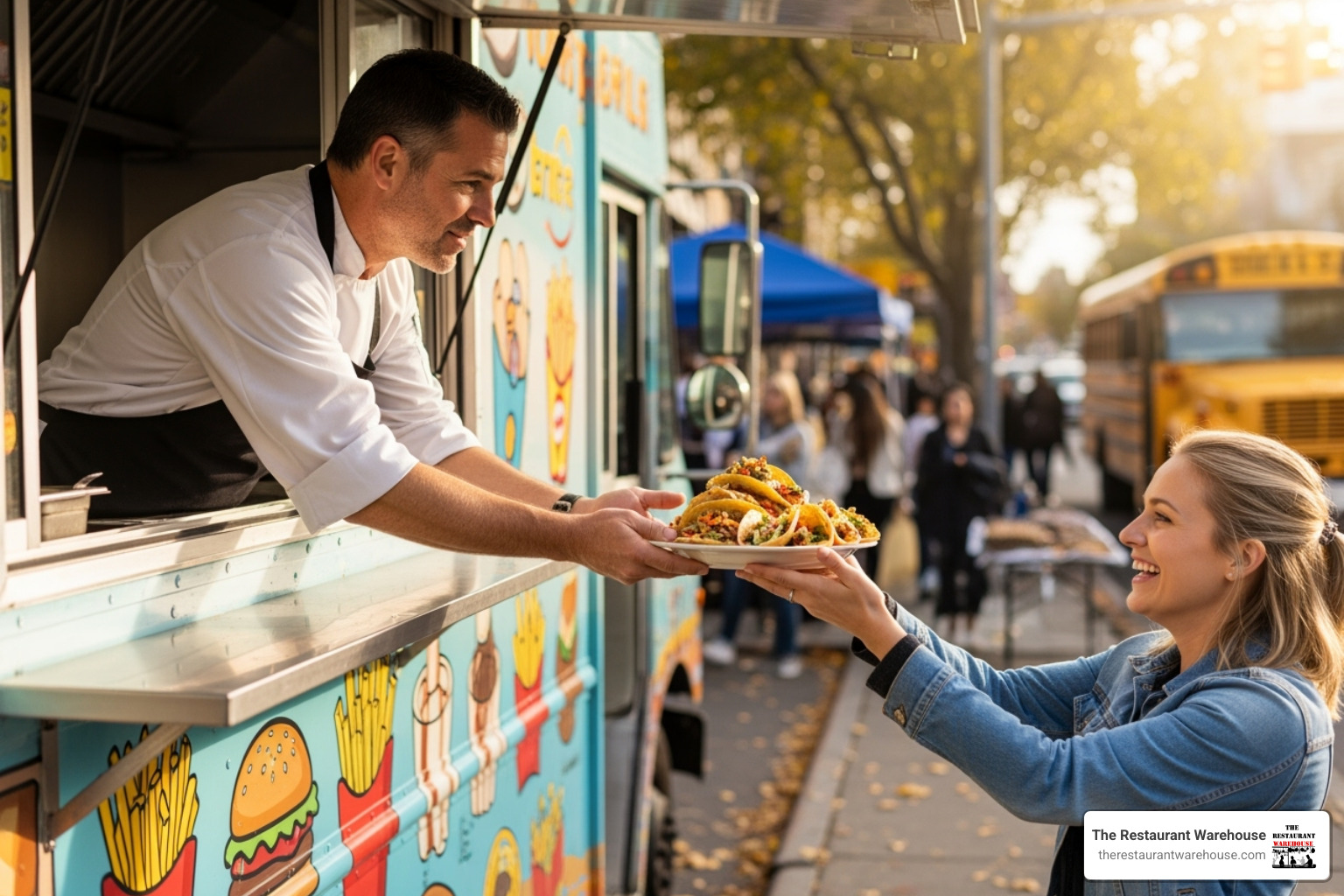
Designing a food truck menu is an exercise in strategic limitation. You are constrained by limited space for storage and preparation, and your offerings must cater to customers who are often eating on the go. This naturally leads to highly focused, streamlined menus centered on a specific concept, such as gourmet burgers, artisanal tacos, or specialty grilled cheese. The emphasis is on items that are easy to hold and eat without a table. Speed and efficiency are paramount; every dish must be designed for rapid assembly and cooking to manage long lines during peak hours. This operational necessity influences every choice, from the ingredients sourced to the cooking methods employed. Smart menu engineering, cross-utilization of ingredients, and meticulous organization are the keys to maximizing output and profitability within the confines of a small, mobile kitchen.
In stark contrast, traditional restaurants benefit from the luxury of space. Expansive kitchens with dedicated stations for different culinary tasks allow for complex, multi-component dishes that require longer prep times and intricate plating. The menu can be much broader, offering everything from appetizers and salads to elaborate entrees and decadent desserts. You are not confined to handheld foods, enabling the creation of multi-course dining experiences. This abundance of space also translates to broader and more flexible sourcing options. A restaurant can build relationships with a diverse array of local farms and purveyors, allowing for daily specials based on seasonal availability and the ability to tell a deeper, more nuanced culinary story.
Staffing and Management: Lean Team vs. Full Brigade
A restaurant food truck is the epitome of a lean operation, typically run by a small, agile crew of 2-4 people. In this tight-knit environment, every team member must be a versatile multitasker, capable of taking orders, cooking, prepping, and cleaning. The owner-operator model is extremely common, with the owner working directly in the truck, shoulder-to-shoulder with their team. This hands-on approach fosters direct customer relationships, ensures rigorous quality control, and allows for immediate problem-solving. Clear, constant communication is absolutely critical to navigating the close quarters and high-pressure rushes of service.
Traditional restaurants, on the other hand, require a full brigade of staff with specialized roles. The operation is typically divided into a front-of-house team (hosts, servers, bartenders, bussers) and a back-of-house team (line cooks, prep cooks, chefs, dishwashers), easily totaling 8-15+ employees for even a moderately sized establishment. This division of labor allows for a higher level of specialized service and culinary execution but comes with significantly higher payroll costs, more complex scheduling, and the challenges of managing a larger, more diverse team. The management structure is necessarily more hierarchical to ensure smooth coordination between the front and back of the house.
Setting the Scene: Customer Experience and Ambiance
The restaurant food truck experience is inherently direct, personal, and informal. Customers order at a service window, often interacting directly with the person who is cooking their meal. The atmosphere is casual, energetic, and social, with the "dining room" being a nearby park bench, an office courtyard, or simply the sidewalk. This creates a dynamic, street-level energy. However, the experience is heavily influenced by external factors, most notably the weather. A beautiful sunny day can create a festive, communal vibe, while rain, wind, or extreme temperatures can deter customers and create an uncomfortable environment.
Traditional restaurants offer the immense advantage of complete environmental control. As the owner, you are the architect of the entire customer experience. You can carefully orchestrate the ambiance through deliberate choices in lighting, music, furniture, and decor to create a specific mood, whether it's a romantic, fine-dining setting or a lively, family-friendly bistro. The full-service experience encourages leisurely meals, special occasion celebrations, and social gatherings, which in turn supports higher check averages. This controlled, predictable setting requires a significant upfront investment but provides a consistent, comfortable, and memorable experience for guests, regardless of what's happening outside.
Building Your Brand: Marketing and Growth in the Restaurant Food Truck World
Whether you are serving customers from a service window or seating them in a dining room, building a strong, recognizable brand is essential for long-term success. However, the strategies and tactics used for marketing, generating revenue, and planning for future growth diverge significantly in the restaurant food truck world compared to the established playbook for traditional restaurants.
Marketing on the Move vs. Marketing a Destination

For a food truck owner, social media is not just a marketing tool; it is a lifeline. Platforms like Instagram, Facebook, and X (formerly Twitter) function as your virtual storefront and real-time GPS. The core of your marketing strategy revolves around announcing your daily or weekly location, posting tantalizing photos of your food, and engaging directly with your followers. This creates a dynamic, interactive relationship with your customer base, who actively follow you to see where you'll be next. This sense of urgency and findy is a powerful marketing driver. Successful trucks master the art of real-time updates, flash promotions, and user-generated content to build a loyal digital community that translates into physical lines at the truck.
In contrast, a traditional restaurant's marketing focuses on establishing itself as a reliable, desirable destination. While social media is still important for showcasing the ambiance and menu, the emphasis shifts to local search engine optimization (SEO). The goal is to appear prominently in searches like "best Italian restaurant near me" or "brunch spots in downtown." A well-optimized Google Business Profile, a steady stream of positive Yelp and TripAdvisor reviews, and clear physical signage all work in concert to build a strong, permanent presence in the community. Marketing efforts are designed to compound over time, building a reputation that draws in both locals and visitors. Customers know where to find you without checking social media daily, which allows for deeper engagement strategies like email newsletters, reservation-based promotions, and robust loyalty programs.
The Bottom Line: Revenue Streams and Profitability
A restaurant food truck typically operates on a high-volume, lower-margin business model. With lower overhead costs (no rent, fewer staff), the path to profitability can be much quicker, often within the first 6-12 months. A profitable truck might see monthly sales between $20,000 and $40,000, with a net profit of about $2 per customer after all expenses are paid. The key to maximizing revenue lies in diversifying income streams. This means balancing steady daily sales at lunch spots with highly lucrative catering gigs, music festivals, weddings, and other special events, which can significantly boost the bottom line and improve brand visibility.
Traditional restaurants face a much longer and more expensive path to profitability, often taking 12-24 months to get into the black due to high startup costs and substantial fixed overhead. However, the potential for overall revenue is significantly higher, with an average revenue per customer of around $27. Key revenue streams are more varied and stable, including dine-in sales, takeout and delivery services, high-margin alcohol and beverage sales, and the booking of private parties and events, which can transform traditionally slow nights into highly profitable ones.
The Long Game: Growth Trajectories and Exit Strategies
For successful restaurant food truck owners, growth often means scaling the mobile concept. This could involve expanding the fleet with additional trucks, potentially launching different culinary concepts under a parent brand to capture more of the market. Many entrepreneurs strategically use their food truck as a proof-of-concept and marketing vehicle for an eventual brick-and-mortar expansion. By building a loyal customer base and perfecting their operations on a smaller scale, they dramatically reduce the risk of opening a full-fledged restaurant. Franchising the mobile concept is another popular and scalable growth path.
Growth for a traditional restaurant can take several forms. The most common path is opening additional locations in new neighborhoods or cities. Another avenue is brand extension, which can include developing a line of retail products like signature sauces, spice blends, or frozen meals sold in grocery stores. Expanding the catering and private events division can also be a major growth driver, leveraging the existing kitchen and brand reputation.
When it comes to an exit strategy, selling a food truck business is typically a more straightforward transaction, involving the sale of a vehicle, equipment, and the brand's intellectual property. Selling a restaurant is a far more complex but potentially more lucrative endeavor. The sale often involves valuable real estate or a long-term lease, extensive physical assets, established goodwill in the community, and a larger, more stable revenue stream, making it an attractive asset for buyers or investment groups.
Navigating the Red Tape: A Look at Regulations and Licensing
For any new food entrepreneur, navigating the labyrinth of legal and regulatory requirements is one of the most daunting and critical challenges. The frameworks governing a restaurant food truck and a traditional restaurant are often managed by different government departments, involve distinct processes, and can vary wildly from one city or county to the next. Underestimating the complexity and cost of compliance is a common and costly mistake.
The Regulatory Maze for a Restaurant Food Truck
Operating a food truck means entering a unique, and often frustratingly convoluted, regulatory maze. The laws governing mobile food vending are relatively new compared to those for restaurants, and as a result, they can be inconsistent, constantly evolving, and highly localized. The time and money required to secure all necessary permits frequently surprise new owners.
Key requirements and challenges include:
- Mobile Vending Permits: These are the golden tickets that dictate where and when you are legally allowed to operate. The rules vary immensely from city to city. Some municipalities have designated zones for food trucks, while others have strict proximity rules preventing you from operating within a certain distance of existing restaurants.
- Commissary Kitchen Agreement: Most health departments require food trucks to operate in conjunction with a licensed commissary kitchen. This is a commercial facility where you will conduct most of your food prep, store bulk ingredients, dispose of waste and used water, and park your vehicle overnight. This adds a significant monthly operational cost, often ranging from $300 to $1,000 or more.
- Parking Restrictions and Route Planning: Beyond the vending permit, you'll face a web of local parking regulations. These can limit how long you can remain in one spot, restrict operations in residential areas, and create logistical headaches. Strategic route planning becomes a constant operational task.
- Specialized Insurance and Health Permits: Food trucks require a unique blend of commercial auto insurance and general business liability insurance. Health department permits for mobile units are distinct from those for restaurants, with a heavy focus on specific mobile requirements like the capacity of on-board fresh and grey water tanks, and the presence of mandatory hand-washing and dish-washing sinks.
Staying current with these evolving laws is a continuous responsibility. Joining a local food truck association can be an invaluable resource for navigating these challenges.
Established Compliance for Brick-and-Mortar Eateries
While traditional restaurants face an equally stringent, if not more extensive, set of regulations, the framework is generally more established and predictable. The laws governing fixed commercial establishments have been in place for decades, which often results in a clearer, more standardized process for achieving compliance, though it is by no means simple or inexpensive.
Key requirements include:
- Building and Zoning Permits: Before any construction or significant renovation can begin, you must obtain the proper building permits, which ensure your plans comply with local building codes, fire safety standards, and zoning laws.
- Certificate of Occupancy (CO): This is one of the most critical documents. Issued after a final inspection, the CO confirms that the building is safe for public use and meets all municipal codes. You cannot legally open for business without it.
- Health Department Inspections: Restaurants are subject to regular, and often unannounced, health inspections. These are thorough examinations of the entire facility, including food storage temperatures, kitchen sanitation, staff hygiene, and pest control.
- Liquor Licenses: If you plan to serve alcohol—a major revenue driver for most full-service restaurants—you must steer the complex and often expensive process of obtaining a liquor license. These are heavily regulated by state and local authorities and can be limited in number, making them difficult to acquire.
- ADA Compliance: The Americans with Disabilities Act (ADA) mandates that your restaurant must be accessible to all customers, including those with disabilities. This includes requirements for ramps, accessible restrooms, and appropriate table heights.
While the initial problems of permits and build-out are substantial, the ongoing compliance for a restaurant is often more straightforward than for a food truck, as the rules are less ambiguous and not subject to the daily logistical challenges of mobility.
Frequently Asked Questions about Starting a Food Business
Aspiring entrepreneurs are often filled with questions as they weigh the significant pros and cons of launching a restaurant food truck versus a traditional eatery. Understanding the nuances of each path is critical before investing your time and capital. Here are detailed answers to some of the most common questions.
Is it cheaper to start a food truck than a restaurant?
Yes, without question, it is significantly cheaper to start a food truck. The primary reason for this vast difference is real estate. A food truck business avoids the enormous costs associated with leasing or purchasing a commercial property and the subsequent expensive build-out. The initial investment for a food truck, including the vehicle, kitchen outfitting, licenses, and initial operating capital, typically falls between $50,000 and $100,000+. In contrast, a brick-and-mortar restaurant can easily cost $180,000 to $800,000 or more, with prime locations and extensive renovations pushing that figure even higher. The savings also extend to staffing, as a truck can operate with a lean team of 2-4 people, whereas a restaurant requires a full brigade of 8-15+ employees, leading to much higher payroll expenses from day one.
Can a food truck be more profitable than a restaurant?
This is a complex question where the answer is, "it depends." In terms of profit margin and speed to profitability, a food truck often has the advantage. Due to dramatically lower overhead, a well-run food truck can become profitable in just 6-12 months. However, they operate on a model of high volume and low profit per transaction, typically earning around $2 in net profit per customer. A traditional restaurant has much higher fixed costs and a longer path to profitability (12-24 months), but its profit potential is ultimately greater due to a much higher average transaction value (around $27) and more diverse, high-margin revenue streams like alcohol sales and private events. A food truck's peak profitability is often capped by its service speed and capacity, while a restaurant's potential is limited more by its seating capacity and turnover. Therefore, while a food truck might be more profitable relative to its initial investment, a successful restaurant generally has a higher ceiling for total annual profit.
What is the biggest challenge for food truck owners?
While financial management is a universal challenge, most seasoned food truck owners would point to a dual challenge: navigating regulations and securing consistently profitable locations. The regulatory landscape is a complex, ever-changing web of city-specific permits, health codes designed for mobile units, commissary requirements, and confusing parking rules. This administrative burden is a constant struggle. Simultaneously, the success of the business hinges on being in the right place at the right time. Finding and gaining access to locations with high, consistent foot traffic—be it a downtown lunch spot, a brewery, or a weekend festival—is a major and ongoing hurdle. This requires constant research, networking, and adaptation, as a once-lucrative spot can dry up overnight.
Do I need a formal business plan for a food truck?
Absolutely. A formal business plan is non-negotiable, whether you're starting a food truck or a fine-dining restaurant. This document is your strategic roadmap. It forces you to think through every aspect of your venture, including your core concept, target market analysis, menu design and costing, marketing and branding strategy, operational plan, and, most importantly, detailed financial projections (startup costs, profit and loss statements, cash flow analysis). If you plan to seek any form of outside funding, whether from a bank, an investor, or even family, a professional business plan will be the first thing they ask to see. It demonstrates that you have done your due diligence and have a viable plan for success.
Conclusion: Which Path Will You Pave?
As we have explored, the choice between launching a restaurant food truck and opening a traditional eatery is not a simple one. It is a decision that requires a deep and honest assessment of your personal and financial resources, your tolerance for risk, and your ultimate vision for your culinary brand. There is no single correct answer, no universally superior model—only the path that aligns perfectly with your unique circumstances and entrepreneurial dream.
Food trucks represent a gateway to the industry defined by agility and a lower barrier to entry. They offer the unparalleled freedom to chase customers, to test and refine a culinary concept with minimal risk, and to operate with a lean, tight-knit team. This flexibility, however, is balanced by the persistent challenges of navigating a complex web of municipal regulations, the daily grind of finding reliable and profitable locations, and the inherent vulnerability to weather and logistical issues.
On the other hand, a traditional restaurant stands as a testament to stability and permanence. While it demands a far greater initial investment of capital and time, it offers the invaluable opportunity to build a true community anchor. It allows you to carefully craft a controlled and immersive dining atmosphere, cultivate deep customer loyalty, and open up significantly higher revenue potential per customer through diverse and high-margin offerings. This stability comes at the cost of mobility and saddles you with the immense responsibility of a fixed location and a large staff.
Your choice will ultimately depend on which set of trade-offs you are willing to make. Are you a nimble innovator eager to hit the streets and build a following from the ground up? Or are you a visionary host dedicated to creating a lasting destination and a cornerstone of your neighborhood? Consider your capital, your desired lifestyle, and the kind of customer experience you are most passionate about creating.
Regardless of the path you choose, success in the food industry is built on a foundation of passion, perseverance, and meticulous planning. It requires a deep understanding of your costs, a relentless focus on quality and consistency, and a creative approach to connecting with your customers. The journey is demanding, but for those who get the recipe right, the reward of turning a culinary vision into a thriving, beloved business is immeasurable.
About The Author

Sean Kearney
Sean Kearney used to work at Amazon.com and started The Restaurant Warehouse. He has more than 10 years of experience in restaurant equipment and supplies. He graduated from the University of Washington in 1993. He earned a BA in business and marketing. He also played linebacker for the Huskies football team. He helps restaurants find equipment at a fair price and offers financing options. You can connect with Sean on LinkedIn or Facebook.
Leave a comment