

Steps to Open a Restaurant A Realistic Guide
So, you’re thinking about opening a restaurant. It’s an exciting thought, but turning that dream of serving amazing food into a thriving, profitable business is a serious journey. It all starts long before you ever fire up a stove, built on a solid foundation of strategic thinking and asking the tough questions.
Let's dive into the first, and arguably most important, phase: taking that brilliant idea in your head and turning it into a concrete blueprint.
From Concept to Reality: Your Restaurant Blueprint

Every great restaurant begins with a single, powerful idea. But an idea alone won't pay the rent. The first real step is to shape that abstract concept into a defined, marketable brand that resonates with a specific audience. This is your blueprint—the strategic foundation you'll build everything else upon.
This initial phase is all about challenging your assumptions before you spend a single significant dollar. It’s time to set aside the romantic notion of just "opening a restaurant" and focus on building a sustainable business that has a real chance to succeed.
Define Your Core Concept
Your restaurant concept is so much more than the type of food you plan to serve. It's the entire experience you're offering your guests—a promise that sets you apart from every other place they could go. Think of it as your restaurant's unique personality.
To really nail this down, you need to get specific on a few key elements:
- Service Style: Will you be a fine-dining spot, a fast-casual joint, a bustling diner, or a cozy café? This decision drives everything from your staffing plan to your kitchen layout.
- Cuisine and Menu: Be specific. Instead of just "Italian," maybe you're "Northern Italian cuisine specializing in handmade pasta." This kind of clarity helps define your identity and attract the right customers.
- Ambiance and Decor: What’s the vibe? Is it rustic and casual, modern and sleek, or vibrant and eclectic? Your atmosphere should feel like a natural extension of your menu and price point.
- Target Audience: Who are you really trying to attract? Young professionals, families with kids, college students, or high-income foodies? You can't be everything to everyone, so get clear on this now.
Before you go any further, it's incredibly helpful to organize your thoughts. Use this checklist to make sure you've covered the essential building blocks of your concept.
Essential Restaurant Concept Checklist
| Concept Element | Key Questions to Answer | Example |
|---|---|---|
| Cuisine & Menu | What's your culinary focus? What are your signature dishes? | "Farm-to-table American with a seasonal, rotating menu." |
| Service Style | How will guests be served? (e.g., table service, counter) | "Fast-casual with counter ordering and food runners." |
| Target Audience | Who is your ideal customer? Demographics, psychographics? | "Health-conscious young professionals aged 25-40." |
| Ambiance/Decor | What is the look and feel? What mood are you creating? | "Industrial-chic with reclaimed wood, metal, and warm lighting." |
| Price Point | What will an average check be? (e.g., $, $$, $$$) | "$$ (Average entree price of $18-$25)." |
| Unique Selling Prop. | What makes you different and better than the competition? | "Only spot in the neighborhood with house-made gluten-free pasta." |
Having clear answers to these questions gives you a solid, defensible foundation to build upon. This isn't just an exercise; it's the core of your brand.
Conduct Meaningful Market Research
With a clearer concept in mind, it’s time to see if it has legs in the real world. Starting a restaurant means stepping into a massive, competitive industry projected to hit $4.1 trillion globally by 2033. Deep-dive market research isn't optional, especially when U.S. restaurant sales alone soared past $1.5 trillion in 2023. You have to understand your local market's DNA—consumer habits, economic health, and cultural trends—to find your sweet spot. For a deeper dive, explore the latest restaurant industry statistics and get a real competitive edge.
Pro Tip: Don't just research your direct competitors (other taquerias, for instance). Analyze your indirect competition, too. That includes any place your target customer might spend their dining dollars, from the hot bar at the local grocery store to meal-kit delivery services.
Analyze the Competition and Find Your Gap
Make a list of 5-10 local competitors. Then, go visit them. Go at different times of day, and don't just go as a customer—go as a detective.
Ask yourself these questions:
- What are they absolutely nailing? (e.g., amazing service, a killer happy hour, incredible ambiance)
- Where are their weaknesses? (e.g., slow service at lunch, dated decor, a confusing menu)
- Who are their customers, and do they overlap with your target audience?
- What’s their pricing strategy, and does the quality they deliver justify it?
Your goal here is simple: find a gap in the market. Maybe your town has a dozen pizza joints but lacks a quality, family-friendly spot that also serves craft beer for the parents. Perhaps there's a huge opportunity for a fast-casual lunch spot that focuses on healthy, locally sourced food.
That gap is your opportunity. Your unique selling proposition (USP) is born from what you can offer that nobody else is doing—or what you can do significantly better.
Crafting a Business Plan That Actually Secures Funding
Let’s be honest: your business plan is more than just a document you have to check off a list. It's the strategic story that gets lenders and investors to believe in your vision—and more importantly, to share the risk with you. This is the roadmap that proves you’ve graduated from the dream phase and are ready to run a serious, profitable business. A truly great plan shows you understand not just food, but the numbers that make a restaurant succeed or fail.
Forget the generic templates you find online. A plan that lands you the capital you need tells a compelling story backed by cold, hard data. It has to be persuasive, realistic, and incredibly detailed, showing you’ve thought through the challenges and have a clear path to generating a return.
The Essential Parts of Your Plan
Your business plan needs to walk the reader through several key areas, each one building on the last to paint a complete picture of your future restaurant. It's a living document that starts with your high-level vision and drills right down to the financial nuts and bolts.
The main sections should flow logically:
- Executive Summary: This is your power pitch—a concise, hard-hitting overview of your entire plan. You should write it last, but it absolutely must go first. Its job is to hook the reader and make them desperate to learn more about your unique concept.
- Company Description: Here’s where you bring your restaurant to life. Detail your concept, service style, who you're serving (your target audience), and what makes you special (your unique selling proposition or USP). Explain why your restaurant will thrive.
- Market Analysis: Show your work. Present the research you’ve done on the local neighborhood, your target customers, and your direct competitors. Use this data to prove there’s a real, tangible demand for what you’re offering.
- Management Team: Investors bet on people just as much as they bet on ideas. This is where you highlight the experience of your key players. If you’ve got a seasoned chef or a general manager with a proven track record, this is the place to shout it from the rooftops.
Each piece is a building block, forming a cohesive argument for why your restaurant is a solid investment.
Nailing Your Financial Projections
This is the section most investors flip to first. Your financial projections have to be thorough, grounded in reality, and completely defensible. Wildly optimistic or poorly researched numbers are a massive red flag and will get your proposal tossed in the "no" pile faster than you can say "check, please."
A classic rookie mistake is underestimating how much operating capital you'll need. It’s not enough to just have money for the build-out and equipment. Most industry experts recommend having at least six to nine months of operating expenses stashed away in cash reserves to survive that critical ramp-up period.
Your projections are essentially a story told through numbers, mapping out your journey from the initial investment all the way to profitability. This flow shows how the core steps of building that financial forecast fit together.
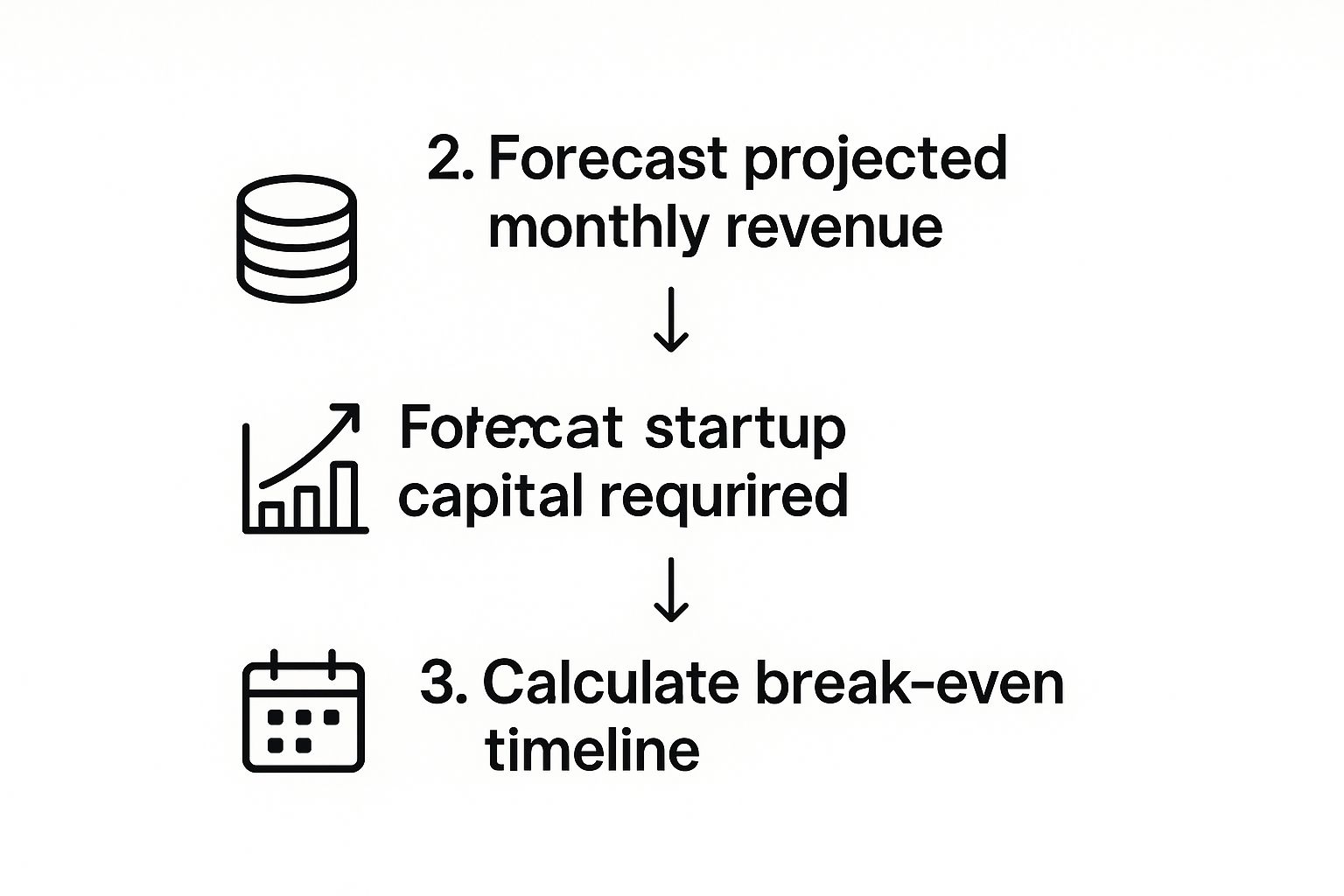
As you can see, estimating your startup cash needs, forecasting your sales, and calculating your break-even point aren’t separate tasks—they’re all interconnected parts of creating a clear financial picture.
To build these projections, you’ll need to detail three core financial statements:
- Startup Costs: This is every single dollar you need to spend just to open the doors. It includes the big stuff like construction and kitchen equipment, but also the smaller things like security deposits and your first food inventory order. To make sure you don't miss a thing, our restaurant startup costs calculator is an incredibly helpful tool.
- Operating Expenses: These are your ongoing monthly bills—rent, payroll, utilities, marketing, and of course, your food and beverage costs. Be conservative and meticulous with your estimates here.
- Revenue Forecasts: This is your educated guess on sales for the first three to five years. Base these numbers on your restaurant’s seating capacity, how many times you expect to turn tables each service (table turnover rate), and what you predict your average check size will be. It’s always smart to create three scenarios: conservative, moderate, and optimistic.
Securing the Capital You Need
With a polished, professional business plan in hand, you're finally ready to go out and get the funding. Different money sources are better for different situations, and you’ll want to tailor your pitch to each one.
- SBA Loans: Backed by the Small Business Administration, these are a popular choice for first-time owners because they lower the risk for lenders. You'll need a rock-solid business plan and good personal credit to qualify.
- Traditional Bank Loans: Banks are going to zero in on your financial projections and your management team's experience. They need to see a clear, low-risk path to getting their money back.
- Angel Investors or Venture Capital: These investors are looking for a high-growth concept where they can get a significant return. They’ll take an equity stake in your business, so your pitch needs to scream scalability and profitability.
- Friends and Family: This can be a more accessible route, but it’s absolutely critical to treat it like a formal business deal. Have a lawyer draw up clear terms and a repayment plan to avoid putting a strain on your personal relationships.
At the end of the day, your business plan is the single most powerful tool you have. It forces you to think critically, plan every detail, and prove—to yourself as much as to others—that your restaurant vision is a business worth building.
Navigating Licenses, Permits, and Location
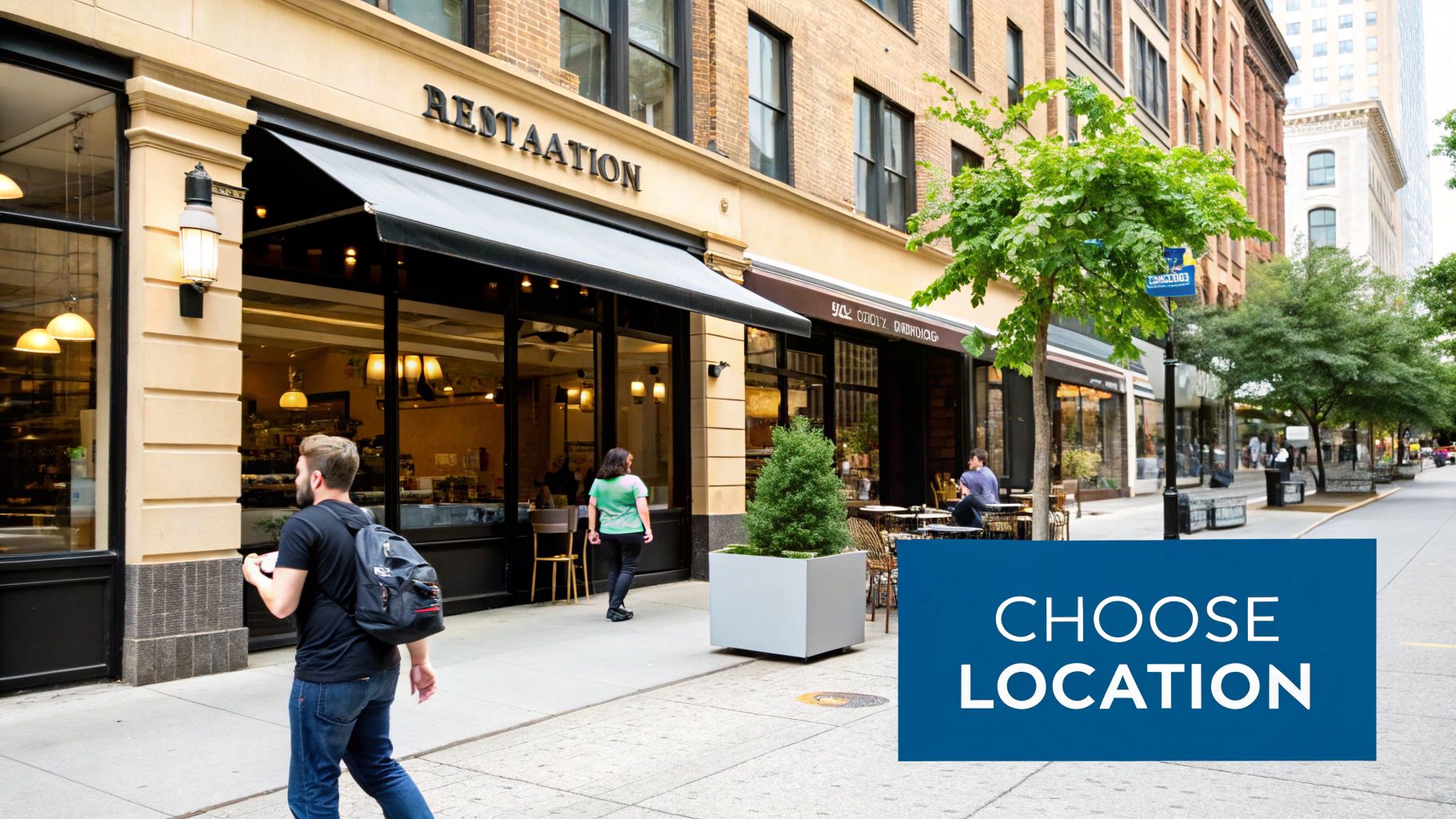
Once you’ve got a solid business plan in hand, it’s time to get into the nitty-gritty. This is where many aspiring restaurateurs hit their first major roadblock: the dual challenge of untangling government red tape and finding the perfect spot for their new place.
Think of it this way: licenses and location are the twin pillars your restaurant will stand on. One is all about paperwork and patience; the other requires a sharp eye and even sharper negotiation skills. Getting either of them wrong can lead to crippling delays or even bring your project to a dead stop. Let’s break down how to manage both successfully.
Untangling the Web of Legal Compliance
Before you can even think about serving your first customer, you need the government's blessing. The process of securing all the right licenses and permits can feel like an absolute maze, and it's notoriously slow. My best advice? Start this as early as you possibly can. Some permits can take months to clear.
Here’s a look at the essential paperwork you'll almost certainly need:
- Business License: This is your basic ticket to operate. It’s the foundational permit from your city or county that says you're legally allowed to do business.
- Food Service License: Issued by your local health department, this license is proof that your establishment meets all the critical safety standards for handling food. You can bet they'll be doing a thorough inspection of your space.
- Liquor License: Planning to serve alcohol? This one is non-negotiable, and it's often the most time-consuming and expensive permit to get. The process varies wildly by state and usually involves extensive background checks.
- Sign Permit: That beautiful sign you’ve designed? You'll need a permit from your local zoning board to hang it. They'll want to make sure it meets all the local rules on size, placement, and lighting.
Don't underestimate this stage. Applying for a liquor license, for instance, can sometimes take up to six months. Start the paperwork the moment you have a potential address, as many applications are tied to a specific location.
The Art and Science of Site Selection
Your location is so much more than an address. It’s a massive strategic decision that will define your visibility, your customer base, and the entire vibe of your brand. I've seen great concepts die on the vine simply because they were in the wrong spot.
Put on your detective hat. Don't just scan "For Lease" signs. You need to dig deep into a neighborhood's DNA to see if it truly syncs up with your concept and the customers you want to attract. The right spot should feel like a natural home for your restaurant.
Analyzing Potential Locations
When you're out scouting, you have to move past gut feelings and focus on cold, hard data and observable patterns. The mission is to find a site that's teeming with your ideal customers.
Here are the critical factors to zero in on:
- Foot Traffic and Visibility: Is the spot on a busy street where people will actually see you? High visibility is like free, non-stop advertising.
- Neighborhood Demographics: Do the people who live and work nearby match your target audience? A high-end steakhouse will likely struggle in a college town, just as a cheap-eats joint might not last in an affluent suburb.
- Parking and Accessibility: How easy is it for customers to get to your front door? A frustrating parking situation can be a major deal-breaker for diners.
- Zoning Laws: This is a big one. Before you get your heart set on a space, confirm it's actually zoned for restaurant use. A beautiful location is useless if the city won't let you put a commercial kitchen in it.
Imagine you're opening a fast-casual lunch spot targeting office workers. A space in a sleepy residential area, no matter how cheap the rent, would be a terrible choice. You need to be right in the middle of a bustling commercial district with a high daytime population.
Securing a Favorable Lease
Okay, you've found a promising location. Now the real dance begins: negotiation. Your lease is a long-term financial handcuff, and its terms will dictate your profitability for years. Whatever you do, don't rush this.
I can't stress this enough: hire a lawyer who specializes in commercial real estate to review any lease before you sign. They’ll spot the nasty clauses and help you negotiate better terms on things like rent increases, renewal options, and who pays for major repairs. Getting this right from day one gives your business the stable foundation it needs to thrive.
Designing Your Menu and Kitchen Workflow
Your menu is the heart and soul of your restaurant. It’s what gets people talking and keeps them coming back. But let's be honest—a great menu is far more than just a list of delicious dishes. It's a powerful financial tool that has to be profitable, exciting, and, most importantly, something your kitchen team can actually pull off, night after night.
This is where smart menu strategy and practical kitchen design have to work together perfectly. You need a seamless flow where the dishes on the page can be made efficiently and safely in the kitchen space you have. It all starts with getting granular and understanding the numbers behind every single plate.
Engineering a Profitable Menu
Before you even think about setting a price, you need to know your costs with almost surgical precision. This is called recipe costing, and it means breaking down every dish into its individual ingredients to figure out the exact cost per serving. Yes, it’s tedious work, but it's completely non-negotiable.
Once you have that cost-per-dish number, you can start pricing things strategically. A good industry benchmark to shoot for is a food cost percentage between 28% and 35%. So, if a dish costs you $5 in raw ingredients, you’d probably want to price it somewhere around $15 to $18 to maintain a healthy margin.
Keep in mind, this isn't a hard-and-fast rule for every single item on your menu. That expensive steak might have a tighter margin, but high-margin items like pasta, sodas, or coffee can help balance things out. The goal is to look at your menu's profitability as a whole.
From here, you get into the real fun: menu engineering. This is where you analyze how popular and profitable each item is, allowing you to make smart, data-driven decisions. You’ll find your dishes fall into one of four categories:
- Stars: These are your winners—high profitability and high popularity. Promote them like crazy. They’re the dishes people love and that make you money.
- Plow Horses: Everyone loves these, but they aren't very profitable. They're crowd-pleasers, so see if you can tweak the recipe slightly to lower the cost without anyone noticing a drop in quality.
- Puzzles: These dishes have great margins but just aren't selling. They're profitable puzzles waiting to be solved. Try giving them a more exciting name, rewriting the description, or training your servers to recommend them.
- Dogs: Low profitability and low popularity. These are prime candidates to be removed from the menu, unless they serve a critical purpose (like being the only kid's meal option).
Building Your Kitchen Around Your Menu
With a costed, engineered menu in hand, you can now design the engine that will power your restaurant: the kitchen. The layout of your kitchen should be a direct reflection of what your menu demands. A place specializing in complex, multi-step dishes is going to need a very different setup than a joint focused on high-volume fried foods.
The key is to design for an efficient workflow, cutting down on the number of steps your cooks have to take. Seriously, think about the journey of an order from the moment the ticket prints to when it lands on the pass.
A logical kitchen flow usually follows a path like this:
- Receiving and storage (dry goods, walk-in cooler, freezer).
- Food prep stations (where the washing and chopping happens).
- The cooking line (grills, fryers, ovens, sauté stations).
- Plating and the pass (where servers pick up finished dishes).
This kind of assembly-line approach is what prevents chaos and bottlenecks during a slammed dinner service. Even small details, like having a refrigerated drawer with prepped ingredients right at the grill station, can shave precious seconds off every order. Those seconds add up over hundreds of covers. Trust me, a poorly designed kitchen can cripple even the most talented and hardworking team.
Selecting the Right Commercial Equipment
Your equipment choices are long-term investments that directly determine whether you can actually execute your menu. This is where you connect specific pieces of gear to your culinary vision.
| Equipment Category | Key Considerations | Example Scenario |
|---|---|---|
| Cooking Equipment | What cooking methods does your menu depend on? Grilling, frying, baking? Be honest about your priorities. | A classic steakhouse simply must invest in a high-quality charbroiler, while a pizzeria's entire operation revolves around its pizza oven. |
| Refrigeration | How much cold storage do you need for raw ingredients versus prepped items? | Prep table refrigerators with cold wells are an absolute must for sandwich or salad stations to keep ingredients safely chilled and within arm's reach. |
| Warewashing | How high will your dish volume be? Can your machine actually keep up when you're in the weeds during a dinner rush? | A high-volume restaurant needs a powerful conveyor-style dishwasher to handle the relentless flow of plates, glasses, and silverware. |
| Point of Sale (POS) | Does it talk to your kitchen display systems (KDS)? Can it handle the flood of online orders? | A fast-casual spot with heavy takeout and delivery needs a robust POS that seamlessly manages both in-house and online ordering. |
Your Point of Sale (POS) system will become the central brain of your entire operation, linking the front of house to the back. A modern system does so much more than just process payments; it tracks sales data, helps manage inventory, and gives you the insights to make smarter decisions about your menu and staffing. Choosing the right one is one of the most critical steps to open a restaurant successfully.
Building a Winning Team From Hire to Open
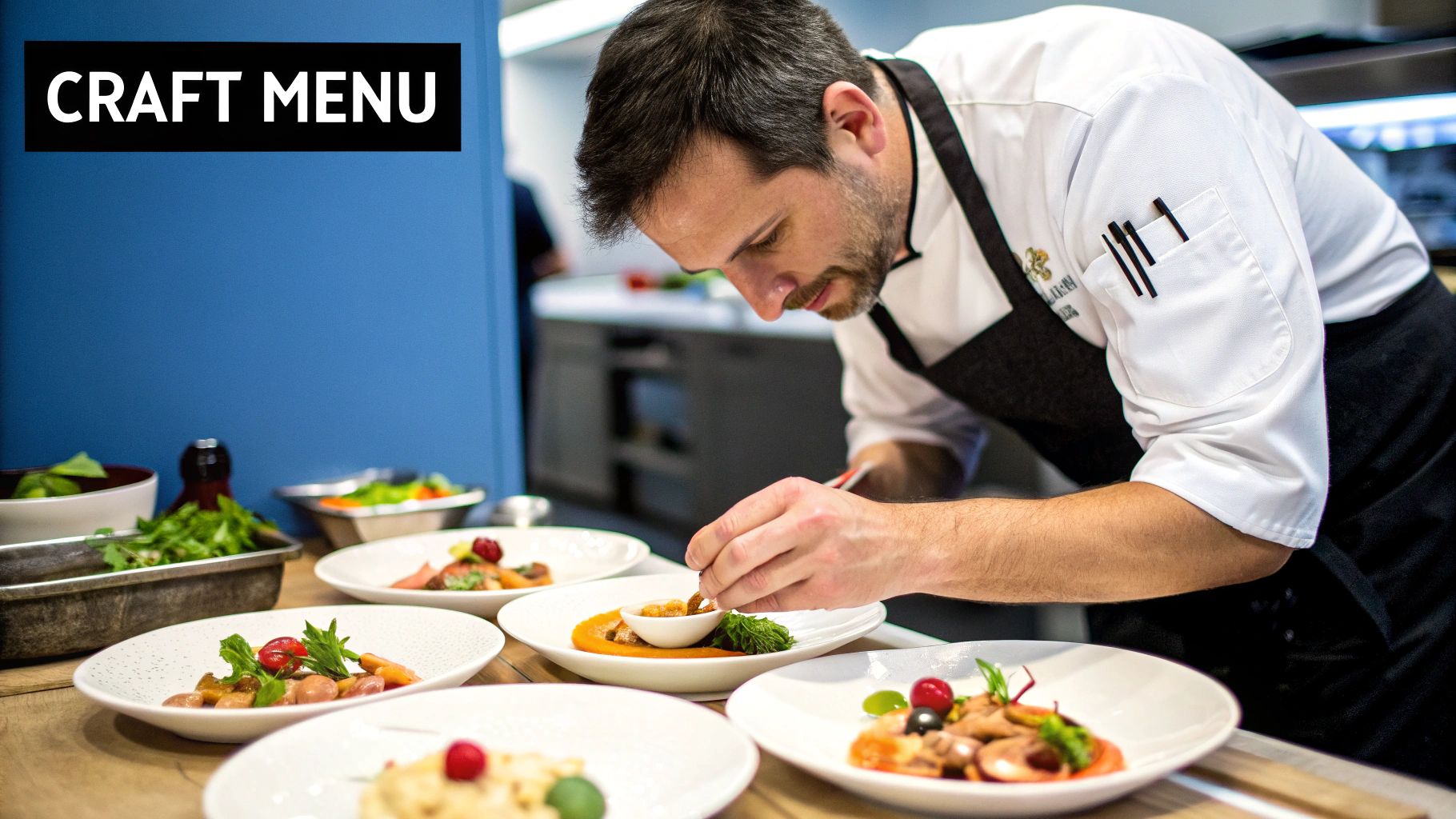
Your kitchen can be perfectly designed and your menu brilliantly engineered, but without the right people, your restaurant is just a room full of equipment. Your team is the living, breathing heart of the guest experience. Assembling a winning staff is one of the most critical parts of opening a restaurant, and it starts long before you even think about unlocking the doors for the first time.
The importance of this stage can't be overstated. With nearly 29% of operators planning new locations in 2025, the competition for top talent is fierce. Labor costs are a major concern for 17% of full-service operators, and recruiting and retaining employees ranks right up there as a critical challenge. A strong team is your best defense against these pressures. You can dive deeper into these critical restaurant trends to see the full picture.
This process isn't just about filling positions; it's about deliberately cultivating a culture that embodies your brand's unique promise.
Crafting Job Descriptions That Attract the Best
Your hiring process kicks off with your job descriptions. Think of them not as a dry list of duties but as your first piece of marketing aimed directly at your future team. Vague, generic postings attract uninspired applicants. A compelling job description, on the other hand, sells your vision and culture.
Instead of just writing "Line Cook Wanted," try something more descriptive that speaks to your restaurant’s soul. For example: "Passionate Line Cook for Farm-to-Table Kitchen." In the description, go beyond the basics.
- Paint a Picture: Briefly describe your restaurant's concept and what makes it special.
- Define the Culture: Mention the kind of work environment you're building (e.g., "a collaborative, fast-paced team dedicated to craft").
- Be Specific About Skills: Clearly list the essential skills ("experience with from-scratch butchery and sauce-making") and the soft skills that matter to you ("a positive attitude and a drive for consistency").
This approach helps candidates self-select. The right people will be drawn to your mission, while those who aren't a good fit will likely move on, saving everyone time.
Conducting Interviews That Reveal True Potential
The interview is your chance to look beyond the resume. A candidate might have an impressive work history, but do they have the right attitude and problem-solving skills to thrive during a chaotic Saturday night service? Your goal is to uncover their personality, work ethic, and how they handle pressure.
Move beyond the standard "What are your weaknesses?" questions. Instead, use behavioral and situational questions to get a real sense of who they are.
| Question Type | Purpose | Example Question |
|---|---|---|
| Situational | Assesses problem-solving in a hypothetical scenario. | "A customer sends back a dish saying it's cold, but you know it just came off the line. How do you handle it?" |
| Behavioral | Explores past behavior to predict future performance. | "Tell me about a time you had a conflict with a coworker. How did you resolve it?" |
| Cultural Fit | Determines if their values align with your restaurant's. | "What kind of work environment helps you do your best work?" |
This style of interviewing helps you find people who are not just skilled but also resilient, team-oriented, and genuinely invested in hospitality.
Attitude over skill. It’s a classic saying in this industry for a reason. You can teach someone how to properly carry three plates or the specific steps to your signature dish. You cannot, however, teach someone to have a positive attitude or a genuine desire to make people happy.
Developing a Training Program for Consistency
Hiring great people is only half the battle. A robust training program is what empowers them to succeed and ensures every guest receives the same fantastic experience, regardless of who is working. Don't throw your new hires into the fire on day one. A structured training plan builds confidence and reinforces your standards.
Your training should cover:
- Culture and Mission: Start with the "why." Explain your restaurant's story, values, and what you stand for.
- Menu Knowledge: This is non-negotiable. Every team member, from the dishwasher to the host, should be able to speak confidently about the menu, including ingredients and potential allergens.
- Procedural Training: Walk them through every step of their specific role, from opening duties to closing checklists.
- Shadowing and Practice: Have new hires shadow your most experienced team members before giving them their own section or station. A soft opening is the perfect, low-stakes environment for this final stage of practice.
By investing in your team from the very start, you're not just staffing a restaurant; you're building a loyal, cohesive unit that will be the foundation of your long-term success.
Marketing Your Launch for a Grand Opening
A successful restaurant launch doesn't just happen—it's engineered. You've built the foundation, designed the menu, and hired the team. Now, it's time to build the one thing that will fill your seats on day one: hype. A strategic marketing push in the weeks leading up to your opening is one of the most vital steps to open a restaurant with some real momentum.
Your marketing playbook is all about creating a sense of anticipation and turning that curiosity into actual foot traffic. This means using a smart mix of digital buzz, local relationships, and a perfectly timed opening event to make sure your restaurant starts not with a quiet hum, but with a roar.
Building Buzz Before You Open
The weeks before you unlock your doors are a golden opportunity. Start teasing your concept on social media platforms like Instagram and Facebook. Share behind-the-scenes content: a sneak peek of the renovation, a tantalizing close-up of a signature dish being tested, or brief video intros of your key team members, like the head chef.
This kind of content does more than just advertise; it tells a story and starts building a community before you even serve a single customer. It gets people invested in your journey.
Beyond social media, it's time to forge real connections within your immediate community.
- Local PR: Reach out to local food bloggers, influencers, and journalists. But please, don't just send a generic press release. Invite them for a personal hard-hat tour or a coffee to share your vision. A genuine connection is far more likely to result in positive, authentic coverage.
- Community Partnerships: Team up with neighboring, non-competing businesses. You could offer a cross-promotional deal, like a discount at your restaurant for customers of the local boutique. This taps into an existing customer base and shows you're invested in the neighborhood's success.
- Digital Presence: Make sure your website is live with your menu, address, and hours. And this is crucial: set up your Google Business Profile with professional photos. This is how most people will find you when searching for nearby dining options.
The Strategic Soft Opening
A "soft opening" is your secret weapon. It’s a limited, invitation-only event or series of events held the week before your official grand opening. Think of it as a full-dress rehearsal where the stakes are much lower. The goal is twofold: to iron out the inevitable kinks in your service and to generate priceless early buzz.
Invite friends, family, local business owners, and those media contacts you've been nurturing. This controlled environment lets your kitchen and front-of-house staff find their rhythm, test the workflow from ticket to table, and pinpoint potential bottlenecks before you're facing a packed house of paying customers.
Use this opportunity to actively ask for feedback. Provide small comment cards asking guests what they loved and what could be improved. This honest, early input is invaluable for making final tweaks to service, timing, or even how a dish is presented.
Planning a Memorable Grand Opening
Your grand opening event is the culmination of all your hard work. It's the official starting line. The goal is to make it a memorable event that generates immediate word-of-mouth and media attention.
Get creative with promotions beyond just a simple ribbon-cutting. Offer a "first 100 customers get a free appetizer" deal, host a giveaway for a dinner for two, or partner with a local charity and donate a portion of the day's proceeds. These tactics create a sense of urgency and build goodwill from the get-go.
This launch phase really highlights the importance of integrating modern business practices. As noted by KPMG, the restaurant sector's embrace of digital tools is projected to intensify in 2025, with industry leaders investing more in tech to streamline ordering and using loyalty programs and targeted promotions to keep sales strong.
Ultimately, a strong launch sets the stage for long-term success. While the grand opening is a single event, your marketing efforts must be ongoing. In addition to social media, a solid email marketing for restaurants strategy can help you build a loyal customer base from day one by capturing guest information and keeping them engaged with future offers and events. This approach is how you turn a strong start into sustained growth.
Frequently Asked Questions About Opening a Restaurant
So, you’re thinking about opening a restaurant. It’s a journey that’s equal parts thrilling and, let’s be honest, a little terrifying. That mix of excitement and uncertainty is completely normal. Having some straight-up, honest answers to the big questions is one of the best ways to build your confidence and make sure you’re walking in with your eyes wide open.
Let's dive into some of the most common hurdles and questions that pop up for aspiring restaurateurs. Think of this as a practical, no-fluff chat to help you get a handle on the realities ahead.
How Much Does It Realistically Cost to Start?
This is the big one, the question on everyone’s mind. And the only honest answer is: it depends. Dramatically. A tiny, bootstrapped takeout joint could potentially get started for around $50,000, while a high-end, full-service restaurant in a prime city location can easily blow past $2 million. There’s just no single magic number.
The median startup cost for a new restaurant often falls somewhere around $375,000. Your own number will be a unique recipe based on these key ingredients:
- Location: This is your down payment on a property or, more commonly, the security deposit and first few months' rent on a lease.
- Renovations: The build-out is where costs can really swing. Transforming a blank space into your dream restaurant is a massive variable.
- Kitchen Equipment: This is a huge slice of the pie, often eating up 30% or more of your entire budget.
- Initial Inventory: That first major order of all your food, drinks, and supplies.
- Licenses and Permits: These fees add up fast, especially if you’re gunning for a full liquor license.
Here's the most critical piece of advice I can give you: secure enough operating capital. You absolutely must have a cushion of at least six months of operating expenses sitting in the bank before you unlock the doors. This is the safety net that will save you when an oven dies unexpectedly or business is slower to ramp up than you hoped.
What Is the Biggest Mistake New Owners Make?
Hands down, the most common and devastating mistake is a brutal one-two punch: underestimating how much cash they’ll need and overestimating how much money they’ll make right out of the gate. It’s a classic, passion-fueled trap.
New owners are running on pure optimism, which is great, but it can lead to financial projections that are more hopeful than realistic. They burn through their cash within the first year because they didn't budget for that slow build or for a pricey HVAC unit to suddenly give up.
Your best defense is a painfully detailed financial plan built on conservative, well-researched estimates. Stress-test your numbers. Plan for the worst-case scenario, not just the dream scenario.
A detailed financial plan isn't just for investors; it's your personal survival guide. It forces you to confront the numbers head-on and make decisions based on data, not just gut feelings.
Do I Need Prior Restaurant Experience to Succeed?
While having direct, hands-on experience is a massive advantage, it’s not an absolute deal-breaker. But—and this is a big but—if you don't have that experience, you have to be brutally honest with yourself about what you don't know and hire experts to fill those gaps. Success is all about building the right team.
If you’re a finance whiz who’s never seen the chaos of a dinner rush, your first and most critical hire is a strong, seasoned general manager. If you’re a culinary genius who gets hives just looking at a spreadsheet, you need an operations partner you can trust to run the business side.
Your job as the owner is to hold the vision, get the funding, and then empower your expert team to do what they do best.
For a bird's-eye view of every single task you'll need to juggle, using an opening a restaurant checklist is an invaluable way to make sure nothing important slips through the cracks.
Ready to equip your dream kitchen? The Restaurant Warehouse provides everything from commercial refrigeration to cooking equipment, with flexible financing options to help you get started. Visit https://therestaurantwarehouse.com to browse our inventory and build the foundation for your success.
About The Author

Sean Kearney
Sean Kearney used to work at Amazon.com and started The Restaurant Warehouse. He has more than 10 years of experience in restaurant equipment and supplies. He graduated from the University of Washington in 1993. He earned a BA in business and marketing. He also played linebacker for the Huskies football team. He helps restaurants find equipment at a fair price and offers financing options. You can connect with Sean on LinkedIn or Facebook.
Leave a comment