

Restaurant Profit Margin Calculator – Maximize Your Profits
Think of a restaurant profit margin calculator as a quick financial health check for your business. It’s a simple but powerful tool that cuts through all the noise, comparing your total sales against all your costs to show you exactly what percentage of that revenue is actual, take-home profit.
With that number in hand, you can start making smarter, faster financial decisions.
Why Your Restaurant Profit Margin Is So Important
Understanding your profit margin is so much more than just an accounting task—it’s a direct look into your restaurant's viability. This single percentage tells a surprisingly detailed story about how efficiently you're running the show, whether your pricing strategy is on point, and your overall financial stability.
Honestly, ignoring it is like trying to navigate a notoriously competitive industry with a blindfold on.
Without a clear grasp of this metric, you could be losing money on your best-selling dishes and not even know it. Or you might not see how rising food and labor costs are slowly but surely eating away at your bottom line. Calculating your profit margin brings all those hidden issues right to the surface.
Gross vs. Net Profit: The Two Sides of the Coin
To get the full story of your restaurant’s performance, it’s crucial to look at two different types of profit margins. They each tell you something unique.
- Gross Profit Margin: This number is all about your menu's profitability. It measures the profit you make from food and drink sales after subtracting the direct cost of the ingredients—what we call the Cost of Goods Sold (COGS). A healthy gross margin is a great sign that your menu is priced effectively.
- Net Profit Margin: This is the real bottom line. It calculates the profit that’s left after every single expense—rent, payroll, utilities, marketing, you name it—is taken out of your revenue. This number reveals the true health of your entire operation.
"A high gross profit margin is great, but if your net profit margin is razor-thin, it's a clear signal that your operating costs are too high. You need to monitor both to make informed decisions."
It’s no secret that restaurant profit margins are famously slim, often falling somewhere between 2% to 6%. Full-service restaurants tend to hug the lower end of that range because of higher labor and overhead costs, while quick-service spots might see slightly better margins.
That said, a strong gross profit margin of around 65% to 70% is a good target. You need that much just to cover all the other expenses of running the business.
Typical Restaurant Profit Margins at a Glance
To give you a better idea of where you might stand, here’s a quick look at some industry averages. Keep in mind these are just benchmarks—your own numbers will depend on your specific concept, location, and operational efficiency.
| Restaurant Type | Average Gross Profit Margin | Average Net Profit Margin |
|---|---|---|
| Full-Service Restaurants | 60% – 70% | 3% – 5% |
| Quick-Service Restaurants (QSR) | 65% – 75% | 6% – 9% |
| Food Trucks | 55% – 65% | 6% – 9% |
| Bars & Taverns | 70% – 80% (beverage-heavy) | 10% – 15% |
| Catering Businesses | 65% – 75% | 7% – 12% |
Seeing how your numbers stack up against these can be enlightening. If you want to dive deeper, you can explore a full breakdown of these industry benchmarks to get a more detailed comparison.
Getting to Grips with Restaurant Profit Formulas
Before you can really trust a profit margin calculator, it helps to understand the simple math that makes it tick. These formulas aren't just for your accountant; they're the language of your restaurant's financial health. They show you exactly where you're winning and, more importantly, where you might be leaking cash.
Let's pull back the curtain on the numbers.
At the heart of your restaurant's finances, there are two key calculations. Each one gives you a different—but equally critical—look at how your business is performing.
Calculating Gross Profit Margin
First up, we have Gross Profit Margin. Think of this as a check-up on your menu's health. It tells you how much money is left over from your sales after you've paid for the ingredients themselves, which is your Cost of Goods Sold (COGS).
The formula is pretty straightforward: (Total Revenue - COGS) / Total Revenue x 100
Let's say your neighborhood bistro brought in $50,000 in revenue last month. The food and drinks it took to make those sales cost you $15,000 (that's your COGS). Plug those numbers in, and you get a gross profit margin of 70%. That's a strong sign your menu pricing is on the right track.
Calculating Net Profit Margin
Next, we have the Net Profit Margin—the real bottom line. This calculation shows you what percentage of revenue is actually left after you’ve paid for everything. That includes COGS, labor, rent, utilities, marketing, you name it. It's the ultimate measure of your restaurant's overall profitability.
Here's the formula: (Total Revenue - Total Expenses) / Total Revenue x 100
Using our bistro example again, let's say your total expenses were $47,000 (that's the $15,000 in COGS plus $32,000 for everything else). With $50,000 in revenue, your net profit is $3,000. This gives you a net profit margin of 6%, which is actually quite solid for this industry.
Understanding both of these margins is non-negotiable. A high gross margin is great—it means your menu is priced well. But if your net margin is low, it's a huge red flag that your operating costs are eating up all your profits before they ever hit your bank account.
This distinction is absolutely crucial in an industry where net margins often hover in a razor-thin 3% to 5% range, even with massive sales volumes. In the U.S., restaurant sales recently topped $1.5 trillion, yet staying profitable is a constant battle for operators. You can get a better sense of the bigger picture by exploring these restaurant industry statistics and trends.
Keeping a tight grip on operating costs, like equipment repairs or new purchases, is key to protecting that slim net margin. For those bigger investments, a good restaurant equipment financing guide can show you ways to manage your cash flow without derailing your budget.
Let's Run the Numbers with the Profit Margin Calculator
Alright, theory is great, but let's get our hands dirty and see what your restaurant’s numbers actually look like. This is where you get a real-time snapshot of your financial health. Our interactive restaurant profit margin calculator is designed to be dead simple, pulling together the key figures that really define your success. All you need to do is grab a few essential pieces of data.
To make it crystal clear, we'll walk through a real-world example using a hypothetical mid-sized spot, "The Local Slice." The idea is to show you exactly where to find your numbers and what they mean once you plug them in.
This visual breaks down the simple flow of information our calculator uses, starting with your top-line sales and ending with your final profit margin.
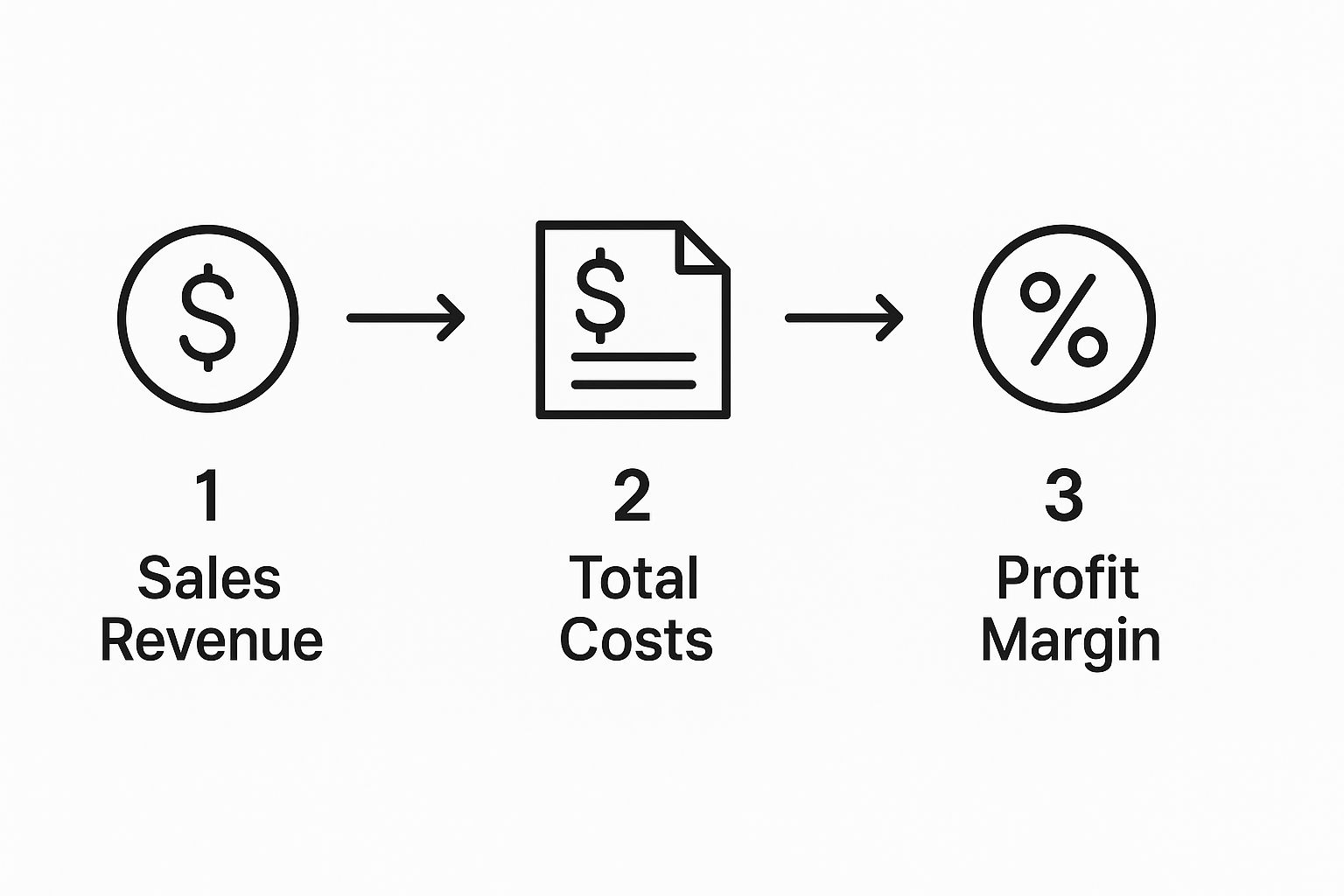
As you can see, the process starts with your total sales, strips out all the associated costs, and leaves you with that all-important profit margin percentage.
Plugging in Your Restaurant's Data
Let’s imagine The Local Slice is calculating its performance for last month. We need to gather four key pieces of information, most of which you can pull right from your POS reports and accounting software.
Here’s what you’ll need to input into the restaurant profit margin calculator:
- Total Revenue: This is every single dollar your restaurant generated. For The Local Slice, their POS system shows they brought in $80,000 last month from dine-in, takeout, and delivery.
- Cost of Goods Sold (COGS): This covers all the direct costs for the food and drinks you sold. By checking supplier invoices, the pizzeria's manager found they spent $24,000 on ingredients like flour, cheese, and toppings.
- Labor Costs: This is the total amount paid to all employees, including salaries, hourly wages, and payroll taxes. The Local Slice’s payroll reports show this came to $28,000 for the month.
- Overhead Costs: These are all your other operating expenses. For the pizzeria, this bucket includes rent ($6,000), utilities ($2,500), marketing ($1,500), and credit card processing fees ($1,200), for a total of $11,200.
By entering these figures into the calculator, The Local Slice can instantly see its gross profit margin (70%) and, more importantly, its net profit margin. With $80,000 in revenue and total expenses of $63,200 ($24,000 + $28,000 + $11,200), their net profit is $16,800.
That works out to a net profit margin of 21%—an excellent figure that shows the business isn't just covering its costs but is actually highly profitable.
What Your Profit Margins Are Actually Telling You

Getting that percentage back from a profit margin calculator is just the start of the conversation, not the end of it. Think of that number as a powerful diagnostic tool. If you know how to read it, it tells a detailed story about the health of your restaurant.
Context is absolutely everything. A 4% net margin might be a huge win for a fine-dining spot with sky-high overhead, but it could spell trouble for a lean food truck that should be seeing much higher returns. The number itself isn't simply "good" or "bad"—it's an arrow pointing you toward specific strengths and weaknesses in your operation.
Diagnosing Common Margin Problems
One of the classic scenarios we see is a restaurant with a pretty healthy gross profit margin but a dangerously low net profit margin. So, what does this tell you? It's a textbook sign that your menu pricing and ingredient costs are in good shape, but your operating expenses are spiraling out of control.
This gap between your gross and net profit is exactly where your business is leaking cash. It immediately shifts your focus away from the menu and onto things like:
- Bloated Labor Costs: Are you overstaffing during those slow Tuesday afternoons?
- High Rent or Utilities: Is your lease actually competitive for your neighborhood?
- Operational Inefficiencies: Are there hidden costs bleeding out from marketing or administrative tasks?
Getting a firm grip on your restaurant food cost percentage is the foundation for all of this, as it directly impacts your gross margin and really sets the stage for net profitability.
A low net margin isn't a failure—it's a roadmap. It tells you exactly where to focus your energy to make immediate improvements to your bottom line.
When you start thinking this way, your profit margin transforms from a simple score into a strategic guide for making smarter business decisions. It helps you pinpoint exactly where to step in to strengthen your restaurant's financial footing and build a business that lasts.
If your numbers aren't where you want them to be, it can feel frustrating. But every problem has a cause, and every cause has a solution. This table breaks down some common issues restaurateurs face when analyzing their margins.
| Problem | Potential Cause | Actionable Solution |
|---|---|---|
| Healthy Gross, Low Net Margin | Operating expenses (labor, rent, utilities) are too high. | Conduct a line-by-line review of your P&L. Audit staff schedules against sales data to cut unnecessary hours. Renegotiate with suppliers or your landlord. |
| Low Gross Margin | Cost of Goods Sold (COGS) is elevated. | Re-engineer your menu to feature higher-margin items. Audit portion sizes for consistency. Shop around for better ingredient pricing from different vendors. |
| Inconsistent Margins Month-to-Month | Seasonal fluctuations, inconsistent sales, or poor inventory management. | Implement a "first-in, first-out" (FIFO) inventory system to reduce spoilage. Analyze sales data to create targeted promotions during slower months. |
| Declining Margins Over Time | "Menu creep" (adding items without removing others), rising supplier costs not passed on to customers, or operational inefficiencies. | Review and update menu prices at least twice a year. Conduct a waste audit to identify and reduce food waste. Streamline kitchen workflows for better efficiency. |
Using this diagnostic approach helps you stop guessing and start making targeted, effective changes that will actually move the needle on your profitability.
Actionable Strategies to Boost Your Profitability
Knowing your numbers is the first step, but the real goal is to make them better. Increasing your restaurant's profitability isn't about one massive, sweeping change. It's about making a series of smart, targeted adjustments to both your costs and your revenue. Small, consistent improvements really do add up to significant gains over time.
The best place to start is by taking a hard look at your two biggest expenses: food costs and labor. These are the areas where you'll find the most opportunity to make a meaningful impact.
Master Your Menu Engineering
Your menu is the single most powerful sales tool you have. Menu engineering is the art and science of analyzing your items based on their popularity and profitability, then using that data to guide customer choices toward your most lucrative dishes. A well-designed menu naturally draws the eye to high-margin "Stars" while downplaying less profitable items.
Here are a few quick wins you can implement right away:
- Highlight Your High-Profit Items: Use simple design tricks like boxes, icons, or bolder text to make your most profitable dishes stand out. This one visual cue can boost sales of an item by up to 30%.
- Re-evaluate Low Performers: Take a look at items that are popular but have razor-thin margins. Can you tweak the recipe with a less expensive ingredient? Or maybe reduce the portion size just slightly without sacrificing quality?
- Price Strategically: Don't just guess at your prices or copy the place down the street. Base them on a deep understanding of your own food costs to ensure every single dish contributes positively to your bottom line.
A common mistake is pricing based on what competitors charge. Instead, you should always price based on your unique costs and desired profit margin. Your operational setup is different from everyone else's, and your pricing needs to reflect that reality.
Optimize Scheduling and Upselling
Labor is a huge expense, but your team is also your number one revenue driver. Smart, efficient scheduling that prevents overstaffing during slow periods is a direct path to cutting costs. Even more importantly, investing time into training your servers to upsell can dramatically increase your average check size.
Encourage your staff to suggest profitable add-ons, like appetizers, premium sides, or your signature cocktails. A well-trained server doesn't just take orders—they actively enhance the guest's experience while boosting sales for the restaurant.
Of course, this kind of strategic investment in training is only possible with proper financial management, which starts with controlling your initial expenses. You can find a great breakdown in this guide for estimating restaurant startup costs. For a deeper dive into proactive management of your restaurant's financial health, understanding the critical role of financial planning and analysis can be incredibly valuable.
Common Questions About Restaurant Profitability

Even after you start getting a handle on your numbers, a few key questions always seem to pop up. Let's tackle some of the most common ones we hear from busy restaurant owners just like you.
How Often Should I Calculate My Profit Margin?
Consistency is everything here. While you’ll definitely do an annual review for tax purposes, you should be using a restaurant profit margin calculator way more often than that.
Running the numbers monthly gives you a fresh, actionable snapshot of your financial health. This rhythm lets you spot any troubling trends and make smart adjustments before a small hiccup turns into a major headache.
What Is the Difference Between Gross Profit and Food Cost?
These two metrics are closely related, but they tell you very different things about your business.
Your food cost percentage is hyper-focused, measuring only the cost of ingredients for a specific dish against the revenue that dish brings in.
In contrast, your Gross Profit Margin zooms out to look at the bigger picture. It measures the profitability of your entire menu by comparing your total sales revenue against the total cost of all your ingredients (COGS).
Can I Improve Profitability Without Raising Prices?
Absolutely. Hiking up your menu prices is just one tool in your belt, and it’s not always the best one.
As we've covered, focusing on smart cost control and efficiency can be just as powerful, if not more so. Things like strategic menu engineering, getting serious about reducing food waste, and optimizing your staff schedules are all proven ways to boost your net profit without changing a single price.
Equip your kitchen for success and profitability with The Restaurant Warehouse. Explore our extensive catalog of commercial equipment and financing options designed for restaurant owners like you. Learn more at https://therestaurantwarehouse.com.
About The Author

Sean Kearney
Sean Kearney used to work at Amazon.com and started The Restaurant Warehouse. He has more than 10 years of experience in restaurant equipment and supplies. He graduated from the University of Washington in 1993. He earned a BA in business and marketing. He also played linebacker for the Huskies football team. He helps restaurants find equipment at a fair price and offers financing options. You can connect with Sean on LinkedIn or Facebook.
Leave a comment