

Optimize Your Business with a Restaurant Inventory Management System
A restaurant inventory management system is a digital tool that tracks food supplies, monitors exactly how ingredients are used, and helps you get a grip on your costs. Think of it as the central nervous system for your kitchen and your stockroom. It connects what you sell directly to what you have on the shelves, cutting down on waste and boosting your bottom line.
From Clipboards to the Cloud: The Evolution of Inventory Control
Picture your restaurant's inventory like a constantly flowing river. For years, the only way to measure that river was to dip a bucket in once a week. This was your classic manual count, done with clipboards and clunky spreadsheets. It was tedious, wildly inaccurate, and only gave you a blurry snapshot of a single moment in time.
This old-school approach was purely reactive. You'd run out of a key ingredient mid-rush or discover a case of produce had spoiled in the back of the walk-in. It was a constant source of friction, frustration, and, frankly, financial loss.
A modern restaurant inventory management system completely changes the game. Instead of that weekly snapshot, it gives you a live video feed of your inventory river. By linking directly to your Point of Sale (POS) system, it automatically deducts ingredients from your stock the second a dish is sold. A customer orders a burger? The system instantly subtracts one bun, one beef patty, a slice of cheese, and two pickles from your digital stockroom. No guesswork involved.
Beyond Simple Counting
But this technology does so much more than just simple subtraction. It pulls your purchasing, receiving, recipe costing, and sales data into one cohesive platform. The shift from manual drudgery to digital insight is huge, impacting everything from your daily kitchen flow to your long-term financial health.
This image really highlights the dramatic difference in efficiency and accuracy.
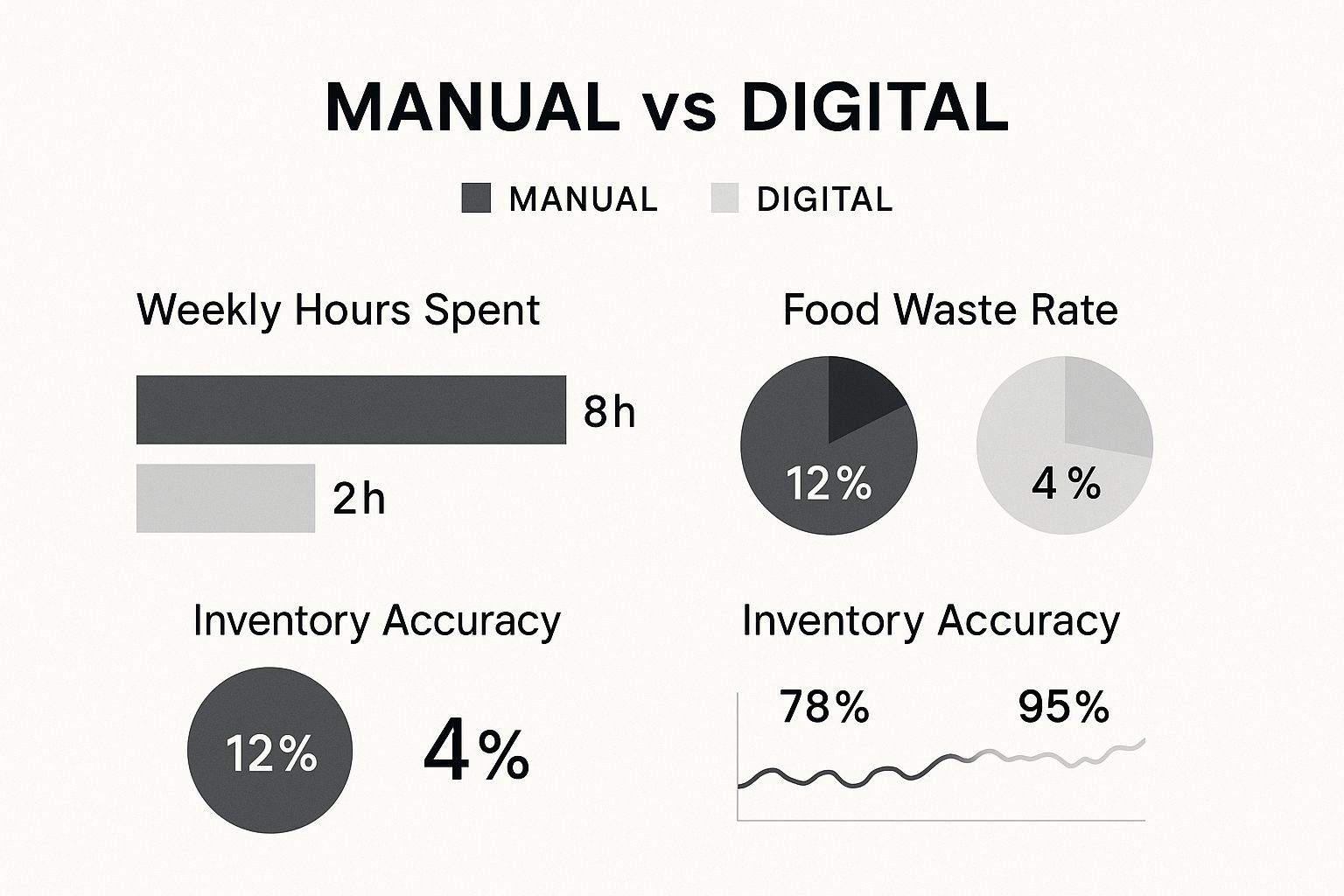
The data makes it crystal clear: automation drastically cuts down on labor hours, slashes food waste, and dials in your inventory accuracy. It’s a strategic move that turns a back-of-house chore into a powerful business intelligence tool.
Let's break down the practical differences you'd see every day with a quick comparison.
Manual vs Automated Inventory Management at a Glance
| Task | Manual Method (e.g., Spreadsheets) | Automated System |
|---|---|---|
| Counting Stock | Physical count of every item, line by line, on a clipboard or sheet. Prone to human error. | System provides a real-time count. Spot checks are faster and more accurate. |
| Tracking Sales | Manually cross-referencing daily sales reports with recipes to guess ingredient usage. | Instantly deducts ingredients from inventory as items are sold through the POS. |
| Placing Orders | Based on gut feeling and the last manual count, often leading to over or under-ordering. | Generates suggested orders based on real consumption data and par levels. |
| Costing Recipes | A time-consuming project to calculate once, rarely updated when ingredient prices change. | Automatically updates recipe costs in real-time as supplier prices fluctuate. |
| Identifying Waste | Waste is often discovered only when spoiled items are thrown out or a count is way off. | Tracks spoilage, over-portioning, and variance, showing you exactly where money is lost. |
The table really says it all. One method is a constant, reactive struggle, while the other gives you proactive control over your operations.
The Strategic Value of Real-Time Data
Understanding what a restaurant inventory management system is means seeing it as a strategic asset, not just a counting tool. It gives you a clear, data-driven view of your operation, empowering you to make smarter decisions.
By providing real-time visibility into stock levels and consumption patterns, a proper management system empowers you to control your Cost of Goods Sold (COGS)—one of the most critical metrics for restaurant profitability.
This system is the foundation for a more efficient, profitable restaurant. It helps you answer crucial questions with absolute certainty:
- Which menu items are our true money-makers? By tying ingredient costs directly to sales, you can see which dishes deliver the best margins.
- Are we over-ordering perishable goods? The system tracks usage trends, helping you avoid tying up cash in excess stock that might spoil.
- How much food waste are we actually generating? Detailed tracking identifies the source of waste, whether it's from spoilage, over-portioning, or even theft.
Ultimately, a restaurant inventory management system acts as the conductor for your kitchen's orchestra. It ensures every single ingredient is accounted for and used effectively to create a harmonious—and profitable—operation.
Core Features Your Management System Needs
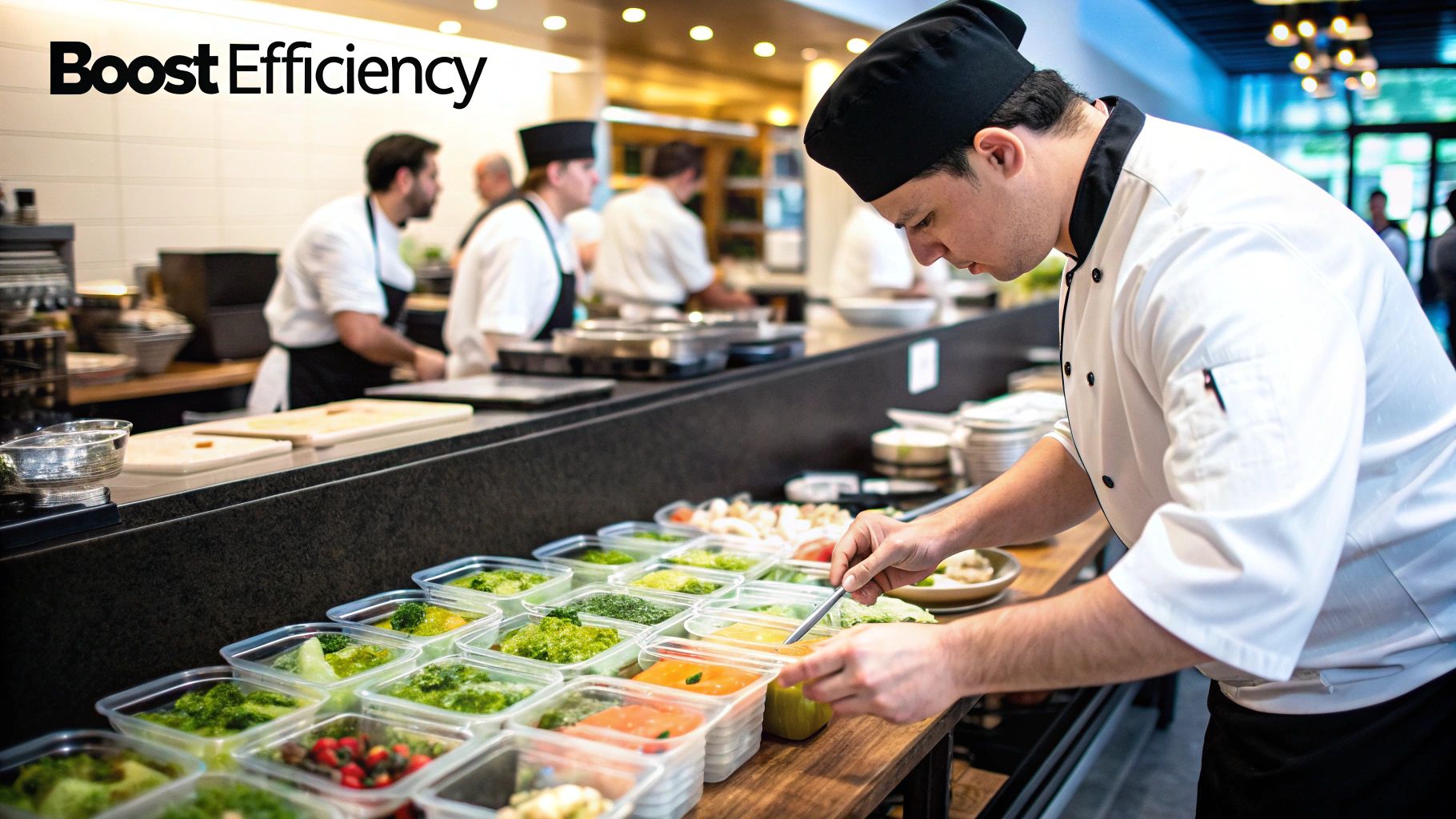
When you're shopping for a restaurant inventory management system, it’s easy to get lost in a generic list of features. To actually solve your biggest headaches, you need specific tools that talk to each other and give you the full picture. A good system gives you complete visibility, changing how you manage every single ingredient from the delivery truck to the final dish.
Let’s follow a single avocado to see how these key features actually work in a real kitchen. Imagine a case of avocados just arrived. The second they’re checked in, the system knows they're on the shelf, ready to become guacamole or the star of your avocado toast.
This journey from shelf to sale is where the real magic happens. A powerful system doesn't just count avocados; it tracks their value, usage, and profit margin every step of the way. Nothing gets lost, and nothing goes to waste.
Real-Time Stock Tracking
The absolute foundation of any good system is real-time stock tracking. Think of it as a live video feed of your inventory that makes those tedious weekly counts a thing of the past. When it’s connected to your POS, every sale automatically updates your stock levels.
For instance, when a customer orders avocado toast, the system instantly deducts the exact amount of avocado, bread, and seasoning from your digital inventory. This kind of accuracy is what stops one of the most frustrating customer experiences—the dreaded "86'd" item. You always know what you have, which means no more running out of a key ingredient mid-service.
A robust inventory system turns guessing into knowing. It provides the data-driven clarity needed to eliminate last-minute supply runs and ensure you can always deliver on your menu promises.
This feature is your first line of defense against both disappointed customers and operational chaos. It makes sure your menu availability matches your actual stock, creating a smoother night for your guests and your staff.
Recipe and Menu Costing
Knowing what’s on your shelves is only half the battle. To protect your profits, you have to understand your costs. That's where recipe and menu costing tools come in—they're essential for calculating the exact cost of every single dish you serve.
The system lets you build digital recipes, attaching a specific cost to each ingredient. For our avocado toast, this isn't just the avocado itself but also the artisan bread, the microgreens, and that drizzle of fancy olive oil. As your supplier prices change, the system automatically updates these costs, giving you a live view of each dish's profitability.
This means you can see which menu items are your real money-makers and which ones might be "loss leaders" secretly eating into your margins. Without this feature, you're just guessing when it comes to menu engineering.
Automated Purchasing and Supplier Management
A great inventory system takes the pain out of the entire ordering process. It uses your sales data and current stock levels to suggest orders, preventing you from ordering too much or, even worse, not enough.
You can set par levels—the minimum amount of an ingredient you need on hand—for critical items like avocados. When your stock dips below that level, the system can automatically generate a purchase order or just ping you to let you know it's time to reorder.
This automation is a game-changer for a few reasons:
- Saves Time: It completely gets rid of the manual work of walking the shelves and building order lists.
- Reduces Waste: By ordering based on what you actually sell, you avoid buying too many perishable items that could go bad.
- Improves Accuracy: It takes human error and guesswork out of purchasing, leading to much more consistent stock levels.
The system also keeps all your supplier information in one organized place. You can track pricing history, manage contacts, and send purchase orders directly from the platform. All that data becomes your secret weapon when it's time to negotiate prices with your vendors, giving you a clear history of your purchasing volume to help you secure better deals.
How AI and Automation Are Changing Inventory Control
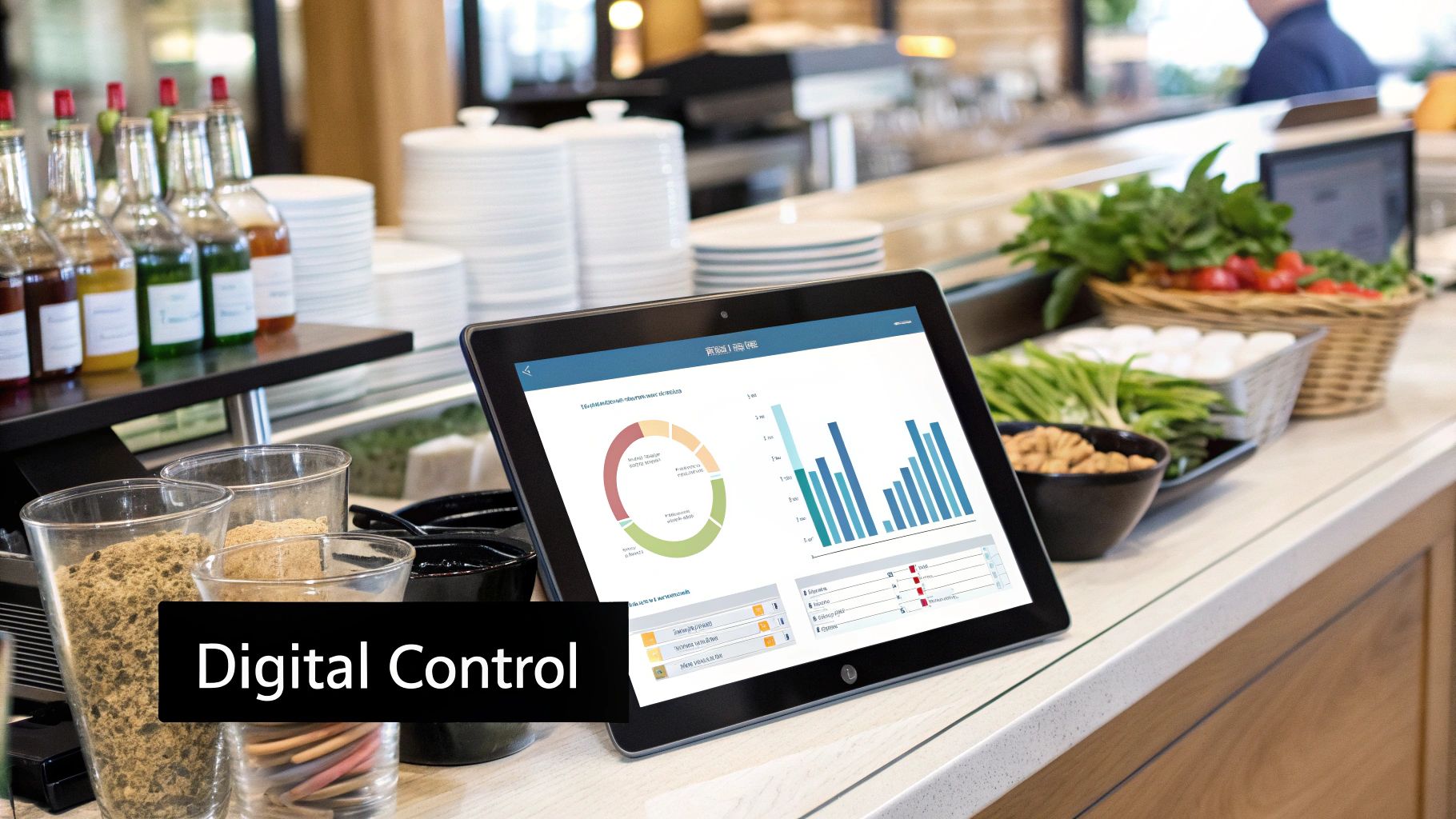
Let’s be honest, traditional inventory has always been a bit of a reactive game. You count what you have, check it against what you sold, and then make your best guess on what to order next. It works, but what if you could flip that whole process on its head?
That’s exactly what’s happening with the infusion of AI and automation. These smart systems are transforming inventory from a backward-looking chore into a forward-looking strategy. They’re less like a simple calculator and more like that seasoned kitchen manager who just knows how busy this weekend is going to be.
Instead of just tallying up what’s gone, the focus is now on predicting what you’ll need before the rush even starts. This is the real power of a modern restaurant inventory management system—using data to make smarter, faster, and more profitable decisions.
Predictive Analytics: The New Crystal Ball
At the heart of this shift is predictive analytics. Think of it as your new secret weapon. AI algorithms dig into massive amounts of data, spotting complex patterns that are nearly impossible for a human to see, and they turn that information into remarkably accurate demand forecasts.
Imagine a system that does more than just notice you sold a ton of burgers last Saturday. It connects that sales spike to the local college football game, the sunny weather, and the happy hour special you were running. The next time a similar set of circumstances line up, the system will proactively nudge you to order extra buns and patties. It’s that smart.
This intelligent forecasting pulls in all sorts of variables:
- Historical Sales Data: Going beyond daily sales to see trends on specific days or months.
- Seasonality: Knowing you’ll need more iced tea in July and more hot cocoa in December.
- Local Events: Factoring in that big concert or street festival happening a few blocks away.
- Promotional Impact: Understanding how your "Two-for-One Taco Tuesday" will drain your avocado supply.
By anticipating demand with this level of detail, you can fine-tune your purchasing like never before. It’s the ultimate balancing act between having enough on hand and slashing the risk of costly spoilage.
Predictive analytics lets restaurants move from "just-in-case" ordering to "just-in-time" purchasing. This shift directly cuts down on food waste and frees up cash that would otherwise be sitting on your shelves as excess inventory.
The Power of Smart Automation
AI’s knack for prediction becomes even more powerful when you pair it with automation. Once the system forecasts what you’ll need, automated features can handle the grunt work, saving your team a massive amount of time and cutting down on human error.
These advanced systems are a world away from manual counts and spreadsheets. They send instant alerts when stock runs low, so you aren't caught off guard during a dinner rush. Want to see how fast this tech is moving? You can dig into the latest restaurant inventory trends to see what's on the horizon.
Here’s how automation can streamline your day-to-day operations:
- Automated Low-Stock Alerts: No more discovering you're out of a key ingredient mid-service. The system pings your phone or email the second an item drops below your set par level.
- Generated Purchase Orders: The system can draft purchase orders for your approval based on its forecasts and your current stock levels. This turns a task that could take hours into a quick, five-minute review.
- Integrated Supplier Ordering: Some of the most advanced platforms can even push approved purchase orders directly into your vendors' systems, closing the procurement loop for you.
This kind of seamless integration means your managers and chefs can spend way less time buried in paperwork and more time doing what they love—creating incredible food and giving your guests an amazing experience. This is the future of running an efficient kitchen.
The Financial and Operational Benefits You Can Expect

Let's be honest, bringing in a new system is all about the results. You're not just looking for slick features; you want to see a real, tangible impact on your restaurant's bottom line. A modern restaurant inventory management system isn't another expense to add to the books—it's a strategic investment that quickly starts paying for itself through some pretty powerful financial and operational wins.
Think of it like this: managing inventory without a system is like trying to find a slow leak in a pipe somewhere in the walls. You know you're losing money, but you can't pinpoint exactly where it's coming from. A good inventory system shines a bright light on every single one of those leaks, so you can patch them up for good.
The numbers back this up. Restaurants that get serious about analytics through their systems report revenue bumps of 5% to 10% and see their operating costs drop by about 15%. That's a clear return on investment that transforms your back-of-house from a cost center into a true profit-generating engine.
Drastic Reduction in Food Waste
One of the first places you’ll see a massive difference is in your food waste. Spoilage, over-portioning, and theft are the silent killers of profit in any kitchen. An inventory system drags these issues out into the open by tracking every ingredient from the moment it’s delivered to the second it's sold.
By digging into your sales history, the system helps you order with surgical precision, so you're not overstocking on perishable items that might end up in the bin. It also helps enforce recipe consistency, making sure your team uses the exact right amount for every dish. No more slow profit drain from a little extra cheese here and a little too much sauce there.
The real magic is in tracking variance—the gap between what you should have used based on sales and what you actually have left. This number tells a story, uncovering hidden waste and pointing you straight to the root cause, whether it’s a training issue or a problem with a supplier.
This isn't just about reducing waste; it's about putting money that was destined for the trash can straight back into your bank account.
Improved Profit Margins Through Plate Costing
Do you know, with 100% certainty, which dish on your menu is your biggest money-maker? The answer might surprise you. An inventory management system gives you the superpower of plate-level costing, calculating the exact cost of every single menu item in real-time.
As your supplier prices inevitably fluctuate, the system automatically updates the cost of each recipe. This is a game-changer, allowing you to:
- Spot Your True Winners: Discover which popular dishes are also pulling in the best margins.
- Uncover Hidden Drains: Identify items that sell well but are barely breaking even or, even worse, losing you money.
- Engineer a More Profitable Menu: Make data-driven decisions about pricing, specials, and which items to feature.
This kind of clarity turns menu design from a purely creative task into a strategic financial tool. You can confidently adjust prices or swap ingredients to protect your margins without ever sacrificing quality. Understanding these financial details is critical, and it's also why exploring different restaurant equipment financing options is so important when considering such a vital investment.
Significant Time Savings and Labor Efficiency
Maybe the most underrated benefit is the huge amount of time you and your team get back. Let's face it, manual inventory counts, building purchase orders from scratch, and chasing down invoices are massive time sinks for any manager.
An automated system takes these tedious tasks off your plate.
- Faster Inventory Counts: Using barcode scanners or mobile apps can slash the time spent on physical counts by over 70%.
- Automated Ordering: The system generates suggested purchase orders based on your par levels and sales forecasts. What used to take hours is now a quick review and a click.
- Streamlined Receiving: You can quickly check in deliveries against purchase orders, ensuring accuracy and instantly updating your stock levels.
All this reclaimed time means your managers can finally step away from the clipboard and focus on what really moves the needle: leading their team, elevating the guest experience, and actually growing the business. It’s a shift from being a reactive administrator to a proactive leader.
How to Choose the Right System for Your Restaurant
Picking the right restaurant inventory management system feels a lot like a chef choosing the perfect knife—it has to be the right fit for the job, feel good in your hand, and perform flawlessly under pressure. The massive, feature-packed software that a bustling multi-location franchise needs would be total overkill for a single-location coffee shop. The real key is finding a system that lines up with your specific day-to-day needs, your budget, and where you see your business going in the future.
This isn’t just about buying some software; it’s about investing in a central nervous system for your back-of-house. So, start by mapping out your daily pain points. Are you constantly 86ing key ingredients mid-service? Is food waste secretly eating away at your profits? Is your manager spending more time counting boxes in the walk-in than coaching your staff? Your answers to these questions will point you straight toward the features that actually matter.
Assess Your Operational Scale and Complexity
First things first, you need to get real about your restaurant's needs. A small cafe with a simple, straightforward menu has completely different inventory headaches than a fine-dining spot with complex, multi-component recipes and a deep wine cellar. Take a hard look at the size of your operation, how many suppliers you’re juggling, and just how intricate your menu really is.
A food truck, for example, needs a system that’s mobile-friendly and dead simple to use on the go. On the other hand, a growing restaurant group requires robust multi-location support and centralized reporting to see the big picture. Even your kitchen's physical setup plays a part. A well-organized space makes implementing any system that much smoother, which really shows the connection between your digital tools and your practical restaurant kitchen layout and design.
Prioritize Non-Negotiable Criteria
Once you’ve got a handle on your needs, you can build a checklist of your must-haves. For any modern restaurant aiming for true efficiency and profitability, certain features are simply non-negotiable.
Here are the core elements to put at the top of your list:
- Seamless POS Integration: This is the big one. Your inventory system absolutely must talk to your Point of Sale (POS) system without a hitch, automatically deducting ingredients as dishes are sold. Without this, you’re stuck manually entering data, which completely defeats the whole purpose of getting the software in the first place.
- User-Friendly Interface: If the software is clunky and a pain to navigate, your team won’t use it correctly—or they just won't use it at all. Look for an intuitive design that your kitchen staff and managers can pick up quickly with minimal training. The best systems are powerful but feel simple.
- Mobile Accessibility: Your manager needs to be able to do spot checks in the walk-in cooler with a phone or approve a purchase order from home. A system with a solid mobile app gives you the flexibility to manage inventory from anywhere, not just from the back office computer.
- Scalability for Growth: Pick a system that can grow with you. Whether you’re planning to add a second location, launch a catering arm, or just expand your menu, your software should be able to handle that increased complexity without forcing you to start all over again.
Choosing a system is a long-term commitment. Prioritize a technology partner that demonstrates a clear roadmap for future updates and innovation, ensuring your investment remains valuable for years to come.
Evaluate Support and Training Resources
Finally, never, ever underestimate the importance of customer support. When you're in the weeds during a chaotic dinner service and a system glitch pops up, you need fast, reliable help. During your demos with different vendors, ask pointed questions about their support hours, typical response times, and what their training resources look like.
The market for these tools has exploded, driven by the demand for integrated, cloud-based solutions. A key trend is the deep link between inventory management and POS systems, which has become the standard for precise, real-time tracking that minimizes the errors plaguing manual methods. You can discover more insights about this growing market on datainsightsmarket.com. A vendor that provides comprehensive onboarding and ongoing support isn’t just selling you a product; they are partnering in your success.
A Step-by-Step Guide to Implementing Your New System
Bringing a new restaurant inventory management system into your kitchen can feel like a huge undertaking, but I promise, it's not as scary as it looks. If you break it down into a few clear, manageable stages, the whole transition can be surprisingly smooth. A good rollout isn't just about installing some software; it’s about weaving a powerful new tool into the very heartbeat of your daily operations. The goal is to get it done with confidence, making sure your team is ready and your data is spot-on from day one.
Think of it like setting up a brand-new, top-of-the-line kitchen. You wouldn't just unbox the shiny new equipment and start cooking. You’d carefully plan the layout, calibrate the ovens, and train your chefs on how to get the best results. We're going to take that same careful approach here.
Data Prep and Your First Count
Alright, first things first: we need to build a solid foundation. Your new system is only as smart as the information you feed it, so getting this initial data right is absolutely crucial. This starts with a massive, wall-to-wall physical inventory count—probably the most thorough one you’ve ever done. This count is going to be the baseline for everything that follows.
Before you even think about counting, get your stockroom organized. I highly recommend using the First-In, First-Out (FIFO) method to make sure you're using up older products first. Once everything's in its place, schedule the count during off-peak hours. This minimizes interruptions and seriously improves accuracy. Trust me, taking the time to nail this initial setup will save you from major headaches down the road.
Setting Up Suppliers and Recipes
With your starting inventory logged, the next step is to load in your restaurant's DNA: your suppliers and your recipes. This is where the system really starts to learn the ins and outs of your business.
Start by entering all your supplier information—product lists, current pricing, contact details, the works. This basically digitizes your whole purchasing process. Next, and this is a big one, you need to meticulously build out your recipes. This means linking every single menu item to the specific ingredients and quantities it requires. This step is absolutely vital for getting accurate plate costs and for real-time stock depletion to work correctly.
A common hurdle I see is people underestimating how much time recipe entry takes. Don't think of it as a chore. Treat it as a strategic review of your menu engineering, a chance to ensure every dish is built for both consistency and profitability.
Effective Staff Training
Technology is only as good as the people using it. A smooth rollout depends entirely on how well your team understands and buys into the new system. Please, don't just schedule one training session and hope for the best. You need a real, structured plan.
I always suggest appointing a "system champion"—a tech-savvy manager or lead cook who can become the go-to expert for everyone else. Schedule multiple, short training sessions during slower periods instead of one long, overwhelming marathon. And focus on role-specific tasks. Your receiving staff only needs to know how to check in orders, while your chefs need to understand how to look up recipes. Keep it relevant to their jobs.
Going Live and Fine-Tuning
This is it—the go-live moment. My advice is to launch during a typically slower part of the week, like a Monday or Tuesday. This gives your team space to adjust without the pressure of a chaotic weekend rush. For the first few weeks, I strongly recommend running your old system (even if it's just spreadsheets) in parallel with the new one. This creates a safety net and lets you cross-reference your data to catch any weird discrepancies early on.
Expect a few bumps in the road; it's totally normal. The key is to constantly gather feedback from your staff and be ready to make small adjustments. Over time, as your system gathers more and more data, you’ll be able to fine-tune your par levels, optimize your purchasing, and finally unlock all the financial and operational benefits of your powerful new tool.
Common Questions About Inventory Management Systems
When you start digging into restaurant inventory management systems, a few questions always seem to pop up. Let's tackle them head-on, so you can get a clearer picture of how one of these systems could really work for your operation.
How Much Do These Systems Typically Cost?
This is the big one, right? The good news is, the cost isn't as scary as you might think. For most independent spots, a solid, basic system will typically run you somewhere between $50 to $100 per month.
If you're running a larger operation or have multiple locations, you might look at more advanced platforms with features like AI forecasting, and those can cost several hundred dollars a month. The key is to think of it less as a cost and more as an investment—weigh that monthly fee against all the money you'll save by slashing food waste and running a tighter ship.
Can It Integrate with My Current POS?
Absolutely—and honestly, this is a dealbreaker. Any modern inventory system worth its salt is built to connect seamlessly with the major Point of Sale (POS) systems out there. This connection is the magic that makes everything work, automatically deducting ingredients from your stock every time a dish is sold.
Before you pull the trigger on any software, you have to confirm it’s compatible with your specific POS. A smooth integration means no more mind-numbing manual data entry, which saves a ton of time and cuts out those little errors that can cost you big. For a full rundown of the tech you'll need, our restaurant equipment checklist is a great resource.
Ready to equip your kitchen for maximum efficiency? At The Restaurant Warehouse, we offer top-tier equipment and supplies to help you streamline operations and boost your bottom line. Explore our extensive catalog and find the perfect tools for your business at https://therestaurantwarehouse.com.
About The Author

Sean Kearney
Sean Kearney used to work at Amazon.com and started The Restaurant Warehouse. He has more than 10 years of experience in restaurant equipment and supplies. He graduated from the University of Washington in 1993. He earned a BA in business and marketing. He also played linebacker for the Huskies football team. He helps restaurants find equipment at a fair price and offers financing options. You can connect with Sean on LinkedIn or Facebook.
Leave a comment