

Your Guide to Restaurant Equipment Rent
Renting restaurant equipment can be a game-changing financial strategy, especially when you're launching or expanding. Instead of pouring tens of thousands of dollars into assets that start losing value the second they’re plugged in, you get to hold onto your cash for the things that really drive growth—like marketing, payroll, and keeping your walk-in stocked. It’s a move that gives you flexibility and keeps your kitchen kitted out with modern gear, all without the heavy financial baggage of ownership.
Why Top Restaurateurs Are Renting Equipment
Opening a restaurant is a capital-intensive marathon, not a sprint. The initial costs can be absolutely staggering, and seasoned operators know that cash flow is the lifeblood of their business. This is exactly where the strategic choice to rent equipment becomes a game-changer, shifting the financial burden away from massive upfront purchases.
Picture a new bistro owner weighing their options: drop $15,000 on a top-of-the-line espresso machine, or rent it for a predictable monthly fee. By renting, they instantly free up a huge chunk of capital. Now, those funds can be pumped into areas that directly fill seats—like a powerful digital marketing campaign or hiring that amazing head chef who can take the menu to the next level.
Preserve Capital and Boost Agility
This isn't just about saving money at the very beginning; it’s about staying financially nimble. The restaurant industry moves fast, and customer tastes can change on a dime. Renting lets you adapt without being chained to expensive equipment that’s losing value every day.
If a new menu idea requires a specialty combi oven you don't own, a rental makes that pivot possible without another huge capital expense. That kind of flexibility is a serious competitive advantage.
The growing appeal of this model is clear in the market trends. The global restaurant equipment rental market was valued at around $4.1 billion, with projections showing it could hit $8.9 billion by 2033. This growth highlights a major shift in how modern restaurant owners are thinking about their assets.
"Renting equipment transforms a major capital expenditure into a predictable operating expense. This simple change improves your balance sheet and gives you the breathing room to invest in growth, not just hardware."
From Renting to Owning
For many restaurateurs, renting isn't just a temporary fix; it's a smart pathway to ownership. A lot of rental agreements come with lease-to-own options, allowing you to build equity over time while still enjoying those lower initial costs.
To get a better handle on how these agreements are structured, check out our comprehensive guide on restaurant equipment leasing. This financial tool bridges the gap between an immediate need and long-term asset acquisition, making it an essential strategy for any savvy restaurant owner.
How to Accurately Assess Your Kitchen Needs
Jumping into a rental agreement without a clear blueprint of your kitchen's needs is a recipe for disaster. Before you even think about looking at rental programs, you need to step back and do a detailed needs analysis. Trust me, this process saves you from overspending on flashy gadgets you’ll barely use or—even worse—under-equipping your kitchen and creating bottlenecks during a dinner rush.
Start by looking at your menu, not a catalog. The complexity and volume of your dishes will dictate every single piece of equipment you need. A high-volume pizzeria's oven and refrigeration requirements are worlds apart from a small, farm-to-table café that focuses on fresh, daily ingredients. Think critically about your core menu items and the workhorses you'll need to produce them consistently, day in and day out.
Distinguish Needs From Wants
It’s easy to get excited about the latest kitchen tech, but your budget demands discipline. The real goal here is to separate the absolute must-haves from the nice-to-haves. A great way I've found to do this is to map every potential piece of equipment to a specific, profitable function in your kitchen.
Ask yourself these questions for every item on your list:
- Menu Dependence: Which dishes—the ones bringing in the bulk of your revenue—would be impossible to make without this specific piece of equipment?
- Workflow Impact: Will this item actually speed up a critical prep or cooking station, or will it just take up valuable space?
- Volume Capacity: Does its capacity match your realistic daily covers? A massive mixer is just wasted money and space if you only bake a dozen pastries a day.
This kind of strategic thinking is crucial. The foodservice equipment market, which includes rentals, is projected to hit $73 billion by 2035. Cooking equipment leads the pack with a 31% share, followed by refrigeration at 24%. This tells you exactly where the core of most kitchen investments lies, and likely where your focus should be, too.
One of the biggest wins with renting is freeing up that significant capital, allowing you to invest in other growth areas like marketing or staffing.
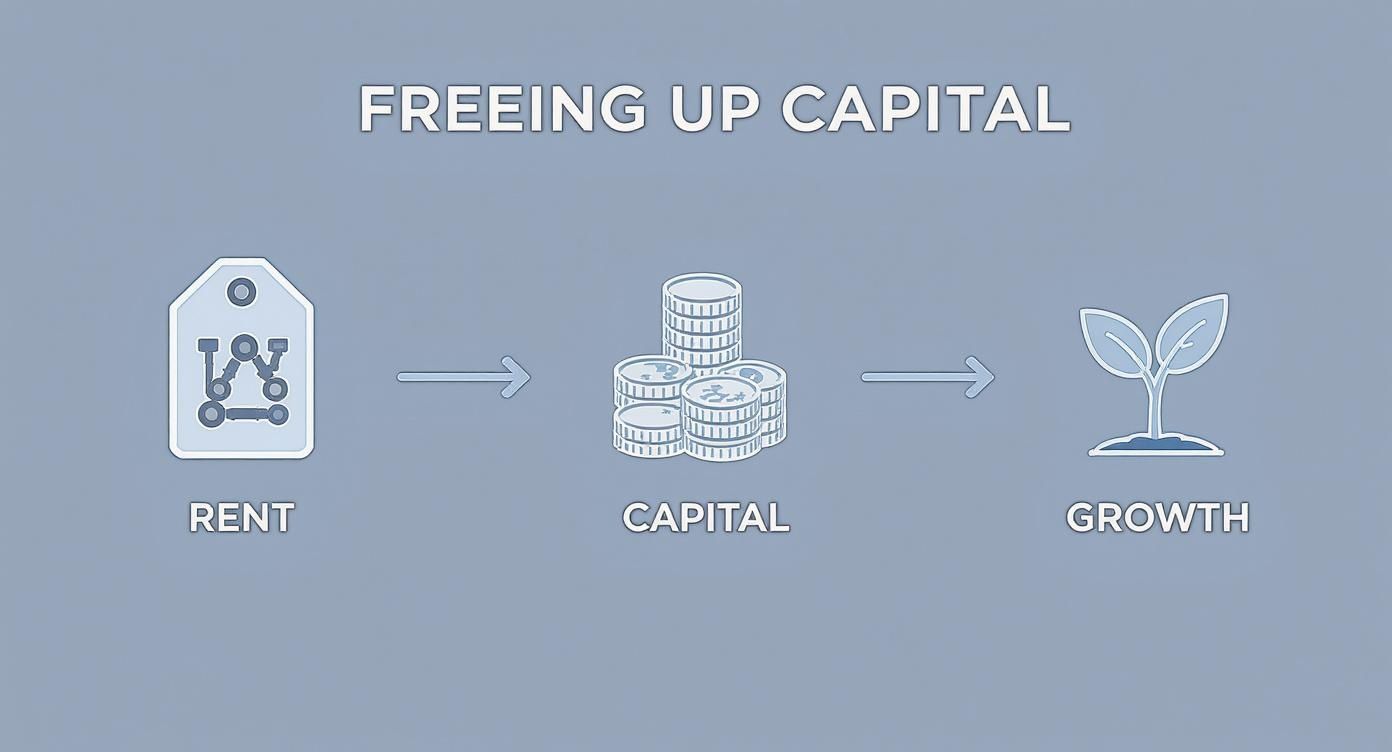
This really drives the point home—renting equipment directly translates into available cash, which is the fuel for expansion and making your operations better across the board.
Creating Your Equipment Blueprint
Once you have a list, it's time to organize it by priority. This isn't just a simple shopping list; it's a strategic document that will guide every single one of your rental decisions. When you're assessing your needs, the nitty-gritty specs and types of equipment are paramount. For more perspective on selection criteria, a comprehensive guide on choosing kitchen appliances can offer some really useful things to think about, even though it's geared toward home settings.
By meticulously planning your needs, you ensure every rental dollar is a direct investment in your kitchen’s efficiency and profitability. Avoid impulse decisions and focus on function over features.
To really nail this down, I've found that a worksheet is the best way to keep things organized and objective. It forces you to justify every piece of equipment against your menu and operational flow.
Equipment Needs Analysis Worksheet
This simple tool can help you cut through the noise and prioritize what truly matters for your kitchen. Go through your list item by item and fill this out honestly.
| Equipment Category | Menu Requirement (Core/Specialty) | Projected Usage (High/Medium/Low) | Space Consideration (Yes/No) | Priority Level (Essential/Important/Optional) |
|---|---|---|---|---|
| Convection Oven | Core | High | Yes | Essential |
| 6-Burner Range | Core | High | Yes | Essential |
| Walk-in Cooler | Core | High | Yes | Essential |
| Ice Machine | Core | High | Yes | Essential |
| Planetary Mixer | Specialty | Medium | No | Important |
| Panini Press | Specialty | Low | No | Optional |
| Vacuum Sealer | Specialty | Low | No | Optional |
This kind of methodical approach ensures your kitchen is primed for success from day one. For an even more structured process, building out a detailed list is invaluable. Our restaurant kitchen equipment checklist offers a thorough template to make sure you don't overlook any essential items, from major cooking stations down to small prep tools. It helps guarantee your kitchen is ready to go, without the financial strain of unnecessary rentals.
Finding the Right Rental Partner for Your Business
Deciding to rent restaurant equipment is a big strategic move, but the partner you choose is just as critical as the gear itself. Not all rental programs are created equal, and the best providers act less like suppliers and more like an extension of your operations team.
They get the rhythm of your business and offer solutions that actually match your goals.
Think about it this way: a food truck gearing up for a packed summer festival season has completely different needs than an established fine-dining spot planning a major kitchen overhaul. The food truck might need a flexible, short-term monthly rental for a high-capacity fryer. Meanwhile, the restaurant may be looking for a long-term, rent-to-own agreement on a sophisticated combi oven, seeing it as a clear path to ownership.
Your ideal partner will have the right contract type for your unique situation, not just a one-size-fits-all plan.
Decoding Different Rental Models
Before you even start looking at companies, you need to get a handle on the main types of rental agreements out there. Each model serves a totally different business purpose and financial strategy.
- Short-Term Rentals: These are perfect for seasonal demands, one-off special events, or just trying out a piece of equipment before you commit. We're talking daily, weekly, or monthly contracts. They give you maximum flexibility but usually come with a higher per-day cost.
- Long-Term Leases: Typically spanning one to five years, these agreements mean lower monthly payments and are ideal for the core equipment in your kitchen. They offer stability and predictable expenses you can build your budget around.
- Rent-to-Own Agreements: This is a hybrid model that lets you apply a chunk of your rental payments toward buying the equipment. It’s an excellent strategy for businesses that want to acquire assets without a massive upfront cash dump.
Getting these options straight is the first step. But picking from the many commercial kitchen equipment suppliers requires a much deeper dive into what they can actually do for you.
Your Vetting Checklist for Rental Companies
Once you have a shortlist of potential partners, it’s time to ask the tough questions. A great price is totally meaningless if the company goes dark when a critical piece of equipment dies during your Friday night rush.
Use this checklist to put any potential provider under the microscope.
The best rental partners understand that their success is directly tied to yours. They provide not just equipment, but reliability, responsiveness, and peace of mind, which are invaluable assets in any kitchen.
A truly supportive partner will be completely transparent about their service protocols and the quality of their gear. You want specific answers, not vague promises.
Key Vetting Questions:
- What is your emergency service response time? Ask for their guaranteed timeline, especially for failures after hours and on weekends. A 4-hour response window is a strong industry standard.
- What does your maintenance policy include? Does it cover preventative maintenance, or only repairs when something breaks? Proactive service can prevent a ton of costly downtime.
- What is the age and condition of your rental fleet? Inquire about their equipment turnover rate. Do they offer new or just certified refurbished options?
- Do you offer ENERGY STAR rated equipment? Energy-efficient models can seriously lower your utility bills, which helps offset some of the rental cost over time.
- What are the contract's early termination penalties and upgrade options? Your business needs will change. Look for a partner that gives you the flexibility to scale up or pivot without getting slammed with excessive fees.
Finding a partner who can confidently answer these questions is how you build a relationship that supports your success, not just one that fills a space in your kitchen.
How to Negotiate Your Rental Agreement
The first quote you get for an equipment rental is just that—a starting point. It's a conversation starter, not the final word. I’ve seen too many operators glance at the monthly payment, nod, and sign on the dotted line. But the real meat of the deal, and the potential headaches, are buried in the fine print.
Don't make the mistake of treating the agreement like it's set in stone. Think of it as a flexible framework. Your goal isn't just to get a good price, but to forge a partnership that actually supports you when things inevitably go sideways in a busy kitchen.
Scrutinize Critical Contract Clauses
Before you even think about signing, you need to dig into the clauses that will directly affect your day-to-day operations and your wallet. Don't be shy about asking for changes or clarification. A rental partner who’s worth their salt will be ready to have these conversations to find terms that work for both of you.
Here’s where you need to focus your attention:
- Maintenance and Repairs: Who’s on the hook for what? A solid agreement doesn't just cover emergency repairs; it includes preventative maintenance. Getting the rental company to cover routine servicing—like swapping out filters and doing calibrations—can save you thousands over the life of the contract.
- Early Termination Penalties: Your business needs can change on a dime. Make sure you understand exactly what it will cost to get out of the contract early. Look for flexible clauses or a buyout option that won't leave you with crippling penalties.
- Liability and Insurance: What’s the plan if a piece of equipment goes haywire and causes damage or, worse, an injury? Get crystal clear on the insurance requirements and make sure the liability for mechanical failures lands squarely with the equipment provider.
The best way to uncover potential landmines is to ask specific, "what-if" questions based on real-world kitchen chaos. For a deeper dive into getting favorable terms, check out these strategies for negotiating agreements with service providers.
The most valuable parts of your rental agreement aren't about the monthly price; they're about the service guarantees. A slightly higher monthly fee that includes 24/7 emergency service is infinitely better than a cheaper deal that leaves you stranded on a Saturday night.
Asking the Right Questions
Your real power in this negotiation comes from asking sharp, detailed questions that prove you know the realities of running a kitchen. This is your business on the line, so now is not the time to be timid.
Here are the kinds of questions you should be bringing to the table:
- "What is the exact protocol for an after-hours equipment failure?" A vague promise like "we'll get someone out there" is a red flag. You need a guaranteed response time, in writing.
- "Can the buyout price be locked in at the start of the lease?" This is crucial. It prevents the provider from jacking up the price if you decide you want to purchase the equipment down the road.
- "Are consumable parts like gaskets, bulbs, and filters covered under the maintenance plan?" These small items seem minor, but their costs add up fast over a few years.
- "What are the options for upgrading equipment if our volume increases mid-contract?" A true partner will have a clear, fair path for you to scale your equipment as your business grows.
Every single one of these points you can get them to concede on is a win. It strengthens your operation and protects your cash flow for the long haul.
Getting Your Rental Delivered and Installed Without the Headaches

You’ve signed the rental agreement, and now for the part that can make or break your week: getting that shiny new equipment into your kitchen and running. This is where so many restaurateurs drop the ball. They focus on the contract but forget the real-world logistics, leading to service shutdowns, surprise costs, and a whole lot of frustration.
Success here comes down to one thing: proactive planning. You have to think like a mover and an installer long before the delivery truck even pulls up.
Don't just assume it's going to fit. I've seen it happen more times than I can count—a brand-new walk-in freezer arrives, and the condenser unit won't squeeze through the back door. Or a beautiful six-burner range shows up, only for the chef to realize it needs a completely different gas line. This isn't just about the equipment's footprint; it's about every inch of the path it takes to get to its final spot.
This kind of operational foresight is absolutely crucial, especially for modern kitchen models. The boom in cloud kitchens, which rely on being able to scale their equipment up or down on a dime, is driving huge growth in the rental market. For these virtual restaurants, a smooth rental and installation process isn't a luxury—it's a core part of their business strategy. You can find more insights on this trend over at Dataintelo.com.
Your Pre-Delivery Site Prep Checklist
Want to avoid a logistical nightmare on delivery day? You have to get your space ready. A simple walkthrough a day or two before the truck arrives can prevent almost every common installation headache. Don't skip this.
Here’s what your checklist should cover:
- Measure Everything. Twice. Get out the tape measure and confirm the dimensions of every doorway, hallway, and tight corner along the delivery path. Compare those numbers against the equipment’s spec sheet.
- Clear the Path. Make sure the route from the delivery truck to the installation spot is wide open and safe. Move any boxes, carts, or other obstacles out of the way for the delivery team.
- Verify Your Hookups. This is a big one. Check that your gas, electric, and water lines are a perfect match for the rental unit’s needs. Do you have the right voltage? The correct outlet type? The proper connection fittings?
- Schedule Smart. Try to plan the delivery for your off-peak hours. This minimizes the disruption to your staff and any service you might have running.
Key Takeaway: A smooth installation isn't just on the rental company. How you prep your physical space is just as important and has a direct impact on how quickly that new equipment can start making you money.
Inspecting the Equipment When It Arrives
When the truck pulls up and the equipment comes off, your job isn't just to sign a delivery slip. You need to give that unit a thorough inspection before the delivery crew heads out. This is your one and only chance to document any issues without it turning into a "he said, she said" situation later.
Go over the equipment carefully. Look for any pre-existing damage—dents, deep scratches, or any broken knobs or components. Pull out your phone and take clear photos of any imperfections you spot, no matter how small they seem. This documentation is your proof, protecting you from being on the hook for damage you didn't cause when your rental term is up.
Finally, do a quick inventory check. Make sure all the promised accessories, like fryer baskets, oven racks, or mixer attachments, are actually there. Taking these few extra minutes on arrival saves you from frustrating surprises and ensures your team can get to work right away.
Got Questions About Renting Kitchen Equipment?
Diving into the world of equipment rentals can bring up a lot of "what-if" scenarios. It’s smart to think through these potential hurdles before you sign on the dotted line. Below are the straight-up answers to the questions we hear most often from fellow restaurateurs, tackling the real-world concerns that pop up in a busy kitchen.
Getting these things straight from the get-go gives you the confidence to negotiate a rental agreement that actually protects your business and keeps your daily operations humming.
What Happens if My Rented Gear Breaks Down Mid-Service?
This is the number one worry for most operators, and for a very good reason. Having a critical piece of equipment die during a dinner rush is a total nightmare. Your rental agreement needs to spell out the emergency service plan in black and white. The rental company is—and should always be—on the hook for all maintenance and repairs.
Before you sign a thing, get their guaranteed response time in writing. A vague promise of "as soon as possible" just doesn't cut it. You need to see a firm commitment, like a technician on-site within four hours, and get clear on whether they offer true 24/7 availability.
A cheap monthly rate is completely worthless if a broken oven can shut you down on a Friday night. The quality of a rental partner is truly tested when something goes wrong.
Also, be sure to ask this crucial follow-up question: "Do you provide a loaner unit if a repair is going to take longer than a day?" That single clause is a major negotiating point and can be the difference between a small hiccup and a full-blown service disaster.
Can I Rent Used Equipment to Save Some Cash?
Absolutely, and it can be a fantastic cost-saving move. Lots of reputable rental companies offer a fleet of certified refurbished equipment at a pretty significant discount compared to brand-new models. This is an excellent option for standard kitchen workhorses like prep tables, stainless steel sinks, or basic gas ranges where the latest tech isn't a top priority.
There's one key condition, though: insist that any used or refurbished gear comes with the exact same maintenance and service guarantee as their new equipment. The responsibility for its performance should still fall entirely on them.
When the equipment arrives, give it a thorough once-over. Check its energy efficiency rating, too, as older models can sometimes have higher utility costs that slowly eat away at your initial savings.
Is It Possible to Upgrade Equipment During My Contract?
A good rental partner gets it—businesses grow and needs change. Most modern rental companies build flexibility right into their agreements with what’s known as an upgrade clause. This allows you to swap out a piece of equipment for a larger or more advanced model as your customer volume picks up.
This process usually involves an adjustment to your monthly payment and might require extending the contract term. If you’re planning for growth—and you should be—make this a central point of discussion during your initial talks. Nailing down a clear and fair upgrade path from the start gives you a massive strategic advantage for scaling your kitchen efficiently down the road.
How Does Renting Equipment Affect My Business Taxes?
From a financial management standpoint, this is one of the most attractive parts of renting. Generally, rental payments are classified as operating expenses, which makes them fully tax-deductible from your business income for the year they are paid.
This is often a much simpler and more direct process than buying an asset and depreciating its value over several years. Of course, tax laws can be complex and vary by location. It's always best to have a chat with your accountant to understand the specific tax benefits for your restaurant and make sure you're maximizing them correctly.
Ready to equip your kitchen with the best gear without the upfront cost? The Restaurant Warehouse offers flexible financing and lease-to-own programs on top-tier equipment, with fast delivery to get you operational in no time. Explore our extensive catalog and find the perfect solution for your business at https://therestaurantwarehouse.com.
About The Author

Sean Kearney
Sean Kearney used to work at Amazon.com and started The Restaurant Warehouse. He has more than 10 years of experience in restaurant equipment and supplies. He graduated from the University of Washington in 1993. He earned a BA in business and marketing. He also played linebacker for the Huskies football team. He helps restaurants find equipment at a fair price and offers financing options. You can connect with Sean on LinkedIn or Facebook.
Leave a comment