

Lease-to-Own Kitchen Gear Without Getting Burned
Why Smart Restaurant Owners Choose Lease-to-Own Equipment
Lease-to-own commercial kitchen equipment lets you get the gear you need without the crushing upfront costs that can drain your startup capital. Instead of paying $30,000 to $120,000 upfront for kitchen equipment, you make manageable monthly payments and own everything at the end of your lease term.
Quick Answer: How Lease-to-Own Works
- Apply: Get approved in 24-48 hours with credit lines up to $50,000
- Choose: Select from over 60,000 restaurant equipment items
- Pay: Make fixed monthly payments for 12-60 months
- Own: Equipment becomes yours at lease end (often for $1)
- Benefits: 100% tax-deductible payments, preserve cash flow, build business credit
The numbers tell the story. Outfitting a new restaurant costs $100,000 to $300,000, with kitchen equipment alone accounting for $30,000 to $120,000 of that expense. For many restaurant owners, especially those just starting out, that's a budget-buster.
"Even the most successful entrepreneurs and business owners may struggle to pay for new equipment for their commercial kitchens," notes one industry expert. That's where lease-to-own steps in as a game-changer.
Unlike traditional leasing where you return equipment at the end, lease-to-own builds toward ownership. You're not just renting - you're investing in your restaurant's future. Monthly payments range from $450-$500 for $20,000 worth of equipment to $1,100-$1,200 for $50,000 worth (with good credit).
The best part? Those payments are typically 100% tax-deductible for most businesses, turning your equipment costs into immediate tax benefits.

Handy lease-to-own commercial kitchen equipment terms:
What is Lease-to-Own and How Does It Work?
Lease-to-own commercial kitchen equipment is a financing agreement that acts as a middle ground between renting and buying. You make monthly payments over a set term, and at the end, you own the equipment. Unlike traditional leasing, every payment builds toward ownership, allowing you to acquire necessary assets without a massive upfront cost. This preserves working capital for other crucial business areas like staffing and marketing.
From an accounting perspective, this is often a \"capital lease,\" meaning you can eventually record the equipment as an asset on your balance sheet. Instead of a single large expense, you spread the cost over time while building equity with each payment.
Understanding the Key Differences
Here’s how lease-to-own commercial kitchen equipment compares to other options:
- Traditional Leasing: A long-term rental where you return the equipment at the end. You don't build equity, making it suitable for tech that quickly becomes outdated.
- Outright Purchase: You pay the full price upfront for immediate ownership. This requires significant capital that can strain cash flow.
- Renting: The most flexible option for short-term needs but also the most expensive long-term, with no path to ownership.
With lease-to-own, you build equity with each payment. At the end of the term, the equipment becomes yours, often for a nominal $1 buyout fee, turning an expense into a business asset. The end-of-term options are simple: once you've made all payments, you complete the purchase and the equipment is officially yours.
For a deeper dive into the mechanics of equipment acquisition, check out our guide on Obtaining Restaurant Equipment Through A Lease Agreement.
The Lease-to-Own Journey: From Application to Ownership
Getting started with lease-to-own commercial kitchen equipment is a streamlined and fast process.
- Application: A simple online form takes less than 5 minutes, with approvals often granted in 24-48 hours.
- Equipment Selection: Choose from our inventory of over 60,000 items to find the perfect fit for your kitchen.
- Agreement Terms: Finalize your agreement with flexible terms from 12 to 60 months and fixed monthly payments for predictable budgeting.
- Making Payments: Once your equipment arrives, you'll make regular, manageable monthly payments.
- Final Buyout: At the end of your term, you purchase the equipment for a nominal fee (often just $1), completing the transition to full ownership.
To learn more about how this process works, explore our Lease Commercial Kitchen Equipment Guide.
The Pros and Cons: Is Lease-to-Own Right for Your Restaurant?
The Financial Recipe for Lease-to-Own Commercial Kitchen Equipment
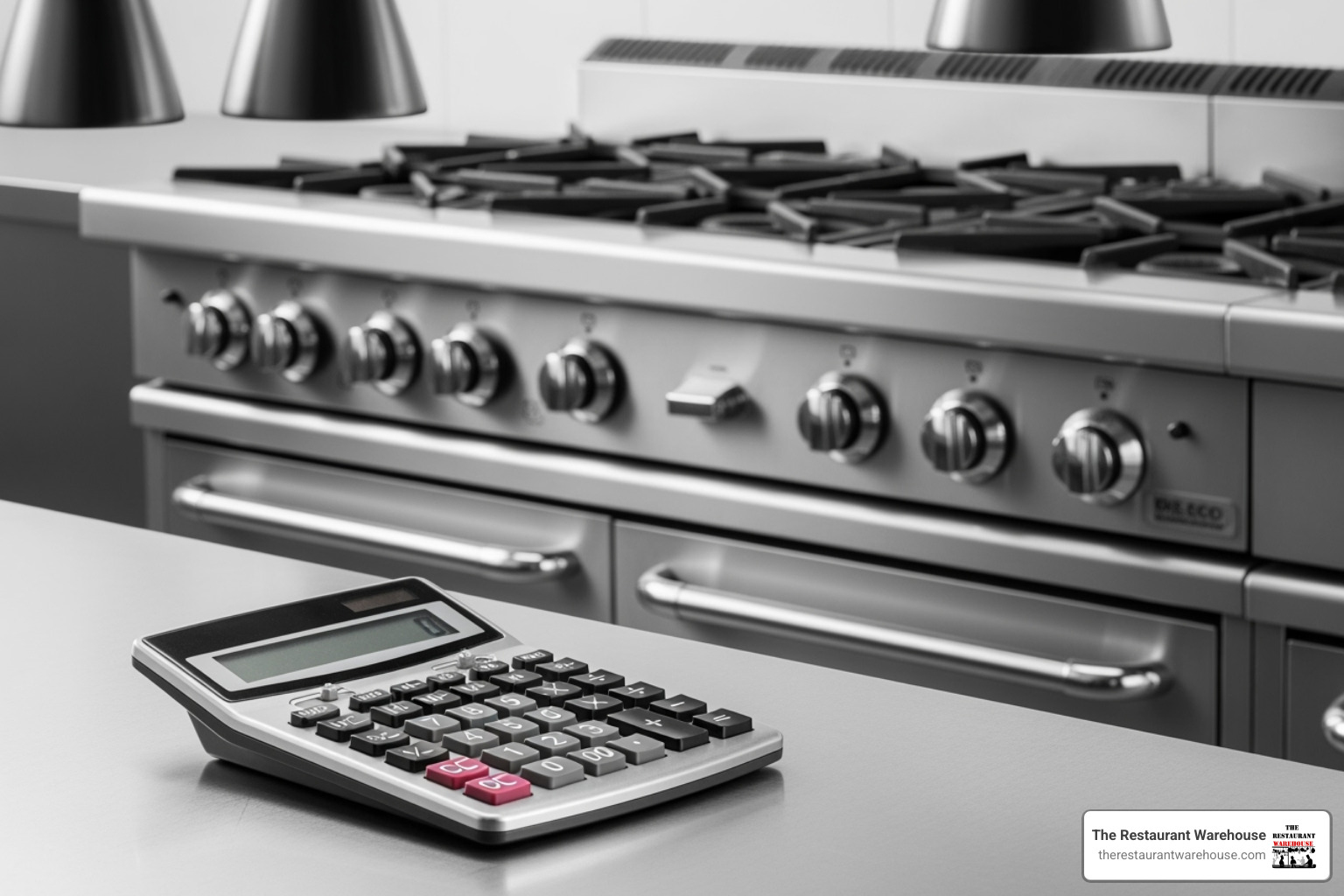
Let's crunch the numbers together, because understanding the financial side of lease-to-own commercial kitchen equipment is like having the perfect recipe – you need to know exactly what goes into it! When you're investing in your restaurant's future, every dollar needs to work as hard as you do during the dinner rush.
The beauty of lease-to-own lies in its predictability. You'll know exactly what you're paying each month, which makes budgeting feel less like guesswork and more like following a trusted recipe. While there isn't a traditional "interest rate" like you'd see with a bank loan, your monthly payment does include the cost of financing spread over your chosen term. Think of it as the cost of convenience and preserved cash flow.
Here's something that might surprise you: many providers offer credit lines up to $50,000, which can cover a substantial chunk of your kitchen setup. We've seen commercial ranges financed for as little as $134 per month! These manageable payments are designed to keep your cash available for the day-to-day expenses that keep your restaurant humming.
One of the smartest aspects of lease-to-own commercial kitchen equipment is how it can bundle those pesky "soft costs" right into your monthly payment. We're talking about delivery, installation, and sometimes even training – all rolled into one predictable monthly amount. No more surprise bills when your new equipment arrives!
Typical Payment Structures and Overall Costs
When it comes to structuring your payments, lease-to-own commercial kitchen equipment offers flexibility that fits different business needs. Most agreements run anywhere from 12 to 60 months, giving you plenty of room to find a payment that works with your budget.
Let's look at some real-world numbers that might help you plan. For $20,000 worth of equipment, you're typically looking at monthly payments between $450 and $500 over a five-year term (assuming you have good credit). Scale that up to $50,000 worth of equipment, and you're looking at roughly $1,100 to $1,200 per month for the same term length.
These figures show just how manageable major equipment purchases can become when you spread them over time. Many providers offer credit lines up to $50,000 with instant approval decisions, which means you could walk away with approval for a significant equipment package faster than you can prep for lunch service.
Here's where it gets even better: most lease-to-own commercial kitchen equipment programs require minimal or no down payment. This is a game-changer compared to traditional bank loans, which often demand substantial upfront payments that can drain your working capital.
The end game is what really matters though. With true lease-to-own agreements, you're typically looking at a $1 buyout option at the end of your term. That means once you've made all your scheduled payments, you pay one symbolic dollar and the equipment is officially yours. This differs significantly from Fair Market Value buyouts, where you'd pay whatever the equipment is worth at the end of the lease. The $1 buyout is what transforms your monthly expenses into a path to ownership.
Opening up Tax Advantages
Here's where lease-to-own commercial kitchen equipment can really boost your bottom line: the tax benefits are fantastic! For most businesses, those monthly lease payments are 100% tax deductible. Every payment you make can be written off as a business expense, which reduces your taxable income and puts money back in your pocket.
This immediate deduction is often more beneficial than purchasing equipment outright, where you'd typically depreciate the asset over several years. With leasing, you get those tax benefits right away, improving your cash flow when you need it most.
You might also want to explore the Section 179 Deduction with your tax professional. This IRS provision allows businesses to deduct the full purchase price of qualifying equipment in the year it's acquired. Since true lease-to-own agreements with $1 buyouts are often treated like purchases for tax purposes, you could potentially qualify for this substantial deduction. For more details on this opportunity, check out Understanding the Section 179 Deduction.
The tax advantages can be significant, but every business situation is unique. We always recommend consulting with a qualified tax professional who can review your specific circumstances and help you maximize these benefits. They can guide you through the depreciation benefits and ensure you're taking advantage of every deduction available to your business.
For a comprehensive look at all your financing choices, explore our Restaurant Equipment Financing Options to find the approach that best fits your restaurant's financial recipe for success.
Qualifying for a Lease and What Equipment is Available

Here's the beautiful truth about lease-to-own commercial kitchen equipment: it's designed to be accessible, not exclusive. Whether you're a seasoned restaurant owner looking to upgrade or a passionate entrepreneur just starting your culinary journey, there's likely a path forward for you.
The qualification process is refreshingly straightforward, especially compared to traditional bank loans that can feel like navigating a maze blindfolded. Most providers understand that restaurants come in all shapes and sizes, with varying financial histories and credit profiles. They've built their programs to work with real businesses, not just the ones with perfect credit scores.
What makes this even more exciting is the sheer variety of equipment available. We're talking about everything from massive walk-in coolers to precision mixers, all available through manageable monthly payments. It's like having access to a fully stocked equipment catalog without the sticker shock of paying for everything upfront.
Who Qualifies for a Lease-to-Own Agreement?
The qualification criteria for lease-to-own commercial kitchen equipment are refreshingly realistic. While having stellar credit certainly helps, it's not the make-or-break factor that many business owners fear it might be.
Credit score requirements typically start in the mid-600s for the best rates and terms, but many providers work with businesses across the credit spectrum. Think of it less as a hard cutoff and more as a sliding scale where better credit gets you better terms, but decent credit still gets you approved.
Startups and new businesses often worry they'll be automatically disqualified, but that's rarely the case. Many financing companies actively want to support entrepreneurial ventures, understanding that every successful restaurant started somewhere. They look at your business plan, your experience, and your potential rather than just demanding years of financial history you don't have yet.
Even if you're dealing with bad credit, don't lose hope. Specialized programs exist specifically for businesses in this situation. Yes, the rates might be higher to offset the increased risk, but these options can provide the lifeline you need to get your kitchen operational. Some providers offer revenue-based financing, asset-based lending, or other creative solutions that look beyond traditional credit scores.
The required documentation is typically minimal and straightforward. You'll need basic business information, some financial statements if you're an established business, and sometimes a personal guarantee. The whole process is designed for speed – a credit application often takes less than 5 minutes to complete, with final approval usually coming within 24-48 hours.
This rapid turnaround means you can move from "we need a new fryer" to "our new fryer is being delivered" in just a couple of days. That's the kind of responsiveness that keeps kitchens running smoothly.
For businesses navigating credit challenges, our Restaurant Equipment Financing Bad Credit guide offers detailed strategies and solutions.
Common types of lease-to-own commercial kitchen equipment
The scope of lease-to-own commercial kitchen equipment available is truly impressive. We offer over 60,000 restaurant equipment items available to lease or finance, covering virtually every piece of equipment your kitchen could need.
Refrigeration equipment forms the backbone of most commercial kitchens. This includes walk-in coolers and freezers, reach-in refrigerators, prep tables with refrigerated bases, display cases, blast chillers, and undercounter units. These are often the most expensive single purchases, making them perfect candidates for lease-to-own arrangements.
Cooking equipment covers the heart of your operation with ranges (both gas and electric), fryers, griddles, charbroilers, convection units, combi systems, pizza equipment, steam tables, and warming cabinets. Each piece plays a crucial role in your kitchen's efficiency and output.
Dishwashers might not be glamorous, but they're absolutely essential. Options include undercounter dishwashers for smaller operations, door-type dishwashers for medium volume, conveyor dishwashers for high-volume operations, and specialized glasswashers for bars and beverage service.
Ice machines are another category where lease-to-own makes perfect sense. Cube ice makers, flake ice makers, ice dispensers, and ice storage bins all fall under this umbrella. These machines are expensive upfront but essential for most food service operations.
Food prep equipment includes the workhorses that help you prepare ingredients efficiently. Commercial mixers (both planetary and spiral), food processors, slicers, blenders, meat grinders, and work tables all help streamline your prep process.
Exhaust hoods and ventilation systems are often overlooked until you need them, but they're crucial for safety and compliance. Both Type I (for grease-laden vapors) and Type II (for heat and condensation) exhaust hoods are available, along with complete ventilation systems.
Beyond these major categories, you'll find water filtration systems, point-of-sale systems, digital menu boards, shelving, and even comprehensive smallwares packages that collectively add significant value to your operation.
The beauty of this comprehensive selection is that you can outfit an entire kitchen through a single lease-to-own program, ensuring everything arrives together and your payment structure remains manageable.
For a complete overview of available equipment, explore our Commercial Kitchen Equipment Guide.
Frequently Asked Questions about Leasing to Own
We get it – diving into lease-to-own commercial kitchen equipment can feel overwhelming with all the details to consider. That's why we've gathered the most common questions our restaurant owners ask, along with straightforward answers to help you make the best decision for your business.
What happens if I want to end my lease early?
Sometimes life throws you a curveball, and your business plans need to change. Maybe you're relocating, downsizing, or pivoting your concept entirely. While lease-to-own commercial kitchen equipment agreements are designed as fixed-term commitments, most contracts do include provisions for early termination.
Here's what you need to know: early termination clauses are standard in most lease agreements, but they typically come with penalties. These fees exist because the leasing company has calculated their returns based on your full lease term, and ending early disrupts that financial model.
Your specific options might include paying off the remaining lease balance plus a penalty fee, or in some cases, a buyout option that lets you purchase the equipment immediately at a predetermined price. The exact terms depend entirely on your contract, so it's crucial to read the fine print before signing.
Our best advice? Contact your leasing company as soon as you think you might need to terminate early. They can walk you through your specific options and help you understand the associated costs. Being proactive and communicating openly often leads to better outcomes than waiting until the last minute.
Who is responsible for equipment maintenance and repairs?
This is probably the most practical question we hear, and for good reason – keeping your kitchen running smoothly is essential for your success. With lease-to-own commercial kitchen equipment, the responsibility for maintenance and repairs typically falls on your shoulders as the lessee.
Think of it this way: you're using the equipment daily and working toward owning it, so it makes sense that you'd handle the day-to-day care. This includes routine cleaning, preventive maintenance, and addressing any repairs that pop up during your lease term.
But don't worry – you're not completely on your own! Most new equipment comes with a manufacturer warranty that covers defects or malfunctions during the warranty period. This protection applies whether you lease or buy outright, so always check the warranty first when issues arise.
Some leasing companies also offer optional service contracts or extended warranties that you can purchase for additional peace of mind. These can help manage unexpected repair costs and keep your kitchen running smoothly.
One important note: since the lessor (financing company) technically owns the equipment until your buyout, you might need their approval for major modifications or significant moves. It's always smart to clarify these maintenance responsibilities before signing any agreement.
Can I lease used commercial kitchen equipment?
Absolutely! While many people think of lease-to-own commercial kitchen equipment as only applying to shiny new gear, leasing used equipment is a fantastic option that can make a lot of financial sense for your business.
Used equipment leasing offers some compelling advantages. The most obvious is cost savings – since used equipment has a lower purchase price, your monthly lease payments will be significantly lower too. This can free up cash flow for other important areas of your business.
You'll also enjoy faster acquisition since used equipment is often readily available and ready to ship. If you need a replacement fryer or an additional refrigerator quickly, used equipment can get you back up and running without long lead times.
There are a few warranty considerations to keep in mind, though. Used equipment might come with a limited warranty (often 90 days) or sometimes no warranty at all, compared to the longer manufacturer warranties on new items. That's why inspection is so important when considering used equipment.
At The Restaurant Warehouse, we take the guesswork out of used equipment by thoroughly inspecting, servicing, and detailing every piece to ensure it's in excellent working condition. We often provide a short-term warranty for added peace of mind.
Choosing used lease-to-own commercial kitchen equipment can be an excellent way to stretch your budget while still getting quality tools for your kitchen. For more detailed information about this cost-effective option, check out our Used Commercial Kitchen Equipment Guide.
Conclusion: Equip Your Kitchen for Success
We've taken quite a journey together through lease-to-own commercial kitchen equipment! From understanding the basics of how it works to diving deep into payment structures, tax benefits, and everything in between. Think of this guide as your recipe book for making smart equipment financing decisions.
Here's what we've finded: lease-to-own commercial kitchen equipment isn't just about getting the tools you need – it's about getting them in a way that makes financial sense for your business. You can preserve your precious cash flow for those unexpected expenses (like when your walk-in cooler decides to take a vacation on the busiest night of the year). You get access to brand-new, reliable equipment without watching your bank account take a nosedive. Those predictable monthly payments make budgeting a breeze, and the potential tax advantages? Well, that's just the cherry on top.
But perhaps most importantly, you're building business credit while working toward owning assets that will serve your restaurant for years to come. Every payment brings you closer to calling that equipment truly yours.
At The Restaurant Warehouse, we've seen how the right equipment can transform a struggling kitchen into a well-oiled machine. We're not just about selling equipment – we're about empowering restaurant growth by making high-quality commercial kitchen gear accessible and affordable. We get it because we've been there. We understand that every dollar matters in this industry, and we're here to help you stretch those dollars further.
The beauty of lease-to-own commercial kitchen equipment is that it turns what could be a financial roadblock into a strategic stepping stone. Instead of waiting months or years to save up for that essential equipment, you can get it now and pay for it as your business grows and prospers.
Making an informed decision about your equipment acquisition is one of the smartest investments you can make in your restaurant's future. We encourage you to take everything we've discussed, sit down with your numbers, and choose the path that aligns with your vision and financial reality.
Ready to turn your kitchen dreams into reality? We're here to help you every step of the way. Explore your restaurant equipment financing options and let's get your kitchen equipped for the success you deserve!
About The Author

Sean Kearney
Sean Kearney used to work at Amazon.com and started The Restaurant Warehouse. He has more than 10 years of experience in restaurant equipment and supplies. He graduated from the University of Washington in 1993. He earned a BA in business and marketing. He also played linebacker for the Huskies football team. He helps restaurants find equipment at a fair price and offers financing options. You can connect with Sean on LinkedIn or Facebook.
Leave a comment