


Keep Your Kitchen Humming: A Guide to Affordable Restaurant Equipment Parts
Why Finding Affordable Parts Keeps Your Kitchen Running
Discount restaurant equipment parts are essential for keeping any foodservice operation running without breaking the bank. When a critical appliance fails, every minute of downtime equals lost revenue. A broken compressor can lead to hundreds of dollars in spoiled food, while a faulty door gasket drives up energy bills.
The good news is that you don't have to pay premium retail prices to keep your kitchen operational. The restaurant equipment parts industry has evolved, with online suppliers offering genuine OEM and quality aftermarket parts at significant discounts by cutting out middlemen. You can find the exact gasket, motor, or heating element you need for 30-50% less than traditional suppliers charge.
The challenge lies in finding quality parts at fair prices and knowing the difference between a smart deal and a costly mistake. This guide will show you how to source affordable parts, understand your options like OEM vs. aftermarket, and build a maintenance strategy that protects your bottom line.
I'm Sean Kearney from The Restaurant Warehouse, and I've spent years connecting foodservice operators with the components they need. Let's explore how to keep your kitchen humming without overspending.
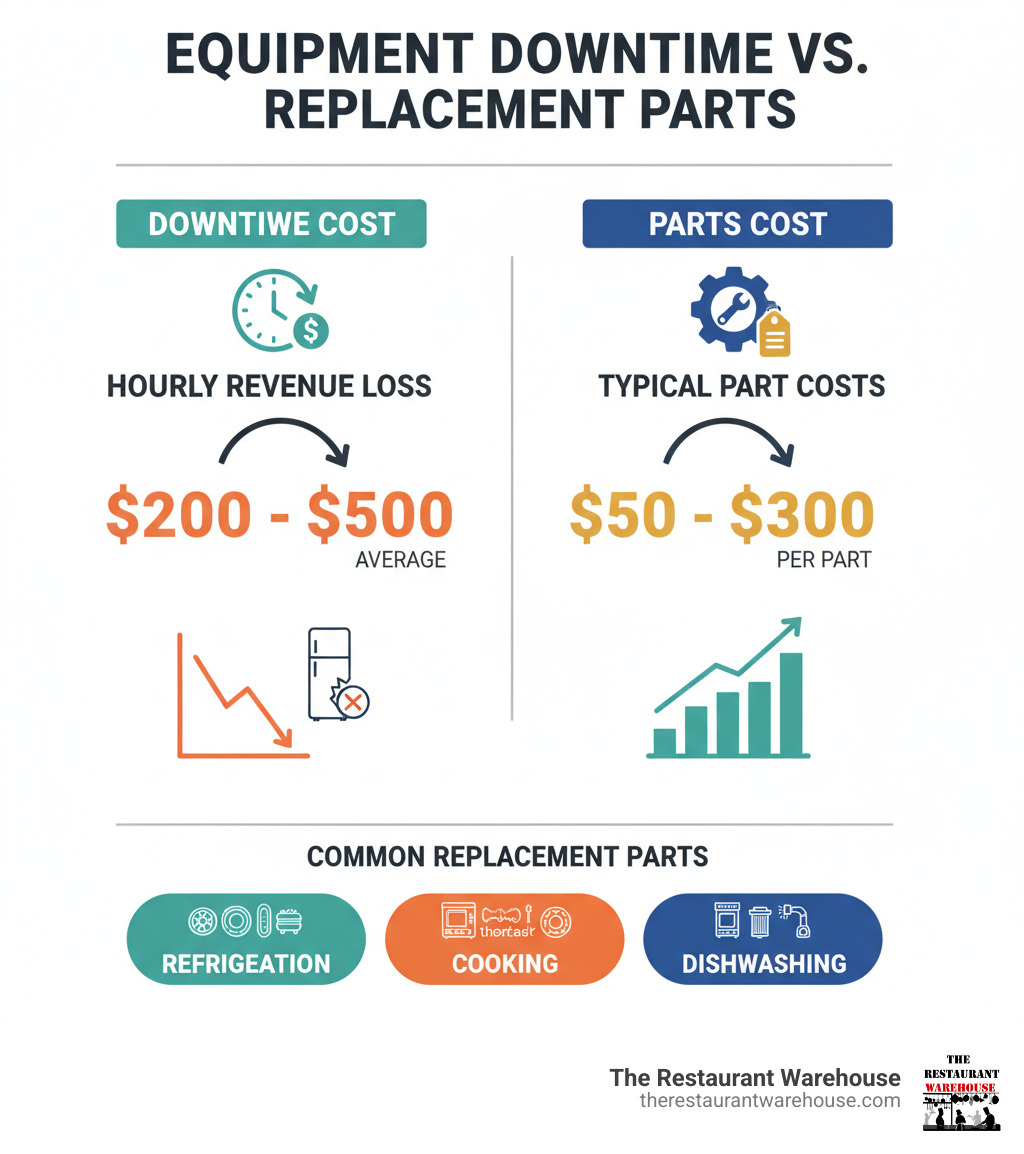
Think of parts sourcing as insurance against disruption. A small investment in the right component can avert a rush-hour meltdown, protect food safety, and maintain staff morale. The right strategy blends speed, accuracy, and cost control: knowing who to call, which parts to stock, and how to verify quality before you buy. In the sections ahead, you’ll learn how to build a practical parts plan, compare OEM and aftermarket choices confidently, and create a proactive maintenance rhythm that keeps your operation steady during peak periods.
If you have an urgent need right now, our team can help you identify the exact part based on your equipment model and serial number. We’ll walk you through options that balance price and performance so you can get back to service fast.
The Smart Business Case: Why Choose Discount Foodservice Appliance Parts?
When your walk-in refrigerator goes down on a Friday night, you're not just looking at a repair bill; you're watching potential revenue evaporate. A broken compressor or worn door gasket is a direct hit to your profitability. This is why smart restaurant owners have shifted their approach to maintenance. Paying premium prices through traditional suppliers is no longer the only option. Sourcing discount restaurant equipment parts isn't about cutting corners—it's about making intelligent financial decisions.
Having access to affordable replacement parts means you can act fast when equipment fails. A faulty thermostat or a worn gasket can be fixed quickly, preventing system-wide failures and climbing energy bills. The financial impact extends beyond the part's sticker price. Savings can be redirected toward better ingredients, staff training, or an emergency repair fund.
Furthermore, repairing existing equipment with reliable, affordable parts extends its life, maximizing your return on significant capital investments. Why replace a $5,000 refrigerator when a $75 part can restore it to full function? This approach is not only good for your budget but also for the environment. Well-maintained equipment also runs more efficiently, consuming less energy and reducing utility bills, as noted by programs like ENERGY STAR.
Key Benefits of Affordable Parts
The advantages of sourcing discount restaurant equipment parts go beyond simple cost savings.
- Lower Upfront Costs: Access parts at wholesale or near-wholesale pricing, making immediate repairs more manageable, especially for operations with tight margins.
- Improved Cash Flow: Capital not spent on overpriced parts remains available for daily expenses, payroll, or unexpected opportunities.
- Easy Accessibility & Wide Selection: Modern online suppliers offer vast inventories 24/7. You can find common replacements or obscure components for older models without being limited to a local distributor's stock.
Balancing Cost and Quality
"Discount" should not mean "low-quality." The goal is to prioritize value over the absolute lowest price. A part that costs $80 but lasts three years is a better value than a $50 part that fails in six months. Quality parts provide durability and performance without the retail markup.
Making smart purchasing decisions involves understanding your options. A door gasket might be a perfect place for a quality aftermarket part, while a critical compressor may warrant an OEM component. The key is knowing when to choose which option and having access to both at fair prices.
OEM vs. Aftermarket vs. Refurbished: Decoding Your Options
When searching for discount restaurant equipment parts, you'll encounter three main categories: OEM, aftermarket, and refurbished. Each offers a different balance of cost, quality, and reliability. The right choice depends on the specific repair, the equipment's importance to your operation, and your budget. A gasket for a reach-in cooler is a great candidate for an aftermarket part, while a walk-in's compressor might warrant the peace of mind of an OEM component.
| Feature | OEM (Original Equipment Manufacturer) | Aftermarket | Refurbished |
|---|---|---|---|
| Price | Highest | Moderate to Low | Lowest |
| Quality | Guaranteed, matches original | Varies by manufacturer | Depends on restoration quality |
| Warranty | Typically includes manufacturer warranty | Varies; reputable suppliers offer one | Limited or none; offered by some suppliers |
| Availability | Generally good, especially for newer models | Wide, especially for common parts | Limited and inconsistent |
| Best Use Case | Critical components, equipment under warranty | Common replacements, non-critical parts, older equipment | Budget repairs, non-critical components, older models |
OEM (Original Equipment Manufacturer) Parts
OEM parts are genuine components manufactured by or for the company that built your equipment. Their primary advantage is guaranteed compatibility and fit, eliminating guesswork during installation. They are engineered to exact specifications and typically come with a manufacturer-backed warranty, offering protection if the part fails. While OEM parts usually have a higher price point, online suppliers like The Restaurant Warehouse offer them at significant discounts by cutting out retail markups. This allows you to get OEM quality without the inflated price. For help finding the right part, you can use resources like Find Your Fit: Locating Parts for Any Atosa Model.
Aftermarket Parts
Aftermarket parts are made by third-party manufacturers to fit various equipment models. Their main appeal is a lower cost compared to OEM. For many common repairs, they represent excellent value. However, quality varies significantly, so sourcing from a reputable supplier is crucial. A quality aftermarket part can match OEM performance and often includes its own warranty, but a cheap knockoff can fail prematurely or even damage your equipment. Always check for certifications like NSF or UL to ensure the part meets safety standards for foodservice use.
Refurbished Parts
Refurbished parts are used components that have been inspected, repaired, and tested to ensure they are in working condition. They are an eco-friendly option and offer the lowest price point, making them suitable for non-critical repairs or older equipment. However, their reliability depends entirely on the supplier's refurbishment process. Only buy refurbished parts from suppliers who provide clear testing information and offer a warranty. A refurbished part without a warranty is a gamble that can be costly in a professional setting.
Ready to find the right parts for your kitchen? Contact The Restaurant Warehouse today to speak with our parts experts who can help you balance quality and cost for your specific equipment needs.
Your Ultimate Guide to Finding Discount Restaurant Equipment Parts
When a key appliance fails, finding the right discount restaurant equipment parts quickly is critical. The internet has transformed how we source parts, connecting us directly with suppliers who maintain massive inventories and pass on savings from their lower overhead. But with so many options, how do you identify a reliable supplier?
Reliable Online Suppliers
Established online suppliers are a go-to strategy for good reason. They often stock hundreds of thousands of products, driving competitive pricing. The ability to shop 24/7 means you can order a part the moment you find a problem, minimizing downtime.
Before buying, leverage customer reviews and ratings to see what other operators have experienced. Was the part correct and did it arrive quickly? Also, understand the shipping and return policies upfront to avoid headaches. Reputable suppliers make this information easy to find. For specific brands, dedicated resources like our comprehensive Atosa Parts Department can streamline your search.

A 10-point Sourcing Checklist
Use this quick checklist before purchasing any replacement component:
- Confirm model and serial number from the data plate.
- Match the exact part number and revision suffix.
- Verify voltage, dimensions, materials, and direction of rotation.
- Choose OEM for safety-critical or under-warranty systems.
- Check availability status: in stock, backorder ETA, or drop-ship lead time.
- Review warranty length and what it covers.
- Read return policy for electrical components.
- Confirm shipping speed and cut-off time.
- Validate the supplier's contact info and support hours.
- Save your order confirmation and tracking.
How to Read Stock and Shipping Language
- In-stock: ships same business day before carrier cut-off.
- Allocated: limited supply—order immediately if you need it this week.
- Backorder: ask for an honest ETA and alternatives.
- Drop-ship: ships from the manufacturer—often fast, but verify tracking timeline.
Tip: For rush situations, ask for split shipments. Getting a gasket and a thermostat via air today while a larger assembly ships ground tomorrow can restore service sooner and lower freight costs.
Returns and Exchanges Without the Headache
- Photograph the unopened box, shipping label, and the part itself when it arrives.
- Keep all protective packaging intact until you confirm fitment.
- Test fit dry (no adhesive, no wiring) when possible to preserve return eligibility.
- For electrical parts, confirm diagnosis first—many returns are denied if the part was powered.
Build a Parts Master List for Your Operation
Create a living catalog of your most-used equipment and the corresponding high-failure parts. Include:
- Model/serial, location in the building, and date of purchase
- Common wear items (gaskets, thermostats, probes, switches, filters)
- OEM and approved aftermarket part numbers
- Preferred suppliers and current prices
- Typical lead times and your minimum on-hand stock
Store this list where managers and maintenance staff can access it. Update it after every repair or upgrade.
Negotiating Better Prices and Terms
- Bundle common items across locations to qualify for bulk tiers.
- Ask for a price match with a link and written quote when appropriate.
- Establish net terms or use financing options so emergency repairs don't disrupt payroll or inventory purchases.
- Request a dedicated rep who learns your fleet of equipment and can proactively suggest interchangeable parts or substitutions.
If you want help setting up negotiated pricing with dependable fulfillment, contact The Restaurant Warehouse and ask for a parts account review.
Quality Control: How to Spot Genuine Parts and Avoid Risks
When searching for discount restaurant equipment parts, saving money should not come at the expense of quality or safety. The market has its share of counterfeit components and low-quality knockoffs that can lead to bigger equipment failures, safety hazards, and costly downtime. Learning to verify authenticity is essential protection for your investment and your operation.
How to Ensure Part Quality
You don't have to sacrifice quality for a good price. Develop an eye for the real deal with these checks:
- Inspect the packaging: Genuine parts arrive in professional, branded packaging with crisp printing. Fuzzy logos, misspellings, or flimsy boxes are warning signs.
- Compare with the old part: Hold the new and old parts side-by-side. Check for identical materials, weight, dimensions, and part numbers. Small differences can indicate a counterfeit or an ill-fitting aftermarket part.
- Look for certifications: Components that handle electricity, gas, or come into contact with food should carry recognized safety marks from neutral standards bodies (for example, NSF or UL), indicating they meet industry requirements.
Identifying Genuine OEM Parts vs. Counterfeits
Counterfeit parts are often sold at prices that seem too good to be true because they are made with inferior materials. Stay vigilant to avoid them.
Many manufacturers use security features like holograms, tamper-evident seals, or QR codes that link to a verification page on their official website. Use these tools whenever available. Also, trust your instincts on price. A fair discount is one thing, but an OEM part offered at 75% off its typical price is suspicious. It could be counterfeit, damaged, or stolen.
Receiving Inspection SOP
Adopt a simple receiving routine to catch problems early:
- Photograph the box and seals before opening.
- Verify the part number against your purchase order and the equipment’s manual.
- Inspect for damage and check that accessories (o-rings, screws, brackets) are included.
- Record serial numbers where applicable and file invoices with your equipment record.
- If anything is off, contact the supplier within 24 hours to preserve claim rights.
Potential Drawbacks and How to Mitigate Them
Even when buying from reputable sources, it's important to manage risks.
- Warranty: Some discounted parts may have limited or no warranty. This is a major risk for expensive components like compressors.
- Compatibility: Aftermarket parts can sometimes have minor fit issues, even with a matching part number.
- Safety: A faulty electrical or gas component is a serious hazard. Never compromise on safety-critical parts.
The best way to mitigate these risks is to buy from suppliers you trust and to document each step—diagnosis, sourcing, installation, and testing. At The Restaurant Warehouse, we vet our inventory and stand behind what we sell with clear warranties and transparent return policies. Discount doesn't have to mean risky; it just means being an informed buyer.
If you want help implementing a quality-control checklist for incoming parts and warranty claims, contact The Restaurant Warehouse and we’ll share a customizable SOP you can roll out with your team.
Proactive Maintenance and Smart Purchasing Strategies
A proactive approach to maintenance can be the difference between an efficient kitchen and one plagued by emergency shutdowns. Preventative care transforms a potential crisis into a manageable expense. Every gasket replaced before it fails or thermostat checked regularly saves you from downtime, spoiled food, and stress.
Common Failures and Commonly Replaced Parts
Certain parts wear out faster than others. Knowing what to watch for helps you stay ahead of problems.
- Refrigeration: These units run 24/7, making them prone to issues. Worn gaskets are a top culprit, causing cold air to leak and compressors to overwork. Faulty thermostats lead to temperature fluctuations that spoil food.
- Dishwashers: Clogged pumps and faulty heating elements are common problems that can halt service and lead to health code violations if sanitizing temperatures aren't met.
- Ice Machines: Failed water inlet valves can stop ice production completely, while malfunctioning probes like the Atosa USA W-0302316 Probe White can cause overflow or shortages during a busy service.
How to Find the Correct Part Number for Your Appliance
Finding the exact replacement part doesn't have to be a puzzle. Follow these steps:
- Check the Owner's Manual: Most manuals include a parts diagram with corresponding numbers.
- Locate the Equipment Data Plate: This sticker, usually on the back or inside the door, lists the model and serial number. Take a photo of it for your records.
- Visit the Manufacturer's Website: Use your model number to search for online parts diagrams. Guides like this one for Atosa refrigerator shelves and parts can also be helpful.
- Contact Supplier Support: A good parts supplier can identify the part you need from the model and serial number.
Preventive Maintenance Calendar You Can Adopt Today
- Weekly: Wipe door gaskets with mild soap, check for tears or gaps, clean condenser air intakes, and verify temperatures at opening and close.
- Monthly: Descale ice machine components where applicable, clean dishwasher filters and spray arms, inspect drain lines, and test thermostats for accuracy.
- Quarterly: Deep-clean condenser and evaporator coils, verify defrost cycles, examine wiring for heat damage, and recalibrate temperature probes.
- Biannually: Replace high-wear gaskets, review compressor amp draw and fan motor performance, test high-limit switches, and audit your parts inventory.
Assign each task to a role and log completion. Consistency reduces surprise failures and creates a documented service history that protects you during inspections and warranty claims.
Stocking Strategy: The Right Parts at the Right Time
- Identify A-movers (frequent replacements) like gaskets, thermostats, probes, contactors, and switches.
- Set par levels: 2-4 units on hand for A-movers, 1-2 for B-movers, and order C-movers on demand.
- Store parts in labeled bins near the point of use with anti-static bags for electronics.
- Use first-in, first-out rotation and note shelf-life for adhesives and sealants.
A thoughtful min-max plan helps you avoid overnight shipping fees and prevents line stoppages during peak hours.
Cost Modeling: Repair vs. Replace
When deciding whether to repair, calculate total cost of ownership:
- Part + labor + freight
- Expected remaining life of the unit
- Energy efficiency impact after the repair
- Cost of downtime if you delay action
A $120 thermostat that restores stable temps and reduces compressor cycling could save more than it costs within a single month of utility bills and reduced food waste.
Leveraging Sales to Get the Best Price
Timing your purchases strategically can lead to significant savings on discount restaurant equipment parts.
- Sign Up for Newsletters: Suppliers often reserve their best deals and promotions for email subscribers. Sign up and save with exclusive deals to get advance notice.
- Shop During Sales: Holiday promotions and end-of-quarter clearances are great times to stock up on common replacement parts like filters and gaskets.
- Consider Bulk Purchases: If you operate multiple locations or need to replace certain parts regularly, buying in bulk can open up discounts of 15-30%.
Contact The Restaurant Warehouse today and let our parts experts help you find exactly what you need.
Frequently Asked Questions about Affordable Appliance Parts
When it comes to discount restaurant equipment parts, many owners have questions about quality, safety, and value. Here are answers to the most common concerns.
What's the main risk of buying the cheapest part available?
The main risk is premature failure. A bargain-basement part might save you money today, but it can fail quickly, leading to another repair, additional downtime, and even damage to other components. A cheap compressor relay that fails during a dinner rush can cost you hundreds in lost food and emergency repair bills. Low-quality parts can also pose safety hazards and may void your equipment's warranty. The smart approach is to focus on value—affordable pricing without sacrificing reliability.
How do I know I have the right part number?
Start with your equipment's data plate, the metal sticker on the back, side, or inside a door panel. It contains the model and serial number. Your owner's manual is another great resource, as most include parts diagrams. If you've lost the manual, check the manufacturer's website for a digital version. When in doubt, contact a reputable parts supplier with your equipment information. A quick call can prevent the hassle of returns and extended downtime.
Are aftermarket parts safe to use in foodservice appliances?
Yes, high-quality aftermarket parts from trusted manufacturers can be safe and effective. They often perform as well as OEM parts at a lower cost. The key is sourcing them from a reputable supplier who vets their brands and offers a warranty. For parts involving electrical systems, gas, or food contact, look for recognized safety certifications from neutral standards bodies.
Will using aftermarket parts void my equipment warranty?
It depends on your warranty terms. Some manufacturers require OEM parts during the warranty period. After warranty, high-quality aftermarket components are often a great value for non-critical repairs. When a unit is under warranty or the part is safety-critical, choose OEM for peace of mind.
What should I do if a part is discontinued?
Ask for an approved substitute or a cross-referenced part that matches specifications for voltage, dimensions, materials, and function. A knowledgeable supplier can often identify compatible replacements that maintain performance and safety.
What information does a supplier need to help me fast?
- Clear photo of the data plate (model and serial)
- Old part number and a photo with measurements
- Symptoms, error codes, and any recent service notes
- Required delivery timeframe and shipping address
How fast can I get parts?
Common items ship same day if ordered before cutoff; expedited options can arrive next day. For time-sensitive repairs, ask about split shipments so the most critical items arrive first.
What’s the best way to store spare parts?
Keep them in a labeled, climate-controlled cabinet near the point of use. Protect electronics in anti-static bags, keep gaskets flat to avoid warping, and note expiration dates on adhesives and sealants.
Ready to find the right parts for your kitchen? Contact The Restaurant Warehouse today and let our parts experts help you source quality components.
Conclusion
Running a successful foodservice operation means making smart decisions that maximize value while maintaining quality. This guide has shown that choosing discount restaurant equipment parts is a strategic move to boost profitability, reduce downtime, and extend the life of your valuable equipment.
We've covered the differences between OEM, aftermarket, and refurbished options, empowering you to make informed choices. We've also highlighted the importance of sourcing from reputable online suppliers and verifying part authenticity to avoid costly risks.
A proactive maintenance approach transforms equipment repair from a crisis into a manageable task. By knowing where to find the right part, vetting your suppliers, and purchasing strategically, you position your kitchen for consistent, profitable operation. Your equipment is the backbone of your business; maintaining it wisely doesn't mean spending the most, but spending smart.
Ready to keep your kitchen running smoothly without breaking your budget? Contact The Restaurant Warehouse today to find the exact parts you need for your foodservice appliances! Our team is ready to help.
For personalized guidance on maximizing your equipment uptime, Book a Strategy Call with our parts experts to maximize your kitchen's uptime!
About The Author

Sean Kearney
Sean Kearney is the Founder of The Restaurant Warehouse, with 15 years of experience in the restaurant equipment industry and more than 30 years in ecommerce, beginning with Amazon.com. As an equipment distributor and supplier, Sean helps restaurant owners make confident purchasing decisions through clear pricing, practical guidance, and a more transparent online buying experience.
Connect with Sean on LinkedIn, Instagram, YouTube, or Facebook.