


How to Choose Espresso Machine for Your Business
Choosing the right espresso machine for your business is all about matching its muscle to your daily grind. Before you get dazzled by polished chrome and high-tech features, you need to get real about your numbers. Start by figuring out your busiest hour, not just your daily total. This simple step will help you choose a machine with the right number of group heads to keep up with demand and prevent frustrating bottlenecks.
A single-group machine is often perfect for lower-volume spots serving under 150 cups a day. Most cafes fall into the sweet spot for a two-group workhorse, handling 150-500 cups a day. For the high-traffic hubs pushing 500+ cups, a three-group (or larger) machine is a non-negotiable. Getting this right from the start is how you make a smart investment.
Matching Your Machine to Your Business Reality
It’s easy to get lost in the dream of a top-of-the-line machine, but let's ground ourselves in reality first. The perfect espresso machine isn't just a purchase; it's the heart of your production line. Picking the right one means you’re investing in a workhorse that drives profit, not a frustrating bottleneck or an expensive piece of art that sits idle.
This process starts with an honest look at your expected output. This isn't just guesswork; it's about making a realistic forecast of your daily drink volume.
- Pinpoint Your Peak Hours: Don't just plan for your total daily sales. Think about the rush. A machine that can handle 200 drinks spread over eight hours might completely choke if 100 of those orders flood in between 7 AM and 9 AM.
- Break Down Your Menu: Are you a straight-espresso-and-Americano kind of place, or is your menu loaded with milk-heavy drinks like lattes and cappuccinos? A constant stream of milk-based orders demands serious, uninterrupted steam power.
- Consider Your Team's Skill Level: Think about who will be behind the counter. A manual machine is a fantastic tool for a seasoned barista who wants creative control. But if you have a less experienced or rotating staff, a more automated volumetric machine is your best friend for ensuring shot-to-shot consistency.
From Boutique Cafe to Bustling Hub
Understanding your business profile is everything. A cozy neighborhood spot that aims to craft 100 beautiful, high-quality drinks a day has completely different needs than a chaotic urban cafe slinging 500+ drinks before the lunch rush even hits. The first might be perfectly happy with a single-group, semi-automatic machine that allows for artistry. The second absolutely requires a two or three-group volumetric machine just to keep the line moving.
This decision tree shows how your daily volume directly connects to the number of group heads you'll need.
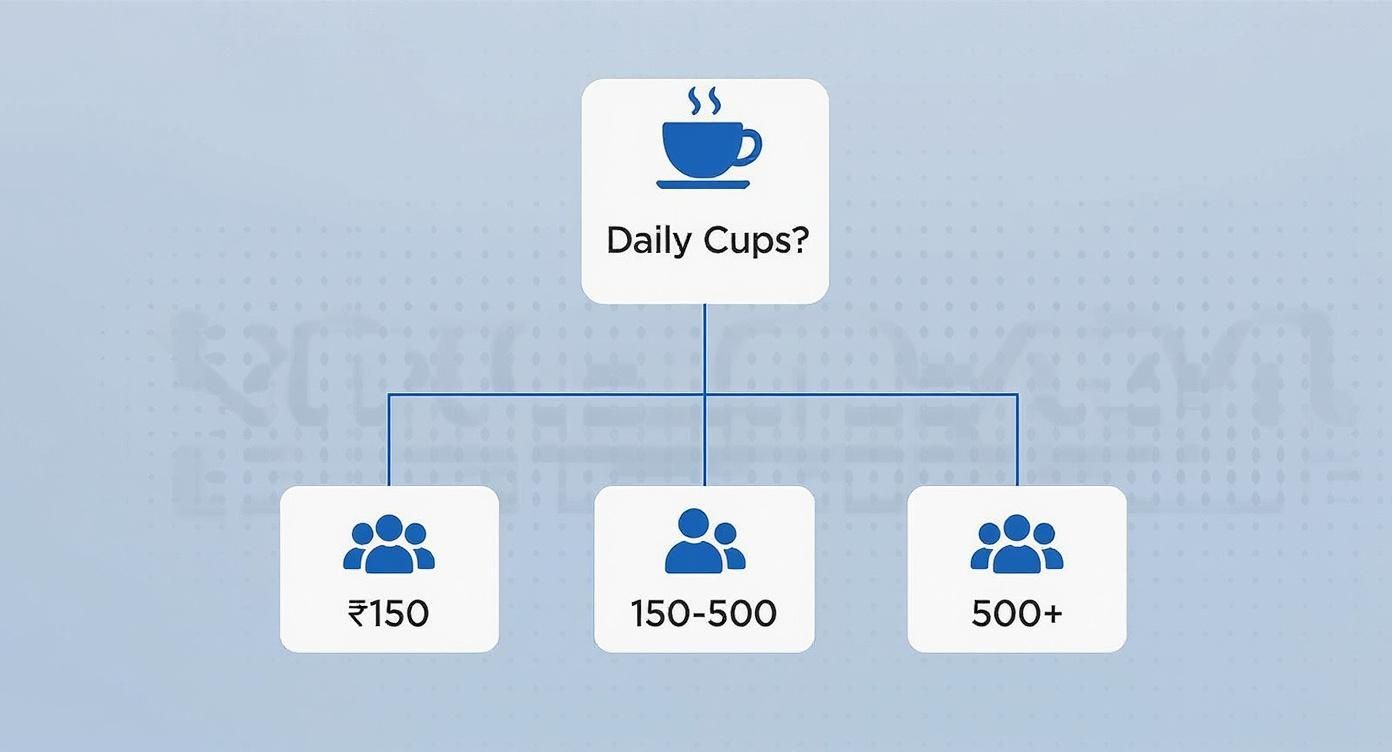
As you can see, aligning your machine's capacity with your actual output is the first and most critical step. If you get this wrong, you'll either end up with an underpowered machine that creates a traffic jam at the counter or an oversized beast that just wastes energy and capital.
Quick Guide to Commercial Espresso Machine Types
To help you get started, here's a quick rundown of the main types of commercial machines and what they're best for. This table should help you quickly identify which category to start exploring.
| Machine Type | Best For | Key Characteristic |
|---|---|---|
| Manual (Lever) | Specialty cafes focused on craft; experienced baristas. | Complete hands-on control over every aspect of the shot. |
| Semi-Automatic | Cafes that value both barista craft and some consistency. | Barista starts and stops the shot, but the machine controls pressure. |
| Automatic (Volumetric) | High-volume shops with rotating staff; ensures consistency. | Programmable buttons deliver a precise volume of water every time. |
| Super-Automatic | Offices, hotels, or self-serve areas where ease of use is key. | Grinds, tamps, and brews with the single push of a button. No barista needed. |
Each of these types can come in different sizes (one, two, or three-plus group heads), so you can match the technology to your volume needs.
A common mistake is buying a machine for the business you want in five years, not the one you have today. It's wiser to choose a machine that perfectly serves your current and near-future needs, with a clear plan for upgrading if and when your volume demands it.
Seeing the Bigger Picture
It helps to know that the demand for quality coffee equipment is strong and growing. The global market for commercial espresso machines was valued at $1941.52 million in 2021 and is on track to hit $2631.42 million by 2025. North America leads the pack with a 31.75% market share, showing just how much businesses are prioritizing high-end, durable machines built for the daily grind.
When you're thinking about your espresso machine, don't forget to consider how it fits in with your other cafe and restaurant supplies. Your coffee program doesn't exist in a bubble; it has to work seamlessly with everything from your water filtration system to your grinder and your countertop layout. Taking a complete view of your equipment helps create a smarter, more efficient workflow for your whole team.
Picking Your Machine: Automation and Output
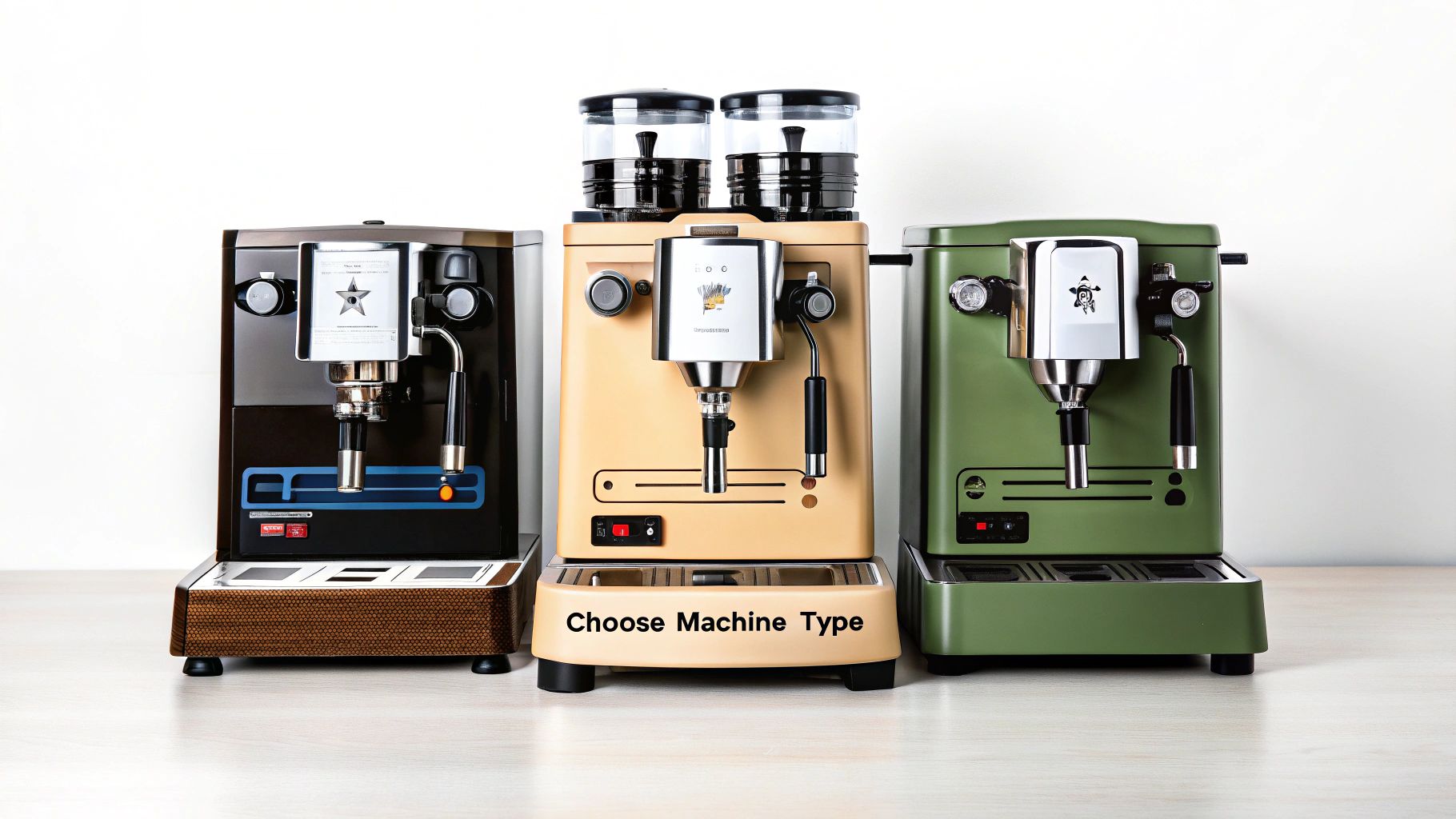
With a solid grip on your daily volume, it's time to move from spreadsheets to steel. Choosing an espresso machine isn’t just about buttons and levers; it's a strategic decision that lines up your equipment with your brand's promise. The level of automation you land on will shape everything from your workflow and staff training to the final quality of every single drink you serve.
Think of the machine type as the relationship between your barista and the coffee. It’s a spectrum that runs from total manual control to a completely hands-off process. Each point on that spectrum is built for a different kind of business, and figuring out where you fit is the key.
The Barista-Driven Choice: Semi-Automatic Machines
For most specialty coffee shops, the semi-automatic machine is the undisputed workhorse. It hits that sweet spot between barista control and mechanical consistency. The barista starts and stops the shot manually, giving them complete command over the extraction time. This allows them to dial in the perfect recipe for each coffee, bringing out its best qualities.
This hands-on approach is perfect for shops that pride themselves on the craft of coffee. It empowers skilled baristas to highlight the unique notes of different beans and roast profiles. But that control also introduces variability. It takes a well-trained team to maintain shot quality from one person to the next, especially during a hectic morning rush.
Consistency Under Pressure: Volumetric (Automatic) Machines
Take a step up in automation and you’ll find volumetric machines. These are the secret weapon for any high-volume cafe, especially those with a rotating staff. Instead of the barista timing each shot with a scale, the machine uses a flowmeter to push a precise, pre-programmed volume of water through the coffee every single time.
This technology is an absolute game-changer for consistency. A brand-new hire can pull shots that are just as consistent as those from a seasoned veteran, all with the push of a button. This reliability is why volumetric machines are perfect for busy spots where speed and repeatability are the top priorities. When trying to understand the nuances, it's helpful to compare a traditional espresso machine versus a bean-to-cup model.
Maximum Speed and Convenience: Super-Automatic Machines
At the far end of the spectrum are the super-automatic machines. These are true "bean-to-cup" systems that handle it all: grinding, tamping, brewing, and sometimes even steaming milk. They require almost no training and crank out a consistent product with incredible speed.
While they lack the nuance and quality ceiling of a semi-automatic machine, their value is undeniable in certain settings. We're talking about high-speed environments where coffee is more of an amenity than the main event:
- Hotel breakfast bars
- Corporate office break rooms
- Airport lounges
- Self-service stations
In these places, convenience and speed win out. The market for these machines is growing fast; it was valued at $2,011.75 million and is expected to hit $3,194.28 million by 2033, with Europe leading the charge.
Your choice of automation isn't just a technical detail—it's a reflection of your business model. Are you selling the craft and expertise of your baristas, or are you selling speed and dependable convenience? Answering this question will point you directly to the right machine type.
Translating Groupheads into Throughput
Beyond automation, the number of groupheads on your machine determines your maximum output. Each grouphead is an independent station for pulling shots. Deciding between a 2-group or 3-group machine is a practical calculation based on your peak hour traffic.
A 2-group machine is the industry standard for most cafes. It allows two baristas to work side-by-side without bumping elbows—one pulling shots, the other steaming milk—creating an efficient workflow that can handle a steady rush.
A 3-group machine, on the other hand, is for the true powerhouses. If you’re anticipating long lines, have a drive-thru, or your business model relies on cranking out a massive number of drinks per hour, that third grouphead is essential. It gives you the extra capacity to keep your espresso machine from becoming the bottleneck in your operation. Once you have a clearer idea of your needs, exploring different cafe equipment suppliers that'll perk up your business can help you find specific models that fit your criteria.
Understanding the Heart of the Machine: Boilers and Steam Power
If the groupheads are the hands of your espresso machine, the boiler is its heart. This is the internal tank that heats water for both brewing coffee and steaming milk, and its design is one of the single biggest factors that will dictate your cafe's workflow, especially during a frantic morning rush.
Choosing the right boiler system is a massive part of picking an espresso machine that won't buckle under pressure. An underpowered boiler can bring your entire service to a screeching halt, creating a frustrating bottleneck as your barista stands there, waiting for the machine to recover pressure between drinks. For any serious coffee shop, the ability to pull shots and steam milk at the same time without a drop in performance is completely non-negotiable.
Single Boilers: A Simple Starting Point
A single boiler system uses just one tank to do everything. While this design is straightforward and helps keep the machine's cost down, it comes with a huge operational trade-off. Brewing espresso and creating steam require two very different water temperatures, and a single boiler simply can't do both at once.
Typically, you pull your espresso shot first, then you have to flick a switch and wait for the boiler to heat up to steam temperature. That pause, even if it's just 30-60 seconds, adds up incredibly fast when you have a line of customers all ordering lattes. Because of this built-in delay, you'll almost exclusively find single boilers in home machines or maybe in an extremely low-volume commercial setting.
Heat Exchangers: The Industry Workhorse
A heat exchanger (HX) machine represents a really clever leap in efficiency. It has one large boiler that's always kept at steam temperature (around 250°F / 120°C). Running through the inside of this main boiler is a separate copper tube—the heat exchanger—that carries fresh, cool water from your plumbing line straight to the grouphead.
As this water travels through the superheated environment of the steam boiler, it rapidly heats up to the perfect brewing temperature. This ingenious design lets you pull shots and steam milk simultaneously from a single boiler, making it a super popular and cost-effective choice for countless mid-volume cafes. It’s a reliable system that beautifully balances performance with a more accessible price point.
Multi-Boiler Systems: The Peak of Precision
For the ultimate in temperature stability and control, nothing beats a multi-boiler (or dual boiler) machine. This setup is exactly what it sounds like: it has a dedicated boiler for steam and one or more separate boilers just for brewing. Each brew boiler is tied to a specific grouphead, which allows you to set precise and independent temperatures for each one.
This level of control is a game-changer for specialty shops that want to dial in the perfect extraction for different coffees at the same time. For instance, you could set one group to a slightly lower temperature for a delicate single-origin espresso and another to a standard temperature for your house blend.
While they are the most expensive option, multi-boiler machines offer unmatched consistency and completely eliminate any chance of temperature fluctuations between brewing and steaming. This makes them the top choice for high-volume, quality-obsessed cafes where precision is everything. The growing demand for these kinds of cafe experiences is driving innovation in the espresso world. In fact, the global espresso market was valued at $4.12 billion and is projected to hit $8.05 billion by 2033, a trend fueled by powerful equipment like this. You can get more details on these market trends in the full report.
To help you visualize the differences, here's a quick comparison of how these systems stack up for a working cafe.
Boiler System Comparison for Commercial Use
Choosing the right boiler technology is about matching the machine's internal power to your business's daily demands. This table breaks down the core trade-offs between the main systems in terms of performance, cost, and which type of cafe they're best suited for.
| Boiler Type | Temperature Stability | Steam Power | Ideal Business Type | Cost |
|---|---|---|---|---|
| Single Boiler | Low (must switch modes) | Moderate (recovers slowly) | Very low-volume or non-commercial | $ |
| Heat Exchanger | Good (requires cooling flushes) | Excellent (strong and consistent) | Mid to high-volume cafes | $$ |
| Multi-Boiler | Exceptional (dedicated brew boilers) | Excellent (unaffected by brewing) | Specialty and high-volume cafes | $$$ |
So, how do you translate this technical jargon into a smart business decision? It’s pretty straightforward. A heat exchanger is a reliable, workhorse investment for most cafes. But if your brand is built on absolute precision and you have the budget, a multi-boiler machine is an investment in ultimate quality control.
The Supporting Cast: Grinders, Water, and Utilities
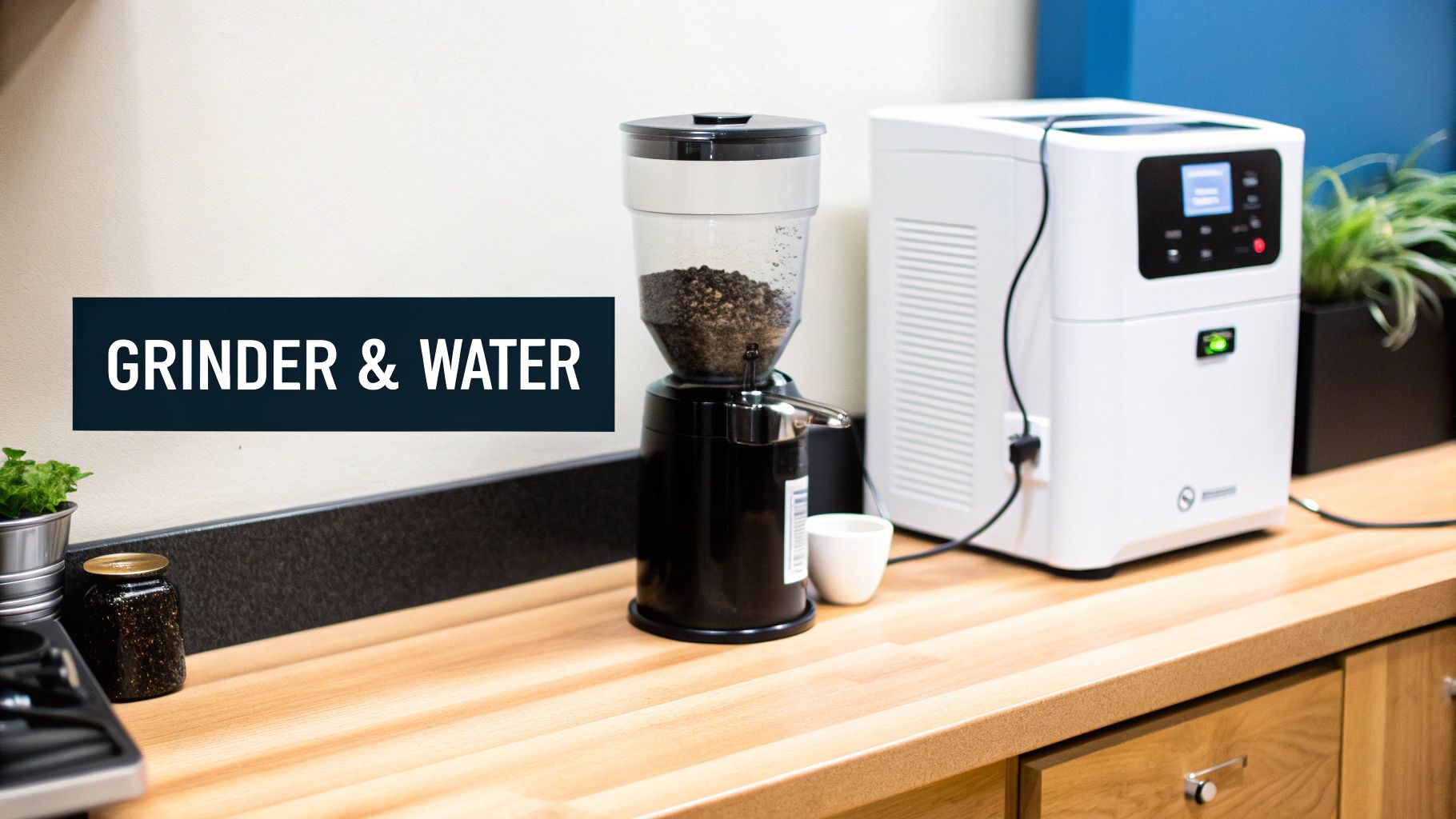
An elite espresso machine, with its powerful boiler and precise groupheads, is only one part of the equation. Without a stellar support system, even the most expensive machine will produce mediocre coffee. Think of your setup as a band; the espresso machine might be the lead singer, but the grinder, water system, and utilities are the essential musicians that make the whole performance work.
It’s a common—and costly—mistake for new business owners to pour their entire budget into a top-tier machine, only to pair it with a subpar grinder. That's like putting budget tires on a Ferrari. You simply can't unlock the potential of great coffee without a great grinder.
Why Your Grinder Is a Non-Negotiable Co-Star
Your grinder isn’t an accessory; it’s the co-star of your coffee program. A high-quality commercial burr grinder is absolutely essential because it produces the uniform, consistent particle size needed for a balanced espresso extraction. An inconsistent grind leads to channeling—where water finds the path of least resistance through the coffee puck—resulting in a shot that is somehow both sour and bitter.
There are two main types of commercial grinders to think about:
- Doser Grinders: These have a chamber that baristas fill with ground coffee, then dispense doses manually with a lever. They’re great for high-volume environments where pure speed is the top priority.
- On-Demand Grinders: These grind beans fresh for every single shot, directly into the portafilter. They minimize waste and ensure maximum freshness, making them the preferred choice for most specialty coffee shops today.
Matching your grinder to your machine's capability is crucial. A high-output, three-group machine needs a fast, durable on-demand grinder that can keep pace during the busiest rush without overheating the beans.
The Silent Killer of Coffee Equipment
Now, let's talk about the silent killer of nearly all coffee equipment: water. The water you use can either be your machine's best friend or its worst enemy. Hard water, which is rich in minerals like calcium and magnesium, is the primary culprit.
When heated, these minerals precipitate out of the water and form limescale, a hard, chalky deposit that coats heating elements, clogs pipes, and restricts water flow. Scale buildup forces your machine to work harder, leading to inconsistent temperatures, reduced steam pressure, and eventually, catastrophic failure.
It's not a question of if limescale will damage an unprotected machine, but when. Most manufacturer warranties are explicitly voided by damage caused by scale, leaving you with a very expensive repair bill for a problem that was entirely preventable.
A dedicated water filtration and softening system isn't a luxury; it's an insurance policy for your investment. These systems are plumbed in before your machine and are designed to remove scale-causing minerals while leaving in the "good" minerals that are essential for flavor.
Planning Your Footprint and Utilities
Finally, let's cover the unglamorous but critical logistics that can bring your grand opening plans to a screeching halt if overlooked. Before you even finalize a purchase, you must confirm your physical space can support the machine.
Start by measuring your counter space meticulously, accounting for not just the machine's footprint but also the grinder, knock box, and the space your baristas need to work efficiently. Remember to leave clearance for ventilation and access for maintenance. A comprehensive rundown of everything you'll need can be found in a detailed coffee shop equipment checklist, which is invaluable for planning your layout.
Next, check your utilities. Most commercial espresso machines require a 220V outlet, which is different from a standard wall plug. You'll also need a dedicated water line for the machine and filtration system, as well as a drain for the drip tray. Have a licensed electrician and plumber assess your site to ensure you have the correct power and plumbing in place before your machine arrives. Overlooking these foundational details can lead to costly delays and unexpected renovation expenses.
Calculating the True Cost of Your Machine
The price tag on an espresso machine is just the opening act. If you want to make a truly smart financial decision for your cafe, you have to look beyond the initial invoice and wrap your head around the Total Cost of Ownership (TCO). This mindset shift is crucial—it stops you from seeing the machine as a one-time purchase and starts you seeing it as a long-term investment in your business’s core production.
It's so easy to get fixated on that upfront cost, trying to shave off a few hundred or even a few thousand dollars. But the real expenses pile up over the machine's lifespan. Overlooking these ongoing costs is a classic mistake that can turn what looked like a great deal into a financial headache down the road.
Beyond the Purchase Price
The moment that beautiful machine is delivered to your door, the secondary costs begin to roll in. It's so important to budget for these right from the start to avoid any unwelcome surprises that could put a strain on your cash flow.
Here are the immediate costs you absolutely need to account for:
- Professional Installation: This is not a DIY project. A certified technician ensures your machine is correctly hooked up to power and water, properly calibrated, and running safely. Trying to cut corners here can void your warranty and cause immediate, expensive damage.
- Initial Staff Training: Your team needs to know how to operate, clean, and handle basic daily maintenance on the new equipment. Investing in professional training from day one means better consistency, a lower risk of user error, and higher quality coffee from the get-go.
- Essential Accessories: Don't forget the tools of the trade. We're talking about high-quality tampers, a few different sizes of milk steaming pitchers, a knock box, and all the necessary cleaning supplies like brushes and backflushing detergent.
A cheap machine with no local support network is a business nightmare waiting to happen. The few hundred dollars you saved upfront will feel pretty insignificant when your machine goes down during a Saturday morning rush and the nearest technician is a six-hour drive away.
Budgeting for Ongoing Maintenance and Support
Just like a car, your espresso machine needs regular service to perform at its peak. These ongoing expenses are a predictable part of ownership, and they should be factored directly into your operational budget. A well-maintained machine doesn't just last longer—it pulls better, more consistent shots.
Routine maintenance always includes replacing parts that wear out. Things like gaskets, shower screens, and water filters have a finite lifespan and must be replaced regularly to prevent leaks and ensure clean-tasting espresso. Setting aside a small monthly budget for these parts keeps them from becoming unexpected expenses.
The real value, though, often lies in the less tangible assets: a strong warranty and access to reliable technical support. A comprehensive warranty that covers both parts and labor can save you thousands in unexpected repair bills. Before you buy, do your homework on the availability of local, manufacturer-certified technicians. When a machine breaks, every single hour of downtime translates directly to lost revenue.
To Buy or to Lease: A Financial Crossroads
Deciding whether to purchase a machine outright or lease it is a major financial decision for any business. Each path has its own distinct advantages and is suited to different situations.
- Buying Outright: This is a significant capital expenditure, but you own the asset. Over the long haul, it’s almost always the cheaper option. You can also claim depreciation on your taxes, and you have complete control over the equipment without being tied to any contractual restrictions.
- Leasing: This option is fantastic for preserving your working capital, which is incredibly valuable for a new business. The monthly payments are lower and predictable, making it much easier to manage your budget. At the end of the lease term, you often have the option to buy the equipment at a reduced price, upgrade to a newer model, or simply return it.
Framing this choice correctly is essential. To help put these numbers into context, using a detailed financial planner can make all the difference. You can explore a powerful restaurant startup costs calculator to see how a large equipment purchase or a monthly lease payment fits into your overall financial plan.
Ultimately, understanding the TCO is how you truly determine which espresso machine is the right fit. It forces you to look past the sticker price and evaluate each option based on its true long-term cost and value to your operation, ensuring your investment serves your business effectively for years to come.
Got Questions? We've Got Answers
Picking the right commercial espresso machine is a huge decision, and it’s natural to have a few questions swirling around. Let’s tackle some of the most common ones we hear from business owners. My goal is to give you direct, real-world answers to help clear up any lingering doubts.
How Many Groups Do I Really Need?
This all boils down to one simple question: how slammed do you get during your busiest hour? The number of groupheads on your machine directly caps your maximum drink output.
- A 1-group machine is really for low-volume spots. Think a small restaurant adding espresso to the menu, or maybe a dedicated machine just for decaf shots.
- The 2-group machine is the undisputed industry workhorse for a reason. It's the sweet spot for most cafes. It lets two baristas work side-by-side during a rush without tripping over each other, keeping the line moving smoothly.
- A 3-group or 4-group machine is built for the big leagues. We're talking high-volume drive-thrus or bustling city-center cafes where pumping out drinks as fast as possible is the name of the game.
The best advice I can give is to be brutally honest about your peak hour drink count. Then, choose the machine that lets your team breathe, not the one that creates a permanent bottleneck at the counter.
Should I Buy a New or Used Commercial Espresso Machine?
Going the used route can definitely save you some cash upfront, but it’s a massive gamble. A brand-new machine comes with a manufacturer's warranty, the latest tech, and the peace of mind that it has a completely clean slate.
A used machine, on the other hand, could be a Pandora's box of hidden issues. Think internal scale buildup from poor water filtration or worn-out gaskets that are about to fail, leading to costly repairs right out of the gate. If you're dead set on used, only buy from a reputable reseller who has professionally refurbished the unit and is willing to stand behind it with some kind of warranty. For most new businesses, the reliability of a new machine is almost always worth more than the initial savings of buying used.
The warranty and support network you get with a new machine are priceless. Downtime is lost revenue, plain and simple. Knowing you have fast access to certified technicians can be the difference between a minor hiccup and a major financial crisis.
What's the Real Difference Between Volumetric and Semi-Automatic?
The core difference here is all about who controls the shot: the barista or the machine. It’s a classic battle of hands-on craft versus push-button consistency.
With a semi-automatic machine, the barista is in complete control, manually starting and stopping the flow of water for every single shot. This allows for total creative freedom over extraction, something that’s highly valued in specialty coffee shops where the art of espresso is front and center.
A volumetric machine (often just called an "automatic") uses pre-programmed buttons for specific shot volumes. Your barista hits a button, and the machine dispenses the exact same amount of water, every single time. This delivers incredible consistency from one barista to the next and is an absolute lifesaver in fast-paced environments where speed and repeatability are king.
How Big of a Deal Is NSF Certification?
For any commercial food business in the United States, it's absolutely non-negotiable. NSF (National Sanitation Foundation) certification is the official stamp that proves a machine meets strict public health and safety standards. It means it’s built from food-safe materials and designed in a way that allows for easy and thorough cleaning.
When the health inspector walks in, one of the first things they'll look for is that NSF seal on your equipment. Buying a machine without it could get you shut down on the spot until you replace it with a compliant one. Always, always confirm the model you're looking at has the right certifications for your local health codes.
At The Restaurant Warehouse, we get that choosing the right espresso machine is a major investment. Our team is here to offer expert, no-nonsense guidance to match the perfect machine to your business needs and budget. Check out our huge collection and flexible financing options to get your cafe set up for success. Visit us at https://therestaurantwarehouse.com to get started.
About The Author

Sean Kearney
Sean Kearney is the Founder of The Restaurant Warehouse, with 15 years of experience in the restaurant equipment industry and more than 30 years in ecommerce, beginning with Amazon.com. As an equipment distributor and supplier, Sean helps restaurant owners make confident purchasing decisions through clear pricing, practical guidance, and a more transparent online buying experience.
Connect with Sean on LinkedIn, Instagram, YouTube, or Facebook.