

Beyond the Bottle: Choosing the Best Commercial Disinfectant Spray
Why Choosing the Right Disinfectant Spray Commercial Solution Matters
Disinfectant spray commercial products are essential tools for maintaining health and safety standards in any foodservice operation. For restaurant owners, selecting the right disinfectant isn't just about meeting regulations—it's about protecting your customers, safeguarding your staff, and preserving the reputation you've worked hard to build.
Quick Answer: What You Need to Know About Commercial Disinfectant Sprays
- EPA Registration: All commercial disinfectants must be registered with the Environmental Protection Agency (EPA) to verify their efficacy.
- Kill Claims: Look for products that specify which pathogens they eliminate and in what timeframe (usually 30 seconds to 10 minutes).
- Surface Compatibility: Ensure the spray is safe for your specific surfaces—from service counters to back-of-house areas.
- Active Ingredients: Common formulations include Quaternary Ammonium Compounds (Quats), Hypochlorous Acid (HOCL), alcohol-based solutions, and hydrogen peroxide.
- Application Method: Available as ready-to-use sprays, concentrates requiring dilution, aerosols, or wipes.
The stakes are high. A single foodborne illness outbreak can devastate a restaurant's reputation and finances. Yet many restaurant owners face confusing product labels and unclear efficacy claims. Commercial disinfectants are formulated differently than household products—they're tested against specific bacteria, viruses, and fungi that pose real threats in high-traffic commercial environments.
Understanding the difference between cleaning (removing visible dirt), sanitizing (reducing bacteria to safe levels), and disinfecting (killing specific pathogens) is foundational. The cost of getting it wrong extends beyond health risks. Using the wrong product can damage expensive equipment, leave harmful residues on food-contact surfaces, or simply waste money on ineffective solutions. Budget-conscious operators need products that deliver proven results without the markup and mystery of traditional distribution channels.
This guide cuts through the marketing claims and regulatory jargon to help you make an informed decision. We'll explore the main types of commercial disinfectant sprays, decode what those EPA registration numbers actually mean, and provide practical criteria for evaluating products based on your facility's specific needs.
I'm Sean Kearney from The Restaurant Warehouse, and I've spent years helping foodservice operators steer the complex world of commercial supplies, including finding the right disinfectant spray commercial solutions that balance effectiveness with budget realities. My background in understanding customer needs has shown me that the right disinfectant isn't just about killing germs—it's about protecting your investment and your peace of mind.
Understanding Disinfectant Fundamentals
When you spray a disinfectant spray commercial formula on a countertop, something powerful happens at the microscopic level. These aren't just fancy cleaning products—they're chemical agents specifically designed to destroy the cellular structure of bacteria, viruses, and fungi living on your surfaces. While a general cleaner might remove visible dirt, a true disinfectant attacks the pathogens themselves, rendering them unable to function or reproduce.
What makes commercial disinfectants different from what you'd pick up at a grocery store is that they're tested, proven, and registered with the Environmental Protection Agency (EPA). That EPA registration number on the label is your guarantee that the product has undergone rigorous laboratory testing to verify it actually kills the specific pathogens it claims to eliminate. For restaurant owners, this matters enormously. You're not just buying peace of mind; you're investing in a tool that helps you meet health codes.
The "kill claims" listed on a disinfectant label tell you exactly which germs the product can eliminate and under what conditions. This specificity is what separates regulated disinfectants from general cleaners. You can find comprehensive information about proper disinfection protocols in the authoritative guide to disinfection from the CDC, which provides detailed standards for various settings.
One of the most misunderstood aspects of disinfection is dwell time, or contact time. This is the amount of time a disinfectant must remain visibly wet on a surface to do its job. Disinfectants aren't instant; they need time to work. Some rapid-action formulas achieve their kill claims in as little as 10 seconds, while others require up to 10 minutes. If your surface dries before the required dwell time is complete, you haven't actually disinfected anything.
Key Active Ingredients in Commercial Sprays
Not all disinfectants work the same way. Understanding the active ingredients can help you choose the right product for your needs.
- Quaternary Ammonium Compounds (Quats) are the workhorses of commercial disinfection. They are cost-effective, work quickly, and tackle a broad spectrum of pathogens. Many Quat formulas also include deodorizing properties.
- Hypochlorous Acid (HOCL) is a newer generation disinfectant that is powerful yet gentle enough for sensitive environments. It sanitizes and deodorizes without harsh fumes and breaks down into simple water and salt after use, making it an eco-friendly choice.
- Alcohols, like ethanol and isopropanol, are common in wipes and quick-drying sprays. Their fast evaporation is an advantage for electronics and other sensitive surfaces, but it can make achieving proper dwell time a challenge.
- Hydrogen Peroxide works through oxidation to kill bacteria, viruses, and fungi. Many formulations are designed for no-rinse use on food-contact surfaces and break down into water and oxygen, leaving no harmful residues.
The Difference Between Sanitizing and Disinfecting
In commercial foodservice, sanitizing and disinfecting have distinct meanings. Sanitizing reduces bacteria to safe levels as defined by public health standards (a 99.9% reduction). This is typically required for food-contact surfaces.
Disinfecting, on the other hand, means killing specific microorganisms—bacteria, viruses, and fungi—on surfaces. Disinfectants are EPA-registered products that eliminate 100% of the pathogens listed on their labels. You'd use disinfectants on non-food-contact surfaces where infection risk is higher: restrooms, door handles, and dining tables.
When evaluating any disinfectant spray commercial product, always check the label to determine whether it's a sanitizer, a disinfectant, or both. Many products carry dual claims, which can simplify your supply inventory.
Ready to find the right disinfection solutions for your facility? Contact us today to explore janitorial products that deliver professional results without the premium pricing.
A Guide to Types of Commercial Disinfectant Sprays
Choosing the right disinfectant spray commercial product involves more than just picking an active ingredient. The format and delivery method matter just as much as what's inside the bottle. A concentrate might save you money, but if your staff mixes it wrong, you're not getting the protection you paid for. A ready-to-use spray might cost more upfront, but it eliminates guesswork.
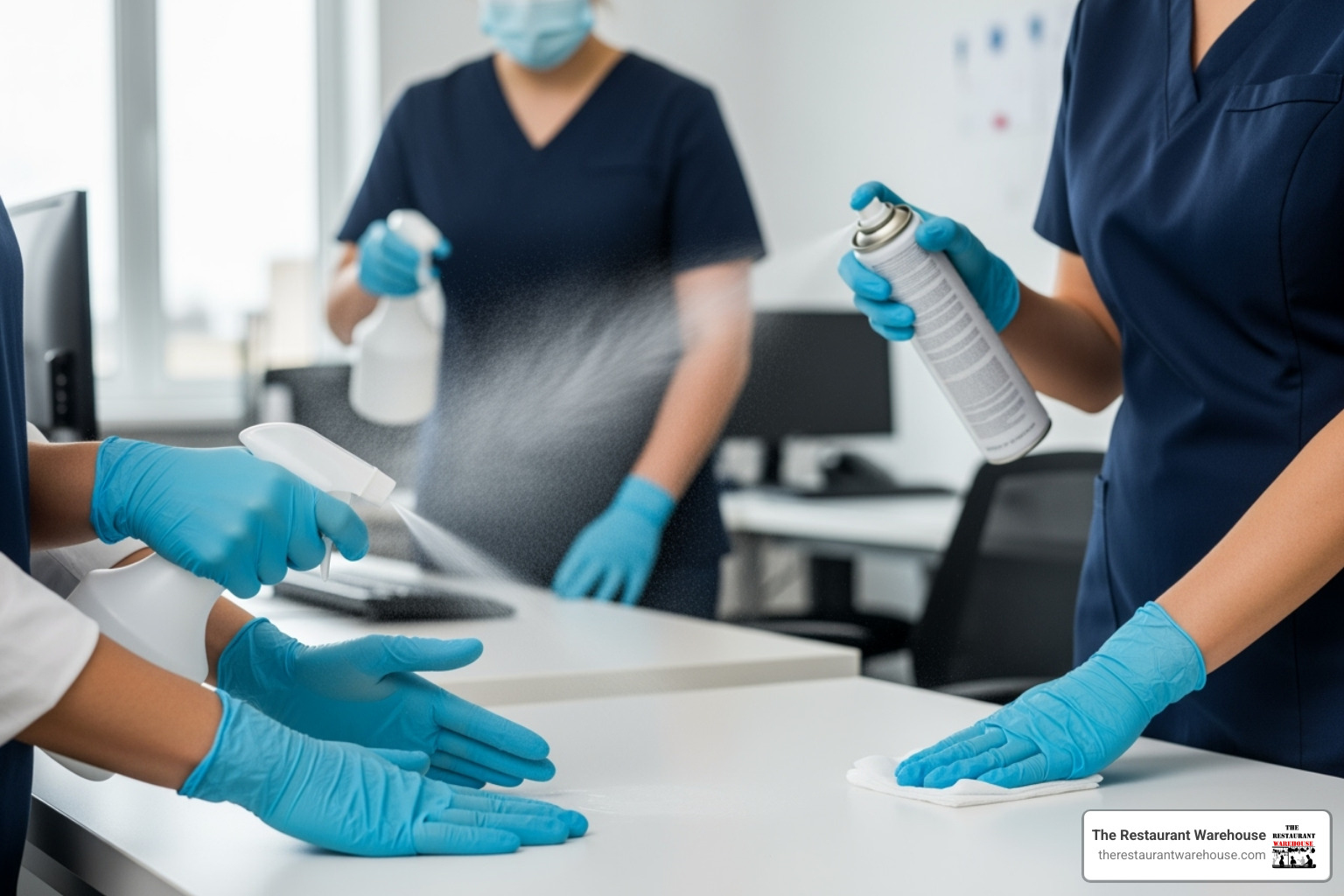
- Ready-to-use (RTU) formulas arrive pre-diluted and ready for action. This convenience makes RTU sprays perfect for quick cleanups and for staff who haven't been trained in chemical handling. The trade-off is a higher cost per gallon and more storage space.
- Concentrates are potent formulas that require dilution with water. One gallon of concentrate can make dozens of gallons of working solution, making them incredibly cost-effective for high-volume operations. The catch is that improper dilution can render the disinfectant ineffective.
- Aerosol sprays deliver a fine mist that can cover broad areas quickly. They're convenient for spot treatments and hard-to-reach areas but are generally not economical for routine, large-scale disinfection.
- Disinfectant wipes come pre-saturated and ready to use, offering maximum convenience for high-touch surfaces like door handles and light switches. They are excellent for preventing cross-contamination but are typically the most expensive option and generate more waste.
Quaternary Ammonium Compound (Quat) Sprays
Quats have earned their place as workhorses in the commercial disinfection world. They work by disrupting the cell membranes of bacteria, viruses, and fungi. The broad-spectrum efficacy of Quats is one of their biggest selling points, tackling a wide array of pathogens. Cost-effectiveness is another major advantage, especially when purchased as concentrates. Unlike some harsh chemicals, Quats are generally low in corrosivity and perform well in hard water conditions. Many Quat products also offer deodorizing properties, leaving surfaces smelling fresh.
Hypochlorous Acid (HOCL) and Hydrogen Peroxide Sprays
In foodservice, the question isn't just "Does this kill germs?" but also "Is it safe around food?" This is where HOCL and Hydrogen Peroxide sprays excel. Many formulations are approved for use on food-contact surfaces without requiring a rinse. This efficiency is invaluable in a busy kitchen. HOCL products often feature remarkably fast kill times and have low toxicity, breaking down into water and salt. Hydrogen peroxide sprays offer a similar no-rinse option and are effective against a wide range of pathogens with rapid kill times. They also have great environmental credentials, breaking down into water and oxygen.
Alcohol-Based and Botanical Sprays
Alcohol-based sprays are trusted disinfectants that work by denaturing proteins in germs. Their standout feature is their fast evaporation rate, leaving virtually no residue. This makes them ideal for electronics and other sensitive surfaces. However, that quick evaporation can make achieving the full dwell time a challenge. They are also flammable and require careful storage.
Botanical sprays represent the growing "green cleaning" movement, using plant-derived active ingredients like thymol. Their appeal lies in their lower toxicity profiles and milder scents. Many are also biodegradable. However, "natural" doesn't automatically mean more effective. Always check for EPA registration and review the specific kill claims and dwell times, which can vary considerably.
Choosing the Right Disinfectant Spray Commercial Solution for Your Business
Selecting the right disinfectant spray commercial product is a strategic decision that protects the trust you've built with customers while keeping your operation running safely. The first step is to assess your facility's unique challenges and requirements. Consider the types of surfaces you are working with and how they might react to different chemical formulations.
Think about your high-traffic areas—spots that see constant contact throughout the day, like door handles, service counters, and restroom fixtures. These surfaces need frequent disinfection with a product that has a practical dwell time that won't slow down your operation.
Industry-specific needs should drive your decision. Foodservice establishments face the constant threat of foodborne pathogens. Your disinfectant needs to address these specific threats while being safe for use in food preparation areas. Some formulations, particularly those with Hypochlorous Acid or hydrogen peroxide, are designed to be no-rinse on food-contact surfaces—a feature that saves time and ensures compliance.
Before committing to any disinfectant, conduct surface compatibility testing. Apply a small amount to an inconspicuous area of each surface type. Let it sit for the recommended dwell time, then inspect for discoloration, corrosion, or any other damage. This simple step can save you from costly mistakes.
At The Restaurant Warehouse, we've built our business model around eliminating middleman markups and passing those savings to you. When you're ready to stock up, we invite you to explore our janitorial supplies for your business needs where you'll find wholesale pricing on essential supplies.
Cost-effectiveness goes deeper than the price tag. When comparing products, calculate the true cost per application. A concentrated formula might be more economical than a ready-to-use spray if it yields many gallons of working solution. Also, consider efficiency gains. A no-rinse formula saves labor time, which translates directly to money saved.
Decoding Labels and Regulatory Standards
Learning to read disinfectant labels is a critical skill. The single most important thing to look for is the EPA registration number. This is your assurance that the product has been tested and proven effective. Without this registration, a product cannot legally claim to disinfect surfaces.
Every commercial disinfectant should come with a Safety Data Sheet (SDS), which provides comprehensive information about the product's chemical composition, potential hazards, and handling procedures. Pay close attention to kill time verification on the label, which states how long the product must remain wet on a surface to kill each pathogen. For detailed guidance, the EPA provides excellent resources, such as its guide on the Six Steps for Safe & Effective Disinfectant Use.
Evaluating a Disinfectant Spray Commercial Product
To choose the best product, use a systematic approach. Start by determining if you need a product for hard surfaces, soft surfaces, or both. Most disinfectants are for hard, non-porous surfaces, but some are also proven effective on soft, porous surfaces like upholstery.
The food-contact surface rating is critical for any foodservice business. Products labeled as "no-rinse, food-contact safe" dramatically streamline sanitation procedures. The scent and overall user experience also matter. A product with a strong chemical smell can be unpleasant for employees and customers. Look for mild or fragrance-free options. Shelf life and stability directly impact whether the product works when you need it. Always check the expiration date and store products in a cool, dry place away from direct sunlight. Finally, if considering concentrates, evaluate the concentrate dilution ratios to understand the true value and ensure your staff can mix them accurately.
Best Practices for Application and Safety
Even the best disinfectant spray commercial product is only as effective as its application. Adhering to best practices for use and safety is paramount to protecting your staff and customers.
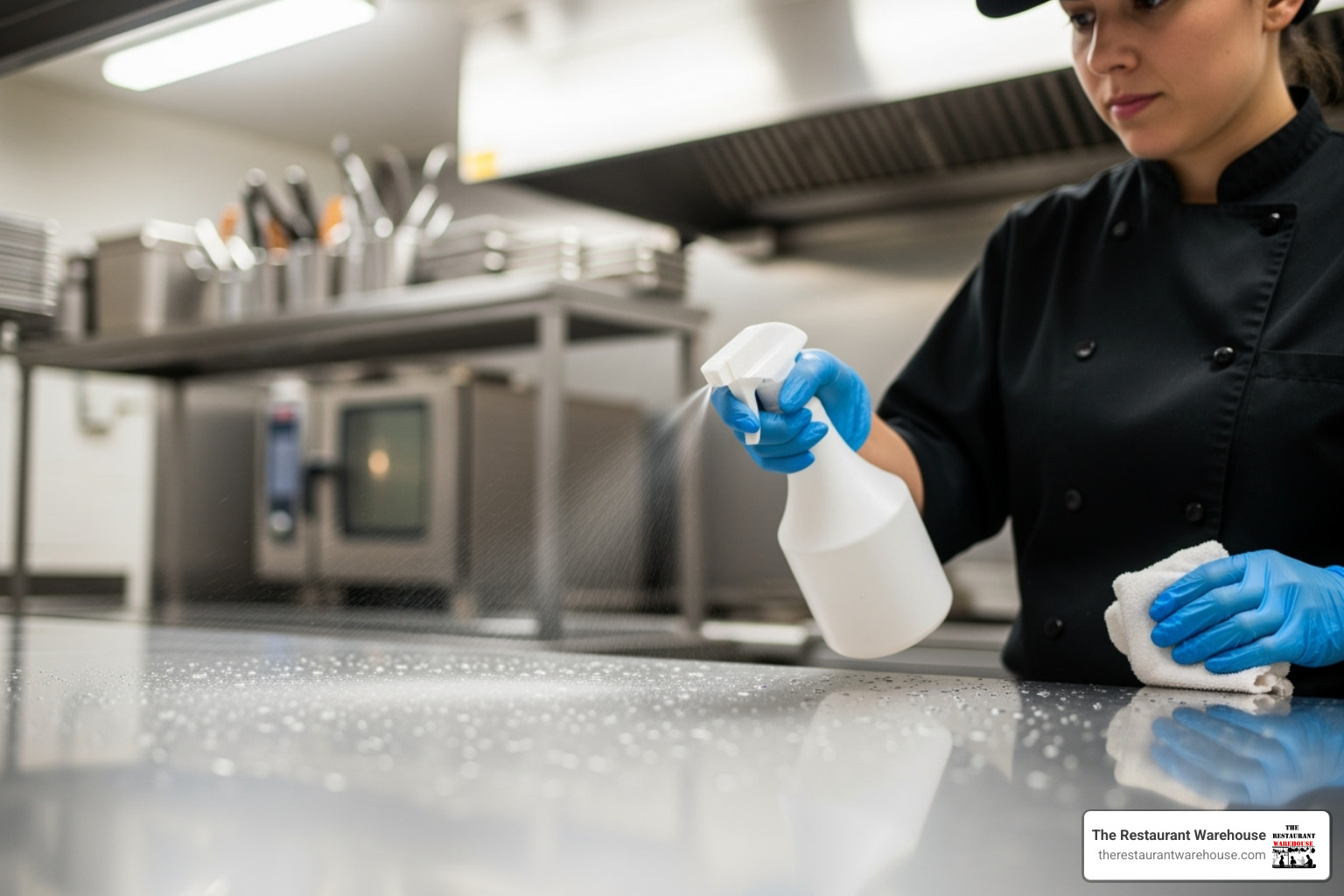
Personal Protective Equipment (PPE) is your first line of defense. Before handling any disinfectant, ensure your staff is wearing appropriate gear, which typically means gloves and eye protection. The product's Safety Data Sheet (SDS) will specify what is required.
Proper ventilation is equally important. Use disinfectants in well-ventilated areas to minimize the inhalation of fumes. Open windows or use fans to ensure good air circulation, especially in smaller spaces like restrooms.
Pre-cleaning surfaces is absolutely essential. Disinfectants are designed to kill germs on clean surfaces, not to cut through grease or food particles. Organic matter can inactivate many disinfectants. Always clean surfaces with a general cleaner first, then rinse and dry before applying your disinfectant.
To prevent cross-contamination, use separate, clean cloths for cleaning versus disinfecting. Consider color-coding them to prevent mix-ups during busy shifts.
Proper Application of a Disinfectant Spray Commercial Formula
Following label directions is the most important rule in disinfection. Every product has specific instructions for use, including dilution ratios, application methods, and required dwell times. Deviating from these instructions can render the product ineffective.
Achieving correct dwell time is where many operations fall short. The surface must stay visibly wet for the entire duration specified on the label. If it begins to dry, reapply the product. For most surfaces, the spray-and-wipe technique works well. Apply the disinfectant with full and even coverage, let it sit for the required dwell time, then wipe with a clean cloth. Pay particular attention to high-touch points.
Electrostatic spray technology can revolutionize large-scale disinfection by ensuring comprehensive coverage while using product efficiently. For floors, a dedicated mop and bucket application is effective, but use separate systems for cleaning and disinfecting.
Storage, Handling, and Disposal
Proper management of your disinfectant spray commercial products protects both your investment and your team. Cool, dry storage in original, tightly sealed containers is the foundation of maintaining product effectiveness. Secure chemicals from unauthorized access to prevent accidental misuse.
When it comes to disposal, never pour unused disinfectant down the drain or toss it in regular trash unless permitted by the label and local regulations. Consult your local waste management authority for proper procedures. Rinsing empty containers is also important; follow label instructions before recycling or disposal.
If you're looking to establish a comprehensive cleaning program, we're here to help. Contact us today to find the right janitorial solutions for your establishment—from the right disinfectants to the tools that make application easier and more effective.
Frequently Asked Questions about Commercial Disinfectant Sprays
We know you have questions, and we're here to provide clear, practical answers to help you steer commercial disinfectants with confidence. Let's tackle the most common questions head-on.
What is the most important factor when choosing a commercial disinfectant?
Here's the truth: the most critical factor is ensuring the product has an EPA registration number and that its label lists kill claims for the specific pathogens you need to eliminate, all while being compatible with your surfaces.
Without EPA registration, a product cannot legally claim to disinfect. That number is your guarantee of efficacy. But don't stop there. You need to verify that the specific pathogens that pose a threat in your commercial setting are listed in the kill claims. For a restaurant, Norovirus is a major concern. Finally, you must confirm the disinfectant spray commercial product is safe for the materials you intend to disinfect. A powerful formula that corrodes your surfaces isn't saving you money—it's costing you in replacements.
How does "dwell time" impact a disinfectant's effectiveness?
Dwell time is arguably the most overlooked factor in effective disinfection. Dwell time, also called contact time, is the period a disinfectant must remain visibly wet on a surface to kill the specified pathogens.
If a product needs 5 minutes to kill a virus, but the surface dries in 2 minutes, that virus may not be fully eliminated. You've done the work but haven't actually achieved disinfection. The surface must stay wet for the entire duration listed on the label. This is non-negotiable. If you see it starting to dry, you need to reapply. Always read the label carefully and build that time into your cleaning protocols.
Are concentrated disinfectants better than ready-to-use sprays?
This is one of those questions where the answer is genuinely "it depends." Concentrates are often more cost-effective per use and have a smaller storage footprint, making them appealing for high-volume needs. However, concentrates require precise dilution. Improper mixing can lead to an ineffective or dangerously strong solution.
Ready-to-use (RTU) sprays offer convenience and consistency, eliminating the risk of mixing errors. They're ideal for quick clean-ups and for staff who may not have extensive chemical handling training. There's zero guesswork. The optimal choice depends on your staff's training levels, the volume of disinfectant you use, and whether you prioritize cost savings or ease of use.
At The Restaurant Warehouse, we carry both options because we understand that different operations have different needs. Contact us today to find the right janitorial solutions for your establishment and we'll help you determine which format makes the most sense for your specific situation.
Conclusion: A Strategic Approach to a Cleaner, Safer Business
We've covered a lot of ground, and this guide should leave you feeling more confident about choosing the right disinfectant spray commercial solution. This isn't just about picking a bottle off a shelf—it's about making a strategic decision that directly impacts the health of your customers, the safety of your staff, and the reputation you've built.
We've walked through the essentials: understanding the importance of EPA registration and kill claims, exploring active ingredients, and evaluating different product formats. We've also emphasized that even the best product is only effective when used correctly, respecting pre-cleaning protocols and critical dwell times.
Your commitment to a clean and safe environment is a reflection of your values. When customers see spotless tables and gleaming counters, they see professionalism and care. When your staff works in a properly disinfected environment, they're safer and more productive.
At The Restaurant Warehouse, we understand that running a successful foodservice operation means making smart financial decisions without compromising on quality or safety. That's why we're committed to providing wholesale pricing on commercial-grade disinfectants and all your janitorial supplies, cutting out the high commissions and retail markups that can strain your budget. You shouldn't have to choose between effective disinfection and affordable pricing—you deserve both.
Disinfection is an ongoing commitment. By implementing the best practices we've outlined, you're building a foundation of safety that will serve your business for years to come.
Ready to stock up on the disinfectants and cleaning supplies your establishment needs? Contact us today to find the right janitorial solutions for your establishment and find how our wholesale approach can help you maintain the highest standards without breaking the bank. Your customers and staff deserve a safe, clean environment, and we're here to help you deliver exactly that.
About The Author

Sean Kearney
Sean Kearney is the Founder of The Restaurant Warehouse, with 15 years of experience in the restaurant equipment industry and more than 30 years in ecommerce, beginning with Amazon.com. As an equipment distributor and supplier, Sean helps restaurant owners make confident purchasing decisions through clear pricing, practical guidance, and a more transparent online buying experience.
Connect with Sean on LinkedIn, Instagram, YouTube, or Facebook.