

The Best Pizza Prep Refrigerators: Slice Through the Competition with Smart Choices
Why Every Pizzeria Needs the Right Refrigeration Solution
A pizza prep refrigerator is a specialized commercial unit combining a refrigerated storage base with an integrated cutting board and a cooled topping rail. This design is specifically for efficient pizza assembly and ingredient storage, making it the backbone of any successful pizza kitchen.
Unlike a standard reach-in refrigerator, which is just a cold box, a proper pizza prep table is a complete workbench. It features an integrated polyethylene cutting board for assembly, a refrigerated topping rail holding pans at food-safe temperatures (33-41°F), and a refrigerated base for backup ingredients. With durable stainless steel construction and insulated covers, it's built for the demands of a commercial kitchen.
Every second counts during a dinner rush. Having mozzarella, pepperoni, and sauce within arm's reach—all at perfect temperatures—is the difference between satisfied customers and a chaotic kitchen. Choosing the right unit isn't an upgrade; it's essential for your operation's efficiency.
Why a Pizza Prep Refrigerator is a Non-Negotiable Asset
Picture a busy Saturday night. With a standard setup, your staff runs between the prep station and coolers, creating chaos that costs you time and money. A pizza prep refrigerator transforms this scene into a well-oiled machine. It's the command center of your pizza operation, creating a centralized workspace that streamlines the entire assembly process.
This isn't just about convenience; it's about workflow efficiency that directly impacts your bottom line. Instead of making dozens of trips for ingredients, your staff can focus on creating consistently delicious pizzas.
Key benefits that make this unit a non-negotiable asset include:
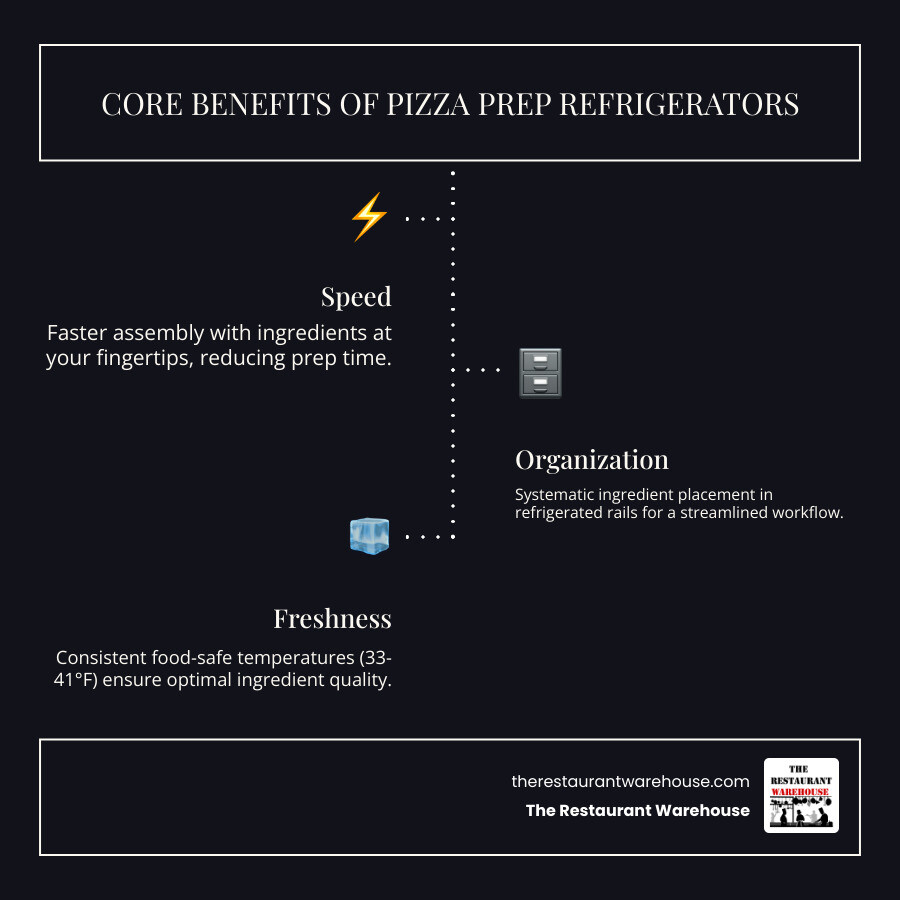
- Food Safety: These units maintain precise temperatures between 33°F and 41°F, keeping ingredients fresh and safe. This temperature range aligns with FDA food safety guidelines for cold food storage. This level of control is impossible when ingredients are constantly exposed to room temperature.
- Ingredient Organization: Each topping has a designated spot in the refrigerated rail. No more digging through containers; everything has its place, allowing your team to work quickly and accurately.
- Reduced Cross-Contamination: With designated spots for ingredients, there's less movement and therefore less opportunity for bacteria to spread.
- Consistent Product Quality: An efficient, systematic workflow ensures every pizza is made to your standards, keeping customers coming back.
The Difference from Standard Refrigeration
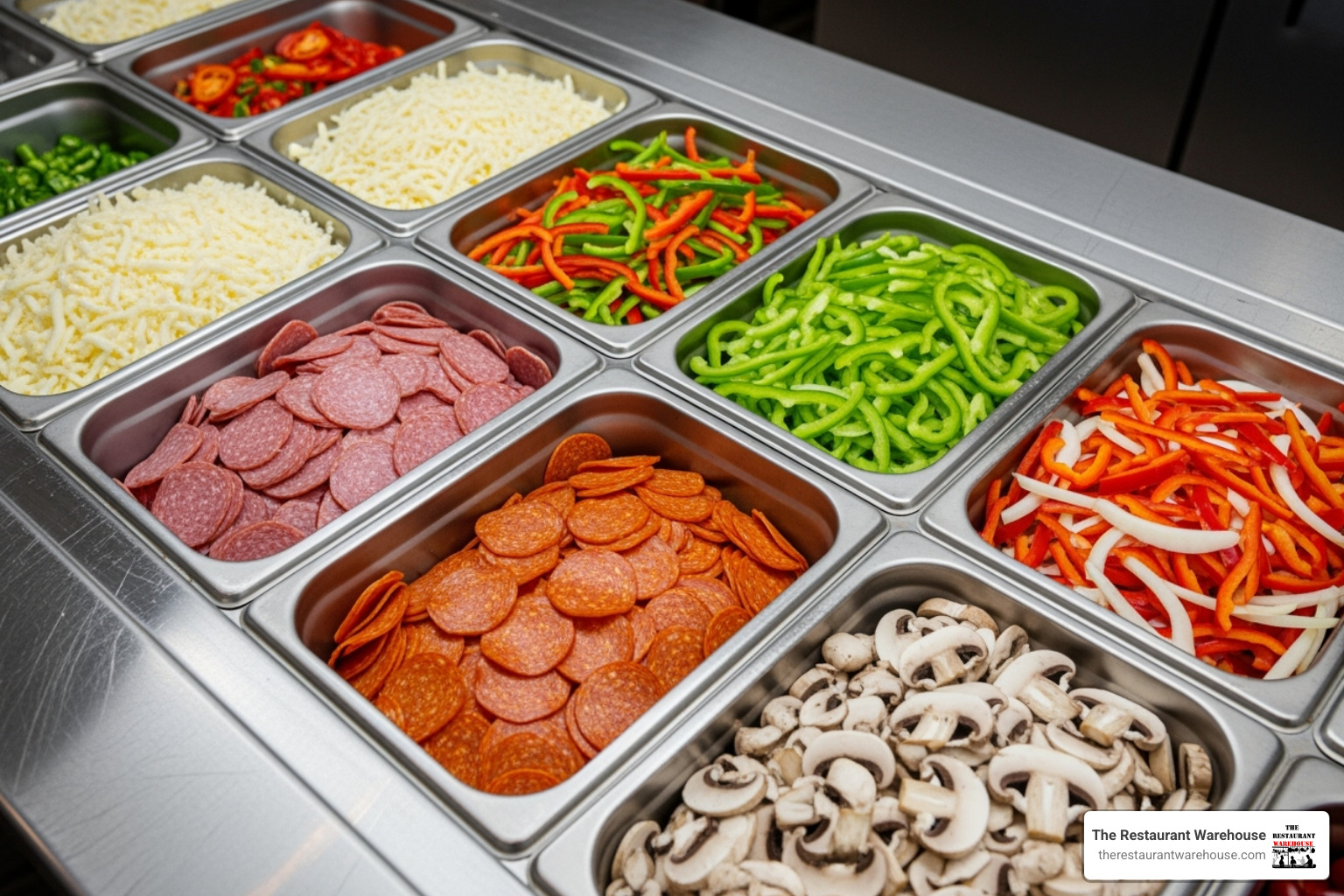
A regular reach-in is a cold storage box. A pizza prep refrigerator is an integrated workspace. The real game-changer is the cooled topping rail sitting directly above the work surface, keeping ingredients perfectly chilled and within easy reach. This ergonomic design minimizes unnecessary movements, reducing staff fatigue during long shifts.
Furthermore, these units are built for commercial kitchens. They can handle the heat, humidity, and constant use that would overwhelm a residential fridge, maintaining temperature consistency even when the doors are constantly opened during high-volume service.
Streamlining Your Pizza Assembly Line
A pizza prep refrigerator brings the culinary principle of mise en place (everything in its place) to life. This creates a natural rhythm and flow, making even the busiest nights manageable.
The most immediate benefit is reduced prep time. With a centralized workstation, wasted motion is eliminated. This easy access to ingredients allows your team to focus on quality, leading to increased order fulfillment. When your team can work faster, they can handle more orders without sacrificing quality.
An often-overlooked benefit is less food waste. Proper organization and consistent temperatures keep ingredients fresh longer, and the clear layout makes it easier to monitor inventory and rotate stock, improving your profitability.
Decoding the Essentials: Key Features to Look For
When shopping for a pizza prep refrigerator, you need a reliable engine for your kitchen. Knowing what to look for simplifies the process.
Stainless steel construction is the foundation. It's not just for looks; this material is a workhorse that resists scratches, dents, and corrosion in a busy kitchen environment. Crucially, it's non-porous and easy to clean and sanitize, ensuring hygienic surfaces. The best units feature stainless steel inside and out for maximum durability and a lasting professional appearance.
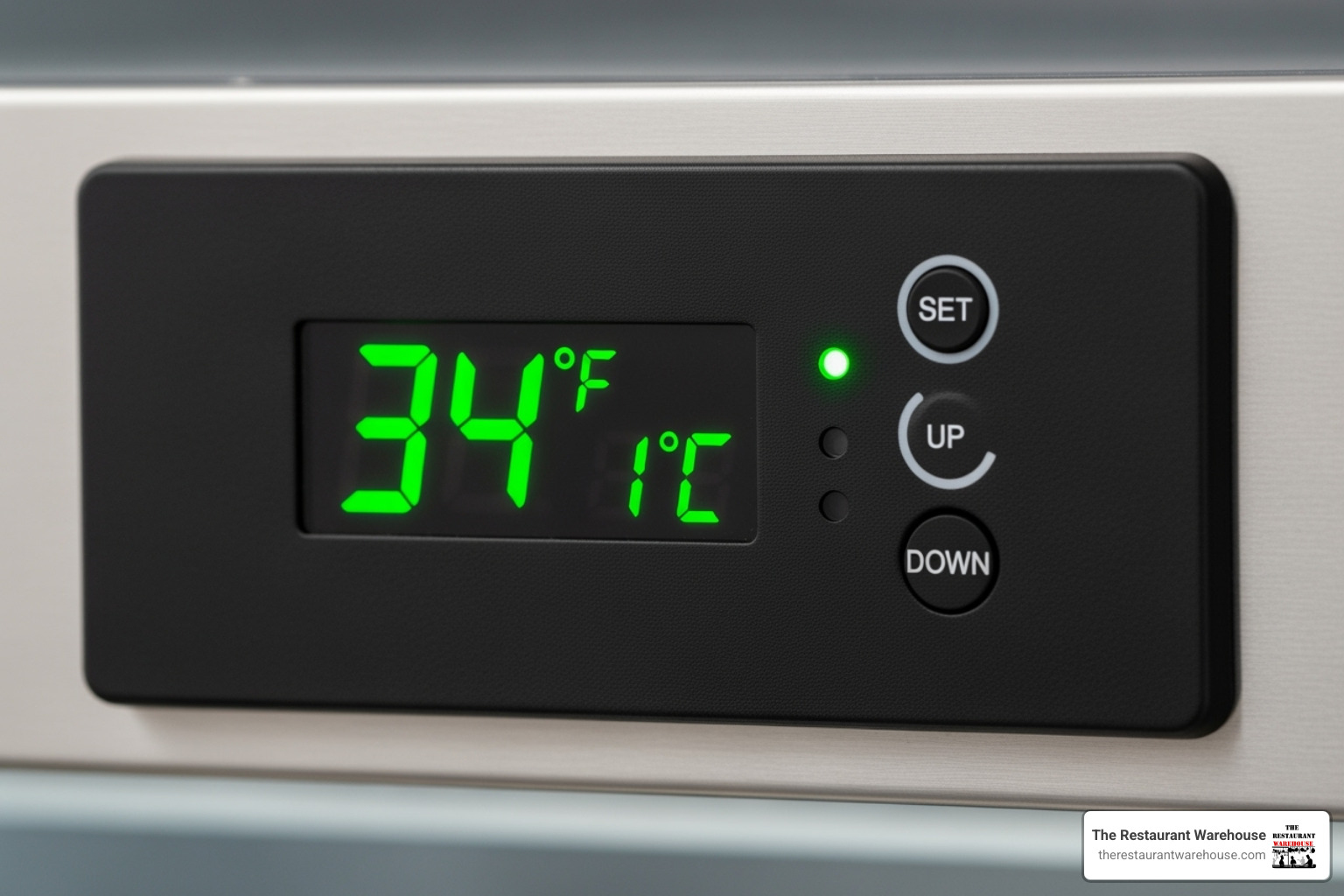
Beyond the material, look for features that improve performance. Insulated lids over the topping rail are essential for protecting ingredients from temperature fluctuations. Digital temperature controls with an LED display give you precise command over the 33°F to 41°F range. Many units also include self-closing doors to conserve energy, often with a stay-open feature for easy loading.
The Refrigerated Topping Rail
The refrigerated topping rail is the heart of your pizza prep refrigerator. It's your ingredient command center, keeping everything organized and chilled. Most units accommodate standard 1/3 size pans and 1/6 size pans, offering flexibility for your topping layout. The insulated hinged covers are crucial for maintaining food-safe temperatures, while a well-designed air distribution system ensures even cooling across all pans. This organization transforms your pizza-making process, putting everything you need at your fingertips.
The Integrated Cutting Board
The integrated cutting board is your pizza canvas. These boards are typically made from high-density polyethylene material, which is durable, resistant to bacteria, and won't absorb odors or stains. A full-length design provides generous prep space depth for assembling pizzas of all sizes. The durability is impressive, but a key feature is that most are removable for cleaning. This allows for thorough sanitizing at a wash station, ensuring you meet the strictest food safety standards. Look for NSF certified boards for professional-grade quality.
Refrigerated Base Storage: Doors vs. Drawers
The refrigerated base is where you store backup ingredients to ensure you never run out during a rush. You have two main options:
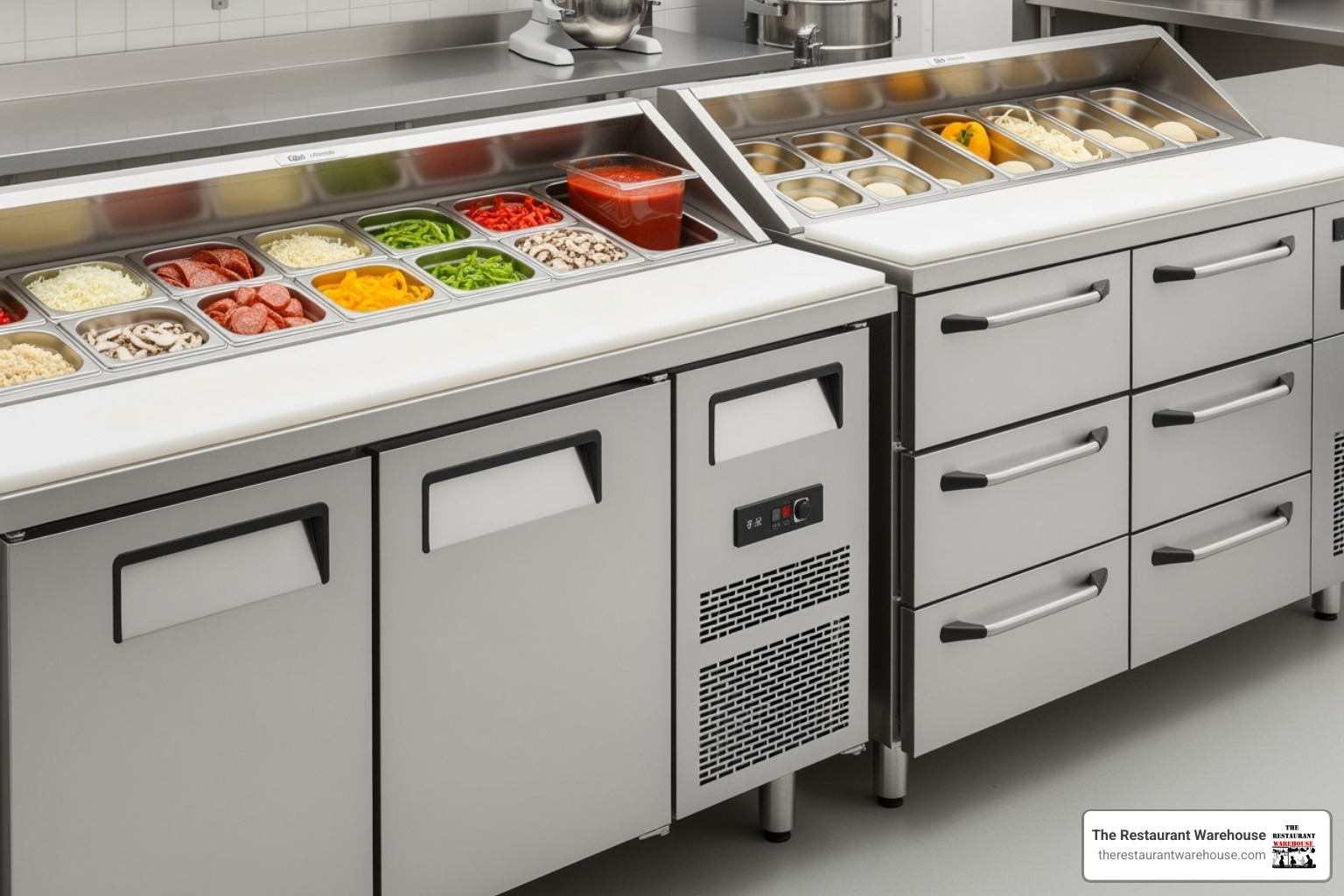
Cabinet storage (Doors): This is the traditional choice, offering wide-open access for larger containers. Doors are generally more budget-friendly and feature adjustable shelves that are epoxy-coated for durability and easy cleaning.
Drawer configurations: Drawers provide superior ergonomic access and organization. Instead of bending and reaching, you pull the drawer out, bringing the contents to you. This is ideal for pan storage in drawers, allowing you to organize ingredients by type. The improved kitchen workflow and reduced physical strain on staff make drawers an efficient, albeit typically more expensive, option.
The choice depends on your budget, workflow, and organizational preferences. Both effectively keep ingredients chilled and ready.
The Ultimate Buyer's Guide to Choosing Your Pizza Prep Refrigerator
Choosing the right pizza prep refrigerator is a critical decision that impacts your kitchen's daily efficiency. It's about finding the perfect match for your business volume, kitchen layout, and budget. Investing in a quality unit saves money in the long run through energy efficiency, lower maintenance, and reliable performance.
Before you buy, consider your daily pizza output and measure your available space, accounting for ventilation and door/drawer clearance. While budget is a factor, the long-term value of a dependable machine often outweighs a lower initial cost. For full details on any model, always consult the product specification sheet and the unit's instruction manual that ships with the equipment.
Sizing Up Your Needs: Capacity and Dimensions
Getting the size right is crucial. Pizza prep refrigerators typically come in 46-inch, 67-inch, and 93-inch nominal widths.
- Single-section (approx. 46"): Perfect for smaller operations or as a secondary prep station, offering around 11.23 cubic feet of storage.
- Double-section (approx. 67"): The sweet spot for many pizzerias, providing 16.3 to 20.4 cubic feet of storage and ample prep space for busy periods.
- Triple-section (approx. 93"): The heavy hitter for high-volume kitchens, boasting over 29.34 cubic feet of capacity for maximum storage and simultaneous use by multiple staff members.
Always check the unit's full external dimensions (e.g., 67.93" W × 31.5" D × 42.8" H) and plan for adequate aisle space and ventilation.
Pan Rail Capacity and Layout Planning
Beyond cabinet size, pan rail capacity determines how many toppings you can stage at once. Most pizza prep rails are configured for a combination of 1/3 and 1/6 pans. When comparing models, look at:
- Total pan count supported with lids closed.
- Maximum pan depth (4" vs 6"). Deeper pans hold more, but ensure the rail is engineered to keep deeper inserts within safe temperature ranges.
- Rail style (full-length vs slightly recessed) and whether the lid closes flush over fully loaded pans.
- Included divider bars and the flexibility to reconfigure layouts during seasonal menu changes.
Pro tip: Map your top 12–18 SKUs that drive 80% of orders. Prioritize those in the rail and rotate lower-volume items from base storage as needed.
Work Surface Depth and Ergonomics
The integrated cutting board should be wide enough for your largest pie size with room for mise en place tools. Consider:
- Board depth and thickness for 14", 16", and 18" pies.
- Board height relative to staff. A working height near 34–36" is comfortable for most operators; verify combined caster/leg height and board thickness when planning ergonomics.
- Reach distance from board edge to the farthest pan. Shorter reaches reduce fatigue and speed assembly.
Critical Technical Specifications for Your Pizza Prep Refrigerator
Pay attention to the technical specs to ensure reliable performance.
- Temperature Control: The unit must maintain a consistent 33°F to 41°F range. Some advanced models offer dual controls for even more precise temperature management. Confirm whether the temperature shown is air temperature or simulated product temperature.
- Compressor: Look for units with 1/6 HP to 1/2 HP compressors. Bottom-mounted compressors are generally more efficient and easier to service. A robust refrigeration system should reliably hold temperature in high ambient conditions.
- Electrical Requirements: Most units use standard 115V power, but amperage varies (3.4 to 6 Amps). Ensure a dedicated circuit with the correct NEMA plug type (often 5-15P) and follow local codes. Avoid overloading circuits with multiple high-draw appliances on one run.
- Certifications: Look for ETL Safety, ETL Sanitation, and NSF/ANSI 7 certifications. These guarantee the equipment meets strict commercial standards for safety and performance.
Insulation and Cabinet Build
Cabinet integrity supports stable temperatures and long-term durability. Evaluate:
- Foamed-in-place insulation thickness and continuity, which improves energy efficiency and temperature recovery.
- Stainless steel inside and out for durability, sanitation, and resistance to dents and corrosion.
- Door/drawer gasket design and replaceability. Snap-in gaskets speed up maintenance and reduce downtime.
Airflow and Rail Cooling Design
Two common approaches keep ingredients safe in the rail:
- Forced-air (air over pans): Circulates chilled air around the pans for quick pull-down and even cooling.
- Cold-wall or ducted designs: Reduce temperature stratification across the rail.
Regardless of approach, verify that the rail is intended for holding pre-chilled product. Always load ingredients cold to minimize food safety risks and reduce compressor workload.
Refrigerated Base Storage: Doors vs. Drawers
The refrigerated base is where you store backup ingredients to ensure you never run out during a rush. You have two main options:
Cabinet storage (Doors): This is the traditional choice, offering wide-open access for larger containers. Doors are generally more budget-friendly and feature adjustable shelves that are epoxy-coated for durability and easy cleaning.
Drawer configurations: Drawers provide superior ergonomic access and organization. Instead of bending and reaching, you pull the drawer out, bringing the contents to you. This is ideal for pan storage in drawers, allowing you to organize ingredients by type. The improved kitchen workflow and reduced physical strain on staff make drawers an efficient, albeit typically more expensive, option.
The choice depends on your budget, workflow, and organizational preferences. Both effectively keep ingredients chilled and ready.
Hybrid Bases and Changeover Speed
Some operations benefit from a mixed base (one door section and one or two drawers). This supports high-turnover items in drawers and bulk or oversized containers behind doors. Consider the time it takes to swap in a fresh set of pans from the base. A well-planned base layout can reduce changeover to under a minute during rush periods.
Lid Design, Night Covers, and Downtime Modes
- Insulated hinged lids preserve rail temperatures between uses and during slower periods. Verify the lid seals properly over all pan configurations.
- Night covers or lid locks help retain cold overnight and protect contents from contamination.
- Some units feature rail-off modes that allow you to shut the rail section for energy savings during extended downtime while keeping the base operating.
Placement, Ventilation, and Clearance
Reliable performance depends on proper placement. Plan for:
- Front-breathing or traditional air intake/exhaust patterns. Follow the manufacturer’s minimum clearance requirements around louvered panels and condenser intakes.
- Avoiding heat sources. Excessive radiant heat raises energy consumption and slows recovery.
- Caster vs. leg choice based on cleaning protocols and floor conditions. Locking front casters help hold position during use, while legs may be preferred for fixed installations.
Throughput and Menu Modeling
Match your prep table to your menu and volume.
- Estimate peak demand (pies per 15 minutes). Ensure the rail holds enough of your top toppings to avoid constant restocking.
- Factor in dough size, sauce volume per pie, cheese blend ratio, and how those items are staged (e.g., cheese in a 1/3 pan, olives in a 1/6 pan). Larger pans for highest-use items reduce restock frequency and improve consistency.
- Consider a secondary cold staging zone nearby for extremely high-volume operations, but keep your main assembly at the pizza prep refrigerator to minimize steps.
Organization and Labeling Systems
Even the best unit underperforms without organization.
- Use color-coded pans or labels for allergens and dietary categories.
- Standardize pan locations. A consistent map reduces errors and speeds assembly.
- Implement first-in, first-out (FIFO) rotation within the base and rail to control waste.
Cleaning and Maintenance Considerations When Buying
Ease of cleaning is a major factor in total cost of ownership.
- Verify the cutting board is removable for deep cleaning and sanitizing.
- Look for tool-free access to condensing components and air filters.
- Check for radius interior corners and minimal seams for faster wipe-downs.
- Confirm that shelves/drawer pans are dishwasher-safe or easy to hand-wash.
Noise, Energy, and Operational Comfort
- Review expected noise levels if available. Lower operational noise supports a more comfortable environment for staff in open kitchens.
- Energy-efficient features such as ECM fan motors, thick insulation, and well-sealed lids lower utility costs and reduce compressor cycling.
Understanding Price, Warranty, and Long-Term Value
Prices for a pizza prep refrigerator can range from $1,599 to over $20,000. Key cost factors include:
- Size and Capacity: Larger units naturally cost more.
- Advanced Features: Drawer configurations, dual temperature controls, and premium materials add to the price but can offer significant operational benefits.
- Brand Reputation: Established brands may cost more but often provide superior build quality and support. Seeking out suppliers that offer commercial restaurant equipment at wholesale pricing can give you access to quality without the high retail markups.
Warranty coverage is a strong indicator of quality. Look for comprehensive warranties covering parts and labor, with a separate, often longer, compressor warranty. A strong warranty protects your investment and provides peace of mind. The best long-term value comes from a reliable, energy-efficient unit that supports your workflow, not just the one with the lowest sticker price.
Buying Checklist: Quick Reference
Use this checklist to validate your choice before purchase:
- Confirm external dimensions, clearance, and door/drawer swing in your floor plan.
- Verify rail pan capacity, pan sizes, and lid compatibility with your standard inserts.
- Ensure the unit holds 33–41°F in your expected ambient conditions.
- Choose door, drawer, or hybrid base to match your restocking pattern.
- Confirm electrical requirements, plug type, and a dedicated circuit.
- Check that the cutting board is removable and NSF certified.
- Review gasket style, availability of replacements, and ease of service.
- Validate certifications (e.g., ETL Safety, ETL Sanitation, NSF/ANSI 7).
- Compare warranty terms for parts, labor, and compressor coverage.
Common Mistakes to Avoid
- Undersizing the rail: Leads to constant restocking and slower service.
- Ignoring ambient heat and clearance: Causes temperature drift and higher energy bills.
- Loading warm product: Overworks the compressor and risks food safety.
- Skipping gasket and coil care: Shortens lifespan and increases operating costs.
- Inconsistent pan maps: Slows assembly and increases errors during rushes.
Choose thoughtfully and your pizza prep refrigerator will become the backbone of a smoother line, safer food handling, and consistently great pies.
The Cool Science: Refrigeration Systems and Eco-Friendliness
The refrigeration system in a pizza prep refrigerator is engineered for power and efficiency, keeping ingredients safe even when your kitchen hits a 100°F ambient temperature. Modern units balance this robust performance with energy conservation, featuring high energy efficiency ratios that lower your electricity bills.
Manufacturers are also focusing on reducing the environmental impact of their equipment. This commitment to modern refrigeration technology means you can get a powerful, reliable unit that is also environmentally responsible.
Compressor, Airflow, and Defrost Systems
Several key components work together to deliver consistent cooling.
- Bottom-mounted compressors are the industry standard. They operate in the cooler air near the floor, improving efficiency and longevity. They are also easier to access for cleaning and maintenance.
- A front-breathing design allows for more flexible placement, as the unit can be set closer to walls without impeding airflow.
- Advanced air distribution systems ensure even cooling throughout the cabinet and topping rail, eliminating hot spots that can compromise food safety.
- The auto-defrost function prevents ice buildup on the evaporator coils, which would otherwise force the compressor to work harder and consume more energy.
- E-Coat evaporator coils offer superior corrosion resistance, extending the life of the unit in a demanding kitchen environment.
Understanding Refrigerant Types
The refrigerant is the fluid that facilitates cooling. The type used has significant implications for performance and the environment.
Many modern units now use R290 refrigerant, a natural, eco-friendly alternative to older synthetic refrigerants. R290 is a game-changer for several reasons:
- Environmentally Safe: It has zero Ozone Depletion Potential (ODP) and an extremely low Global Warming Potential (GWP) of 3, compared to thousands for some older refrigerants.
- Energy Efficient: R290 has excellent thermodynamic properties, often resulting in a higher energy efficiency ratio. This means the refrigerator consumes less electricity to achieve the same cooling power, saving you money.
The shift to eco-friendly refrigerants like R290 is a smart business decision, aligning your operation with sustainability goals while reducing long-term operating costs.
Keeping It Fresh: Maintenance and Cleaning Best Practices
A pizza prep refrigerator is a durable workhorse, but it requires proper care to perform at its best. Consistent maintenance ensures reliability, maintains energy efficiency, and guarantees food safety compliance. A clean prep station also looks professional and keeps health inspectors satisfied.
Daily and Weekly Cleaning Procedures
Consistency is the key to effective cleaning. A simple daily and weekly routine will keep your unit in top condition.
Daily Tasks:
- Wipe Surfaces: Use a damp cloth and mild, food-safe cleaner to wipe down all stainless steel surfaces, inside and out.
- Sanitize Cutting Board: Thoroughly clean and sanitize the polyethylene cutting board. Its removability makes this task easier.
- Clean Gaskets: Wipe down the rubber door and drawer seals to remove grime and ensure a tight seal.
- Clean Topping Pans: Empty, wash, and sanitize all pans from the topping rail.
- Check Temperatures: Verify that the digital display shows a temperature within the safe 33°F to 41°F range.
Weekly Tasks:
- Perform a deeper interior cleaning by removing all shelves and pans.
- Clean the hinged covers over the topping rail and the area around the casters.
Essential Long-Term Maintenance
Proactive long-term care prevents major issues and extends the life of your pizza prep refrigerator.
- Clean Condenser Coils: This is the most critical task. Monthly or quarterly, use a brush and vacuum to clean dust and grease from the coils (usually near the bottom-mounted compressor). Clogged coils force the unit to work harder, increasing energy costs and risking failure.
- Check Door Seals: Regularly inspect gaskets for cracks or tears. A damaged seal leaks cold air and wastes energy. Replace worn seals promptly.
- Calibrate Thermostats: Occasionally, verify the unit's temperature with a calibrated external thermometer to ensure accuracy.
- Schedule Professional Servicing: Have a qualified technician inspect your unit annually to check refrigerant levels, electrical components, and overall system health.
- Follow Manufacturer Guidelines: Your instruction manual provides the best roadmap for maintenance specific to your model.
Proper maintenance is an investment in the longevity and efficiency of your equipment, protecting your business and ensuring every pizza meets the highest standards.
Conclusion
A pizza prep refrigerator is far more than just a piece of equipment; it's a strategic investment in your pizzeria's success. It is the command center that transforms a chaotic assembly line into a smooth, efficient, and profitable operation. By streamlining workflow, you save precious seconds during peak hours, leading to happier customers and a healthier bottom line.
This guide has highlighted the essential features that make these units indispensable: the integrated cutting board for a dedicated workspace, the cooled topping rail for fresh ingredients at your fingertips, and the base storage with doors or drawers to keep you stocked. We've covered the importance of selecting the right size—whether a 46-inch, 67-inch, or 93-inch model—and understanding key technical details like temperature ranges (33°F-41°F) and the benefits of eco-friendly R290 refrigerant.
Purchasing the unit is just the first step. Consistent cleaning and maintenance are crucial to protect your investment and ensure your refrigerator operates reliably for years. A well-maintained unit preserves not just your food, but also your peace of mind.
Understanding the impact that quality equipment has on a foodservice business is key. Many suppliers are committed to providing commercial restaurant equipment at wholesale pricing, cutting out the high retail overhead so that every kitchen can afford the professional-grade tools they need to thrive.
Your pizza prep refrigerator is the workhorse that will help you slice through the competition. It's an investment in efficiency, food safety, and the consistent quality that builds a loyal customer base.
Ready to take the next step? For a deeper dive into selecting the perfect unit, continue your research with comprehensive buyer's guides and find how the right choice can lift your entire operation.
About The Author

Sean Kearney
Sean Kearney used to work at Amazon.com and started The Restaurant Warehouse. He has more than 10 years of experience in restaurant equipment and supplies. He graduated from the University of Washington in 1993. He earned a BA in business and marketing. He also played linebacker for the Huskies football team. He helps restaurants find equipment at a fair price and offers financing options. You can connect with Sean on LinkedIn or Facebook.
Leave a comment