

Grill Power: Unearthing the Best Commercial Table Top Grills
The Essential Role of Commercial Table Top Grills
In the high-stakes, world of modern foodservice, every piece of equipment must justify its footprint. Among the most valuable players in any professional culinary setup, the commercial table top grill stands out as an indispensable and versatile workhorse. These compact powerhouses are the unsung heroes for busy restaurants, agile food trucks, high-volume catering operations, and innovative ghost kitchens. They provide the critical ability to cook a vast array of different foods with remarkable speed, consistency, and efficiency, directly impacting ticket times, customer satisfaction, and the bottom line.
These grills are more than just a cooking surface; they are a strategic solution to many of the challenges modern kitchens face. Let's explore the key benefits that make commercial tabletop grills a must-have investment:
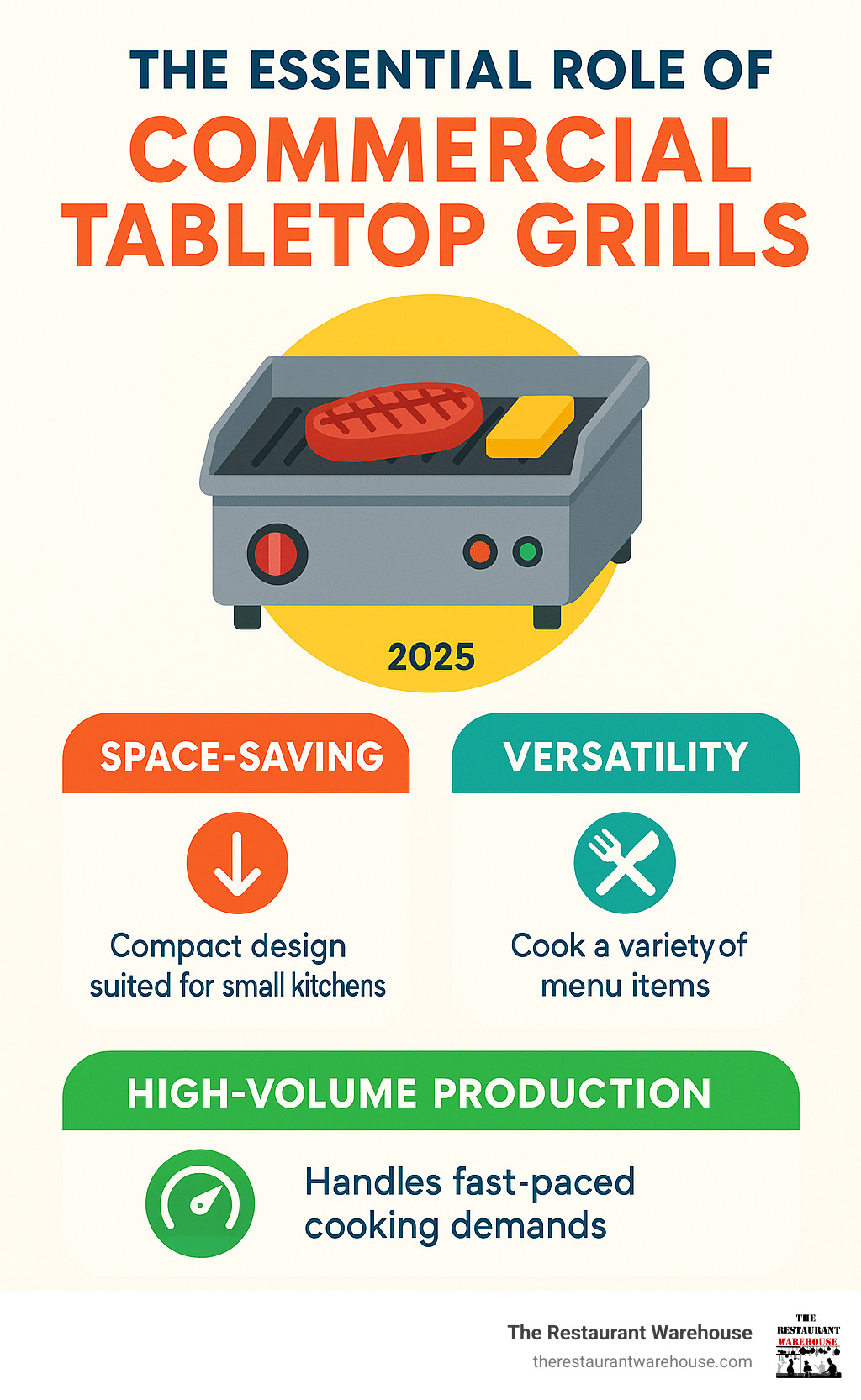
- Space-Saving: In a commercial kitchen, counter space is prime real estate. A tabletop grill's compact design is its most celebrated feature. It allows operators to maximize their cooking capacity without undertaking costly renovations or sacrificing floor space needed for traffic flow and other essential equipment. This is a game-changer for smaller venues like cafes, concession stands, and food trucks where every inch is carefully planned.
- Versatility: The sheer range of what you can cook on a flat-top grill is astounding. It can be the star of your breakfast service, turning out perfectly fluffy pancakes, sizzling bacon, and fried eggs. Come lunchtime, it seamlessly transitions to searing burger patties, grilling chicken breasts for sandwiches, and creating the perfect melt on a panini. For dinner service, it can handle delicate fish fillets, beautifully seared steaks, and vibrant grilled vegetables. This adaptability allows for incredible menu creativity and flexibility.
- High-Volume Production: Don't let the compact size fool you. These grills are engineered for the relentless demands of commercial use. Featuring powerful heating elements and thick, heavy-duty cooking plates, they are designed to handle continuous cooking during the busiest service periods. Their excellent heat retention and quick recovery time mean you can place new items on the grill without a significant temperature drop, ensuring consistent results and keeping the line moving.
- Mobility: The portable nature of many tabletop models open ups a world of opportunity beyond the four walls of your kitchen. This mobility is essential for caterers who need to set up professional cooking stations at off-site events like weddings, corporate functions, or outdoor festivals. It also allows restaurants to easily create seasonal patio grilling stations or pop-up concepts, bringing the action and aroma of fresh cooking directly to the customers.
- Efficiency: In an industry with tight margins, efficiency is paramount. Commercial tabletop grills heat up rapidly, significantly reducing pre-cooking wait times compared to larger ranges. They transfer heat directly and evenly to the food, ensuring faster cook times and reducing energy waste. This operational efficiency saves valuable time for the kitchen staff and translates into lower utility bills over the long term.
As industry experts note, commercial grills and griddles are truly the "workhorses of busy restaurant kitchens, cafeterias, and ghost kitchens." They deliver formidable cooking power within a minimal footprint, empowering chefs and operators to serve delicious, high-quality food consistently and profitably.
Why a Commercial Tabletop Grill is Your Kitchen's Secret Weapon
In the competitive world of foodservice, every piece of equipment must be a top performer, earning its place on your counter through sheer utility and return on investment. This is precisely what makes a commercial table top grill such a profound game-changer. It's not merely another appliance that consumes valuable space; it's a dynamic and versatile powerhouse that can fundamentally transform your kitchen's workflow, expand your culinary horizons, and boost your profitability.
Imagine the scene: you're managing a busy operation where every square foot is critical, online and in-person orders are flooding in, and your team needs equipment that is not just reliable but also intuitive and efficient. A commercial tabletop grill rises to meet every one of these challenges head-on, all while opening the door to exciting new menu possibilities that you might have previously considered out of reach.
The Core Benefits for Modern Foodservice
When you invest in new kitchen equipment, you're looking for a tangible, positive impact on your daily operations. Commercial table top grills deliver on this expectation across multiple fronts, which is why they have cemented their status as invaluable assets in professional kitchens of every size and type.
Space efficiency is often the most immediate and appreciated benefit. Unlike massive, cumbersome freestanding units that can dominate a kitchen's layout and impede workflow, tabletop grills integrate seamlessly with your existing setup. They sit conveniently on a countertop or equipment stand, granting you immense cooking power without consuming that all-important floor space. This is an absolute necessity for operations working within the tight confines of a food truck, a small urban café, a concession stand, or any kitchen where optimizing the layout is a constant puzzle.
The portability factor is a strategic advantage that many operators don't fully grasp until they experience it. Many commercial tabletop grills are engineered for mobility. Need to establish a dedicated cooking station on your patio for a special summer weekend event? It's simple. Catering a large outdoor festival or a private party? Your grill is ready to travel with you. This adaptability extends to internal logistics as well; rearranging your kitchen line to optimize for different dayparts—like a breakfast rush versus a dinner service—becomes exponentially easier when your equipment can move and adapt with your needs.
Supplemental cooking capability transforms these grills into your kitchen's most valuable player during peak hours. Picture the chaos of a Saturday night dinner rush: your main range is completely maxed out, and tickets are starting to pile up. A tabletop grill acts as a crucial relief valve, providing an additional, high-performance cooking surface to handle the overflow. It can be dedicated to searing steaks, grilling shrimp, or toasting buns, ensuring that orders continue to flow smoothly out of the kitchen. This prevents those dreaded bottlenecks that can stress out your staff and lead to long wait times for hungry customers.
From a financial standpoint, the energy savings can be substantial over time. Operating a smaller, dedicated cooking surface is inherently more energy-efficient than firing up a full-sized, multi-burner range, particularly when you only need one or two cooking zones active for a specific task. This targeted energy use means less waste and lower utility bills. In a business where every dollar counts, these operational savings contribute directly to your bottom line and can also be a selling point for an increasingly eco-conscious customer base.
The lower initial investment makes professional-grade cooking power accessible to a wider range of businesses. Whether you're a startup launching your first food truck, an established restaurant looking to expand its menu, or a multi-unit operator adding a new location, you don't need to secure massive capital funding to get started. The accessibility of these units means that high-performance grilling is not limited to large, heavily-funded operations. This affordability is a key driver of culinary innovation, allowing smaller businesses to compete effectively. Sourcing equipment from suppliers who offer competitive or wholesale pricing can be a strategic move, allowing businesses to acquire high-quality, durable equipment without the burden of excessive upfront costs, freeing up capital for other critical areas like marketing, inventory, and staffing.
Don't let the compact dimensions mislead you about the increased output potential. These grills are not residential appliances; they are commercial machines engineered for high-volume cooking. With powerful heating elements, robust construction designed for all-day use, and thick cooking plates that provide excellent heat retention, they are built to perform. Some models offer a large enough cooking surface to handle as many as 14 burgers at once. That's a serious capacity that allows you to serve hundreds of customers efficiently during your busiest hours.
Menu diversification becomes not just possible, but easy with a versatile tabletop grill. Have you been wanting to add a lucrative breakfast menu to your lunch-focused café? A flat-top grill is perfect for pancakes, eggs, and bacon. Are you thinking about offering healthier options like grilled salmon or vegetable skewers? It's an easy addition. These grills provide the flexibility to experiment with new dishes, run limited-time specials, and quickly adapt to changing customer tastes and dietary trends without needing to invest in a separate, highly specialized piece of equipment for each new idea.
Common Applications and Scenarios
The true beauty of a commercial table top grill is revealed in its remarkable adaptability across the diverse landscape of the foodservice industry. Let's examine the real-world environments where these grills don't just work—they excel.
Food trucks are arguably the quintessential use case. In a mobile kitchen, space is the ultimate luxury, and a compact grill delivers unparalleled cooking versatility in a minimal footprint. The aroma of sizzling onions, peppers, and meats from a tabletop grill is a powerful magnet for foot traffic. Food truck operators can execute a wide-ranging menu—from classic burgers and cheesesteaks to breakfast burritos, street tacos, and gourmet grilled cheese sandwiches—all from a single, reliable, and efficient appliance.
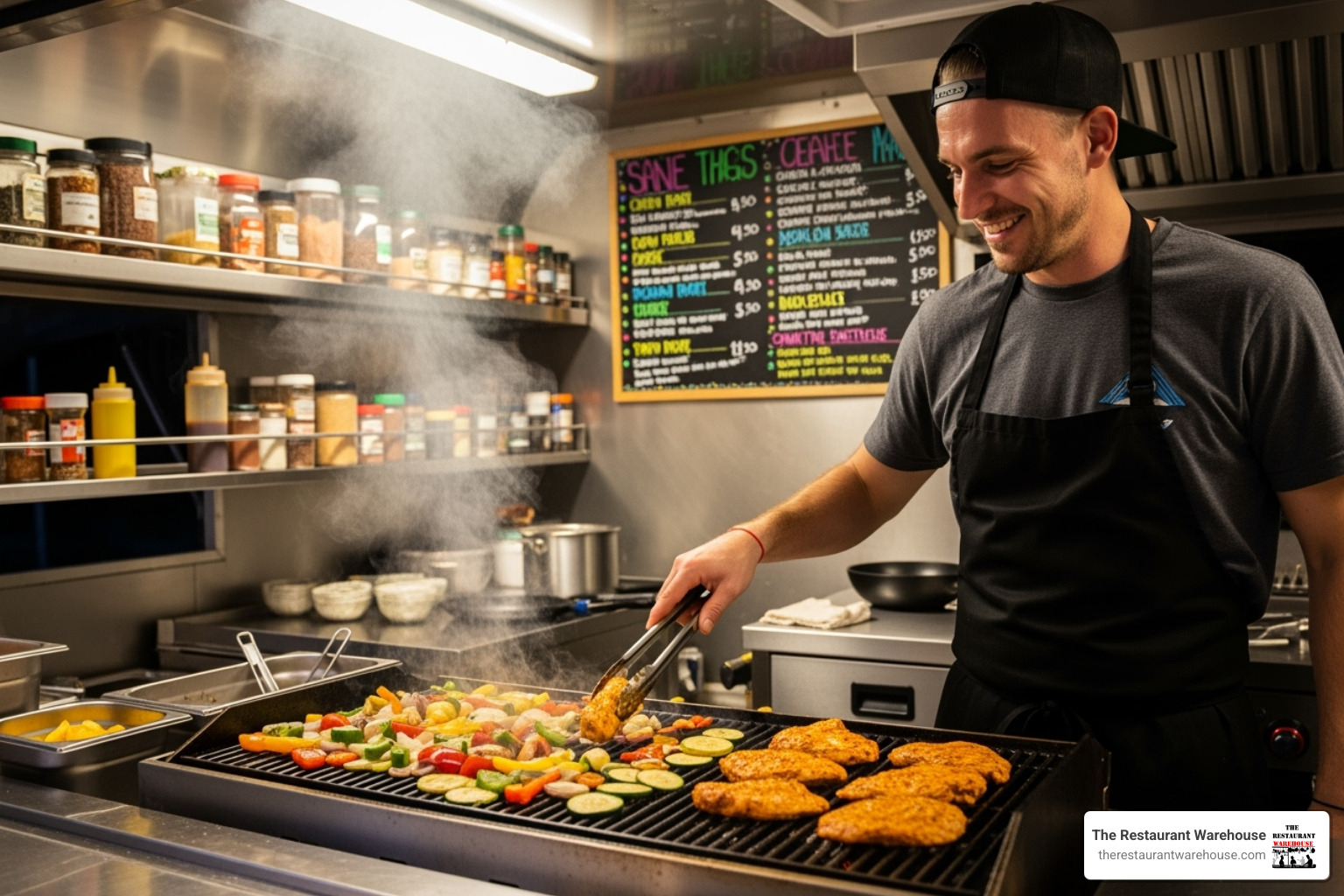
Catering events live and die by their ability to deliver high-quality food in any setting. This demands equipment that is both portable and dependable. A tabletop grill can be easily transported, set up, and operated virtually anywhere, making it the perfect tool for cooking fresh food at weddings, corporate picnics, or outdoor music festivals. The ability to prepare hot, freshly grilled food on-site—rather than serving pre-cooked items from a hot box—dramatically lifts the guest experience and can set your catering business far apart from the competition.
Concession stands at sports stadiums, fairgrounds, and entertainment venues are all about speed and volume. Long lines of eager customers need to be served quickly and efficiently. Tabletop grills are masters of this domain, capable of churning out hundreds of hot dogs, sausages, burgers, and grilled sandwiches with speed and consistency, keeping the lines moving and maximizing sales during peak event times.
Ghost kitchens and delivery-centric operations are built on the principles of efficiency and specialization. These businesses thrive by optimizing their workflow for a specific menu designed for delivery. A dedicated tabletop grill can be the cornerstone of this production line, streamlining the cooking process for popular items like burgers or quesadillas while keeping overhead costs, such as rent and energy consumption, to a minimum.
Small cafes and bistros frequently face the challenge of limited kitchen space paired with a desire for a diverse menu. A tabletop grill neatly bridges this gap. It can anchor the breakfast service, handling pancakes, eggs, and sausage, and then effortlessly pivot to the lunch menu, grilling chicken for salads, searing steak for sandwiches, and pressing paninis, all without missing a beat.
Breakfast stations in hotels, corporate cafeterias, and buffet-style restaurants depend heavily on the efficiency of flat-top cooking surfaces. Imagine a single grill where crispy home fries and hash browns are cooking on one side, while eggs are being prepared to order and pancakes are being flipped on the other. This kind of simultaneous, zoned cooking is precisely what a busy breakfast service requires to function smoothly.
Outdoor patios and seasonal dining areas can be transformed into revenue-generating spaces with a portable tabletop grill. You can expand your seating and dining capacity during favorable weather and create an interactive, engaging experience for guests who love to watch their food being prepared fresh in an open-air setting. The sights and smells of live grilling add a unique ambiance that can become a major draw.
Demonstration cooking for culinary schools, television segments, or in-store retail promotions requires equipment that is both professional in appearance and accessible in operation. Tabletop grills provide the perfect platform for chefs to showcase cooking techniques up close, while their commercial-grade build maintains the credibility and authority of a professional kitchen environment.
Each of these scenarios powerfully illustrates that commercial tabletop grills are far more than simple cooking tools. They are strategic business assets that foster flexibility, drive efficiency, and open up new opportunities for growth across the entire foodservice spectrum.
A Buyer's Guide to the Perfect Commercial Table Top Grill
Selecting the right commercial table top grill is a critical decision that will have a lasting impact on your kitchen's daily efficiency, the quality and consistency of your food, and your long-term operational costs. The market is filled with a wide array of options, and the sheer number of choices in terms of power source, size, material, and features can feel overwhelming. This comprehensive guide will break down the decision-making process into key, manageable considerations. By evaluating your specific menu, volume, space, and budget against these criteria, you can confidently select the perfect grill that will serve as a reliable and profitable asset for years to come.
First Major Decision: Gas vs. Electric Power
The most fundamental choice you will make is between a gas-powered and an electric-powered model. There is no single "best" option; the right choice is entirely dependent on your kitchen's existing infrastructure, your menu's specific needs, your staff's skill level, and even your geographical location. Both types offer distinct advantages and have potential drawbacks that must be carefully weighed.
| Feature | Gas Grills | Electric Grills |
|---|---|---|
| Power & Heat Profile | Best in raw power, gas grills boast high BTU (British Thermal Unit) ratings. This translates to incredibly fast preheating and near-instantaneous temperature recovery, even when loading the grill with cold product. This makes them the undisputed champion for high-volume searing of steaks, burgers, and other proteins where a deep crust is desired. | The hallmark of electric grills is precision. They provide exceptionally stable and consistent temperature control across the entire cooking surface, virtually eliminating hot and cold spots. This makes them ideal for delicate items like eggs, pancakes, fish fillets, and crepes, where even, predictable heat is paramount to prevent scorching or uneven cooking. |
| Installation & Utility | Installation is more involved. Natural gas models require a dedicated gas line installed by a licensed professional. Propane models offer more flexibility but require space for safe tank storage and regular refills. Crucially, all gas grills require a robust, code-compliant ventilation and fire suppression system (Type 1 hood) to safely manage heat and combustion byproducts. | Installation is significantly simpler. Most models are "plug-and-play," requiring only a compatible electrical outlet. However, check the voltage and amperage requirements (e.g., 208V or 240V), as a standard 120V outlet may not suffice for a powerful commercial unit. This ease of setup makes them perfect for locations without existing gas lines. |
| Portability & Location | Propane-fueled gas grills are the ultimate portable solution. Their self-contained power source makes them the go-to choice for off-site catering, food trucks, farmers' markets, and outdoor patio setups where access to high-voltage electricity is unreliable or nonexistent. | Portability is limited by the need for a suitable electrical outlet. While they can be moved around a kitchen, they are less suited for true off-grid or remote event cooking. They are the safer, and often required, choice for indoor locations with strict fire codes, such as mall kiosks, airport terminals, or high-rise buildings. |
| Control & Operation | Gas grills typically feature manual controls with high/medium/low settings or simple dials. Many seasoned chefs prefer this tactile, hands-on approach, using the visual feedback of the flame to make instant adjustments. This allows for an intuitive, "feel-based" style of cooking. | Electric grills almost always feature thermostatic controls. This allows the operator to set a precise temperature (e.g., 350°F), and the grill will automatically cycle its heating elements to maintain that exact temperature. This is invaluable for ensuring consistency across shifts, simplifying staff training, and minimizing food waste from over- or under-cooking. |
| Kitchen Environment | The open flame and combustion process generate significant ambient heat, which can make the cookline hotter and place a greater load on your HVAC system. They also produce more airborne grease and fumes, reinforcing the need for powerful ventilation. | By producing no combustion fumes and radiating less ambient heat, electric grills contribute to a cooler, cleaner, and often quieter kitchen environment. This can improve staff comfort and potentially lower air conditioning costs. |
| Cost Considerations | The initial purchase price for a gas grill can sometimes be lower than a comparable electric model. However, the ongoing cost of natural gas or propane is a variable operational expense. Installation costs for a new gas line can also be significant. | Electric models may have a slightly higher upfront cost. However, electricity prices are often more stable, and their energy efficiency in maintaining temperature (rather than being constantly "on") can lead to lower long-term utility bills, especially in operations where the grill is used for precise, intermittent tasks. |
Sizing Your Grill: Matching Footprint to Output
After deciding on a power source, the next critical step is selecting the right size. A grill that is too small will create bottlenecks during peak hours, while one that is too large wastes valuable counter space and energy. Sizing is a function of your menu, projected volume, and kitchen layout.
Commercial tabletop grills are typically measured by their width, with common sizes ranging from a compact 12 inches to a massive 72 inches. Depth is also a factor, usually around 24 to 30 inches. To choose correctly, analyze your menu:
- High-Volume, Single-Item Focus: If your concept revolves around burgers, cheesesteaks, or breakfast platters, you'll need a larger surface area (36 to 72 inches) to meet demand. Calculate your peak hourly output (e.g., 100 burgers per hour) and determine the grill surface needed to cook that many items at once, factoring in flip time.
- Diverse, Multi-Item Menu: If the grill is a supporting player for searing fish, grilling chicken for salads, and toasting buns, a smaller unit (15 to 30 inches) may be sufficient.
A key feature to consider is thermostatic control zones. Larger grills (24 inches and up) are often equipped with multiple, independently controlled heating elements. For example, a 36-inch grill might have three separate 12-inch zones. This is incredibly versatile, allowing you to sear steaks at a high temperature on one zone while gently warming tortillas or holding cooked items on another zone set to a low temperature. This multi-zone capability transforms a single piece of equipment into multiple cooking stations.
The Cooking Surface: Material and Thickness Matter
The grill plate itself—the surface your food actually touches—is arguably the most important component for determining cooking performance and maintenance requirements. The material and its thickness directly impact heat retention, heat distribution, and cleanup.
- Standard Steel Plates: This is the most common and versatile option, the true workhorse of the industry. Standard steel is durable, provides excellent heat transfer, and can withstand the rigors of all-day use with metal utensils. The critical factor here is thickness. Plates typically range from 1/2-inch to 1-inch thick. A thicker plate (3/4-inch or 1-inch) takes longer to preheat but offers far superior heat retention and recovery. When you place cold burgers on a 1-inch plate, the surface temperature drops much less than it would on a 1/2-inch plate, resulting in a better sear and faster cook times. Thicker plates are also more resistant to warping over time.
- Chrome-Plated Tops: Chrome is a premium surface option that offers several distinct advantages. The mirror-like finish is non-porous and highly non-stick, which means less oil is needed for cooking and there is minimal flavor transfer between items—you can grill fish and then immediately toast buns without any lingering taste. Chrome surfaces radiate significantly less heat into the kitchen, creating a more comfortable work environment. They are also exceptionally easy to clean, often requiring just a wipe-down with a damp cloth. However, they come at a higher initial cost and require more care, as metal utensils can scratch the chrome finish. They are an excellent choice for open kitchens, display cooking, and delicate foods like eggs and pancakes.
- Cast Iron Plates: While less common in modern tabletop models, cast iron is the traditional material for griddles. It offers unparalleled heat retention and creates a fantastic sear. However, it is heavy, brittle, and requires significant maintenance. Cast iron must be properly seasoned to create a non-stick surface and prevent rust, a process that requires time and consistency.
Essential Features for Usability, Safety, and Maintenance
Beyond the core specifications, several design features can dramatically impact the day-to-day experience of using and maintaining your grill.
- Grease Management System: High-volume grilling produces a lot of grease. An effective management system is non-negotiable. Look for wide, deep grease troughs or channels that effectively direct runoff away from the cooking surface. The grease should flow into a large-capacity collection tray or drawer that is easy to remove and clean, even when hot. A small, difficult-to-access grease tray will quickly become a frustrating and hazardous chore.
- Splash Guards: These are the raised metal walls around the sides and back of the grill plate. They are a crucial safety feature, containing hot grease splatter that could otherwise cause burns or create a slippery floor hazard. They also help keep your walls and adjacent equipment much cleaner, simplifying end-of-day cleanup.
- Build Quality and Durability: A commercial kitchen is a demanding environment. Look for a grill with a body constructed from heavy-gauge stainless steel, which resists corrosion and is easy to clean. Welded seams are generally more durable and sanitary than screwed-together frames. Check for sturdy, adjustable legs to ensure the unit sits level and stable on your countertop.
Final Checks: Certification and Warranty
Finally, before making a purchase, verify two critical details. First, ensure the grill is NSF Certified. The NSF (National Sanitation Foundation) mark indicates that the equipment has been tested and meets strict standards for public health, safety, and sanitation. Using non-certified equipment in a commercial kitchen is a health code violation and can void your insurance. Second, review the manufacturer's warranty. A strong warranty is a good indicator of the manufacturer's confidence in their product's durability and reliability.
By thoughtfully considering these factors—power source, size, plate material, and essential features—you can move beyond just buying a piece of equipment and make a strategic investment in a commercial tabletop grill that will empower your menu, streamline your operations, and drive profitability for your business.
About The Author

Sean Kearney
Sean Kearney used to work at Amazon.com and started The Restaurant Warehouse. He has more than 10 years of experience in restaurant equipment and supplies. He graduated from the University of Washington in 1993. He earned a BA in business and marketing. He also played linebacker for the Huskies football team. He helps restaurants find equipment at a fair price and offers financing options. You can connect with Sean on LinkedIn or Facebook.
Leave a comment