

10 Key Food Service Industry Trends for 2025
The food service landscape is evolving at an unprecedented pace, driven by technological leaps, shifting consumer values, and new economic realities. For restaurant owners and operators, staying ahead of these changes isn't just an advantage-it's essential for survival and growth. This roundup moves beyond generic advice to provide a deep, actionable look at the 10 most impactful food service industry trends shaping the coming year. We will explore everything from the operational efficiency of ghost kitchens and the integration of robotics to the revenue potential of subscription-based dining models.
You'll get practical implementation strategies, real-world examples, and specific insights to help you adapt and innovate. We'll break down what each trend means for your business, providing the tools needed to thrive. For instance, as menus adapt to include more plant-based and functional foods, the information presented to the consumer becomes critical. Beyond the operational shifts discussed here, understanding the legal and consumer-driven aspects, such as the emerging trends in food labelling for 2025, is equally vital for compliance and building trust. This guide is designed to equip you with a comprehensive roadmap for navigating the challenges and opportunities ahead.
1. Ghost Kitchens and Virtual Restaurants
Ghost kitchens represent a fundamental shift in restaurant operations, and this model is a dominant force among current food service industry trends. These commercial cooking facilities operate without a dining room, focusing exclusively on delivery and takeout orders. This delivery-centric approach allows operators to launch "virtual restaurants" – digital-only brands that exist on platforms like DoorDash and Uber Eats – with significantly less capital than a traditional brick-and-mortar establishment.
The primary benefit is agility. Operators can test new cuisines, menus, and brand concepts with minimal financial risk. Success stories like CloudKitchens and Kitchen United demonstrate the model's scalability, allowing a single kitchen to house multiple virtual brands, each targeting a different customer demographic. This diversification maximizes revenue potential from a single, optimized operational footprint.
Actionable Insights
- Optimize Your Menu for Travel: Design dishes that maintain their integrity, temperature, and texture during transport. Stews, rice bowls, and certain sandwiches often travel better than delicate or fried items.
- Invest in Quality Packaging: Use vented containers for crispy foods, insulated bags, and tamper-evident seals. Good packaging is your final touchpoint with the customer and directly impacts their perception of quality.
- Master Delivery App Analytics: Use the data provided by delivery partners to understand peak order times, popular items, and customer feedback. Use these insights to refine menus and kitchen workflows for maximum efficiency.
Here is a quick reference summarizing the core advantages of the ghost kitchen model.
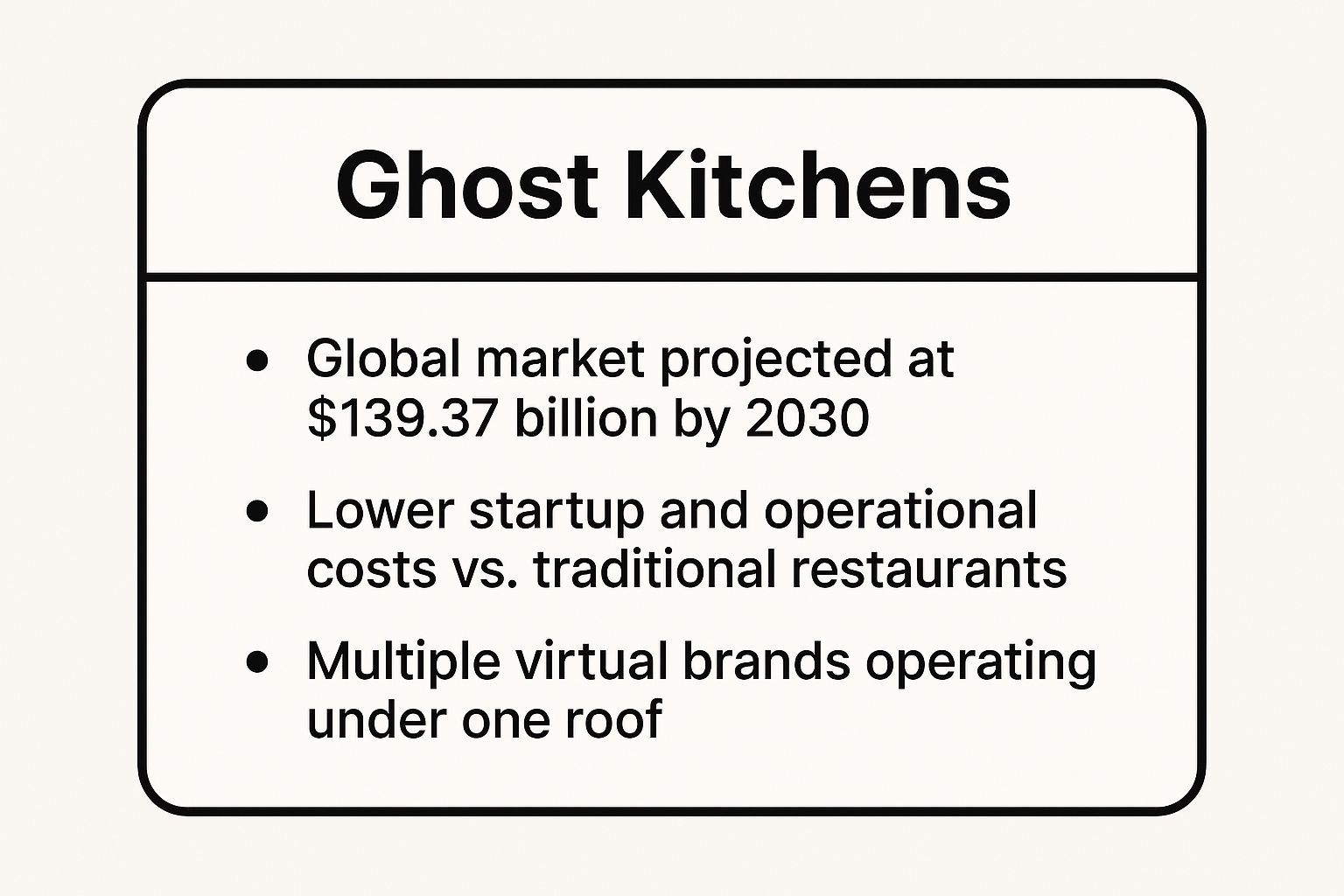
The data clearly illustrates why this trend has such staying power: it's a financially accessible model with a massive and growing market. For those considering this agile approach, understanding the specific operational needs is the first step. You can learn more about how to start a ghost kitchen and find the right equipment to maximize your space and efficiency.
2. Plant-Based and Alternative Protein Integration
The demand for plant-based and alternative proteins has exploded, moving from a niche market to a mainstream expectation. This is a critical food service industry trend driven by consumer interest in health, sustainability, and ethics. This goes far beyond simple veggie burgers; it involves integrating sophisticated plant-based meats, dairy alternatives, and even novel proteins into every part of the menu. Major players have validated this shift, with Burger King's Impossible Whopper and KFC's Beyond Fried Chicken tests demonstrating widespread consumer acceptance and demand.
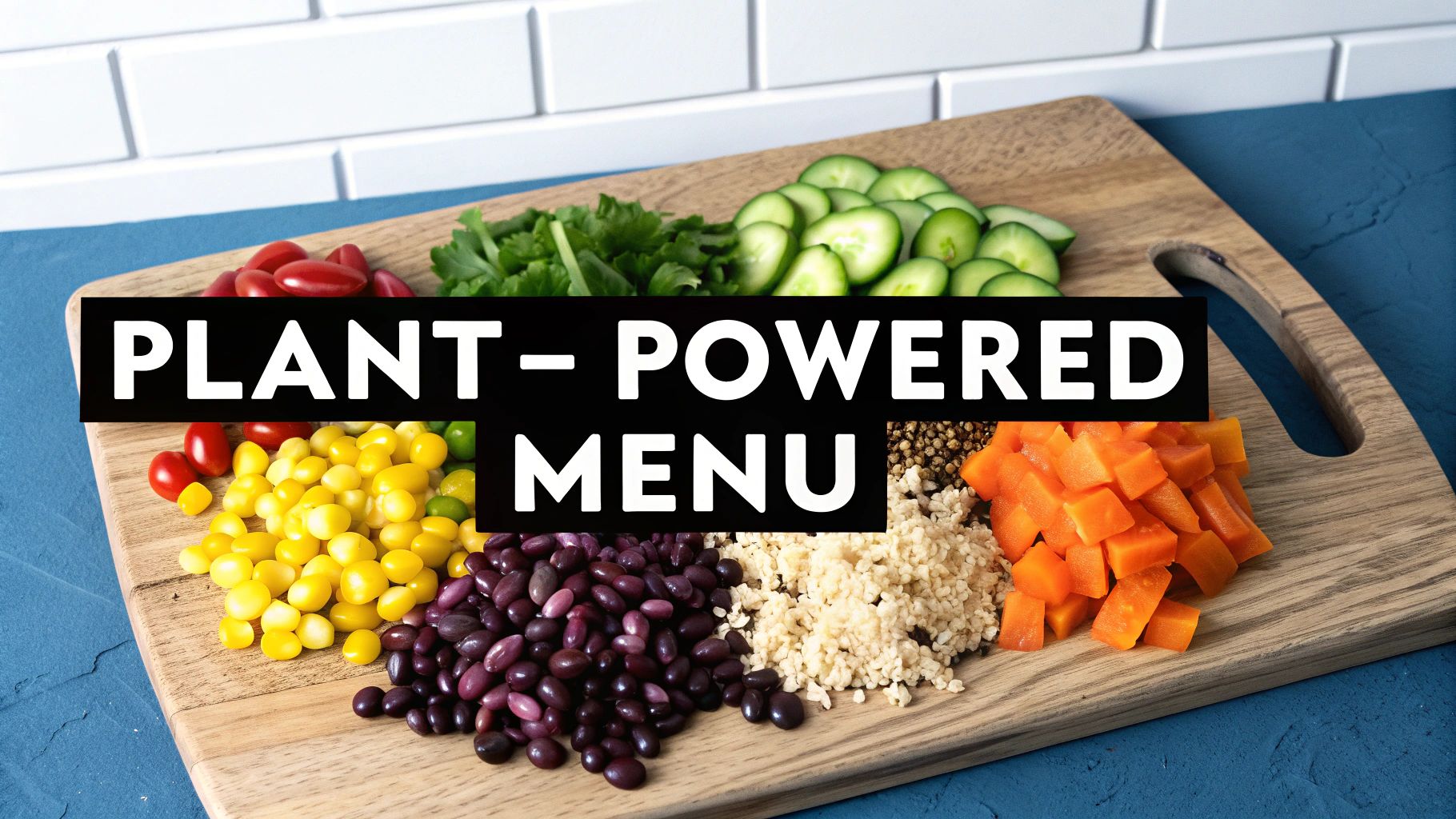
The primary benefit is tapping into a rapidly expanding customer base that actively seeks these options. Offering credible plant-based alternatives can attract new demographics, increase visit frequency from existing customers, and significantly boost check averages. Success stories from chains like White Castle and Subway show that partnering with established brands like Impossible Foods or Beyond Meat can lend immediate credibility and attract brand-loyal customers to your establishment. This trend is about addition, not replacement, creating more choices for more people.
Actionable Insights
- Start with Familiar Formats: Introduce plant-based options in familiar, high-demand items like burgers, tacos, or sausage patties. This lowers the barrier to entry for curious customers who might be hesitant to try an entirely new dish.
- Train Staff on Preparation and Cross-Contamination: Plant-based proteins often have different cooking times and temperature requirements. Ensure your kitchen team is trained on proper handling to deliver the best taste and texture, and have clear protocols to prevent cross-contamination for guests with dietary restrictions.
- Market the Experience, Not Just the Ingredient: Focus marketing on the delicious flavor and satisfying experience of the dish. While highlighting health or environmental benefits is great, leading with taste is what convinces most customers to make the purchase.
The data and market adoption rates confirm that this is not a fleeting fad but a permanent evolution in diner preferences. For operators looking to meet this demand, understanding the nuances of sourcing, preparation, and marketing is key. You can find essential strategies by reading more about how to launch and equip a successful plant-based menu.
3. Hyper-Personalization Through AI and Data Analytics
Leveraging customer data is no longer just for e-commerce giants; it has become one of the most transformative food service industry trends. Hyper-personalization uses artificial intelligence (AI) and data analytics to tailor every aspect of the dining experience, from marketing messages to menu suggestions. By analyzing past orders, visit frequency, and even time-of-day preferences, restaurants can create unique, one-to-one interactions that drive loyalty and increase spending.
This goes far beyond simply using a customer's first name in an email. Industry leaders are already demonstrating its power. Starbucks uses its "Deep Brew" AI platform to generate personalized recommendations on its app, while McDonald's acquired Dynamic Yield to customize drive-thru menu boards based on factors like weather, time of day, and current order selections. This level of data-driven insight allows operators to anticipate customer needs, making diners feel understood and valued, which is a powerful competitive advantage.
Actionable Insights
- Integrate Your POS and CRM: Connect your point-of-sale system with a customer relationship management tool to start building detailed customer profiles. Track order history, visit dates, and total spend to identify your most valuable patrons.
- Segment Your Marketing Efforts: Instead of sending one generic email blast, use your data to create customer segments. Send a special offer for a favorite dish to a loyal customer who hasn't visited in a while or promote new vegetarian options to those who frequently order plant-based meals.
- Ensure Data Privacy and Transparency: Be upfront with customers about what data you are collecting and how you are using it. Building trust is essential; a clear privacy policy and secure data handling practices are non-negotiable.
4. Contactless Dining and Service Technology
The adoption of contactless technology is a defining characteristic of modern food service industry trends, transforming the customer journey from arrival to payment. Initially accelerated by health and safety concerns, these systems are now a standard expectation for convenience and efficiency. This includes QR code menus, mobile ordering directly from the table, and touchless payment solutions, all of which streamline operations and reduce friction for both guests and staff.
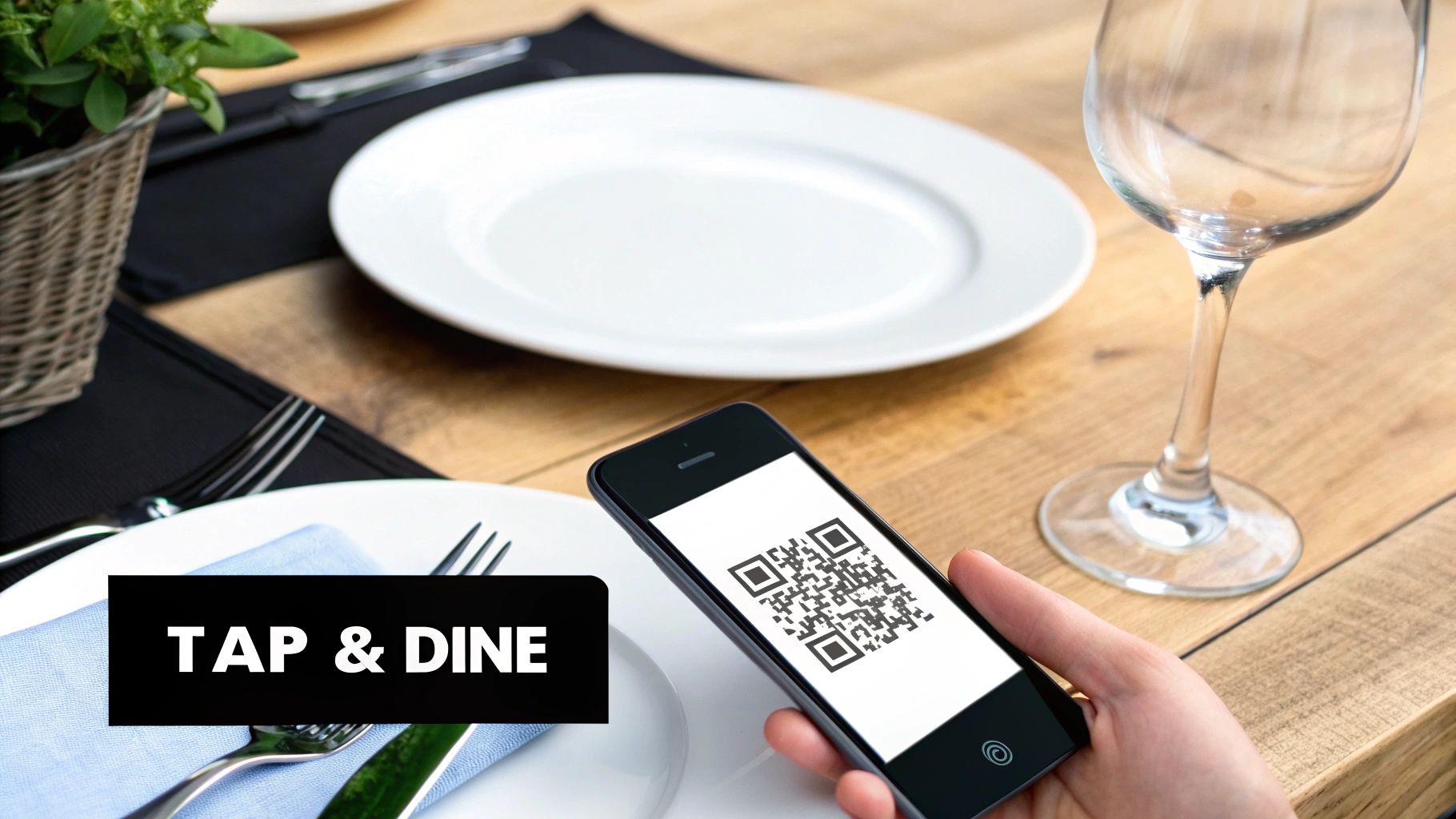
The primary advantage is a faster, more accurate service cycle. Systems from providers like Toast POS integrate ordering and payment into one seamless flow, empowering guests to control their own dining pace. Major brands like Panera Bread and Olive Garden, with its Ziosk tabletop tablets, have demonstrated how this technology can increase table turnover rates and check averages by making it easier for customers to order more and pay faster, all while freeing up staff to focus on higher-value hospitality tasks.
Actionable Insights
- Offer Analog Alternatives: While digital is dominant, always provide physical menus for guests who are uncomfortable with or unable to use QR codes. This ensures inclusivity and prevents customer frustration.
- Invest in Robust WiFi: A slow or unreliable internet connection will render your digital systems useless and create a poor customer experience. Ensure your infrastructure can handle peak capacity.
- Train Staff as Tech Ambassadors: Your team should be experts in your contactless systems. Train them to patiently guide guests through the process, turning potential tech hurdles into positive, helpful interactions.
- Maintain the Human Element: Technology should enhance, not replace, hospitality. Instruct staff to use the time saved by automation to engage with customers, check on satisfaction, and provide a personal touch that technology cannot replicate.
5. Sustainable and Zero-Waste Operations
The shift towards sustainability is one of the most impactful food service industry trends, moving from a niche concern to a core consumer expectation. This approach involves a comprehensive operational overhaul to minimize environmental impact. It encompasses everything from responsible ingredient sourcing and waste reduction to energy-efficient practices and the elimination of single-use plastics, creating a circular economy within the restaurant itself.
This trend is not just about environmental responsibility; it’s a powerful business strategy. Restaurants like Blue Hill have pioneered "nose-to-tail" cooking, while chains such as Chipotle and Sweetgreen champion sustainable packaging and carbon-neutral goals. These efforts resonate deeply with modern consumers who increasingly align their spending with their values. Adopting sustainable practices can enhance brand reputation, attract a loyal customer base, and often lead to significant long-term cost savings through reduced waste and energy consumption.
Actionable Insights
- Implement a Waste Audit: Begin by tracking exactly what your restaurant throws away. This data will reveal your biggest opportunities, whether it's food scraps that can be composted, excess packaging, or recyclable materials being sent to a landfill.
- Embrace "Root-to-Stem" Cooking: Train your kitchen staff to use entire ingredients. Turn vegetable peels into stock, transform herb stems into pesto, and use leftover bread for croutons or puddings. This maximizes your food cost budget while minimizing waste.
- Partner with Local and Sustainable Suppliers: Sourcing locally reduces your carbon footprint from transportation and supports your community's economy. Prioritize suppliers who share your commitment to sustainable farming, fishing, and production practices.
6. Micro-Fulfillment and Dark Store Concepts
The convergence of e-commerce speed and consumer demand for immediate gratification has given rise to micro-fulfillment centers and dark stores. This model is a critical food service industry trend, reshaping expectations around delivery speed. These are small, hyperlocal warehouses or "dark stores" that are not open to the public but are strategically located in dense urban areas to facilitate ultra-fast delivery, often promising orders in 30 minutes or less. This approach blurs the line between a traditional restaurant kitchen, a convenience store, and a logistics hub.
The core advantage is unprecedented speed and convenience for the consumer. By stocking a curated selection of high-turnover prepared foods, groceries, and convenience items, operators can meet immediate needs. Pioneers like Gopuff and Getir have demonstrated the model's power, building extensive networks of these dark stores to dominate the quick-commerce space. For food service operators, this represents an opportunity to partner with or adopt a similar model, extending their reach beyond traditional meal delivery into the lucrative CPG and grocery market.
Actionable Insights
- Curate a High-Turnover Menu: Focus on a limited, highly desirable selection of convenience-oriented products, prepared foods, and popular grocery staples. Think grab-and-go meals, popular snacks, beverages, and essential household items.
- Invest in Robust Inventory Tech: Real-time inventory management is non-negotiable. Use software that provides pinpoint accuracy to prevent stockouts, manage expiration dates, and optimize reordering for your specific location.
- Optimize Location for Delivery Density: Choose your dark store locations based on population density and delivery radius optimization, not foot traffic. The goal is to maximize the number of customers you can reach within a 15-30 minute delivery window.
7. Automation and Robotics in Food Preparation
The integration of automation and robotics is rapidly transforming kitchen operations, emerging as one of the most impactful food service industry trends. These systems handle repetitive and high-volume tasks, from flipping burgers to assembling complex bowls, addressing persistent labor shortages and improving output consistency. This technological wave allows human staff to focus on more complex, customer-facing roles, elevating the overall service experience.
The primary benefit is operational efficiency. By automating mundane tasks, restaurants can significantly increase production speed and ensure every dish meets precise quality standards, regardless of the time of day or staff on shift. Success stories like White Castle’s use of the Flippy robot for frying or Spyce’s fully automated cooking woks showcase the technology's potential to streamline back-of-house processes, reduce food waste, and maintain a predictable, high-quality output.
Actionable Insights
- Start with Simple, Repetitive Tasks: Implement automation for straightforward, high-frequency jobs first, such as frying, dispensing drinks, or assembling simple pizza bases. This allows for a smoother integration and a quicker return on investment.
- Calculate ROI Carefully: When evaluating a system, factor in not just the initial purchase price but also ongoing maintenance, software updates, and potential staff training costs to get a true picture of the financial commitment.
- Train Staff to Collaborate with Tech: Position automation as a tool that assists employees rather than replaces them. Train your team on how to operate, troubleshoot, and work alongside robotic systems to maximize their effectiveness and foster a positive work environment.
Here is a quick reference summarizing the core advantages of the automation and robotics model.
The data highlights how automation directly boosts efficiency and consistency, which are critical for profitability and brand reputation. For operators ready to embrace this trend, understanding the different types of systems is the crucial next step. You can learn more about how kitchen robots work and which options might be right for your operation.
8. Subscription and Membership-Based Dining Models
Borrowing from the success of SaaS and retail, subscription models are one of the most innovative food service industry trends, creating predictable, recurring revenue streams. This approach involves customers paying a regular fee for access to specific products or benefits, such as a daily coffee or discounted meals. This model fosters deep customer loyalty and provides operators with a stable financial baseline, independent of daily foot traffic fluctuations.
This trend’s power lies in its value exchange. For the customer, it offers convenience and perceived savings. For the business, it guarantees income and provides rich data on customer habits. Success stories like Panera Bread’s MyPanera+ coffee subscription and Taco Bell's Taco Lover's Pass demonstrate the model's viability across different market segments, turning casual visitors into dedicated, high-value members. As food service businesses explore new revenue streams, a growing trend is subscription and membership-based dining, similar to successful models leveraging advanced subscription box fulfillment strategies.
Actionable Insights
- Define a Clear Value Proposition: Ensure the benefits, whether it's unlimited coffee or a percentage off every order, clearly outweigh the monthly cost. The value must be immediately obvious and easy for the customer to calculate.
- Start with a Pilot Program: Before a full-scale launch, test your subscription model with a small, select group of customers. Use this phase to fine-tune pricing, benefits, and operational kinks based on real-world feedback.
- Create an Effortless User Experience: The sign-up and cancellation processes must be simple and frictionless. A complicated system will deter potential subscribers and create frustration for existing ones, undermining the convenience you aim to offer.
9. Health-Conscious and Functional Food Integration
The demand for health-conscious dining is evolving beyond basic calorie counts into a more sophisticated desire for functional foods. This is one of the most consumer-driven food service industry trends, where diners actively seek menu items that offer specific health benefits like immune support, improved gut health, or reduced inflammation. This involves integrating ingredients like superfoods, adaptogens, and probiotics directly into familiar dishes, transforming everyday meals into wellness opportunities.
This trend moves beyond niche health food stores and into mainstream dining. Success stories range from national chains like Sweetgreen, which built its brand on nutrient-dense ingredients, to specialized concepts like True Food Kitchen, which bases its entire menu on an anti-inflammatory food pyramid. These operators demonstrate that consumers are willing to pay a premium for food that not only tastes good but also makes them feel good, providing tangible health value with every bite.
Actionable Insights
- Partner with Nutrition Experts: Collaborate with a registered dietitian to develop menu items that are both delicious and nutritionally sound. Their expertise adds credibility and ensures health claims are accurate.
- Educate Your Staff and Customers: Train your team on the specific benefits of functional ingredients so they can confidently explain them to guests. Use menu descriptions and marketing materials to clearly communicate why an ingredient like turmeric or maca is included.
- Start Small and Familiar: Introduce functional ingredients by enhancing popular existing menu items. For example, add collagen peptides to smoothies, offer a mushroom coffee alternative, or create a salad dressing with probiotic-rich kefir.
10. Social Commerce and Influencer Kitchen Partnerships
The line between entertainment and dining has blurred, making social commerce and influencer partnerships a vital component of modern food service industry trends. This approach moves beyond simple marketing by directly integrating social media with the point of sale. It involves collaborating with creators to develop and promote unique, limited-time menu items or even entire virtual brands, turning their digital influence into direct revenue.
This trend leverages the authentic connection influencers have with their audiences to drive incredible demand. High-profile successes like Travis Scott's meal with McDonald's or Charli D'Amelio's signature drink at Dunkin' demonstrate the model's power to generate massive sales and cultural buzz. On a more accessible scale, a local restaurant can partner with a regional food blogger to create a co-branded dish, driving their loyal followers directly to the restaurant or its online ordering platform. It's a strategy that turns passive scrolling into active purchasing.
Actionable Insights
- Choose Partners Authentically: Select influencers whose brand and audience genuinely align with your restaurant’s target demographic and values. An authentic match results in more believable and effective promotions.
- Co-Create Unique, Shareable Items: Work with the influencer to develop a menu item that is not only delicious but also visually appealing or "Instagrammable." This encourages user-generated content and organic sharing.
- Structure Clear, Goal-Oriented Campaigns: Define the partnership's goals from the outset, whether it’s driving a specific number of sales, increasing online orders, or boosting brand awareness. Use unique promo codes or dedicated landing pages to track ROI effectively.
- Leverage Scarcity and Exclusivity: Frame the collaboration as a limited-time offer. This sense of urgency motivates followers to act quickly, transforming passive interest into immediate sales and creating a "fear of missing out" effect.
Top 10 Food Service Industry Trends Comparison
| Item | Implementation Complexity 🔄 | Resource Requirements ⚡ | Expected Outcomes 📊 | Ideal Use Cases 💡 | Key Advantages ⭐ |
|---|---|---|---|---|---|
| Ghost Kitchens and Virtual Restaurants | Medium - requires tech integration | Moderate - shared kitchens, delivery platforms | Scalable delivery-only operations, reduced overhead | Delivery-optimized cuisine, multi-brand testing | Lower startup costs, flexibility, faster expansion |
| Plant-Based and Alternative Protein Integration | Medium - ingredient sourcing and training | Moderate - specialty ingredients, staff training | Appeal to health/environmental consumers, premium pricing | Menus targeting vegans, flexitarians | Environmental benefits, market growth, brand differentiation |
| Hyper-Personalization Through AI and Data Analytics | High - advanced AI systems and data management | High - tech investment, expert staff | Increased loyalty, higher order values, efficiency | Customer experience, targeted marketing | Enhanced personalization, operational optimization |
| Contactless Dining and Service Technology | Medium - digital ordering/payment tech | Moderate - infrastructure and devices | Improved hygiene, faster service, labor savings | Modern dining, pandemic-response | Safety, speed, data insights |
| Sustainable and Zero-Waste Operations | Medium to high - process changes and sourcing | Moderate to high - sustainable supplies, training | Cost savings, brand reputation, environmental impact | Eco-conscious brands, waste reduction initiatives | Long-term savings, consumer appeal, regulatory benefits |
| Micro-Fulfillment and Dark Store Concepts | High - automation and location planning | High - automation tech and real estate | Ultra-fast delivery, efficient urban fulfillment | Fast grocery/food delivery in dense areas | Speed, scalability, lower real estate costs |
| Automation and Robotics in Food Preparation | Very high - robotics and system integration | Very high - robotics, maintenance, training | Consistent quality, labor cost reduction, 24/7 ops | High-volume kitchens, labor shortage solutions | Consistency, efficiency, reduced labor dependency |
| Subscription and Membership-Based Dining Models | Medium - pricing and benefits design | Moderate - system integration and marketing | Predictable revenue, customer loyalty | Frequent customers, niche products | Recurring revenue, better customer retention |
| Health-Conscious and Functional Food Integration | Medium - ingredient sourcing and staff education | Moderate - specialty ingredients and training | Premium pricing, brand differentiation | Health-focused, wellness-oriented consumers | Market growth, brand differentiation, partnerships |
| Social Commerce and Influencer Kitchen Partnerships | Medium - campaign management and content creation | Moderate - influencer fees and marketing resources | Viral brand awareness, new customer acquisition | Social media-driven marketing and product launches | Authenticity, viral potential, expanded reach |
Your Recipe for Future Success
Navigating the dynamic landscape of the modern food service industry requires far more than just a delicious menu. It demands a forward-thinking strategy built on adaptability, technological fluency, and a profound understanding of evolving consumer behavior. The trends we've explored are not isolated fads but interconnected pillars shaping the future of dining. From the operational agility of ghost kitchens and the precision of AI-driven hyper-personalization to the ethical appeal of sustainable, zero-waste practices, these shifts represent a fundamental restructuring of what it means to run a successful food business.
The most resilient and profitable operators will be those who view these changes not as challenges, but as opportunities for reinvention. The key is to avoid being overwhelmed and instead identify the trends that align most closely with your brand identity, customer base, and operational capacity. The future of your business hinges on mastering the delicate balance between high-tech efficiency and high-touch hospitality.
Synthesizing the Trends for Strategic Growth
The core message woven through these food service industry trends is a move toward a more efficient, personalized, and conscious dining experience. Consider the powerful synergy between these concepts:
- Technology as the Enabler: Contactless dining, automation in the kitchen, and data analytics are not just about cutting costs. They are tools that free up your team to focus on what matters most: creating exceptional guest experiences, innovating your menu with functional or plant-based options, and ensuring quality.
- Meeting the Consumer Where They Are: Ghost kitchens, micro-fulfillment centers, and social commerce partnerships all address a fundamental shift in consumer habits. Success is no longer confined to your four walls; it extends into the digital realm and the customer’s home.
- Building Community and Loyalty: Subscription models and hyper-personalization transform transactional relationships into long-term loyalty. By offering unique value and making customers feel seen and understood, you build a loyal following that is less susceptible to price-based competition.
Your Actionable Roadmap Forward
The path forward begins with a single, strategic step. Don't attempt to implement everything at once. Instead, perform a strategic audit of your current operations and identify your biggest opportunity for impact.
- Choose Your Entry Point: Could a virtual brand leveraging your existing kitchen capacity be a quick win? Is implementing a more robust online ordering system with data-capture capabilities the most logical next step?
- Pilot and Measure: Select one or two initiatives to pilot. Launch a limited plant-based menu special, test a simple subscription box for your most loyal customers, or partner with a local micro-influencer. Track the results meticulously.
- Invest in the Right Infrastructure: Embracing these trends often requires an upgrade in equipment and technology. Whether it's energy-efficient refrigeration for your sustainability goals or specialized cooking equipment for a new virtual concept, having the right tools is non-negotiable.
Ultimately, the most critical takeaway is the need for proactive adaptation. The food service industry trends of today are the standard operating procedures of tomorrow. By thoughtfully and strategically integrating these innovations, you are not just keeping up; you are building a more resilient, profitable, and relevant restaurant enterprise poised for sustained success.
Ready to turn these trends into reality? Equipping your kitchen for the future starts with the right foundation. For everything from commercial refrigeration and cooking equipment to the specialized gear needed for a ghost kitchen or a zero-waste operation, The Restaurant Warehouse offers the high-quality, affordable tools you need to innovate and grow. Visit The Restaurant Warehouse to find the essential equipment that will power your next successful venture.
About The Author

Sean Kearney
Sean Kearney used to work at Amazon.com and started The Restaurant Warehouse. He has more than 10 years of experience in restaurant equipment and supplies. He graduated from the University of Washington in 1993. He earned a BA in business and marketing. He also played linebacker for the Huskies football team. He helps restaurants find equipment at a fair price and offers financing options. You can connect with Sean on LinkedIn or Facebook.
Leave a comment