
Prep Tables & Equipment Stands

Atosa SE3630ECR2 30" Mixrite Series Stainless Steel Equipment Stand, 36"x30"
Atosa
Original price
$338.00
Original price
$338.00
-
Original price
$338.00
Original price
$338.00
Current price
$244.00
$244.00
-
$244.00
Current price
$244.00
The Atosa SE3630ECR2 is a commercial-grade stainless steel equipment stand engineered for professional kitchen environments. Measuring 36" wide by ...
View full details
Original price
$338.00
Original price
$338.00
-
Original price
$338.00
Original price
$338.00
Current price
$244.00
$244.00
-
$244.00
Current price
$244.00
Save 28%

Atosa SE3636ECR2 36" Mixrite Series Stainless Steel Equipment Stand, 36"x36"
Atosa
Original price
$374.00
Original price
$374.00
-
Original price
$374.00
Original price
$374.00
Current price
$270.00
$270.00
-
$270.00
Current price
$270.00
The Atosa SE3636ECR2 is a commercial-grade stainless steel equipment stand engineered for professional kitchen environments. Measuring 36"x36", thi...
View full details
Original price
$374.00
Original price
$374.00
-
Original price
$374.00
Original price
$374.00
Current price
$270.00
$270.00
-
$270.00
Current price
$270.00
Save 28%

Atosa SE3648ECR2 48" Mixrite Series Stainless Steel Equipment Stand, 36"x48"
Atosa
Original price
$447.00
Original price
$447.00
-
Original price
$447.00
Original price
$447.00
Current price
$323.00
$323.00
-
$323.00
Current price
$323.00
The Atosa SE3648ECR2 is a commercial-grade stainless steel equipment stand engineered for professional kitchen environments. Measuring 36" wide by ...
View full details
Original price
$447.00
Original price
$447.00
-
Original price
$447.00
Original price
$447.00
Current price
$323.00
$323.00
-
$323.00
Current price
$323.00
Save 28%

Atosa SE3660ECR2 60" Mixrite Series Stainless Steel Equipment Stand, 36"x60"
Atosa
Original price
$558.00
Original price
$558.00
-
Original price
$558.00
Original price
$558.00
Current price
$403.00
$403.00
-
$403.00
Current price
$403.00
The Atosa SE3660ECR2 is a heavy-duty stainless steel equipment stand engineered for commercial kitchen environments. Measuring 36" wide by 60" long...
View full details
Original price
$558.00
Original price
$558.00
-
Original price
$558.00
Original price
$558.00
Current price
$403.00
$403.00
-
$403.00
Current price
$403.00
Save 28%
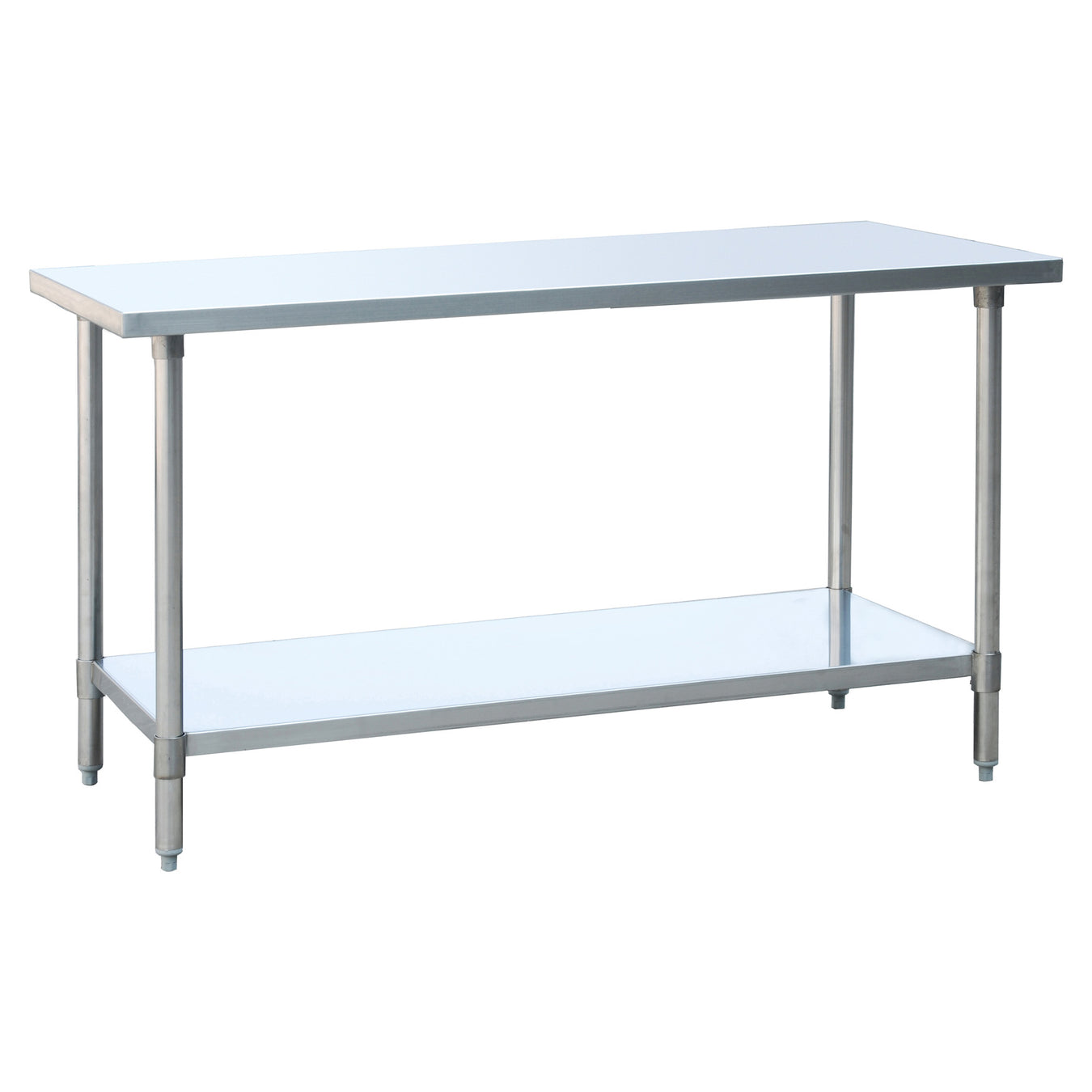
Stainless Steel Prep Tables, Work Tables & Equipment Stands
Prep Table or Work Table — Same Product, Different Names
Here, "prep table" and "work table" refer to non-refrigerated stainless steel work surfaces used for food preparation, dough work, equipment staging, and back-of-house support. This collection also includes equipment stands for compatible countertop appliances, explained in the dedicated section below. Prep tables and equipment stands are not interchangeable for every application; check each model for its dimensions, rated capacity, and intended use.
Why 18-Gauge 430 Stainless Steel
Many Atosa work tables use 18-gauge 430 stainless steel. Gauge numbers run in reverse: 16-gauge is thicker than 18-gauge, and 14-gauge is thicker still. Choose by the complete table construction and rated capacity, not gauge alone. Stainless steel still needs proper care; promptly remove food residue and follow the manufacturer’s cleaning instructions.
Sizing the Table to Your Station
Choose length and depth around your cutting board, ingredient containers, equipment, and available floor space. A compact table can suit a small dedicated task, while a larger station may need more room for staging or multiple workers. There is no single minimum length that fits every kitchen. Check leg placement, undershelf access, door swings, and the exact model’s load rating.
Backsplash or Open Top
Choose a flat-top table for access from multiple sides, or a rear backsplash for a wall-side station. Atosa MixRite ST models include both configurations: the ST2430EC is a flat-top table, while the ST2448ECB4 has a 4-inch rear backsplash. Check the individual model rather than assuming that all ST tables have a backsplash.
Mobile Workstations
Some Atosa work tables accept an optional WA400001 caster set. Confirm compatibility, required caster quantity, load capacity, and installed working height for your exact model before ordering. Mobile tables can help with cleaning and flexible layouts; engage the supplied brakes and check stability before using the workstation.
Best Uses
- Vegetable and protein prep stations
- Sandwich and salad assembly lines
- Dough work and bakery prep
- Equipment staging — mixers, slicers, scales
- Dishwasher landing tables and clean-side prep
- Back-of-house utility and storage support
Looking for Refrigerated Prep Tables?
If you need a prep table with a refrigerated rail and pan inserts for sandwich or pizza assembly, see the sandwich prep tables and pizza prep tables collections. Those are dedicated refrigerated cabinets — different product category from the flat stainless tables on this page.
Choosing a Commercial Prep Table for Your Workstation
A stainless steel prep table should fit the work happening on it, not just the empty space on your floor plan. Before choosing a size, lay out your cutting board, ingredient containers, scale, and finished-food tray. Leave enough room to move between tasks without balancing supplies on the edge or blocking nearby equipment.
| Station | What to prioritize | What to check before ordering |
|---|---|---|
| Vegetable and protein preparation | A stable cutting area with separate space for ingredients and completed prep | Board footprint, usable tabletop area, and your separation procedures for raw and ready-to-eat foods |
| Bakery and dough preparation | An unobstructed surface and convenient storage for pans and mixing bowls | Working height, room for dough handling, and access to the undershelf |
| Countertop equipment station | A table rated for the appliance and everything used with it | Equipment footprint, manufacturer load limits, operating clearances, and utility access |
| Wall-side prep station | A rear backsplash and accessible cleaning space | Backsplash height, wall obstructions, and the position of outlets |
| Island or pass-through workstation | A flat top accessible from multiple sides | Walking space, door swings, and room to transfer trays safely |
Heavy-Duty Stainless Steel Tables: Look Beyond the Gauge
Steel thickness is only one part of choosing a heavy-duty stainless steel work table. Compare the tabletop reinforcement, leg configuration, shelf construction, and the manufacturer's stated capacity for the exact model. Do not assume that a table's total load rating also applies to its undershelf, or that a static weight rating automatically makes it suitable for vibrating countertop equipment.
An adjustable undershelf can keep clean pans and supplies close to the station, but leave room to retrieve them and clean underneath. If you need knee space or room for a rolling bin, check the table configuration before ordering; do not remove structural components unless the manufacturer permits it. Confirm whether casters are included or sold separately and how they affect height and load capacity.
Setting Up a Cutting Board on a Restaurant Prep Table
Choose a cutting board that fits fully on the tabletop and leaves space for ingredients and utensils. Use a foodservice-appropriate board and a clean, suitable non-slip support so the board does not rock or slide during cutting. The table itself should be level and stable before you start work.
- Match the board to your cleaning process. Check the manufacturer's instructions for dishwasher suitability, heat exposure, sanitizers, and maintenance rather than assuming all plastic or wood boards can be treated the same way.
- Separate preparation tasks. Use designated boards and utensils for raw foods and ready-to-eat foods. Color coding can support staff procedures, but it does not replace cleaning and sanitizing.
- Inspect the cutting surface. Replace or professionally resurface boards, as appropriate, when grooves, cracks, or other damage prevent effective cleaning and sanitizing.
- Store boards dry. After cleaning and sanitizing, let boards air-dry fully in a clean rack or other protected storage arrangement. Avoid stacking damp boards together.
A cutting board does not turn a stainless work table into refrigerated storage. Keep perishable ingredients under the temperature controls required for your operation, and use the separate sandwich prep tables or pizza prep tables collections when you need a refrigerated assembly station.
How to Clean and Sanitize a Prep Table
Cleaning removes food residue and soil; sanitizing is a separate step after the surface is clean. Build both into your operating procedures, including changes from raw-food preparation to ready-to-eat work and whenever contamination occurs. Follow your local food code, the equipment care instructions, and the sanitizer label for your operation.
- Clear the surface. Remove food, utensils, cutting boards, and loose scraps so the whole work area is accessible.
- Wash. Use an appropriate detergent and cleaning tool to remove grease and food residue without damaging the stainless finish.
- Rinse. Remove loosened soil and detergent with clean water before applying sanitizer.
- Sanitize. Use a product labeled for food-contact surfaces and compatible with the table. Follow the specified dilution, temperature, contact time, and any rinsing instructions. Use the appropriate test method to check solution strength.
- Air-dry. Allow the surface to air-dry before use rather than wiping it dry with a reusable towel. Air-drying is the final step, not a substitute for sanitizing.
Clean and sanitize removable boards and utensils separately, and include shelf edges, legs, and accessible areas beneath the table in your cleaning schedule. Never mix cleaning chemicals or use stronger concentrations than the label specifies. Purdue Extension's food-contact surface sanitation guidance explains the distinction between washing, rinsing, sanitizing, and air-drying.
Commercial Equipment Stands for Countertop Appliances
Equipment stands and stainless steel prep tables belong to the same workstation family, but they serve different jobs. A prep table provides a work surface for food preparation and other approved tasks. An equipment stand is intended to support a compatible countertop appliance at an appropriate operating height. Do not assume that a general work table can support a griddle, charbroiler, hot plate, or another appliance simply because it fits on the top.
Choose the stand and appliance as a complete installation. Confirm the appliance manufacturer's support requirements, the stand's rated capacity, and all required operating clearances. Heat exposure, utility connections, ventilation, and the location of appliance feet can matter as much as the overall dimensions.
| Buying consideration | Prep or work table | Equipment stand |
|---|---|---|
| Primary task | Food preparation, dough work, staging, or another use allowed by the table manufacturer. | Supporting a compatible countertop appliance. |
| Height planning | Evaluate the tabletop working height for the task and operator. | Evaluate the stand height plus the appliance's working surface and controls. |
| Load assessment | Check tabletop and shelf ratings for the intended load and activity. | Account for appliance weight, contents, accessories, and the manufacturer's support requirements. |
| Installation checks | Allow room for movement, cleaning, and access to stored supplies. | Also check appliance clearances, heat exposure, ventilation, service access, and utility routing. |
Check Footprint, Weight, and Working Height
Measure the appliance's support footprint and confirm that all feet or mounting points sit where the stand is designed to carry the load. A top that is wider than the appliance does not automatically establish adequate support. Compare the actual model specifications rather than treating stainless steel thickness or a series name as a load rating.
Consider the total operating height before ordering. A stand that looks convenient when empty may put a tall appliance's controls or cooking surface too high for the intended task. Also check the delivery route and the space needed to remove panels, clean beneath the appliance, or reach the shutoff and electrical connection.
Atosa and BK Resources Equipment Stand Options
This collection brings together Atosa ATSE and MixRite SE equipment stands with BK Resources options. Use the individual listings to compare dimensions, support construction, undershelves, and raised edges. Product names and dimensions alone do not establish compatibility with a particular appliance.
- Atosa ATSE models: Compare the ATSE-3024, ATSE-3036, and ATSE-3048 with your countertop equipment and available space.
- Atosa MixRite SE models: Review the SE3630ECR2, SE3636ECR2, SE3648ECR2, and SE3660ECR2 for alternative stand configurations.
- BK Resources models: Compare the EETS-7230, SVET-7230, and SVET-7230-6, including differences in legs, undershelf, and edge configuration.
Undershelves, Mobility, and Safe Installation
An undershelf can provide storage, but its own load rating and the appliance's clearance requirements still apply. Do not store items where they interfere with utility connections, cleaning, ventilation, or safe operation. Raised edges can help define the support area, but they are not a substitute for any required restraint or approved mounting method.
If mobility is needed, confirm that the exact stand accepts the proposed caster kit and review the resulting height, load limits, and stability requirements. Do not fit casters solely because they appear to match the legs. Moving gas or electrically connected equipment also requires an installation designed for that movement, with the appropriate connections and restraints specified by the manufacturers and applicable codes.
Before purchase, confirm the intended appliance, loaded weight, support dimensions, stand capacity, overall operating height, and installation requirements. Use a qualified installer where required. Choosing the proper stand can keep equipment off a food-preparation station without treating every work table as a cooking-equipment base.
Stainless Steel Prep Table & Work Table FAQ
Are prep tables and work tables the same thing?
For the non-refrigerated tables in this collection, the terms describe the same type of stainless work surface. Elsewhere, “prep table” can also mean a refrigerated sandwich or pizza prep cabinet, so check whether the application calls for a work surface or refrigeration.
What gauge stainless steel is best for a commercial prep table?
There is no single best gauge for every task. Lower gauge numbers mean thicker steel: 16-gauge is thicker than 18-gauge. Many Atosa work tables use 18-gauge tops, but tabletop reinforcement, leg construction, and the manufacturer’s load rating also matter when choosing a table.
What is 430 stainless steel and why does it matter?
430 stainless steel is used in many Atosa work tables. Check the exact model for its material specification and sanitation certification; a steel grade by itself is not an NSF certification. Follow the manufacturer’s care instructions and avoid leaving corrosive residues on the surface.
What size prep table do I need?
Measure the space needed for your board, ingredients, equipment, and completed work, then check the available floor area and access around the station. Compact tables can work for single tasks; larger tables offer more staging room. Confirm length, depth, working height, shelf clearance, and rated capacity on the specific model.
Should I get a prep table with a backsplash?
A rear backsplash can help contain splashes at a wall-side station. A flat top is often more convenient for island work or passing trays across the table. Both configurations exist within the MixRite ST range, so compare the exact model’s specification.
What height are commercial prep tables?
Check the listed working-surface height and overall height separately. For example, the Atosa ST2430EC flat-top model is listed at 34 inches high, while the ST2448ECB4 lists 38 inches overall including its 4-inch backsplash. Casters and leveling adjustments may affect installed height.
Can I make a prep table mobile?
Some models accept an optional caster kit, including the WA400001 on specified Atosa tables. Verify compatibility, caster quantity, load limits, and installed height for the exact model. Engage the brakes and confirm the table is stable before starting work.
Is this the same as a refrigerated prep table?
No. The tables on this page are flat stainless steel surfaces — no refrigeration, no pan inserts, no cabinet underneath. If you need a refrigerated prep table for sandwich, salad, or pizza assembly, see the sandwich prep tables or pizza prep tables collections.
How do I clean a stainless steel prep table?
Remove food and loose debris, wash with a compatible detergent, rinse with clean water, then sanitize with a product labeled for food-contact surfaces and compatible with the table. Follow the sanitizer label for concentration, contact time, and any rinsing requirements. Allow the surface to air-dry before use and follow local food-code requirements.
What's the difference between SSTW and Mixrite ST?
Compare exact model specifications rather than choosing by series name alone. Atosa MixRite ST models include flat tops and rear-backsplash configurations. Verify dimensions, steel construction, shelf design, sanitation certification, and caster compatibility on the product you are considering.